

Manufacturing facilities waste an average of 20% of their operational budget on inefficiencies that remain invisible without proper monitoring systems. Many plant managers hesitate to adopt Manufacturing Execution Systems, assuming implementation costs outweigh benefits. Yet facilities implementing MES achieve 15-30% cost reductions within twelve months through enhanced visibility and control. This article explores proven strategies for leveraging MES technology to cut costs, optimise resources, and drive sustainable efficiency improvements across your production operations. You will discover practical approaches to waste reduction, resource optimisation, and phased implementation that deliver measurable financial returns whilst strengthening operational performance.
| Točka | Podrobnosti |
|---|---|
| Cost transparency gains | MES improves cost transparency and delivers 15 to 30 per cent cost reductions within twelve months through enhanced visibility and control. |
| Real time monitoring | Real time monitoring enables rapid detection of inefficiencies and provides alerts that support proactive corrective action before waste accumulates. |
| Resource optimisation gains | Resource optimisation reduces idle equipment time and unnecessary overtime while lowering inventory through accurate materials planning and balanced workloads. |
| Waste reduction potential | Waste reduction is accelerated by tracking inputs and outputs to identify scrap, rework or losses and by targeting high waste producers. |
| Phased adoption benefits | Phased adoption with careful integration planning and user engagement helps mitigate risk and maximise return on investment. |
Manufacturing Execution Systems create cost savings through four interconnected mechanisms that address the root causes of operational waste. Understanding these pathways helps you identify where MES delivers the greatest financial impact in your specific production environment.
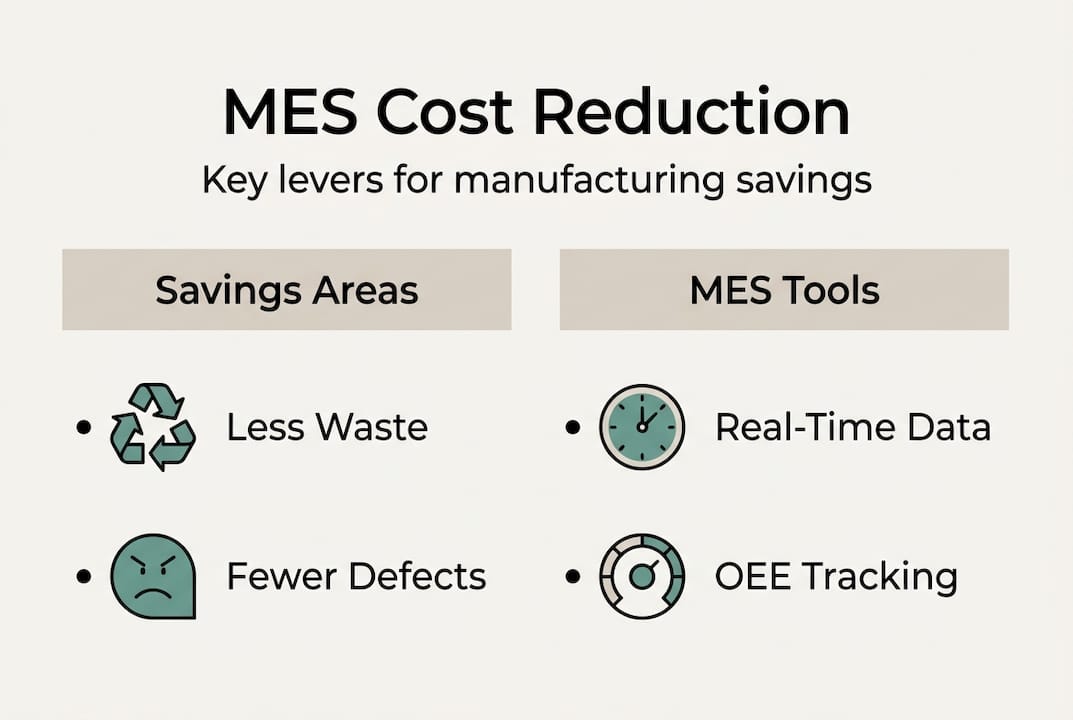
Real-time monitoring forms the cornerstone of MES cost reduction capabilities. The system captures live data on machine performance, material consumption, labour utilisation, and quality metrics across your production floor. This visibility allows you to detect inefficiencies within minutes rather than discovering them during monthly reviews. When a machine begins consuming excessive energy or producing off-specification products, you receive immediate alerts that enable corrective action before waste accumulates. MES enables cost reductions through real-time monitoring, resource optimisation, waste reduction, and energy efficiency improvements by providing the data foundation for informed decision-making.
Resource optimisation represents the second major cost driver. MES analyses production schedules against actual capacity, identifying opportunities to reduce idle equipment time and eliminate unnecessary overtime. The system balances workloads across machines and shifts, preventing bottlenecks that force expensive rush orders or expedited shipping. Inventory levels decrease as you gain precise visibility into material requirements and consumption patterns. You maintain just enough stock to support production without tying up capital in excess raw materials or finished goods sitting in warehouses.
Waste reduction accelerates when you can identify specific sources quickly. MES tracks every input and output, revealing where materials disappear into scrap, rework, or unaccounted losses. Energy consumption patterns become visible at the machine level, exposing equipment that runs inefficiently or remains powered during idle periods. You discover that certain product changeovers generate excessive waste whilst others proceed smoothly, enabling targeted improvements. The data shows which operators achieve better yields, allowing you to replicate their techniques across shifts.
“Process control improvements through MES typically reduce defect rates by 20-25% within the first year, cutting material waste and eliminating rework labour costs that often represent 5-8% of production expenses.”
Energy efficiency gains emerge from granular consumption monitoring. MES reveals which machines draw excessive power, when peak demand charges occur, and where process adjustments could reduce utility costs. You identify opportunities to shift energy-intensive operations to off-peak hours or optimise heating, cooling, and compressed air systems. Small adjustments across multiple machines compound into significant savings, particularly in facilities with high energy costs. This detailed tracking supports procesi za učinkovitost proizvodnje that systematically eliminate waste whilst improving output quality and consistency.
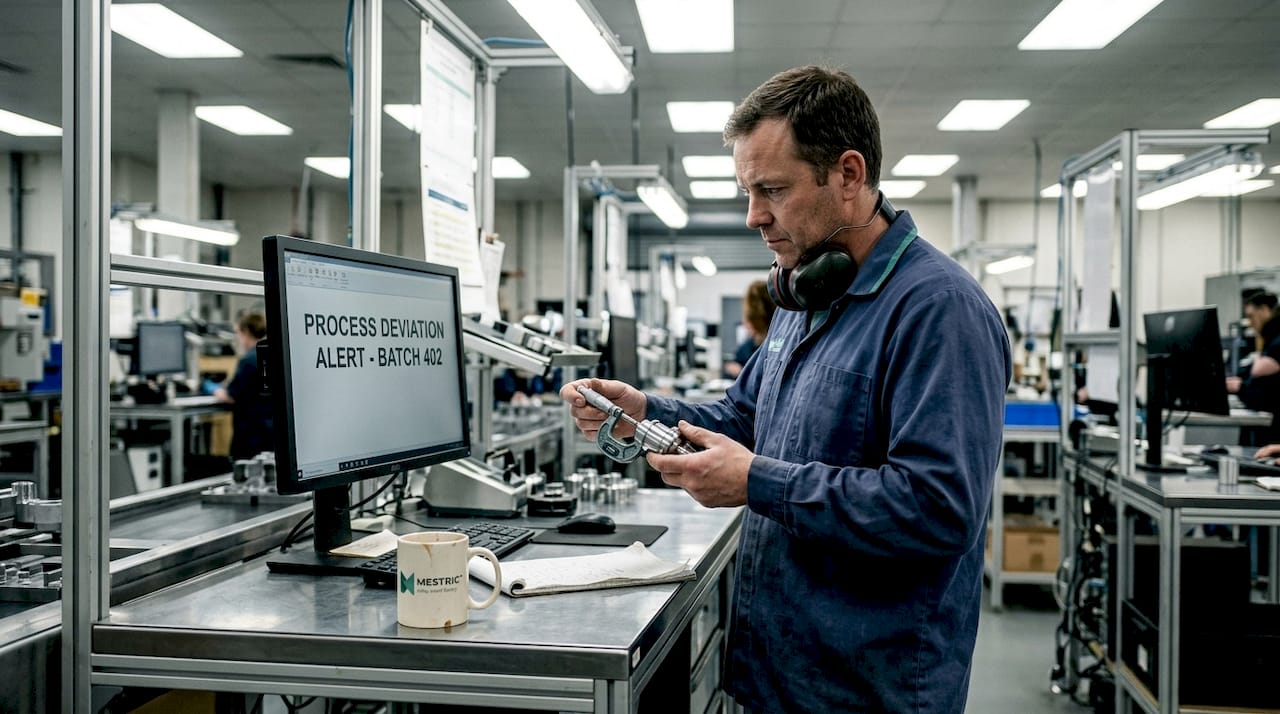
Defect prevention delivers perhaps the most substantial cost impact. When MES detects process deviations early, you prevent entire production runs from becoming scrap. Quality parameters stay within specification because the system alerts operators to trending issues before products fall outside acceptable ranges. Rework decreases as root causes become visible through data analysis rather than guesswork. Customer returns drop when consistent processes deliver reliable quality, protecting both revenue and reputation.
Successful MES deployment requires strategic planning that balances investment costs against expected returns whilst managing technical and organisational challenges. A phased approach reduces financial exposure and builds organisational capability progressively.
Begin with a clearly defined pilot project in one production area or product line. This limited scope allows you to validate MES benefits, refine implementation processes, and develop internal expertise before expanding system-wide. Choose a pilot area where problems are well-understood and improvements will be visible, building credibility for broader adoption. The pilot demonstrates actual cost savings and operational improvements to stakeholders who may question the investment.
Phased implementation, pilot programmes, and cost-benefit analysis mitigate high initial investment and deployment risks by allowing course corrections based on real experience. You learn which features deliver the most value, how users interact with the system, and what training approaches work best. Technical issues surface in a controlled environment where they can be resolved without disrupting entire operations. Success metrics from the pilot provide concrete evidence for securing budget approval for subsequent phases.
Cost-benefit analysis must account for both tangible and intangible returns. Direct savings include reduced waste, lower energy costs, decreased overtime, and improved equipment utilisation. Indirect benefits encompass better decision-making, enhanced quality reputation, reduced customer complaints, and improved employee satisfaction. Calculate payback period realistically, typically 18-24 months for comprehensive MES implementations, though focused deployments may achieve faster returns.
User engagement determines whether MES delivers promised benefits or becomes expensive shelfware. High upfront costs, integration with legacy systems, user resistance; MES unsuitable for very small ops with fewer than 50 employees or unstable processes represent common barriers that require proactive management. Involve operators, supervisors, and maintenance personnel from project inception, seeking their input on system requirements and workflow design. Demonstrate how MES makes their jobs easier rather than adding bureaucratic burden.
Legacy system integration presents technical challenges that affect implementation timelines and costs. Assess existing equipment connectivity, ERP system compatibility, and data infrastructure capabilities early in planning. Some machines may require additional sensors or controllers to communicate with MES. Data standards and protocols need alignment across systems. Budget for integration specialists who understand both manufacturing operations and information technology requirements.
Pro tip: Establish a cross-functional implementation team including production, quality, maintenance, and IT representatives who meet weekly during deployment. This ensures technical decisions align with operational realities whilst building internal expertise for ongoing system optimisation. The team becomes your MES champions, supporting user adoption and identifying continuous improvement opportunities. Their involvement transforms implementation from an IT project into an operational improvement initiative that delivers sustainable cost reductions. This collaborative approach supports comprehensive production optimisation across your facility.
Manufacturing Execution Systems provide the data foundation that transforms lean manufacturing from philosophy into measurable practice. The system reveals specific waste sources and quantifies improvement opportunities across seven classic waste categories.
MES supports lean manufacturing by providing data for waste identification and process stabilisation in facilities of all sizes. Overproduction becomes visible when MES tracks actual customer demand against production schedules, revealing inventory building faster than sales. Waiting time appears in machine utilisation reports showing idle periods between operations. Transportation waste emerges from material movement tracking that highlights unnecessary handling steps. Overprocessing shows up when cycle time data reveals operations that add no customer value.
| Waste category | MES detection method | Typical reduction |
|---|---|---|
| Overproduction | Inventory vs demand tracking | 15-25% |
| Waiting | Machine idle time analysis | 20-30% |
| Defects | Real-time quality monitoring | 20-25% |
| Excess inventory | Material consumption vs holdings | 25-35% |
| Unnecessary motion | Operator activity tracking | 10-15% |
| Excess processing | Cycle time vs standard analysis | 15-20% |
| Transportation | Material movement logging | 20-25% |
Defect reduction accelerates when quality data flows in real time. MES captures measurements at each process step, comparing results against specifications and alerting operators to deviations immediately. Statistical process control charts reveal trending issues before products fall outside tolerance. Root cause analysis becomes data-driven rather than speculative, as you correlate defects with specific machines, materials, operators, or environmental conditions. This precision targeting eliminates guesswork from quality improvement efforts.
Inventory optimisation relies on accurate consumption tracking. MES records exactly how much material each production run consumes, revealing discrepancies between theoretical and actual usage. You identify where excess material gets scrapped during changeovers or where theft and damage occur. Buffer stocks decrease as production becomes more predictable and reliable. Just-in-time delivery becomes feasible when you trust your process data and can communicate precise material requirements to suppliers.
Process stability improves through variance reduction. MES monitors critical parameters continuously, maintaining processes within narrow control limits. When temperatures, pressures, speeds, or other variables drift, the system triggers corrections before quality suffers. This stability reduces unplanned downtime, as equipment operates consistently within design parameters rather than swinging between extremes that accelerate wear. Maintenance becomes predictive rather than reactive, as trending data reveals developing issues before failures occur.
Operational Equipment Effectiveness gains translate directly into cost reductions. Empirical benchmarks show 15-30% cost reduction, 10-15% OEE improvement, and 20-25% waste cuts within 12 months of MES implementation in typical facilities. Availability increases as downtime decreases through better maintenance and faster changeovers. Performance improves when processes run at optimal speeds with minimal interruptions. Quality rises as defects drop and first-pass yield increases. These three OEE components multiply together, so small improvements in each create substantial overall gains.
Continuous improvement becomes systematic rather than sporadic. MES data reveals which improvement initiatives actually deliver results versus those that sound good but produce minimal impact. You prioritise projects based on quantified waste reduction potential rather than intuition. Progress tracking shows whether changes stick or revert to old patterns. Successful improvements get documented and replicated across similar operations. This data-driven approach to streamlining manufacturing processes ensures resources focus on activities that genuinely reduce costs and improve efficiency.
Pro tip: Create visual management boards that display MES data in production areas, showing real-time OEE, quality metrics, and cost performance against targets. This transparency engages operators in improvement efforts and creates healthy competition between shifts or production lines. Update displays hourly so teams can see immediate results from their actions. Recognition programmes that celebrate waste reduction achievements reinforce desired behaviours and sustain momentum. The combination of visible data and positive reinforcement transforms culture from accepting waste as inevitable to actively eliminating it. Understanding the role of data in manufacturing efficiency empowers your entire organisation to contribute to cost reduction efforts.
Reducing operational costs whilst maintaining quality requires sophisticated tools that transform raw production data into actionable insights. Manufacturing facilities implementing proven MES strategies achieve substantial savings through enhanced visibility and control.
Mestric specialises in helping plant managers deploy Manufacturing Execution Systems that deliver measurable cost reductions and efficiency improvements. Our platform connects directly with your equipment, providing real-time performance tracking, quality monitoring, and productivity analytics that reveal hidden waste and optimisation opportunities. You gain immediate visibility into machine performance, downtime causes, quality parameters, and cost drivers across your entire operation.
Discover how MES compares with traditional manufacturing approaches to understand which deployment strategy fits your facility. Explore types of manufacturing software that complement MES for comprehensive operational control. Learn proven procesi za učinkovitost proizvodnje that facilities use to achieve 15% or greater cost reductions through systematic waste elimination and resource optimisation. Our solutions integrate AI-powered optimisation tools that identify bottlenecks, accelerate processes, and support data-driven decision-making that protects your bottom line whilst improving quality and customer satisfaction.
Manufacturing facilities implementing comprehensive MES solutions typically achieve 15-30% operational cost reduction within the first twelve months. These savings come from reduced waste, improved equipment utilisation, lower energy consumption, and decreased defect rates. Larger facilities with complex operations often see greater absolute savings, whilst smaller operations may achieve faster payback periods due to focused implementations targeting specific high-impact areas.
MES provides the data foundation that makes lean manufacturing measurable and sustainable. The system identifies all seven waste categories through real-time tracking of production, quality, inventory, and equipment performance. Process stability improves as MES maintains critical parameters within tight control limits, reducing variability that causes defects and downtime. Continuous improvement becomes systematic when you can quantify which initiatives deliver actual results versus those that produce minimal impact on costs or efficiency.
High upfront investment, integration complexity with legacy systems, and user resistance represent the primary MES implementation challenges. Overcome these through phased deployment starting with pilot projects that demonstrate value before expanding system-wide. Engage users early in design decisions and provide comprehensive training that shows how MES simplifies their work rather than adding burden. Budget for integration specialists who understand both manufacturing operations and information technology requirements to ensure smooth connectivity with existing systems.
MES delivers greatest value for facilities with at least 50 employees and stable, repeatable processes. Very small operations may find the investment exceeds available budget or the system provides more capability than needed for their simple workflows. Highly variable or unstable processes should first achieve basic control before implementing MES, as the system optimises existing processes rather than fixing fundamental operational problems. Mid-size and large facilities with multiple production lines, complex scheduling, or stringent quality requirements benefit most from comprehensive MES capabilities.
MES tracks machine performance continuously, revealing idle time, minor stoppages, and speed losses that reduce effective capacity. Predictive maintenance becomes possible when trending data shows developing issues before failures occur, allowing planned repairs during scheduled downtime rather than emergency breakdowns. Changeover times decrease as the system guides operators through optimised setup procedures and tracks improvement progress. Overall Equipment Effectiveness typically improves 10-15% within the first year as availability, performance, and quality components all increase through better visibility and control.


 069 763 552