

TL;DR:
- Manual errors persist in manufacturing due to demographic shifts, process complexity, and system fragmentation.
- They significantly impact costs including scrap, rework, downtime, and quality issues, often hiding in data blind spots.
- Combining technology like error-proofing tools with process discipline and a supportive culture effectively reduces errors.
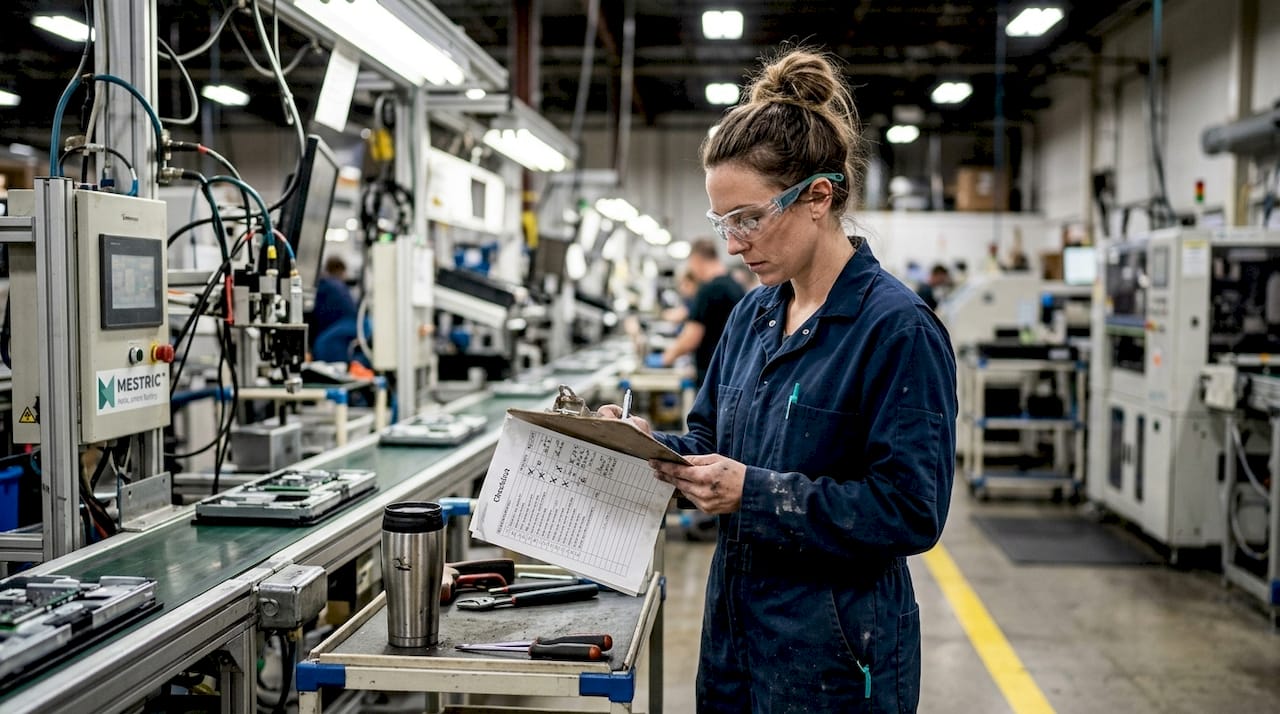
Manual errors remain one of the most persistent and costly challenges in modern manufacturing. Even in facilities with sophisticated automation, manual processes carry significant risk of introducing defects, delays, and rework. Digital transformation has made operations faster and more visible, but it has not erased the human element. In fact, as production complexity grows, the opportunity for human error often grows with it. This article explores why manual errors persist, what they truly cost your business, and what you can do right now to build more reliable, error-resistant production.
| Point | Details |
|---|---|
| Hidden risks remain | Manual errors persist even in cutting-edge production and undermine efficiency if unaddressed. |
| Tackle process and mindset | Lasting error reduction depends on technology, standardised practices, and empowered people. |
| Blend digital and human skills | Automation and digital tools work best when paired with robust workflows and frontline engagement. |
| Leadership sets the tone | Visible management commitment is critical in cultivating an error-resistant culture. |
It is tempting to assume that errors are simply a matter of inattentiveness. The reality is more complex. Demographic changes and production complexity are two of the most significant drivers of elevated error risk in today’s factories. An ageing workforce, higher product variance, and increasingly intricate assembly sequences all create conditions where even experienced operators make mistakes.
Digital workstreams can also introduce new blind spots. When systems are not properly integrated, operators must manually transfer data between platforms. Each handoff is a potential point of failure. A single transcription mistake in a batch record or a missed process step in a complex build can trigger a cascade of quality issues downstream.
The most common root causes include:
Even highly automated environments are not immune. Set-up, maintenance, and troubleshooting still rely on human judgement. When an operator intervenes in an automated process without a clear, standardised procedure, errors propagate quickly and are often difficult to trace.
“The interaction between human operators and digital systems is where the greatest risk and the greatest opportunity for improvement now lies in modern manufacturing.”
A structured productivity checklist can help you identify where your processes are most vulnerable. Pairing this with a thorough production optimisation guide gives you a solid foundation for targeted improvement.
Understanding the causes is only the first step. What matters to you as a manufacturing leader is the bottom-line impact. Manual errors derail process efficiency and quality, and the costs accumulate faster than most executives realise.
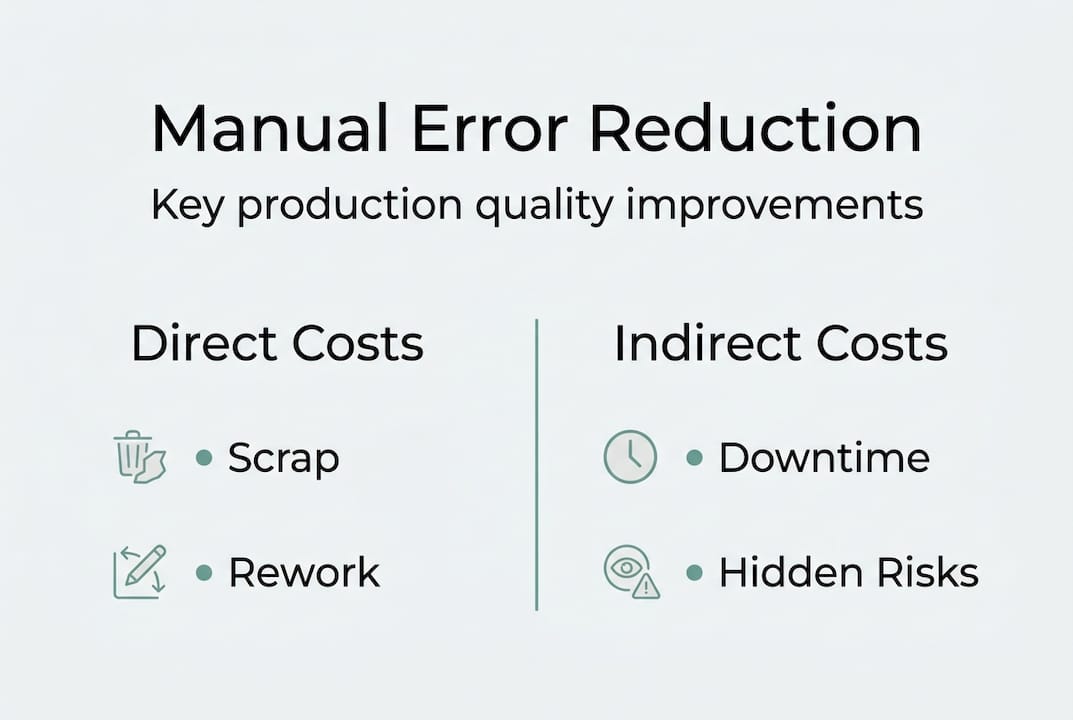
The direct costs are straightforward: scrap, rework, wasted materials, and unplanned equipment downtime. But the indirect costs are often far greater and much harder to see.
| Cost category | Direct impact | Indirect impact |
|---|---|---|
| Scrap and rework | Wasted materials, labour hours | Reduced throughput, missed targets |
| Equipment downtime | Lost production time | Delayed shipments, penalty clauses |
| Quality excursions | Defective products, returns | Customer dissatisfaction, lost contracts |
| Regulatory breaches | Fines, corrective actions | Reputational damage, audit risk |
| Untracked manual tasks | Invisible errors in analytics | Executive blind spots, poor decisions |
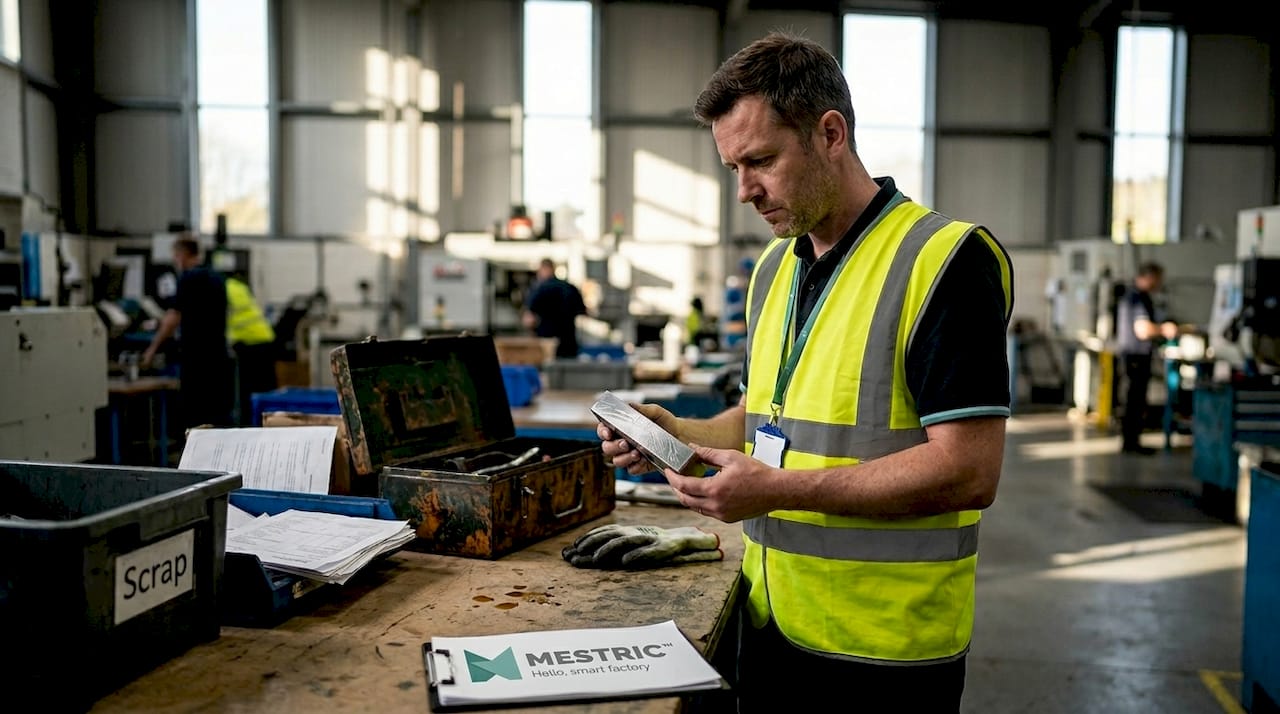
One of the most underestimated risks is the quality excursion: a single manual input error that multiplies as it moves through a complex process. By the time it surfaces, the defect may affect an entire batch or a full production run.
Hidden costs are particularly problematic. Manual tasks that are not captured in your digital analytics create blind spots for executives. You cannot act on data you cannot see. This is why reviewing your cost reduction strategies regularly is so important, and why an optimisation checklist is a practical starting point for identifying gaps.
Pro Tip: Review your incident logs at least monthly. Repeating error patterns are often invisible at the shift level but become clear when you look across weeks or months of data.
So what actually works? The most effective approaches combine technology with process discipline and a culture that supports error prevention. Poka-Yoke, standard operating procedures, and digital work instructions are the proven cornerstones of error-proofing in manufacturing.
| Strategy | How it works | Best suited for |
|---|---|---|
| Poka-Yoke (contact type) | Physical design prevents incorrect assembly | High-volume, repetitive tasks |
| Poka-Yoke (warning type) | Alerts operator when error is detected | Complex builds with variable steps |
| Digital work instructions | Step-by-step guidance on screen or tablet | Multi-variant production lines |
| Machine vision | Camera systems detect defects in real time | Quality inspection, surface defects |
| AR guidance | Augmented reality overlays guide operators | Complex assembly, training scenarios |
Technology is powerful, but automation complements, not replaces human-driven processes. The facilities that achieve the greatest error reduction are those that align their technology investments with strong operator engagement and clear management commitment.
Key practices for minimising manual error:
Learning how to streamline manufacturing processes is often the most efficient route to sustainable error reduction.
Pro Tip: Invest equal effort in process mapping and team education as you do in technology upgrades. A well-trained team using a basic system will outperform a poorly trained team using the most advanced one.
Knowing the strategies is one thing. Executing them across a live production environment is another. Here is a practical sequence for manufacturing leaders who want to build genuinely error-resistant operations.
“Leadership commitment is the single most reliable predictor of sustained error reduction. Without it, even the best tools and processes will stall.”
The goal is not perfection on day one. It is a clear, measurable improvement trajectory that your whole team can see and contribute to.
Here is a perspective that many technology vendors will not share with you: the facilities that struggle most with manual errors are rarely the ones with the oldest equipment. They are the ones where operators do not feel empowered to flag problems.
We have seen this repeatedly. A plant invests in a new MES, installs machine vision, and rolls out digital work instructions. Error rates improve for a quarter, then plateau. Why? Because the underlying reporting culture did not change. Staff still hesitate to log a near-miss for fear of scrutiny.
Technology alone is insufficient for error elimination. It must be aligned with culture and process. The leaders who get this right treat error reduction as a people initiative that happens to use technology, not the other way around.
True digital transformation closes the gap between manual skill and digital tools. It gives operators the information they need, at the moment they need it, in a format they can act on. A healthy reporting culture, where every near-miss is a learning opportunity, will outperform even the most sophisticated AI if your staff do not feel safe speaking up. The future of manufacturing is hybrid and collaborative. Use your stepwise optimisation guide to build that future deliberately.
You now have a clear picture of where manual errors come from, what they cost, and how to address them systematically. The next step is putting the right digital infrastructure in place to support your efforts.
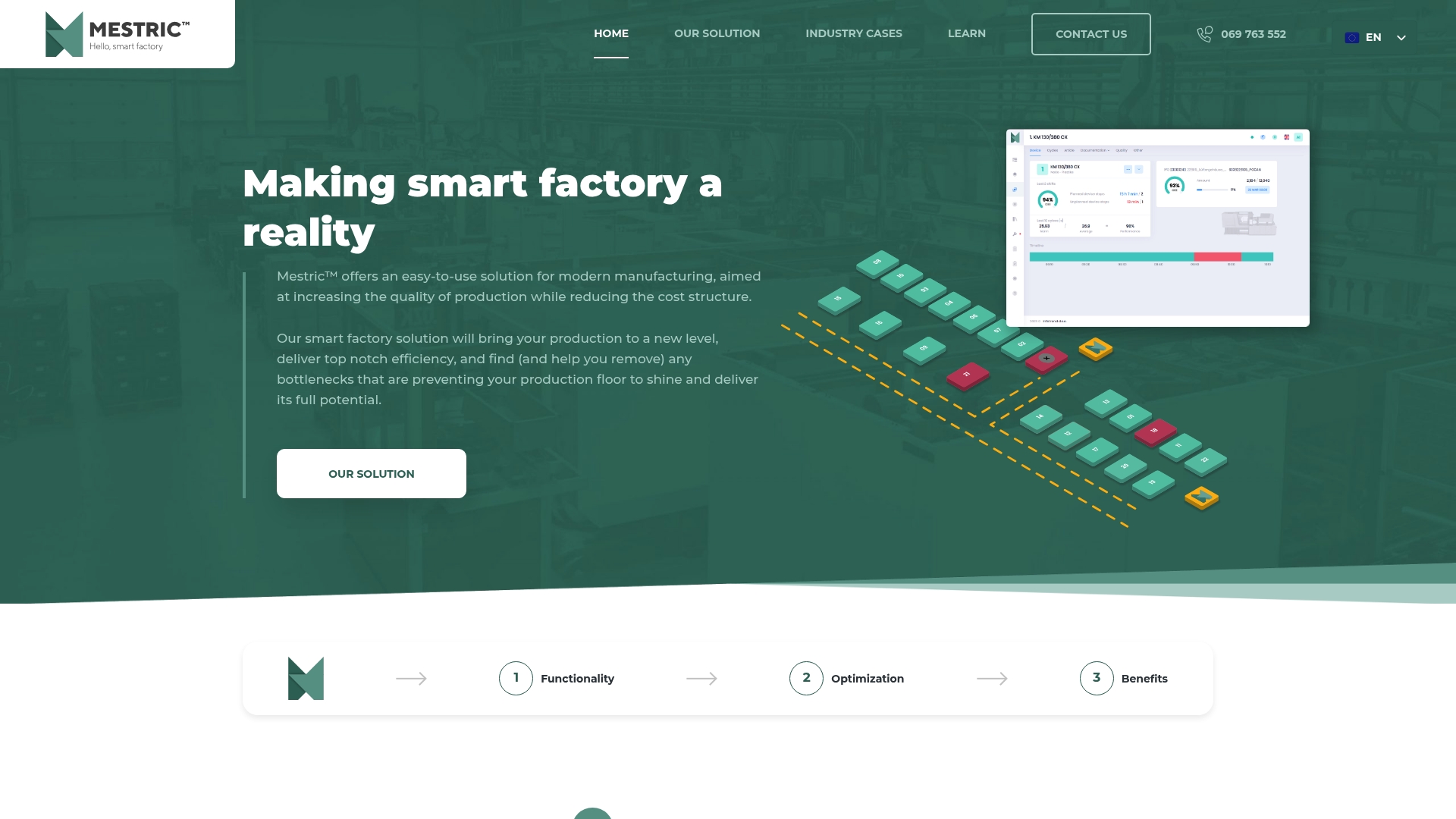
Mestric™ is built specifically for manufacturing leaders who want real-time visibility into quality, performance, and error trends without adding complexity to their operations. Understanding the difference between MES and traditional manufacturing approaches is a good starting point. You can also explore the 7 types of manufacturing software to understand where an MES fits in your technology stack. And if you want to see how AI drives efficiency in real production environments, that resource will show you exactly what is possible.
Typical errors include missed steps and mis-assembly, as well as data entry mistakes and improper equipment set-up. These are often the result of unclear instructions or unstandardised practices rather than operator negligence.
Digital tools such as Poka-Yoke, AR, and machine vision can signal or stop mistakes in real time, giving operators immediate feedback before an error becomes a defect.
Automation complements but does not replace human judgement. Full error elimination is rare; the best results come from blending automation, digital oversight, and a strong process culture.
An ageing workforce increases risk of error alongside factors such as experience levels and staff turnover, all of which require tailored training programmes and clearly written SOPs to manage effectively.


 069 763 552