


Quality failures rarely announce themselves politely. They show up as a batch of rejected parts at the end of a shift, a customer complaint that lands on the wrong desk, or a cost overrun that nobody can fully explain. The frustrating truth is that most of these failures are not random. They stem from improvement efforts that are vague, inconsistent, or built on gut instinct rather than data. A structured, step-by-step approach changes that entirely. Frameworks such as DMAIC and Lean give your team a repeatable pathway to measurable gains, and at Six Sigma level, that means targeting just 3.4 defects per million opportunities.
| Pont | Részletek |
|---|---|
| Structured methods win | Stepwise approaches like DMAIC and Lean deliver more reliable, measurable quality improvements than ad-hoc fixes. |
| Tailor framework to need | Choose DMAIC for complex, chronic issues and Lean for efficiency and flow; hybrid methods often provide best results. |
| Track and sustain | Use clear metrics like FPY, OEE, and PPM to measure success and keep gains from eroding after project completion. |
| Scale with digital tools | Implementing MES and real-time quality monitoring systems ensures change is scalable and transparent across sites. |
| Case studies matter | Real-world manufacturing improvements, such as lower rejection rates and higher Sigma levels, showcase the power of structured processes. |
Unstructured improvement is one of the most expensive habits in manufacturing. Teams identify a problem, apply a quick fix, and move on, only to find the same issue resurfacing three months later. Without a defined process, there is no accountability, no baseline to measure against, and no way to confirm whether the fix actually worked.
A stepwise plan changes the dynamic entirely. It creates transparency across departments, assigns clear ownership at each stage, and produces results that can be replicated across lines or facilities. This repeatability is what separates high-performing manufacturers from those perpetually firefighting.
Leading frameworks such as DMAIC (Define, Measure, Analyse, Improve, Control) and Lean manufacturing have become the industry standard precisely because they impose rigour without bureaucracy. They force teams to define the problem clearly before reaching for solutions, which is where most ad-hoc efforts go wrong.
Industry benchmarks give you a concrete target to aim for. Empirical performance data suggests high-performing manufacturers should target:
If your current numbers fall short of these benchmarks, a structured improvement programme is not optional. It is the most direct route to quality defect reduction and sustainable cost savings. Reviewing your quality control tips alongside these benchmarks gives you an immediate sense of where the gaps lie.
“The goal is not to fix problems faster. It is to build a system where the same problem cannot recur.”
Before you map a single process or collect a single data point, you need the right foundations in place. Launching a quality improvement initiative without them is like starting a production run without a validated setup. The output will be unpredictable.
The first requirement is stakeholder buy-in. Quality improvement projects that lack executive sponsorship stall quickly. A project champion at leadership level keeps resources allocated, removes organisational blockers, and signals to the wider team that this is a priority, not a side project.
Next, you need baseline data. You cannot improve what you cannot measure. Before selecting a method, gather your current FPY, OEE, PPM, and cost of quality figures. If these numbers are not readily accessible, that itself is a signal that your quality monitoring infrastructure needs attention.
Process mapping is equally critical. A value stream map (VSM) gives you a visual picture of where value is added and where waste accumulates. Without it, improvement efforts tend to focus on the loudest problem rather than the most impactful one.
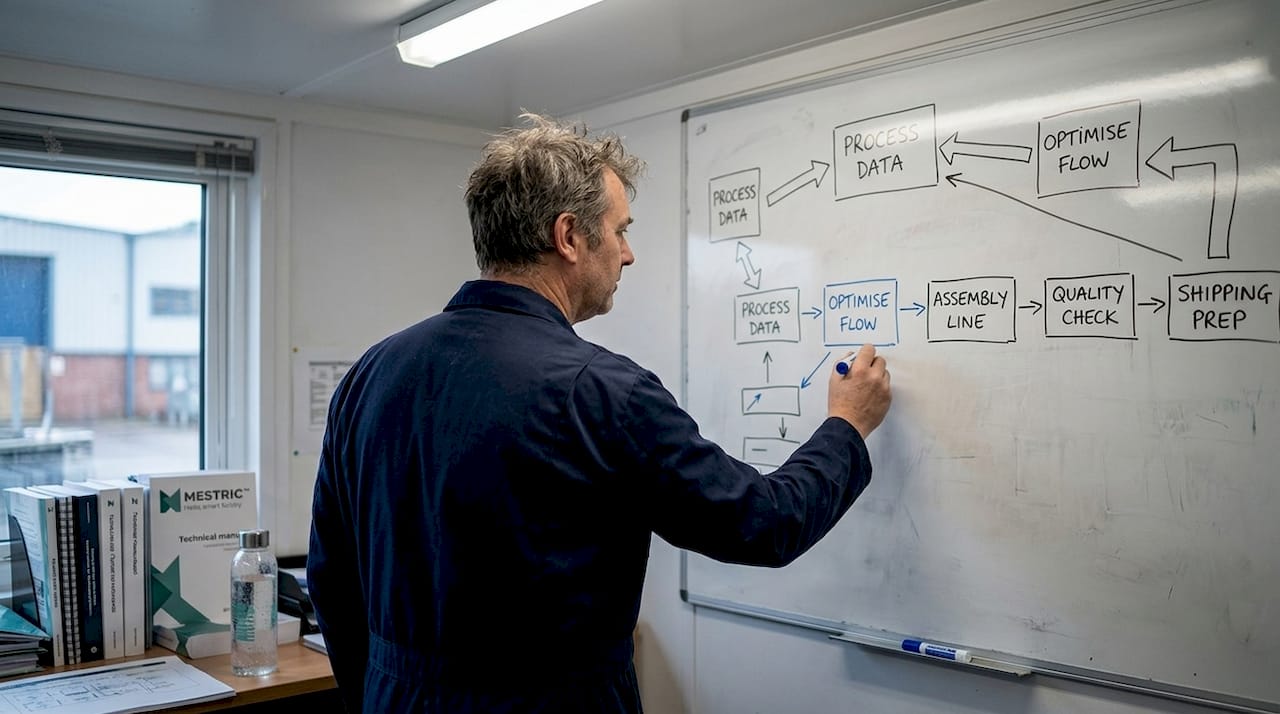
Finally, choose your method deliberately. DMAIC suits complex, data-heavy problems where root causes are unclear, while Lean is best applied when flow, speed, and waste reduction are the primary goals. Understanding the difference before you start saves weeks of misdirected effort.
Profi tipp: If your rejection rate is high but the cause is unknown, start with DMAIC. If your cycle times are long and the waste is visible, start with Lean. You can always blend both once the initial phase is underway.
| Prerequisite | Why it matters | How to address it |
|---|---|---|
| Executive sponsorship | Sustains resources and momentum | Assign a named project champion |
| Baseline metrics | Establishes the starting point | Pull FPY, OEE, PPM from your MES or ERP |
| Process map | Identifies where to focus | Conduct a value stream mapping session |
| Method selection | Aligns tools to the problem type | Assess problem complexity and data availability |
| Cross-functional team | Brings diverse expertise | Include quality, operations, and engineering leads |
For manufacturers working with complex materials such as steel, understanding how carbon steel is made can also inform where in the process quality risks are highest. Pairing that knowledge with a robust efficiency workflow ensures your improvement effort targets the right stages.
With your foundations in place, you are ready to execute. Both DMAIC and Lean follow a logical sequence, and understanding each step helps you apply the right tool at the right moment.
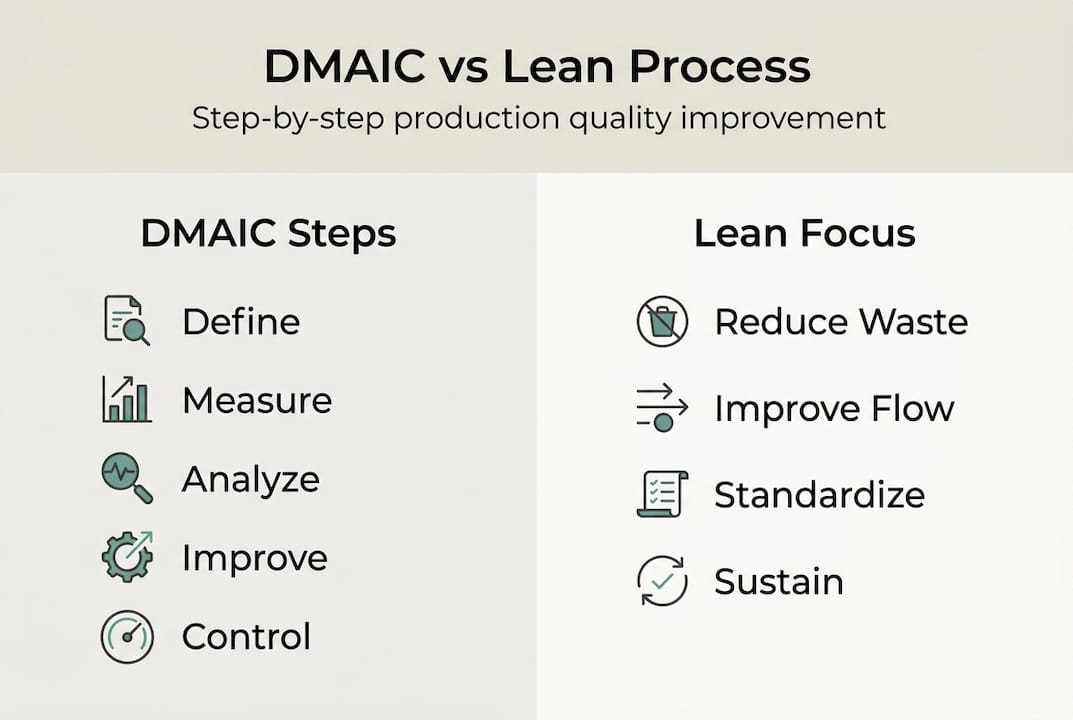
DMAIC: Five steps for data-driven quality improvement
Lean: Five principles for flow and waste elimination
DMAIC is preferred for data-driven, complex quality issues, while Lean targets the eight production wastes: defects, overproduction, waiting, non-utilised talent, transportation, inventory, motion, and extra processing. Most manufacturers benefit from blending both. Hybrid approaches cut defects by 40% and lead times by 25%, making the combined method the most powerful option for sustained performance gains.
Profi tipp: Run a 5S event on your target production area before starting a DMAIC project. A cleaner, more organised workspace produces more reliable measurement data and makes root cause analysis significantly easier.
| Dimension | DMAIC | Lean | Hybrid |
|---|---|---|---|
| Best for | Complex, data-heavy defects | Waste and flow problems | Most manufacturing environments |
| Speed of results | 3 to 6 months | Weeks to months | Phased, with early quick wins |
| Data requirement | High | Mérsékelt | Mérsékeltől a magasig |
| Key tools | SPC, DOE, MSA, control charts | 5S, VSM, Kaizen, JIT | All of the above |
| Sustainability | Very high with control phase | Requires cultural reinforcement | Highest when both are embedded |
For a detailed walkthrough of each phase, the stepwise optimisation guide provides practical templates and worked examples. You can also explore cost-saving methods that align directly with Lean waste reduction, and the process improvement guide for a broader operational perspective.
Theory is useful. Evidence is better. A published case study in crankshaft forging demonstrates exactly what a disciplined DMAIC application can achieve in a real production environment.
The facility faced a chronic rejection rate of 3.04%, well above acceptable thresholds and generating significant scrap and rework costs. The team applied the full DMAIC methodology, starting with a precise definition of the CTQ characteristics for the forging process, followed by a rigorous measurement phase to establish process capability.
Root cause analysis revealed specific process parameter variations that were driving the majority of defects. Targeted improvements to those parameters, validated through DOE, produced a measurable shift. DMAIC reduced the rejection rate from 3.04% to 1.88% and improved the process Sigma level, translating directly into lower scrap costs and higher throughput.
| Metric | Before DMAIC | After DMAIC |
|---|---|---|
| Rejection rate | 3.04% | 1.88% |
| Sigma level | Below 3 Sigma | Improved toward 4 Sigma |
| Scrap and rework cost | Elevated | Significantly reduced |
| Process capability (Cpk) | Below target | Within acceptable range |
“The improvement was not the result of working harder. It was the result of working on the right variables, in the right sequence, with the right data.”
The scalable takeaways from this case are clear:
Tracking quality monitoring outcomes in real time during and after the project is what allows you to confirm gains are holding. Pairing this with efforts to streamline production operations ensures the improvement does not exist in isolation.
The Control phase of DMAIC is where most improvement projects either succeed long-term or quietly unravel. Gains made during the Improve phase are fragile until they are institutionalised. Without deliberate sustainment, teams revert to old habits within months.
The first step is updating your standard operating procedures (SOPs) to reflect the improved process. If the new method is not documented, it will not survive staff turnover or shift changes. Training must follow immediately, not weeks later.
Metric tracking is non-negotiable. Set up regular reviews of FPY, OEE, and PPM at a frequency that matches your production volume. Weekly reviews are appropriate for high-volume lines. Monthly reviews suit lower-volume or project-based environments. High-performing manufacturers achieve on-time delivery at 99.7% and defect rates at Six Sigma levels, and they maintain those results through disciplined, ongoing measurement.
Profi tipp: Build a simple visual management board at the line level showing current FPY, OEE, and PPM against target. Visibility drives accountability far more effectively than monthly reports buried in a spreadsheet.
Leadership support is the most underrated sustainment factor. When managers stop asking about quality metrics, teams stop prioritising them. Schedule regular quality reviews at the leadership level and treat backsliding as a process failure, not a people failure.
Feedback loops close the cycle. When a metric dips, the team should have a defined escalation path that triggers a mini root cause analysis rather than a blame conversation. This is how continuous improvement becomes a culture rather than a project. MES tools that surface real-time alerts make this response faster and more consistent. Revisiting your quality control tips periodically also ensures your standards keep pace with evolving production demands.
Key sustainment actions to embed:
Structured improvement frameworks deliver real results, but sustaining and scaling those results across a facility requires more than spreadsheets and manual reviews. A Manufacturing Execution System (MES) gives you the real-time visibility that makes every phase of DMAIC and Lean faster, more accurate, and easier to sustain.
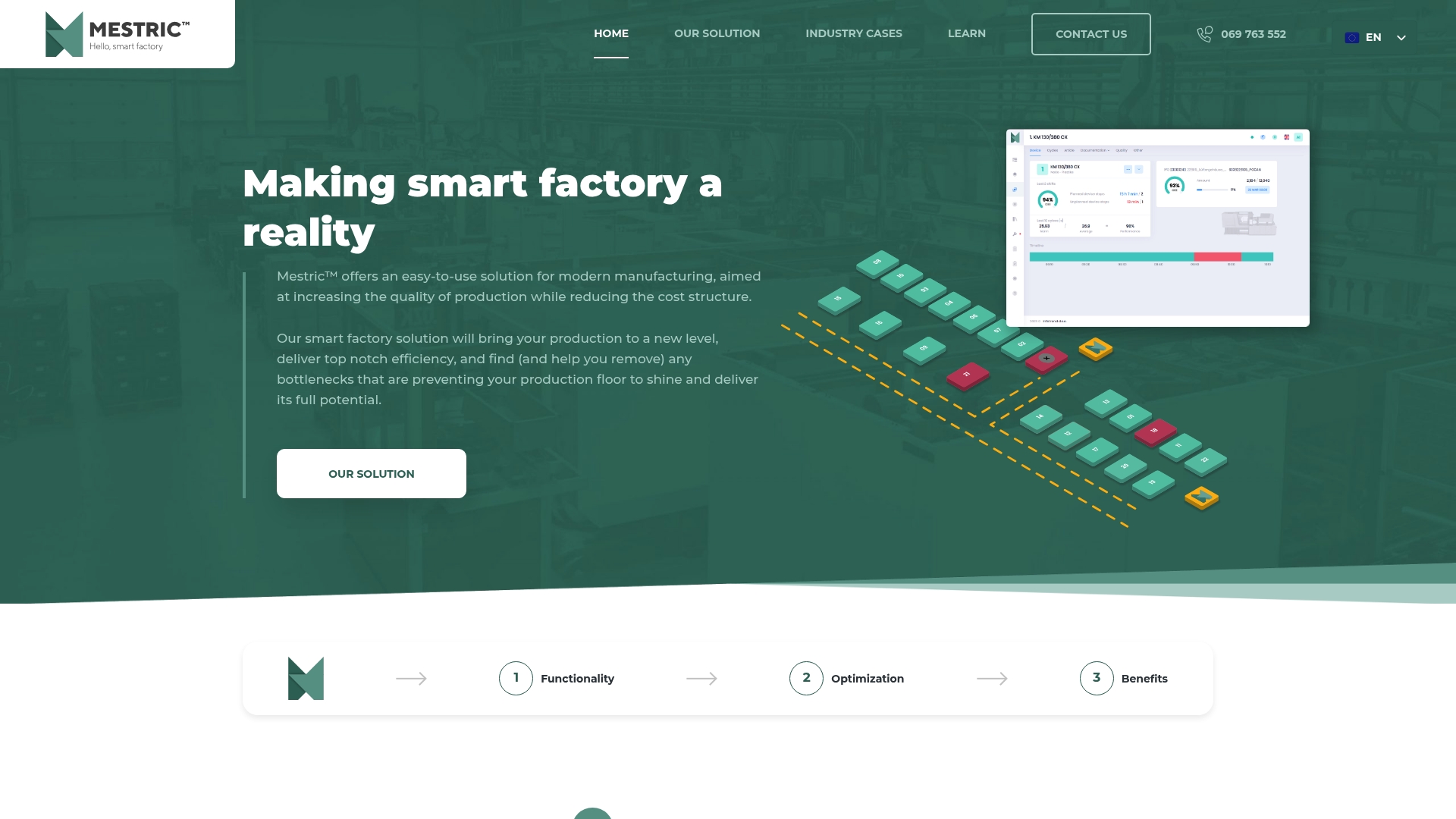
Mestric™ connects directly with your production equipment, surfacing live KPIs including FPY, OEE, PPM, and downtime in a single dashboard. That means your Measure phase starts with clean, reliable data rather than manually compiled figures. The Control phase becomes self-reinforcing when alerts flag process drift the moment it occurs. Explore how MES compares to traditional manufacturing approaches, review our quality monitoring solutions to see how real-time data transforms your improvement programme, and use our optimisation guide to plan your next project with confidence.
DMAIC suits data-heavy challenges where root causes are unclear, while Lean delivers quick, flow-based gains when waste and cycle time are the primary issues. Assess your problem type before committing to either method.
The core indicators are first pass yield (FPY), overall equipment effectiveness (OEE), and parts per million defects (PPM). These metrics give you a complete picture of quality, efficiency, and process capability in one view.
Lean interventions can produce visible improvements within weeks for targeted waste reduction, while DMAIC delivers sustainable gains over a typical three to six month project cycle. The depth of the problem determines the timeline.
Absolutely. DMAIC and Lean are applied successfully across electronics, steel, food processing, pharmaceuticals, and consumer goods manufacturing, wherever process variation and waste exist, the frameworks deliver results.


 069 763 552