

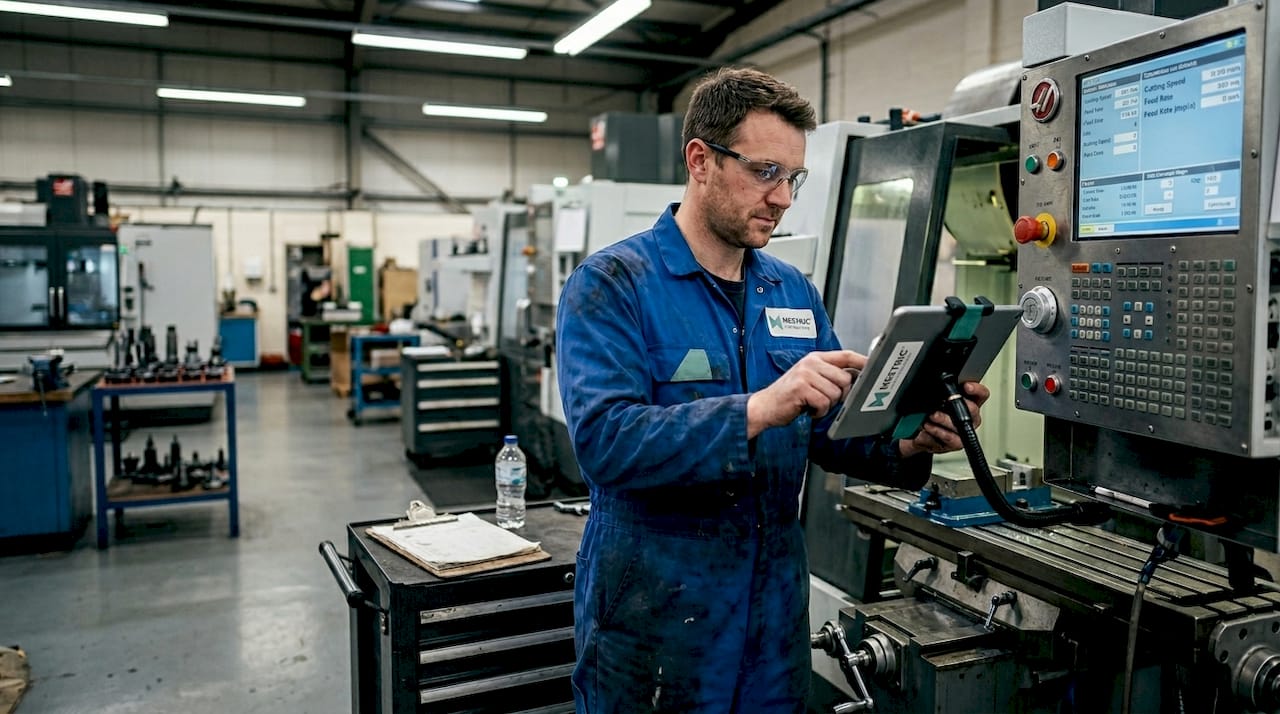
TL;DR:
- Connected machinery provides real-time data sharing across factories, enabling faster decision-making.
- Implementing connected systems significantly reduces unplanned downtime, defects, and cycle times.
- The true value lies in organizational agility and continuous process optimization through data insights.
Most manufacturing executives believe their operations are running at close to peak efficiency. The reality, revealed by connected machinery deployments across global factories, is quite different. Hidden inefficiencies, untracked downtime, and avoidable defects quietly drain resources every single shift. Connected machinery changes this by linking your equipment to real-time data platforms, giving you visibility that traditional systems simply cannot provide. In this article, you will learn what connected machinery actually means, how it transforms day-to-day operations, why it sharpens decision-making, and how it delivers measurable cost savings that go well beyond basic automation.
| Pont | Részletek |
|---|---|
| Real-time data boosts efficiency | Factories using connected machinery achieve faster decisions and solve issues in minutes, not days. |
| Cost savings are proven | Companies like AGCO have cut process times by 35%, showing clear ROI for connected machinery. |
| Training and adaptability improve drastically | AI-driven connected systems halve operator learning times, speeding up operational changes. |
| Adaptation is as valuable as automation | The biggest value is not just automation or cost, but the ability to adapt and innovate faster in changing markets. |
Connected machinery refers to networked production equipment that continuously shares operational data with software platforms, other machines, and the people managing them. Rather than each machine working in isolation, connected systems create a live, factory-wide picture of what is happening at every stage of production.
The core technologies behind this include:
The contrast with traditional, isolated machinery is significant. Older equipment typically generates data only when an operator manually checks it, or not at all. Problems go undetected until they cause a breakdown or a batch of defective products. Connected machinery, on the other hand, provides continuous feedback. IoT in manufacturing has become a foundational element of modern factory strategy precisely because of this shift from reactive to proactive management.
AI-powered connected worker platforms reduce operator learning curve and process time, demonstrating that the value extends beyond machines to the people operating them. This human-machine integration is what separates genuinely connected factories from those that have simply added a few sensors. AI in manufacturing is the intelligence layer that makes all of this data useful rather than overwhelming.
Profi tipp: Before selecting a connected machinery solution, map your most pressing operational challenges first. Technology should solve specific problems, not simply follow industry trends. A clear problem statement will guide better investment decisions and faster returns.
Connected systems do not simply automate existing tasks. They fundamentally change how your operations respond to problems and how consistently they perform.
When a machine begins to drift out of specification, a connected system detects the change immediately. Your team receives an alert, investigates the root cause, and corrects it before the issue affects output quality. This is a very different reality from discovering the problem during an end-of-shift inspection, by which point hundreds of defective units may already exist.
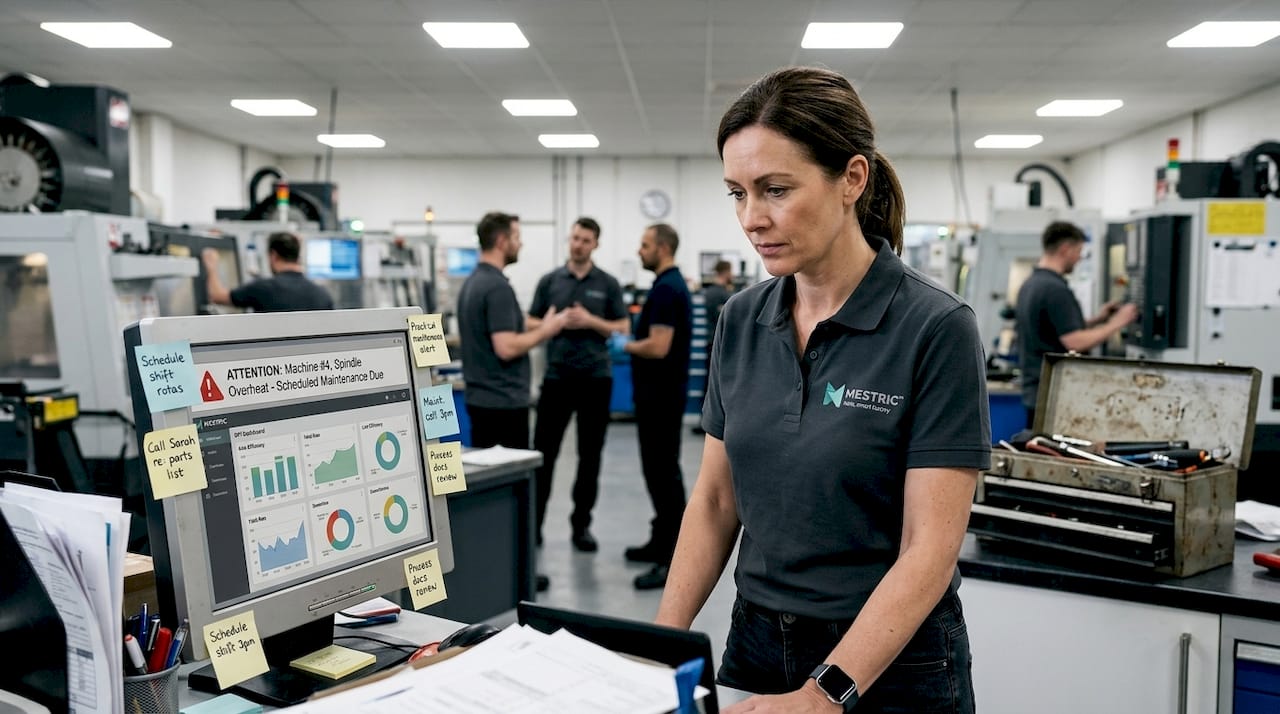
The operational gains are well documented. AGCO achieved a 35% decrease in process time and a 50% reduction in operator learning curve after deploying an AI-powered connected worker platform. These are not marginal improvements. They represent a structural shift in how efficiently the factory operates.
Here is a summary of the key operational improvements manufacturers typically experience:
The table below illustrates typical before-and-after KPIs from connected machinery implementations:
| KPI | Before connected machinery | After connected machinery |
|---|---|---|
| Unplanned downtime | 12% of production time | 4% of production time |
| Defect rate | 3.5% | 1.1% |
| Operator onboarding time | 8 weeks | 4 weeks |
| Process cycle time | Baseline | 35% shorter |
| Safety incidents | High frequency | Significantly reduced |
Accessing real-time production data is what makes these improvements sustainable rather than one-off gains. When your team can see exactly what is happening, they can act on it. Data-driven efficiency in manufacturing is not a theoretical concept; it is the practical outcome of connecting your equipment to intelligent platforms.
Operational gains are only part of the story. The second major advantage of connected machinery is the quality and speed of the decisions it enables at every level of your organisation.
Traditional manufacturing reporting relies on batch data, often compiled hours or even days after the events it describes. By the time a production manager reviews a shift report, the opportunity to intervene has passed. Connected machinery eliminates this lag entirely.
Consider how Caterpillar implemented IIoT for real-time production data intelligence, enabling faster decision-making and cross-facility benchmarking. Rather than waiting for monthly performance reviews, Caterpillar’s managers could compare site performance in real time and direct resources to where they were needed most.
The table below compares real-time and traditional batch reporting across key decision-making dimensions:
| Dimension | Traditional batch reporting | Real-time connected reporting |
|---|---|---|
| Decision speed | Hours to days | Seconds to minutes |
| Error detection | Post-event | Immediate |
| Benchmarking | Monthly or quarterly | Continuous |
| Response to quality issues | Reactive | Proactive |
| Data accuracy | Subject to manual entry errors | Automated and consistent |
“The shift from batch reporting to real-time data intelligence is not just a technology upgrade. It is a fundamental change in how manufacturing leaders exercise control over their operations.”
To leverage data intelligence effectively from your connected systems, follow these steps:
Analytics in manufacturing gives your leadership team the clarity to act confidently. Predictive analytics in manufacturing takes this further, helping you anticipate problems rather than simply respond to them.
For most manufacturing leaders, the business case for connected machinery ultimately comes down to measurable cost reduction. The good news is that the evidence is strong and growing.
Connected machinery delivers cost savings across several distinct areas:
The figures from real deployments reinforce this. A 35% process time reduction and a 50% reduction in operator learning curve directly translate into lower labour costs per unit produced and faster throughput on the same asset base. These are the kinds of gains that shift the economics of a production line materially.
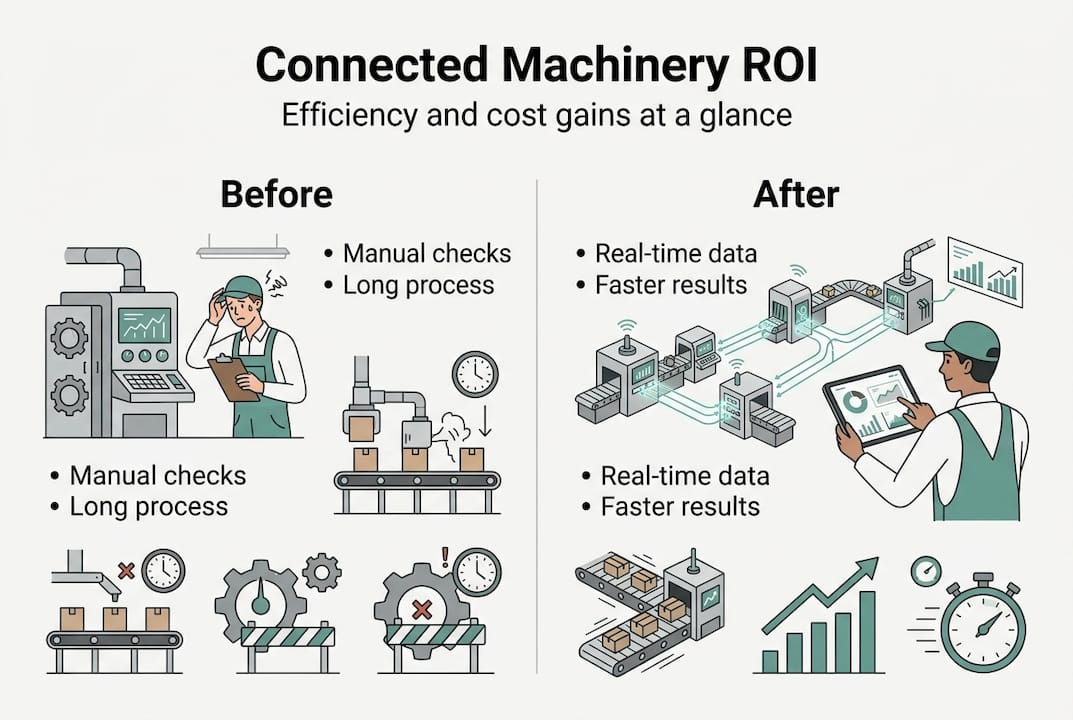
For practical guidance on manufacturing cost cuts with MES, the combination of connected machinery and a robust Manufacturing Execution System creates compounding benefits. You can also explore industrial measurement workflow examples to see how connected systems are applied in real production environments.
A common pitfall is treating the initial hardware and software investment as the total cost of connected machinery. The true ROI calculation must include implementation, training, integration, and ongoing support. Use a production optimisation guide to structure a holistic assessment before committing.
Profi tipp: When calculating ROI, include the cost of not acting. Ongoing defect rates, unplanned downtime, and manual reporting errors all carry a price. Factoring in these hidden costs often makes the business case for connected machinery far stronger than an initial investment comparison suggests.
Most conversations about connected machinery focus on cost savings and efficiency metrics. These matter, but they are not the deepest source of value.
The real advantage is adaptability. Connected machinery gives your organisation the ability to change quickly. When market demand shifts, when a supplier changes a material specification, or when a new product variant enters the line, a connected factory can recalibrate far faster than one relying on manual processes and delayed reporting.
Many manufacturers underutilise their connected systems by simply substituting old processes with digital equivalents. They monitor the same things they always monitored, just faster. The firms that extract the most value are those that use connected insights to reimagine workflows entirely, questioning assumptions about batch sizes, shift structures, and quality checkpoints.
Optimising production processes is not a one-time project. It is an ongoing discipline that connected machinery makes genuinely possible for the first time. The data is there. The question is whether your organisation has the appetite to act on what it reveals.
You now have a clear picture of what connected machinery delivers: faster decisions, lower costs, better quality, and the organisational agility to keep improving.
Mestric™ is built to make this transition straightforward. Our platform connects directly with your equipment, surfaces the KPIs that matter, and gives your team the tools to act on real-time data from day one. Explore analytics for efficiency to see how data intelligence works in practice, or compare approaches with our guide on MES vs traditional methods. When you are ready to see what connected manufacturing looks like for your specific operation, Mestric’s smart factory solutions are the natural starting point.
Connected machinery shares real-time data across the factory and with analytics software, while traditional automation typically operates in isolation without data sharing. IIoT-enabled systems enable faster decisions and cross-site benchmarking that isolated equipment simply cannot support.
Timelines vary, but results can appear within months of deployment. AGCO achieved a 35% decrease in process time relatively quickly after implementing their connected worker platform.
Yes, modern connected solutions are scalable and increasingly cost-effective, making them accessible to SMEs seeking to improve efficiency and reduce operational costs without enterprise-scale budgets.
Absolutely. Firms like AGCO have cut operator learning time by 50% by deploying AI-powered connected platforms that guide operators through processes in real time.


 069 763 552