


TL;DR:
- Effective production scheduling translates high-level plans into detailed, executable shop floor instructions that improve throughput and on-time delivery.
- Advanced scheduling tools incorporate constraints, real-time data, and optimization algorithms to outperform manual methods, boosting capacity by up to 30%.
Production scheduling is the process of assigning specific manufacturing jobs to machines, workers, and resources in a precise time sequence to maximise throughput and meet delivery commitments. Known formally as operations scheduling, it translates high-level production plans into detailed, executable instructions for the shop floor. Scheduling answers the operational questions of what to produce, where, when, and in what order. Advanced Planning and Scheduling (APS) systems, Theory of Constraints (TOC), and Drum-Buffer-Rope frameworks all exist to solve this problem at scale. When done well, production scheduling reduces lead times, cuts idle time, and keeps your customers receiving orders on time.
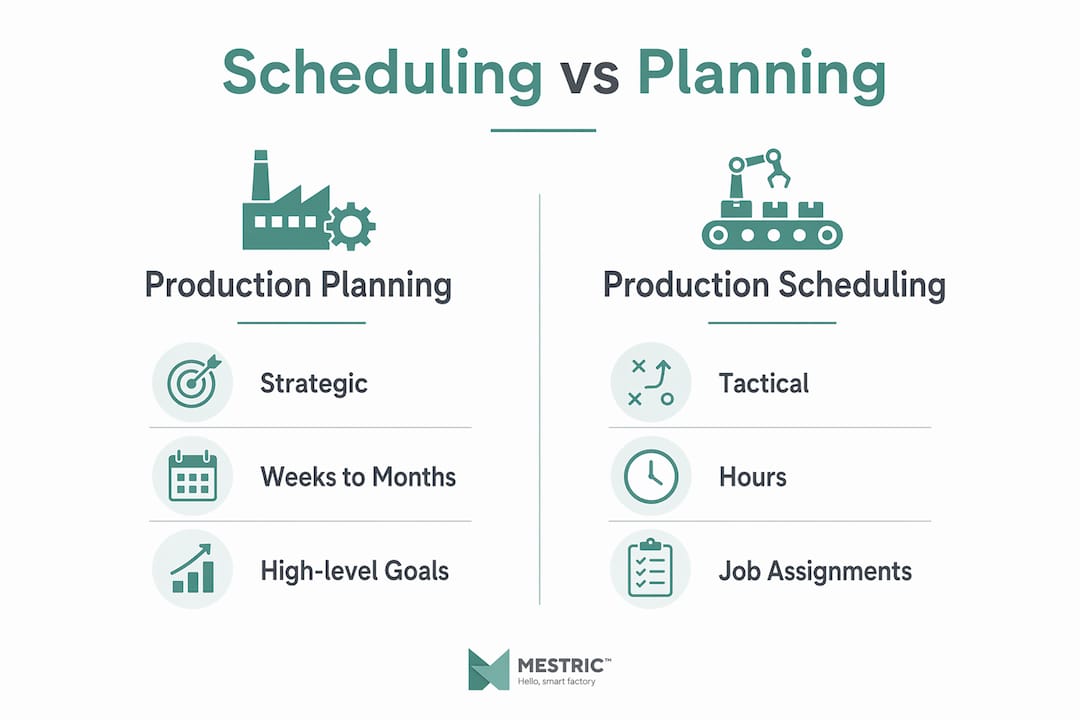
Production scheduling and production planning are related but operate at different levels of detail and time horizon. Confusing the two leads to plans that look good on paper but fall apart on the shop floor.
Production planning is strategic. It answers questions like: how many units do we need to produce this quarter, which product lines will run, and what raw materials must we procure? Planning typically covers weeks or months and works at an aggregate level, setting rough capacity targets and material requirements. Enterprise Resource Planning (ERP) systems such as SAP or Oracle handle much of this layer.
Production scheduling is tactical. It takes the plan and drills down to specific sequences, start times, and machine assignments for individual jobs. A scheduler decides that Job A runs on Machine 3 from 06:00 to 09:30, followed by Job B after a 20-minute changeover. This level of detail is what the shop floor actually executes.

The table below summarises the key differences:
| Attribute | Production planning | Production scheduling |
|---|---|---|
| Time horizon | Weeks to months | Hours to days |
| Level of detail | Aggregate (product families) | Individual jobs and operations |
| Primary output | Capacity and material requirements | Sequenced job list with start/end times |
| Typical system | ERP (SAP, Oracle) | APS or MES |
| Key question | What and how much to produce? | When, where, and in what order? |
The practical implication is clear. A production plan that says “produce 500 units of Product X this week” is not a schedule. The schedule specifies which machine runs which batch, in what order, and when each operation starts. Without that detail, supervisors improvise, bottlenecks go unmanaged, and delivery dates slip.
Real-world scheduling is not a simple sequencing exercise. Every factory operates under a set of constraints that, if ignored, produce schedules that look optimal on screen but are unworkable on the floor.
The most common constraints you need to account for include:
Pro Tip: Map your sequence-dependent setup matrix before building any schedule. Even a rough changeover time table, captured in a spreadsheet, will reveal grouping opportunities that cut hours of idle time per week.
Ignoring any one of these constraints produces a schedule that supervisors immediately override. When that happens repeatedly, trust in the scheduling process collapses and teams revert to informal, experience-based sequencing. That is a costly cycle to break.
Manual scheduling, typically done in Microsoft Excel or on a whiteboard, works adequately when order volumes are low and product variety is limited. As complexity grows, spreadsheets fall short because they cannot model interdependencies, enforce constraints, or reoptimise after disruptions in real time.
Advanced Planning and Scheduling systems address this directly. An APS system integrates machine availability, labour, material, and tooling data with priority rules and sequence logic to generate executable schedules automatically. The practical benefits are measurable. Intelligent sequencing that groups setups and reduces idle time can cut lead times by 15 to 25%. Moving from good manual scheduling to APS-generated schedules can improve plant throughput by 20 to 30%. That is capacity gained without capital expenditure.
Two frameworks underpin most advanced scheduling logic:
Pro Tip: If you are managing more than 50 active jobs across five or more work centres, a manufacturing software upgrade from spreadsheets to an APS or MES is likely to pay back within one quarter through reduced overtime and improved delivery performance.
The shift to advanced tools is not about replacing scheduler expertise. It is about giving experienced schedulers the computational power to act on that expertise at a speed and scale that manual methods cannot match.
Building a schedule is one thing. Keeping it accurate and trusted across a full working week is another challenge entirely. The following steps reflect best practice for manufacturing environments running mixed-product, multi-machine operations.
Start with clean data. Your schedule is only as reliable as the inputs feeding it. Confirm machine availability, operator rosters, current inventory levels, and open order priorities before generating any sequence. Garbage in, garbage out applies here without exception.
Set the scheduling frequency. Best practice calls for updating production schedules daily or at every shift start. This frequency allows the schedule to absorb disruptions, such as machine breakdowns, rush orders, and material delays, before they cascade into missed delivery dates. A weekly schedule that is never revised is a forecast, not a schedule.
Involve shop floor supervisors. Schedulers who work in isolation from the floor produce plans that operators quietly ignore. Supervisors know which machines are running rough, which operators are most productive on which jobs, and where informal workarounds exist. That knowledge must feed the scheduling process, not sit outside it.
Integrate with your ERP and MES. A production schedule that does not connect to your ERP for order data and your MES for real-time machine status will drift from reality within hours. Integration is what turns a static plan into a live control tool. You can explore how MES integration supports scheduling in practice to understand the data flows involved.
Track and analyse schedule adherence. Measure the percentage of jobs completed on time against the schedule each day. When adherence drops below your target, investigate the root cause. Common culprits include unrealistic setup time estimates, unplanned downtime, and material shortages. Use a production optimisation guide to structure your continuous improvement reviews.
Pro Tip: Build a short daily scheduling meeting of no more than 15 minutes with your supervisors. Review yesterday’s adherence, flag today’s risks, and confirm the shift plan. This single habit prevents most of the informal schedule overrides that erode planning discipline.
Avoid the common pitfall of treating the schedule as a fixed document. Shift-based schedule updates are the standard for any operation that wants to maintain on-time delivery through real-world disruptions. Rigidity in scheduling is not discipline. It is a recipe for firefighting.
Effective production scheduling requires finite capacity modelling, constraint-aware sequencing, and daily revision to translate production plans into reliable, executable shop floor instructions.
| Point | Details |
|---|---|
| Scheduling vs planning | Scheduling assigns specific jobs to resources with start times; planning sets aggregate targets over weeks or months. |
| Constraints drive feasibility | Machine capacity, operator qualifications, and setup times must all be modelled for a schedule to be executable. |
| APS delivers measurable gains | Moving from manual to APS scheduling can improve throughput by 20 to 30% and cut lead times by 15 to 25%. |
| Bottleneck focus is non-negotiable | Per Theory of Constraints, only improving the bottleneck resource increases overall throughput. |
| Daily updates maintain accuracy | Updating schedules at every shift start is best practice for absorbing disruptions and protecting delivery dates. |
After working with manufacturing operations across different sectors, the pattern I see most often is not a lack of scheduling knowledge. It is a gap between what teams know they should do and what their tools actually allow them to do.
Most plants I encounter are still running production schedules in Excel. The schedulers are experienced, diligent, and genuinely skilled. But they are spending three to four hours each morning rebuilding a schedule that an APS system would regenerate in under five minutes. That time cost is invisible on a P&L, but it shows up in late deliveries, excessive overtime, and supervisor frustration.
The Theory of Constraints insight is the one that tends to land hardest with plant managers: improving any resource that is not your bottleneck does nothing for throughput. I have seen factories invest in new equipment on a non-constraint work centre and wonder why output did not improve. The answer is always the same. The bottleneck was elsewhere and the schedule was not protecting it.
My honest view is that production scheduling optimisation is the highest-return investment most mid-sized manufacturers can make in 2026. Not new machinery. Not headcount. Better sequencing logic, real-time data, and a scheduling cadence that the whole team trusts. That combination consistently outperforms capital expenditure as a route to capacity gain.
— Andraž
Mestric’s Manufacturing Execution System connects directly to your production equipment, giving you real-time visibility of machine status, downtime events, and job progress across every work centre. That live data feeds directly into your scheduling decisions, so you are always working from current reality rather than yesterday’s assumptions. Mestric’s AI-powered analytics identify bottlenecks, flag capacity conflicts, and support the kind of daily schedule revision that best practice demands. If you are ready to move beyond spreadsheets and build a scheduling process that holds under real-world pressure, explore how MES outperforms traditional methods to see what that shift looks like in practice.
Production scheduling is the process of assigning manufacturing jobs to specific machines, operators, and time slots in a sequence that maximises throughput and meets delivery dates. It is the tactical layer that translates a production plan into executable shop floor instructions.
Production scheduling optimisation is the use of algorithms, constraint-based logic, or APS systems to generate job sequences that minimise lead times, reduce changeover waste, and protect bottleneck resources. APS-generated schedules can improve throughput by 20 to 30% compared to manual methods.
Production schedules should be updated daily or at every shift start. This frequency allows the schedule to absorb disruptions such as machine breakdowns, rush orders, and material shortages before they affect on-time delivery performance.
ERP systems handle aggregate production planning, procurement, and order management at a high level. APS systems use finite capacity modelling and sequencing algorithms to generate detailed, executable schedules that respect real machine and labour constraints.
Theory of Constraints identifies the single bottleneck resource that limits overall throughput. Scheduling must prioritise protecting and exploiting that resource, because improving any non-constraint work centre has no effect on total output.


 069 763 552