


TL;DR:
- Operational excellence is driven by daily behaviors, culture, and leadership decisions, not just KPIs or technology.
- True sustainability depends on embedding principles like respect, humility, and continuous improvement into daily work.
- Technology such as MES platforms accelerates improvement cycles but must complement a strong, adaptive culture.
Many manufacturers believe operational excellence is simply a matter of hitting KPI targets or rolling out the latest technology. It is not. The real driver of sustained performance is something far less visible: the daily behaviours, cultural norms, and leadership decisions that shape how work actually gets done on the shop floor. This guide separates the principles from the tools, the genuine improvements from the box-ticking exercises. You will find practical frameworks, honest warnings about common pitfalls, and actionable steps to help you build operational excellence that actually lasts, not just a programme that looks good in a boardroom presentation.
| Pont | Részletek |
|---|---|
| Principles over tools | True operational excellence is driven by leadership behaviours and culture, not just adopting new technologies. |
| Continuous improvement is digital | Embedding real-time data and digital systems accelerates PDCA cycles and effective manufacturing improvements. |
| Beware metric traps | Over-focusing on efficiency benchmarks or targets like OEE can reduce agility and result in surface-level compliance. |
| Adapt excellence to context | Operational excellence frameworks must be tailored to your plant’s specific realities—there’s no one-size-fits-all solution. |
| Frontline ownership matters | Sustainable results arise when shop-floor teams own and adapt excellence practices daily. |
To clarify what operational excellence really means, let us first unpack its foundational pillars and the key distinctions that matter.
Operational excellence is not a destination you reach by installing new software or hitting a particular OEE score. It is a management philosophy built on a set of interconnected pillars, each reinforcing the others. The Shingo Model identifies these clearly: leadership commitment, cultural enablers such as humility and respect, continuous improvement using scientific thinking and PDCA cycles, process standardisation, meaningful performance metrics, and enterprise alignment. Strip any one of these away and the whole system becomes fragile.
The critical distinction the Shingo Model makes is between principles and tools. Tools are things you adopt, such as Kanban boards, Six Sigma projects, or a new MES platform. Principles are the beliefs and values that shape how people behave every single day, whether anyone is watching or not. Sustainable results come from principles, not tools.
| Principles (what drives results) | Tools (what supports execution) |
|---|---|
| Respect for every individual | Lean boards and visual management |
| Humility in leadership | Six Sigma projects |
| Focus on process, not blame | PDCA worksheets |
| Alignment across all levels | MES dashboards |
| Scientific thinking as a habit | Statistical process control |
To build genuine operational excellence, your organisation needs to foster several core behaviours consistently:
“Principles inform ideal behaviours, and ideal behaviours, over time, produce ideal results. Tools, in contrast, produce events.” This insight from the Shingo Institute captures precisely why tool-driven transformations so often fail to last.
Understanding operational efficiency in manufacturing is a useful starting point, but operational excellence goes further. It demands that efficiency improvements are sustained through culture, not chased through one-off projects.
With these pillars in mind, operational excellence depends heavily on the leadership behaviours that bring these principles to life.
You cannot delegate operational excellence. This is one of the most common and costly misunderstandings we see in manufacturing organisations. A senior team that appoints an OpEx manager, launches a continuous improvement programme, and then returns to business as usual has not created excellence. They have created a parallel activity that sits alongside real work rather than being embedded within it.

As the Shingo Model approach confirms, OpEx requires leadership embodiment. Systems shape the daily behaviours that decide success, and those systems are built by leaders. If the systems reward speed over quality, people will prioritise speed. If the systems reward reporting good news, bad news gets buried. Leaders set those systems, consciously or not.
Leadership actions that signal real commitment to operational excellence include:
None of these require a large budget. They require consistency and intentionality.
Pro Tip: One of the most damaging mistakes manufacturing leaders make is treating OpEx as a project with a start and an end date. The moment the programme concludes, behaviours revert. The better framing is to ask: “How do we build this into the way we manage every day?” That shift in mindset is where lasting change begins. Investing in process improvement in manufacturing only pays off when leadership sustains the conditions for it.
Once leadership has established the culture, continuous improvement becomes the engine of excellence, now increasingly driven by digital technologies.
The PDCA cycle (Plan, Do, Check, Act) remains the most reliable framework for structured improvement in manufacturing. It sounds simple, but most organisations shortcut it badly. Here is what successful manufacturers actually do at each stage:
Digital tools, particularly MES platforms, dramatically accelerate this cycle. Where traditional improvement teams once relied on manual data collection and weekly review meetings, real-time production data now allows you to detect variation within minutes and respond within the same shift. As the Industry 4.0 integration evidence shows, context-specific OEE targets matter far more than universal benchmarks, especially in high-mix, low-volume environments where a single OEE figure can mask significant performance variation across product lines.
| Improvement approach | Cycle time | Data source | Response speed |
|---|---|---|---|
| Traditional (manual) | Weeks to months | Paper logs, spreadsheets | Retrospective |
| Digital/real-time (MES) | Hours to days | Live machine data | Within the same shift |
For a practical view of optimising with real-time data, the difference between reactive and proactive improvement is often just a matter of the right data arriving at the right time.
Still, the pursuit of excellence is not without its hazards, and ignoring these can turn best intentions into costly mistakes.
Chasing efficiency metrics relentlessly is one of the most underappreciated risks in manufacturing leadership. The global semiconductor shortage of 2020 to 2022 illustrated this vividly. Manufacturers who had hyper-optimised for just-in-time production found themselves completely exposed when supply chains broke down. Years of stripping out buffer stock and reducing supplier redundancy in the name of efficiency left them with no resilience when conditions shifted.
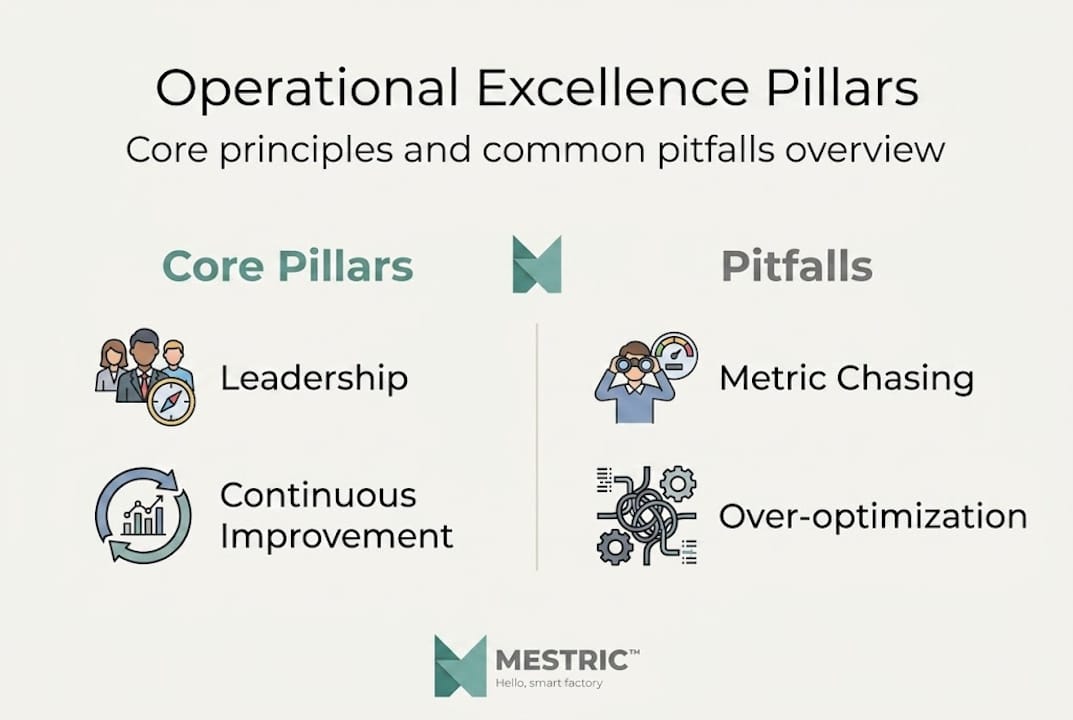
The same trap applies to metric targets. Setting an 85% OEE target across all production lines sounds disciplined, but it frequently leads to metric gaming. Operators learn quickly which numbers get scrutinised and adjust their reporting accordingly. The OEE score improves while actual performance does not.
Warning signs that your plant has fallen into metric traps include:
Pro Tip: Balance efficiency targets with adaptability measures. Track how quickly your plant can respond to a sudden order change or supply disruption. If your efficiency score is excellent but your changeover time is poor, you have optimised for the wrong thing. Streamlining operations for agility should always account for both dimensions.
“Operational excellence becomes ‘paperwork theatre’ when the focus shifts from floor-level execution to form-filling and compliance rituals. The documentation looks thorough; the process does not actually change.”
This is why understanding manufacturing metrics in context matters so much. Metrics are diagnostic tools, not performance goals in themselves.
Stepping back, it is clear that the true path to operational excellence is not formulaic. Here is why our experience points towards a more nuanced approach.
We have seen well-resourced organisations deploy world-class frameworks and achieve almost nothing lasting. We have also seen modest plants with limited technology achieve remarkable consistency simply because their frontline teams owned the problems and the solutions. The difference is never the model. It is always the people.
No two manufacturing sites are identical. Shift patterns, product complexity, workforce tenure, and equipment age all create unique constraints that a generic framework cannot account for. The organisations that succeed start small: one line, one team, one genuine improvement at a time. They resist the urge to roll out a site-wide programme before proving the approach works locally.
Technology matters enormously, and platforms like Mestric provide real advantages in visibility and speed. But technology only amplifies the culture already present. If the culture is one of blame and box-ticking, faster data just means faster blame. The better investment is always in building operational impact in practice through frontline capability, not just dashboards.
Operational excellence must be earned from the bottom up, adapted to each site’s realities, and owned by the people doing the work.
If you are ready to move operational excellence from theory to reality, here is how Mestric can help you harness the latest solutions.
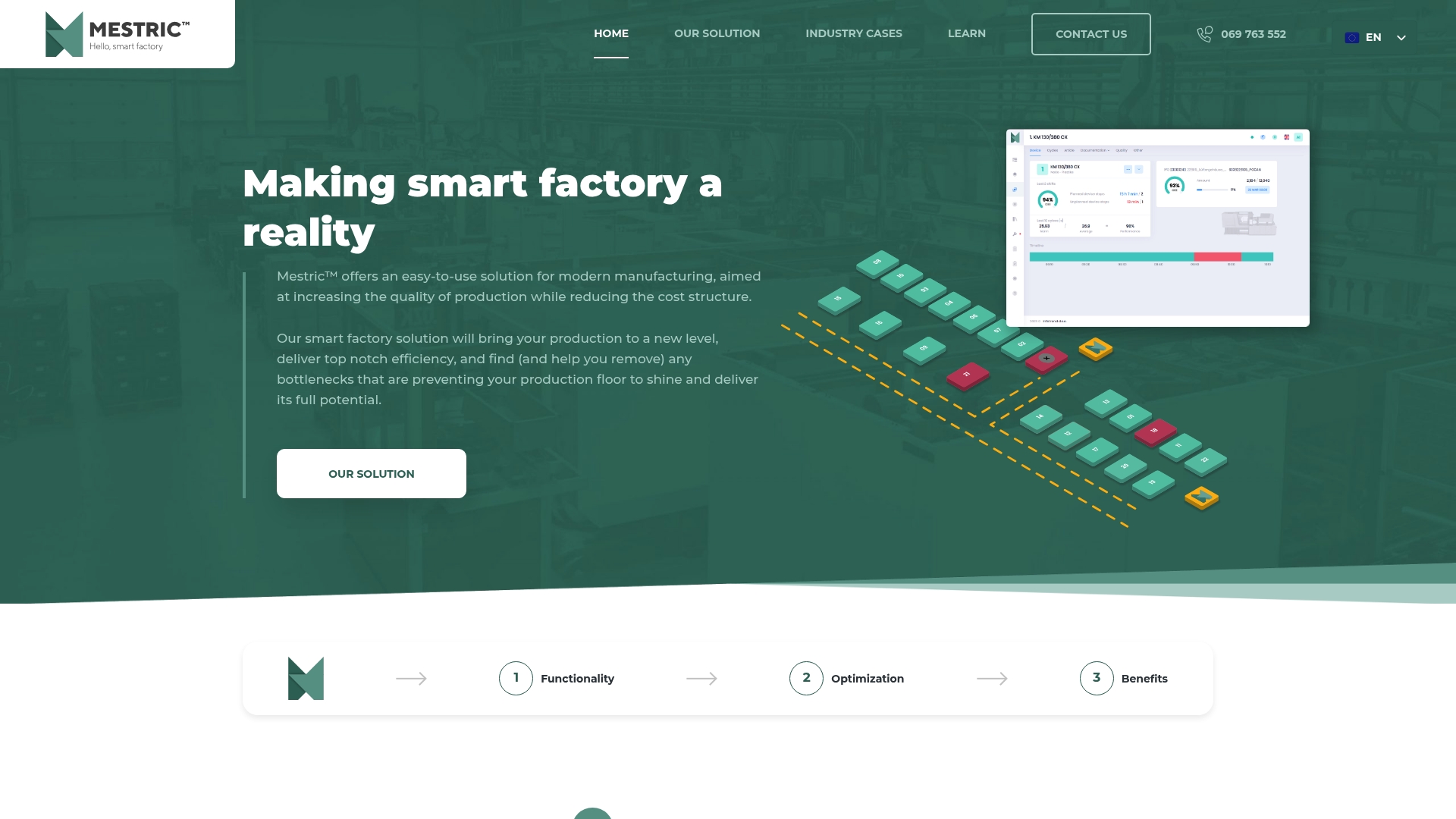
Mestric’s MES platform gives your production teams real-time visibility across performance, quality, and downtime, without the complexity of legacy systems. You can explore MES solutions for modern plants to understand how connected equipment and live KPI tracking accelerate every stage of the PDCA cycle. For a broader view of the technology stack that supports excellence, our guide to essential manufacturing software covers what every plant manager should consider. When you are ready to act, streamline your operations with tools built for the realities of modern manufacturing.
Book a no-obligation onsite demonstration and see exactly how Mestric connects with your equipment to deliver the data your teams need to improve, every shift.
Operational excellence focuses on creating a culture of sustained improvement and adaptability across the whole organisation, while operational efficiency is typically about achieving specific outcomes faster or at lower cost. As the Shingo approach confirms, systems and behaviours drive lasting excellence in a way that efficiency targets alone cannot.
An MES digitises, monitors, and optimises shop floor performance, enabling the real-time continuous improvement that is essential for sustained operational excellence. Industry 4.0 integration means modern MES platforms turn raw machine data into actionable improvement insights within the same shift.
An 85% OEE target may drive unhealthy metric gaming and produces diminishing returns, especially in complex or high-mix environments. As efficiency trap research shows, benchmarks must be context-specific to reflect the realities of each production type.
‘Paperwork theatre’ describes when manufacturers focus on completing forms and satisfying compliance requirements rather than driving genuine, floor-level process improvement. The efficiency trap analysis identifies it as one of the most common failure modes in OpEx programmes.


 069 763 552