


TL;DR:
- Defining clear, measurable quality parameters improves consistency and reduces rework costs.
- Process capability metrics like Cp and Cpk help identify and improve underperforming processes.
- Balancing proactive quality assurance with reactive quality control is essential for sustainable manufacturing success.
Relying on routine inspections alone is one of the most expensive habits in manufacturing. Quality checks without clearly defined parameters are little more than guesswork dressed up as process. When your teams inspect products without precise, measurable criteria, you end up with inconsistent outputs, customer returns, and rework costs that quietly erode your margins. Many executives confuse quality control with quality assurance, and that confusion has real financial consequences. This article gives you a clear, practical guide to quality parameters: what they are, how to measure them, and how to use them to drive efficiency and reduce costs across your operations.
| Point | Details |
|---|---|
| Quality parameters drive results | Defining measurable parameters is the foundation for sustainable manufacturing efficiency and quality improvement. |
| Internal benchmarks matter most | Year-on-year gains against your own baseline deliver more value than chasing industry-wide benchmarks. |
| Proactive QA reduces defects | Strong quality assurance systems minimise the need for costly, reactive quality control interventions. |
| Process capability signals risk | Monitoring Cp and Cpk helps identify at-risk processes before costly failures occur. |
A quality parameter is a measurable criterion used to evaluate whether a product or process meets a defined standard. These are not vague goals. They are specific, quantifiable values that tell you whether your production is performing within acceptable limits.
Typical quality parameters in manufacturing include:
These parameters tie directly to two things: customer expectations and operational efficiency. When you define them clearly, your teams know exactly what good looks like. When you fail to define them, you leave too much room for interpretation, and variation creeps in.
“Having quality parameters in place is not just about compliance. It is about giving your production floor a shared language for what acceptable performance means.”
Manufacturing quality standards vary significantly by sector, which is why it is critical to define your own internal benchmarks before benchmarking externally. Many manufacturers fall into the trap of chasing industry-wide comparisons without accounting for their specific equipment, product mix, or customer requirements.
APQC benchmarking data consistently shows that world-class performance sits within the top 6% across industries. Cross-industry medians are available as reference points, but they are rarely a practical target. What matters far more is establishing your own internal baseline and improving production quality against it year on year.
The role of quality monitoring in achieving this cannot be overstated. Without structured monitoring of defined parameters, you are simply reacting to problems rather than preventing them.
Process capability metrics are among the most valuable tools available to manufacturing leaders. They translate complex production variability into simple, actionable numbers.
Cp measures a process’s potential capability. It compares the width of your specification limits to the natural spread of your process output. A high Cp score tells you that your process could produce within specification, but it does not tell you whether it actually is.
Cpk measures actual capability. It factors in where your process is centred relative to the specification limits. A process can have a good Cp score but a poor Cpk if the output is consistently shifted toward one limit.
Here is how to interpret the scores:
| Cpk score | What it means | Action required |
|---|---|---|
| Below 1.00 | Process is not capable | Urgent investigation needed |
| 1.00 to 1.32 | Marginally capable | Improvement required |
| 1.33 to 1.66 | Acceptable | Monitor and maintain |
| 1.67 to 1.99 | Excellent | Continue optimisation |
| 2.00 and above | World-class | Sustain and document |
According to process capability standards, a Cpk of 1.33 is the minimum acceptable in most industries, 1.67 is considered excellent, and 2.0 or above is regarded as world-class. A negative Cpk is a critical signal: it means your process mean has drifted entirely outside your specification limits. This is not a monitoring situation. It requires you to stop production immediately, identify the root cause, and correct it before resuming.
Understanding what your Cpk score is telling you allows your process improvement guide to be grounded in real data rather than assumptions. You can identify which processes are underperforming, direct your resources accordingly, and track whether corrective actions are working.
Pro Tip: Do not chase a Cpk of 2.0 across every process simply because it is labelled world-class. Focus your improvement efforts on the processes with the lowest current scores and the highest impact on your product quality and customer satisfaction. Targeted gains deliver far more value than scattered perfectionism.
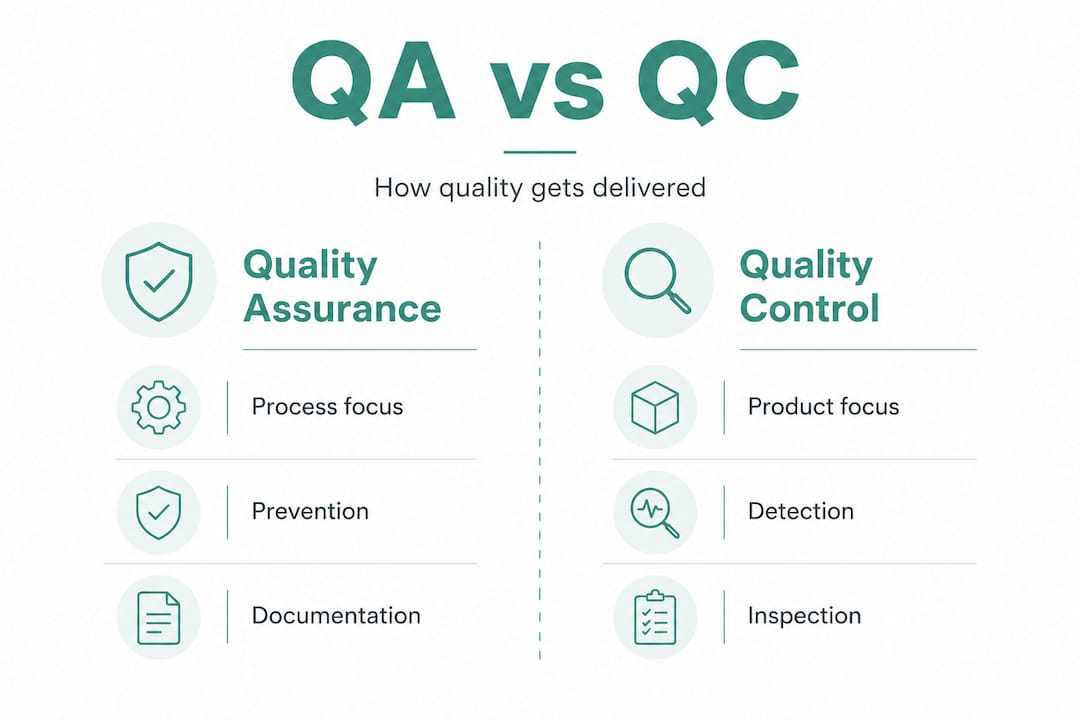
Many manufacturing leaders use quality assurance (QA) and quality control (QC) interchangeably. They are not the same, and treating them as such creates gaps in your quality management approach.
Quality assurance is proactive. It focuses on the process, not the product. QA activities include writing standard operating procedures (SOPs), conducting Failure Mode and Effects Analysis (FMEA), implementing Statistical Process Control (SPC), and running internal audits. The goal is to prevent defects from occurring in the first place.

Quality control is reactive. It focuses on the product, evaluating whether it meets specification after or during production. QC activities include inspection, dimensional checking, testing, and sampling. When a defect is found, QC triggers corrective action.
| Dimension | Quality assurance (QA) | Quality control (QC) |
|---|---|---|
| Focus | Process | Product |
| Approach | Proactive (prevention) | Reactive (detection) |
| Timing | Before and during production | During and after production |
| Tools used | SOPs, FMEA, SPC, audits | Inspection, testing, sampling |
| Goal | Prevent defects | Detect defects |
Both functions are essential, but the relationship between them is worth understanding. QA cost savings are often underestimated because they show up as defects that did not happen rather than costs that are easy to see on a report. A strong QA programme can significantly reduce the overhead required for QC, because fewer defects reach the inspection stage.
That said, newer or less mature manufacturing processes may still require heavier QC investment while QA systems are being established. QC best practices recommend building your inspection protocols around your defined quality parameters so that every check is purposeful and directly linked to a measurable standard.
AI-driven quality control is also increasingly being used to support QC functions, reducing reliance on manual inspection and catching defect patterns that human inspectors may miss at scale.
The key insight here is balance. Over-investing in QC without strengthening your QA foundation means you are paying to find problems repeatedly rather than stopping them from happening. Effective QA, built on well-defined quality parameters, is where sustainable cost reduction begins.
Knowing what quality parameters are and how to measure them is only part of the challenge. The real value comes from embedding them systematically into your operations.
Follow these steps to move from awareness to consistent application:
Define your critical parameters. Start with the product and process characteristics that have the most direct impact on customer satisfaction, regulatory compliance, and cost. Prioritise ruthlessly. Not every dimension needs to be a controlled parameter.
Establish your baseline. Before setting targets, measure your current performance. Collect at least 30 data points per process to get a statistically meaningful starting point. This is your internal benchmark.
Set specification limits based on customer requirements. Do not invent tolerances arbitrarily. Specification limits must reflect what your customer actually needs, not what is convenient to produce.
Calculate and track Cp and Cpk. Use your baseline data to calculate initial capability scores. Document these results and review them monthly as your minimum frequency for established processes.
Identify your highest-risk processes. Focus your initial improvement efforts on processes with Cpk scores below 1.33 or high defect rates. Use root cause analysis tools such as fishbone diagrams or Pareto charts to identify the drivers of variation.
Implement monitoring and control. Use Statistical Process Control charts to track your processes in real time. Control charts distinguish between normal process variation and signals that something has changed and needs attention.
Review and improve regularly. Schedule formal capability reviews at least quarterly. Compare results against your internal baseline, not just against external benchmarks.
According to APQC performance data, world-class performance is achieved by only the top 6% of organisations, and the variation across industries is substantial. Using cross-industry benchmarks as your primary target often leads to misallocated improvement resources. Focusing on modernising quality guides and building on your own data produces more reliable, sustainable gains.
Digital platforms designed for quality monitoring make this significantly more manageable. Real-time data collection, automated alerts, and integrated analytics remove the lag that exists in manual tracking systems and allow your production managers to act on issues before they escalate.
Pro Tip: When you first introduce quality parameters, avoid the common mistake of trying to control everything at once. Select the three to five parameters with the greatest impact on your output quality and cost, nail those first, and then expand your control framework incrementally.
Proper preparation of your production processes matters too. Resources like guidance on weld joint preparation illustrate how upstream preparation directly affects downstream quality outcomes, a principle that applies across virtually every manufacturing process.
Here is the uncomfortable truth: most manufacturers know they should be monitoring quality parameters, but many are doing it in a way that delivers far less value than it should. The core misunderstanding is this: they treat quality parameters as a compliance exercise rather than a performance management tool.
We see this pattern regularly. A plant installs an inspection process, defines some specification limits, and then benchmarks itself against industry averages. The team celebrates when they hit the median and worries when they fall below it. But the median is not the target. It simply tells you what the middle of the market is doing, including all of the underperformers pulling that number down.
APQC data is clear: world-class performance sits in the top 6%, and the cross-industry median reflects enormous variation in equipment age, product complexity, and customer requirements. A plant producing simple aluminium extrusions and a plant producing aerospace-grade composites cannot be compared on the same scale.
The better question is not “Are we above the industry median?” It is “Are we better than we were six months ago, and do we know exactly why?”
Focusing on operational quality through internal baseline improvement delivers a compounding advantage. When you improve Cpk from 1.10 to 1.40 on your highest-volume process, that improvement reflects a genuine reduction in variation specific to your equipment, your operators, and your product. That knowledge belongs to you. It is not something a competitor can replicate just by looking at the same benchmark report.
Root cause analysis is the discipline that makes this work. When your control charts show a signal, you investigate immediately, identify the root cause, and implement a countermeasure. Over time, your process capability scores rise because you are systematically removing sources of variation rather than just inspecting around them.
This approach is less exciting than chasing a headline number. But it is far more effective.
For manufacturing leaders who are ready to move from theory to real operational results, the right digital infrastructure makes all the difference.
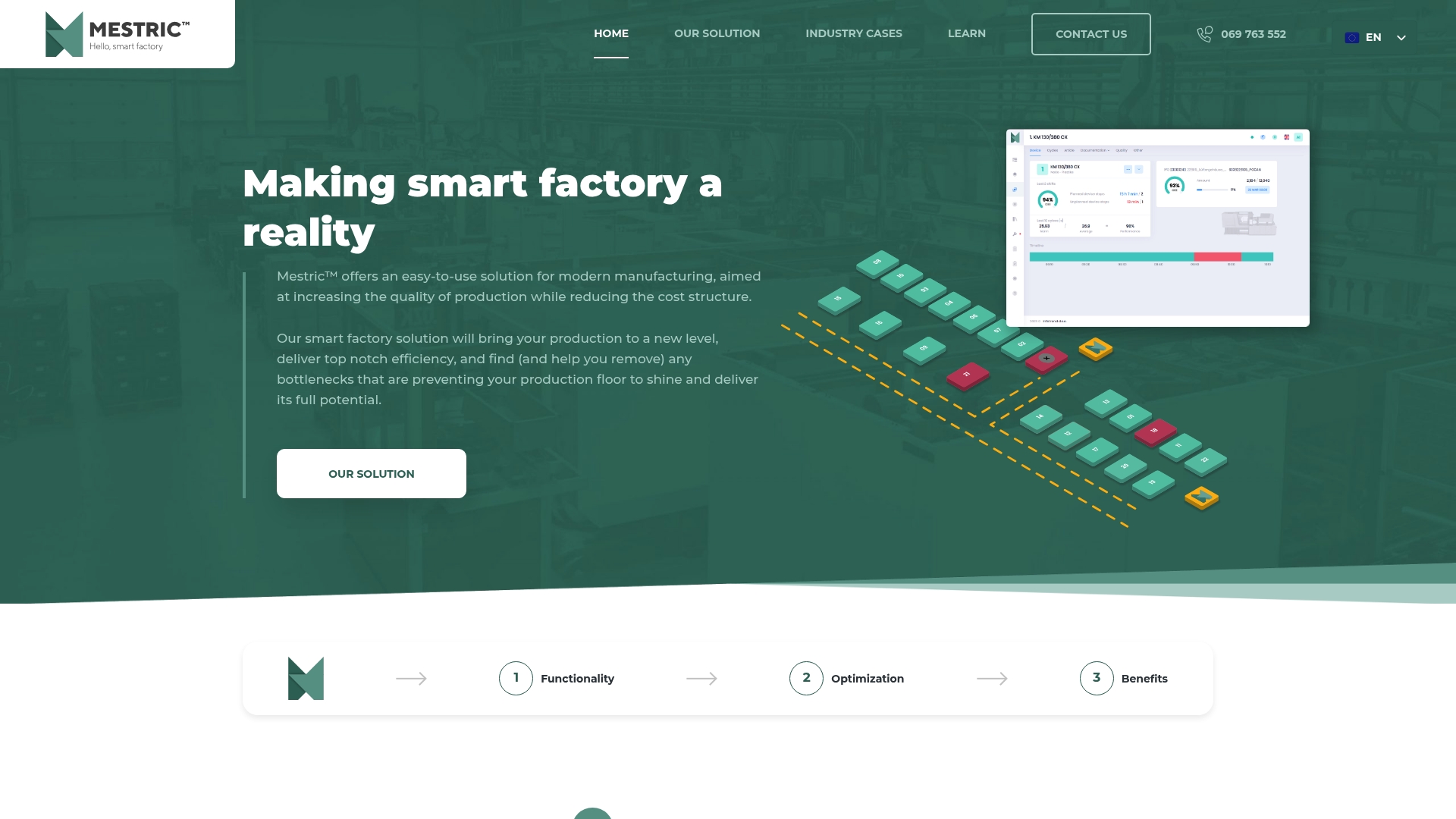
Mestric™ gives production managers and executives a real-time view of quality parameters, process capability, and performance KPIs directly connected to your equipment. You can track Cp and Cpk scores live, receive automated alerts when processes drift, and access integrated analytics that identify the root causes of quality issues before they become costly defects. Whether you are exploring how MES compares to traditional manufacturing, looking to strengthen your quality monitoring solutions, or seeking a structured approach to improve efficiency with MES, Mestric™ provides the connected, data-driven environment your operations need to improve continuously and consistently.
A Cpk of 1.33 is the minimum acceptable in most industries, with 1.67 regarded as excellent and 2.0 as world-class performance.
Select parameters that directly affect customer satisfaction, regulatory compliance, and cost. Prioritise both product-level and process-level metrics aligned with your customer requirements.
QA is proactive and focuses on preventing defects through process controls, while QC is reactive, focused on detecting defects through inspection and testing after or during production.
No. A negative Cpk means your process mean is outside the specification limits, which requires you to stop production immediately and implement corrective action before continuing.
World-class performance represents only the top 6% of manufacturers. Rather than chasing external outliers, focus on consistent improvement against your own internal baseline for more reliable and sustainable gains.


 069 763 552