


TL;DR:
- Paperless manufacturing replaces paper workflows with integrated digital systems that enable real-time data sharing. It eliminates delays caused by manual data entry, leading to faster decisions and improved quality. Successful implementation depends on process re-engineering, system integration, and engaging workers in digital transformation.
Paperless manufacturing is defined as the replacement of paper-based production workflows with integrated digital systems that capture, process, and share operational data in real time. The industry term for the technology that powers this shift is the Manufacturing Execution System, or MES. Where traditional factories rely on printed work orders, handwritten logs, and manual data entry, paperless production processes use mobile devices, digital checklists, and connected software platforms such as MES, ERP, and CMMS to give every team member and manager a live view of what is happening on the floor. The result is faster decisions, fewer errors, and a data foundation that supports AI-driven analytics.
Paperless manufacturing is the transformation of factory operations from manual, paper-dependent workflows to integrated digital systems that improve data visibility and process control. The shift matters because paper creates structural delays. Manual data entry causes a 12-hour average gap between when information is collected and when it becomes available to managers. That gap means production decisions are made on yesterday’s data, not today’s reality.
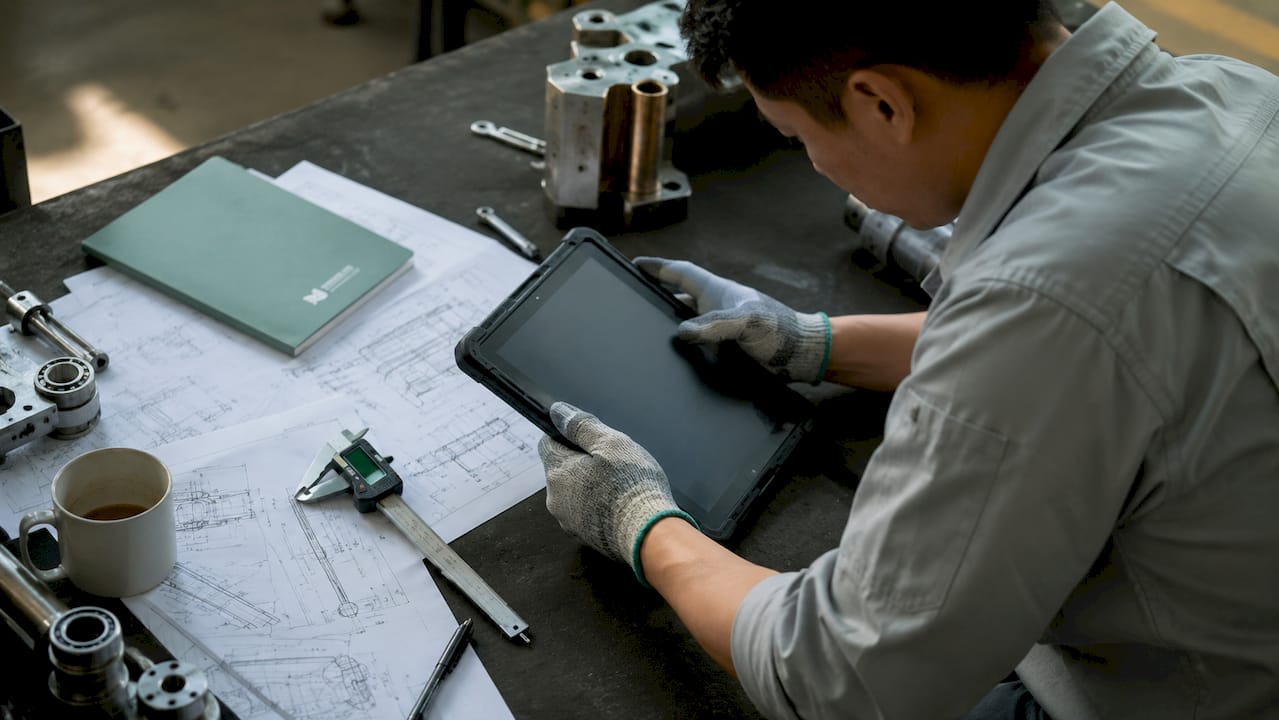
The consequences compound quickly. A quality defect spotted at the end of a shift may not reach the production manager until the following morning. By then, hundreds of additional units may have passed through the same flawed process. Paperless systems close that gap by logging data at the point of activity and making it visible across the organisation immediately.
Digital transformation in manufacturing is not a single technology purchase. It is a change in how operational knowledge flows through a factory. When MES, ERP, and CMMS systems are connected, every work order, quality check, and maintenance record feeds a single operational picture rather than sitting in a filing cabinet or a disconnected spreadsheet.
The benefits of paperless manufacturing are measurable and appear across quality, productivity, and compliance. The most direct gain is the elimination of transcription errors. When a technician logs a measurement directly into a mobile device, there is no re-entry step where digits get transposed or records get lost.
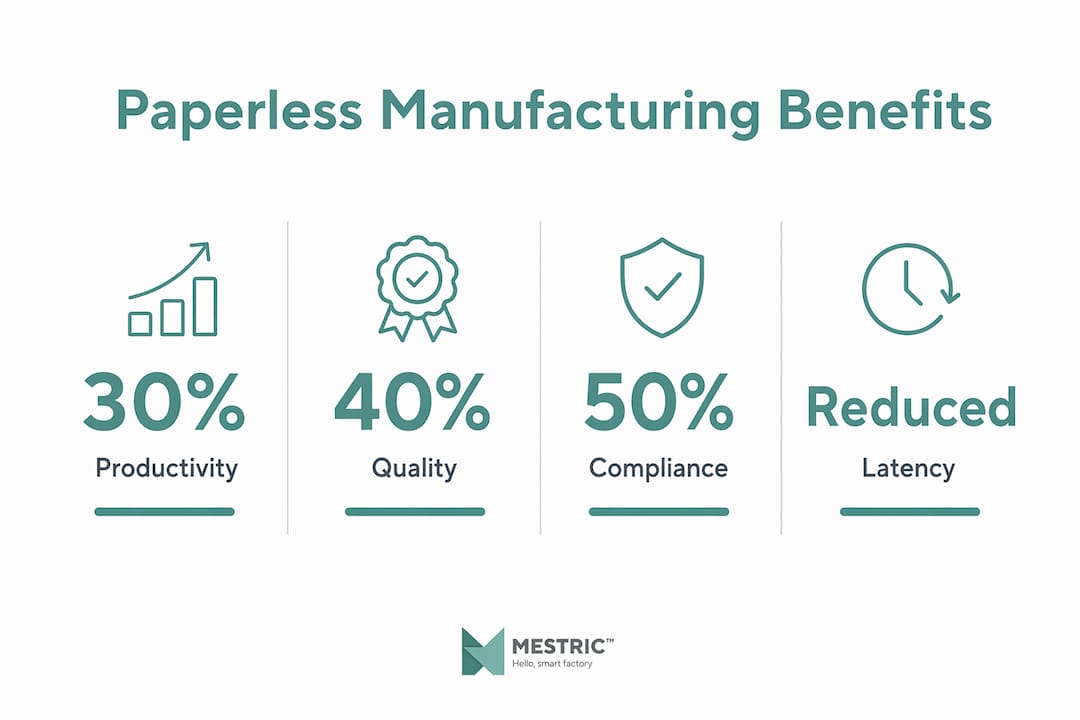
Productivity gains are equally concrete. Technicians lose around 30 minutes each day searching for work orders, manuals, or parts lists. For a 10-person maintenance team, that adds up to 1,300 non-productive hours every year. Paperless systems put the right document on the right device at the right moment, recovering that time for actual production work.
The benefits extend beyond the shop floor:
“Paperless manufacturing is not simply the elimination of paper, but the transformation of processes into data-structured, automated workflows that enable responsiveness and better operational performance.” Visionsoft
Once data is structured and workflows are integrated, the factory gains a second layer of value. AI-powered reports and anomaly detection become possible only when field data is clean, consistent, and machine-readable. Paper cannot provide that foundation.
Pro Tip: Before calculating ROI on a paperless project, measure your current information latency. Track how long it takes for a floor-level observation to reach a manager’s dashboard. That number is your baseline, and closing it is your first win.
Paperless production processes operate through a connected chain of digital tools that replace every paper touchpoint on the factory floor. The workflow typically follows this sequence:
The following table shows how key technologies map to specific factory functions:
| Technology | Factory function | Primary benefit |
|---|---|---|
| MES | Production scheduling and execution | Real-time order tracking |
| ERP | Resource and inventory management | Accurate cost and materials data |
| CMMS | Maintenance management | Planned vs. reactive maintenance ratio |
| Mobile devices | Field data capture | Immediate, accurate logging |
| Voice reporting | Hands-free data entry | Speed and accuracy in active environments |
Integration with MES, ERP, and CMMS transforms individual digital tools into a connected operational layer. Without that integration, you have digital files instead of digital workflows. The difference matters enormously for traceability and compliance.
Pro Tip: Prioritise offline functionality when selecting mobile tools for the factory floor. Connectivity gaps are common in large facilities. A system that syncs automatically when connection is restored prevents data loss without requiring technicians to re-enter anything.
The most common mistake in a paperless transition is the “paper-on-glass” trap. Digitising flawed paper workflows without re-engineering the underlying process simply speeds up the existing errors. If a paper form had redundant fields, poor sequencing, or missing validation steps, copying it into a digital form preserves every one of those problems.
The second major pitfall is siloed implementation. Isolated digital tools without integration create new data islands. A maintenance team using a standalone mobile app that does not connect to the ERP system produces records that never reach financial or production planning. The operational picture remains fragmented.
Practical best practices for a successful transition include:
Pro Tip: Choose your pilot area based on pain, not convenience. The process with the most visible inefficiency will generate the clearest before-and-after data, making the business case for wider rollout far easier to defend.
The distinction between true paperless manufacturing and paper-on-glass approaches is the difference between process transformation and process replication. Paper-on-glass means taking a paper form and displaying it on a screen. The data still gets entered manually, the workflow logic is unchanged, and the output is a digital file rather than a connected data record.
True paperless manufacturing redesigns the workflow. Data entry is validated at the point of capture. Records are linked automatically to work orders, batches, and equipment IDs. Compliance documentation is generated without a separate step. The table below summarises the key differences:
| Dimension | Paper-on-glass | True paperless manufacturing |
|---|---|---|
| Data entry | Manual, field by field | Guided, validated, partially automated |
| Integration | None or minimal | Connected to MES, ERP, CMMS |
| Traceability | Manual cross-referencing | Automatic, timestamp-linked |
| Compliance | Separate documentation step | Generated as a by-product of execution |
| AI readiness | Low, unstructured data | High, structured and machine-readable |
The compliance and traceability gap is particularly significant for regulated industries such as pharmaceuticals, food production, and aerospace. Digital consistency across processes reduces the risk of errors and losses that paper-based records cannot prevent. For smart factory initiatives, true paperless manufacturing is the prerequisite. You cannot build AI-driven analytics on top of a folder of PDF scans.
Mestric’s approach to real-time production data reflects this distinction. The platform connects directly to manufacturing equipment and feeds structured data into dashboards that production managers can act on immediately, rather than reviewing after the fact.
Paperless manufacturing delivers measurable gains in quality, productivity, and compliance only when it replaces paper-based workflows with fully integrated, process-engineered digital systems.
| Point | Details |
|---|---|
| Definition is precise | Paperless manufacturing replaces paper workflows with integrated MES, ERP, and CMMS digital systems. |
| The 12-hour gap is real | Manual reporting creates a 12-hour information delay that paperless systems eliminate with real-time capture. |
| Productivity loss is quantifiable | A 10-person team loses 1,300 hours annually to information searching that digital tools recover. |
| Paper-on-glass is not enough | Digitising flawed workflows without process re-engineering accelerates errors rather than removing them. |
| AI readiness requires structure | Structured, integrated data is the prerequisite for AI-driven analytics and predictive maintenance. |
I have seen factories declare a paperless project complete after replacing clipboards with tablets. Six months later, the tablets are gathering dust and the clipboards are back. The reason is almost always the same: the technology was implemented without changing the process or bringing the people along.
The factories that get lasting results treat paperless manufacturing as a foundation, not a finish line. They start with one process, prove the value in numbers their finance director can read, and then scale. They also invest in the cultural side. A technician who understands that the data they enter feeds the production manager’s dashboard, and ultimately their own shift planning, has a reason to enter it accurately.
The next frontier is genuinely exciting. Once your data is structured and your workflows are integrated, AI-driven anomaly detection and predictive maintenance become practical rather than theoretical. I have watched plants move from reactive firefighting to scheduled, data-led maintenance within 18 months of a well-executed paperless rollout. The smart factory trends emerging in 2026 all assume that structured operational data already exists. If yours does not, that is where to start.
My advice: resist the urge to digitise everything at once. Pick the process where paper is causing the most visible pain, fix the workflow logic first, then add the technology. The proof point you generate will do more for internal buy-in than any business case document.
— Andraž
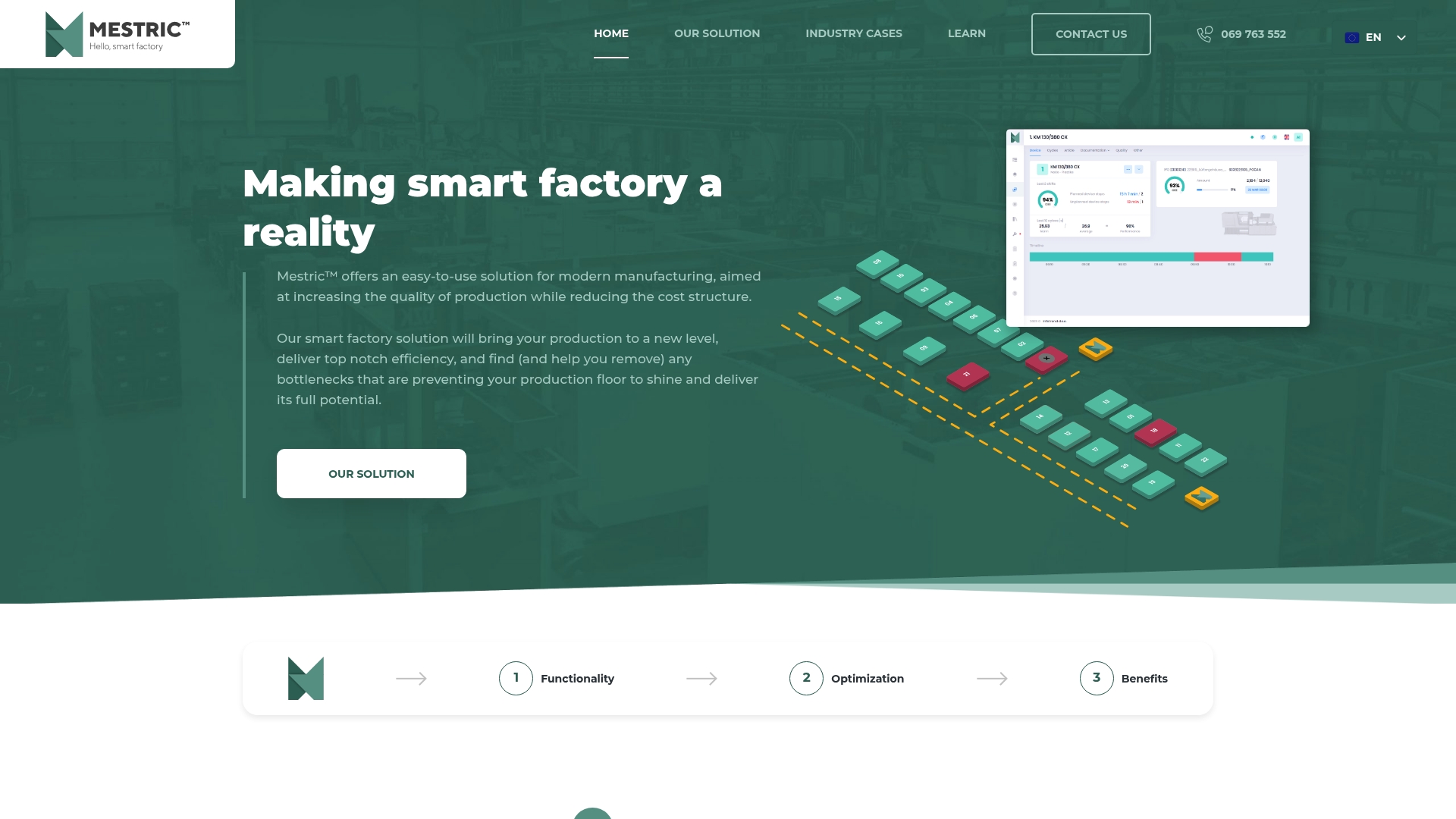
Mestric is a Manufacturing Execution System built for production managers who want real-time visibility without complexity. The platform connects directly to your equipment, captures structured data at the point of activity, and surfaces KPIs including performance, downtime, quality parameters, and cost analysis in a single dashboard. If you are evaluating how a connected MES fits into your paperless manufacturing plans, the MES vs traditional manufacturing comparison is a practical starting point. You can also explore how Mestric supports manufacturing process efficiency at every stage of a digital transition. Request an onsite demonstration to see connected machinery in a real production environment.
Paperless manufacturing is the goal. An MES, or Manufacturing Execution System, is the primary technology used to achieve it by connecting equipment, workflows, and data in real time.
A single-process pilot can deliver measurable results within weeks. A full factory rollout typically takes 6–18 months depending on the number of systems being integrated and the complexity of existing workflows.
The paper-on-glass trap is the mistake of digitising paper forms without re-engineering the underlying process, which replicates existing inefficiencies in digital format rather than removing them.
No. Effective paperless systems include offline functionality with automatic sync, so data captured in low-connectivity areas is stored locally and uploaded when the connection is restored.
AI-driven analytics and anomaly detection become practical once field data is structured, consistent, and integrated across MES, ERP, and CMMS systems. Unstructured or siloed data cannot support reliable AI outputs.


 069 763 552