


TL;DR:
- Manufacturing agility is the ability to detect change, reconfigure processes, and maintain quality quickly and accurately. It requires integrating process flexibility, operational visibility, faster decision cycles, and design discipline to enable real-time adaptation. Building systems for visibility and closing planning-execution gaps is essential for achieving true operational agility and resilience.
Manufacturing agility is one of those terms that gets thrown around in boardrooms and trade publications until it loses all meaning. It sounds like a cultural ambition rather than an operational discipline. But understanding what is manufacturing agility, precisely and practically, is essential if you lead production in an environment where demand shifts, supply chains fragment, and customers expect near-instant responsiveness. This guide cuts through the noise, defines agility with engineering accuracy, and shows you how to build it deliberately into your operations.
| Pont | Részletek |
|---|---|
| Manufacturing agility defined | It is a discipline combining engineering accuracy, process flexibility, and operational visibility to adapt quickly. |
| Distinct from resilience | Agility is rapid change adaptation, while resilience focuses on recovery after disruptions. |
| Industry challenges | Only 45% of manufacturers are highly agile due to rising costs, digital hurdles and fragile supply chains. |
| Technology enablers | Prioritising data analytics and MES technologies supports faster decisions and operational control. |
| Planning and execution | Dynamic planning models and ERP-MES integration avoid delays and enable true shop-floor agility. |
Manufacturing agility is not about moving fast for its own sake. It is the ability of a production operation to detect change, reconfigure processes, and maintain output quality and throughput without significant delay or rework. Agile manufacturing is an execution discipline, not a slogan. It requires aligned engineering, design, and production systems that allow real-time adaptation under pressure.
The core elements of manufacturing agility include:
What distinguishes truly agile manufacturing from merely flexible manufacturing is the integration of all four elements at once. Flexibility alone means you can change. Agility means you change accurately, quickly, and without sacrificing control. It balances lean efficiency with operational precision, which is why it demands more than a process change or a new piece of equipment.
Understanding the different manufacturing software types available to you is often the first practical step, because agility depends heavily on the systems that surface data and coordinate execution across the shop floor.
These three concepts are frequently conflated. They are related but distinct, and treating them as interchangeable leads to gaps in your operational strategy. Agility focuses on quick adaptation, while business continuity focuses on maintaining deliveries, and resilience on recovery after disruptions. Each one plays a different role in your overall operational architecture.
| Capability | Primary focus | When it activates | Key measure |
|---|---|---|---|
| Agility | Rapid operational adaptation | Ongoing, in response to change | Speed and accuracy of reconfiguration |
| Business continuity | Maintaining delivery commitments | During a crisis or disruption | Uptime and customer fulfilment rate |
| Resilience | Returning to normal operations | After a disruption has occurred | Recovery time and process stability |
The practical implication is this: a manufacturer can be resilient without being agile. You might recover well from a disruption but still take weeks to respond to a new customer requirement. Conversely, an agile operation that lacks business continuity planning may adapt quickly to market changes but fail to maintain deliveries when a critical supplier goes offline.
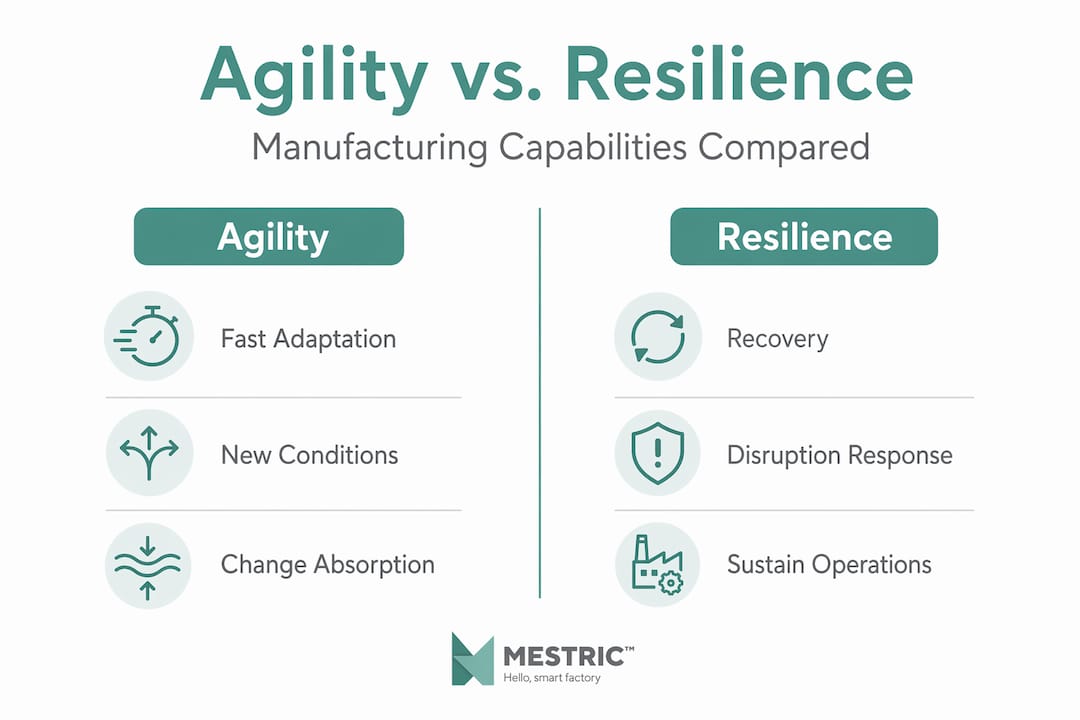
Effective manufacturing requires all three capabilities working together. Agility reduces the frequency and severity of disruptions by adapting before they become crises. Business continuity ensures customers are protected when disruptions occur. Resilience gets you back to full capacity faster. Building any one of these in isolation leaves the other two exposed.
Despite the obvious value of agility, the industry is struggling to build or maintain it. Only 45% of manufacturers describe themselves as highly agile in 2025, the lowest rate in five years. That is a striking figure for an industry that has invested heavily in digital transformation over the same period.
Several converging pressures are responsible:
The shift in focus is notable. Manufacturers are moving away from ambitious digital disruption programmes and towards steadier gains in operational efficiency and resilience. That is not necessarily a mistake, but it does mean agility is being deprioritised at precisely the moment supply chain volatility is increasing. Understanding the wider context behind manufacturing trends in 2026 helps explain why this is happening and what it means for investment decisions.
Statistic: Only 45% of manufacturers rated themselves as highly agile in 2025, the lowest proportion recorded in five years, signalling a structural decline in agility capability across the sector.
The good news is that targeted technology investment can rebuild agility even within constrained budgets. The key is knowing which technologies deliver the most direct impact on execution speed and operational control. 40% of manufacturers rank data analytics as their top investment to boost smart manufacturing agility within 24 months. That prioritisation reflects a clear industry consensus.
The technologies that most directly support manufacturing agility include:
The common thread across all of these is visibility. Agile production processes require that the people making decisions have access to accurate, timely information. Without that, adaptation is guesswork. Manufacturing data analytics is where most manufacturers see the fastest return because it directly accelerates the decision cycles that define agility.
Profi tipp: Before investing in analytics tools, establish clear data governance rules. Define which data sources are authoritative, how frequently they update, and who is responsible for acting on alerts. Analytics-driven decisions are only as reliable as the data quality behind them.
Technology alone does not deliver agility. One of the most persistent barriers is the gap between what your enterprise planning system says should happen and what is actually occurring on the shop floor. Static planning assumptions cause systemic misalignment. When demand shifts or a machine goes down, a plan built on fixed parameters does not update itself. The result is delays, missed schedules, and reactive firefighting.
Manufacturing agility requires closed-loop feedback between enterprise planning systems (ERP and APS) and shop-floor execution systems (MES and real-time monitoring) to eliminate the information gaps that cause those delays. Without that closed loop, your planning and execution operate as separate silos, and agility collapses at the boundary between them. Understanding this bridge is fundamental to production operations efficiency in any modern facility.
Here is a practical sequence for implementing dynamic planning integration:
| Integration maturity level | Planning type | Response to disruption | Agility outcome |
|---|---|---|---|
| Low | Static, manual | Delayed, reactive | Poor agility |
| Medium | Semi-dynamic, partial data | Slow but structured | Moderate agility |
| High | Dynamic, AI-driven | Real-time, predictive | High agility |
Profi tipp: Distinguish clearly between planning flexibility (the ability to create different plans) and execution agility (the shop floor’s ability to carry them out). Many manufacturers invest in flexible planning tools but neglect the execution layer. Both must be aligned or the gap between plan and reality widens.
Most writing on manufacturing agility focuses on culture, leadership mindset, or change management. Those things matter. But in our experience, the operations that actually achieve agility treat it as an engineering and systems problem first. They ask concrete questions: Where does information slow down? Which handoffs between planning and execution introduce latency? Which processes break when a single parameter changes unexpectedly?
The manufacturers we see struggling with agility are usually not lacking ambition or leadership commitment. They are lacking instrumentation. They cannot see what is happening on the shop floor in real time, so every adaptation is delayed by the time it takes to discover the problem, communicate it, and decide on a response.
The uncomfortable truth is this: you cannot manage your way to agility without operational visibility. Agility is downstream of data quality, system integration, and process discipline. Get those foundations right, and agility becomes a natural outcome. Try to build it on top of opaque, fragmented operations, and it will remain aspirational regardless of how many transformation programmes you launch.
If the gap between planning and execution is where agility breaks down, then closing that gap is where Mestric™ focuses. Our MES connects directly to your production equipment, giving you live visibility into performance, downtime, quality parameters, and cost metrics, all in one place.
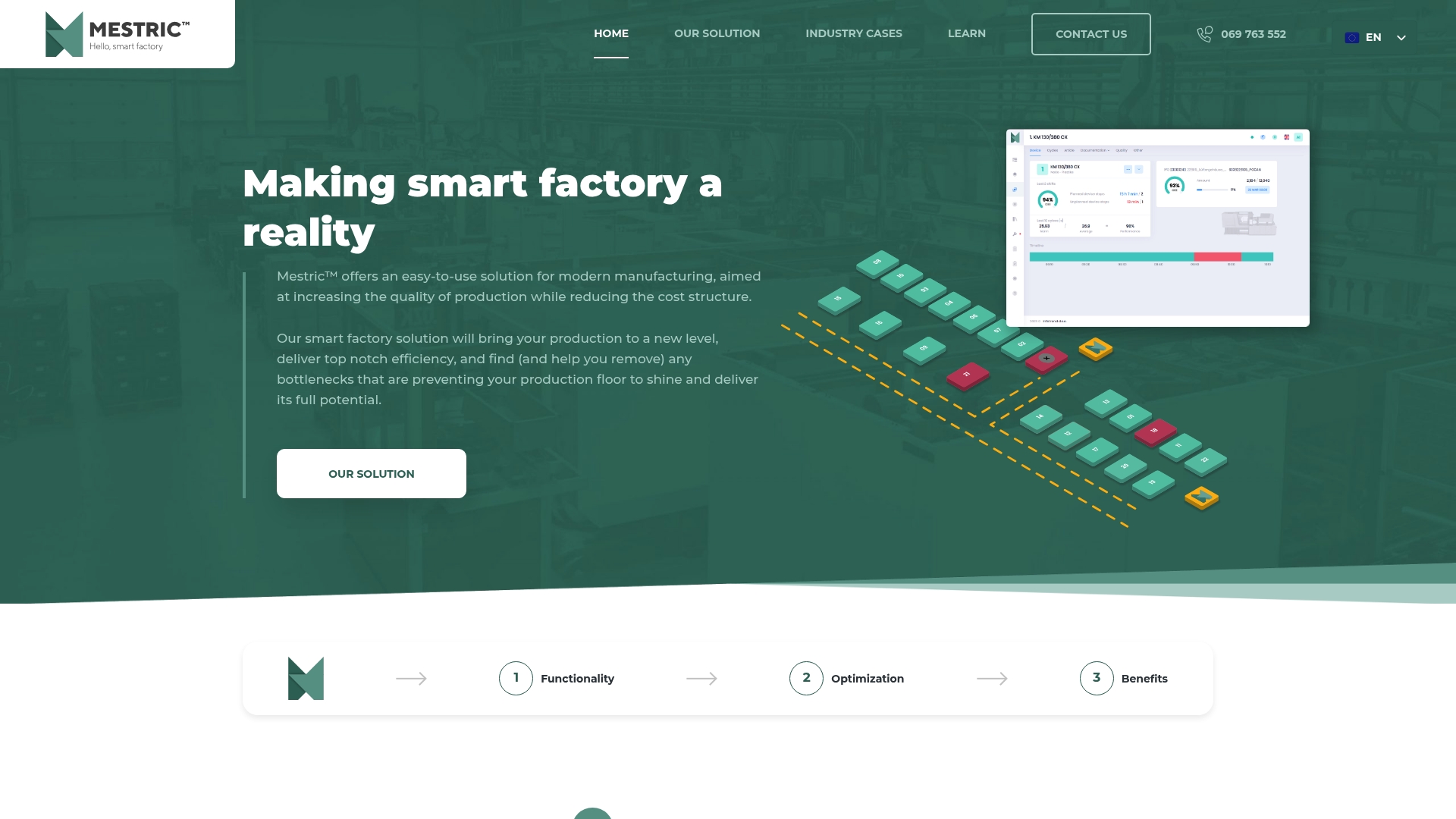
Mestric™ integrates AI-powered analytics with real-time operational data so that your production managers are not reacting to yesterday’s numbers. They are acting on what is happening now. From identifying bottlenecks to tracking quality deviations before they escalate, the platform supports the faster decision cycles that agile production processes demand. If you are ready to see what this looks like in your facility, book an onsite demonstration and we will show you exactly how connected machinery changes operational decision-making in practice.
Manufacturing agility focuses on quick adaptation to change, whereas resilience involves recovering operations after disruptions to return to normal functioning. Both are necessary but serve different operational purposes.
Agility enables manufacturers to absorb change quickly without sacrificing quality or throughput. Manufacturers unable to adapt quickly are directly exposed to disruption, delivery delays, and avoidable operational risk in volatile supply and labour markets.
Technologies like data analytics and MES provide real-time visibility and execution control. Data analytics is ranked as the top investment priority by manufacturers seeking to improve smart manufacturing agility within two years.
Relying on static planning assumptions without integration between ERP and MES systems is the most frequent cause of delays and misalignments. Static planning parameters create information gaps that slow execution responses and undermine agility at the shop floor level.


 069 763 552