

Effective complaints management centralises every complaint into one record, contains exposure immediately, and closes each case with disciplined root-cause analysis and verified corrective action, following the logic behind ISO 9001 and CQI-20. Real-time production data from an MES shortens investigations considerably. Your first move today: open a single intake record for every open complaint and start a priority root-cause analysis on your top contributor.
TL;DR:
- Record each complaint once with batch, line, and shift details, then prioritize safety risks and repeat reports tied to the same production source.
- Stop affected shipments, quarantine suspect inventory, notify customers of the hold and timeline, and document each action with its owner and time.
- Use repeated why questions for simple failures, fishbone diagrams for interacting causes, and FMEA for safety or complex assemblies; verify each fix before closing.
- Batch traceability limits quarantine to affected lots, while machine telemetry and downtime logs reveal preceding conditions and shorten reconstruction during investigations.
- Focus the 30 to 90 day pilot on the two costliest complaint drivers, track repeat complaints and verified closures, and review Pareto causes monthly.
A customer complaint often gets filed, apologised for, and closed. That treats it as an administrative nuisance rather than what it actually is: a direct signal of process drift that your inspection routines missed.
The costs run in two directions. Direct costs show up as rework, returns and warranty payouts. Indirect costs are harder to tally but often larger: lost repeat orders, damaged supplier relationships, reputational drag that outlasts the original defect. ISO 9001 auditing guidance treats a nonconformity as incomplete until its systemic cause is found and fixed, not merely patched.
Every complaint needs exactly one home. When complaints live in email threads, spreadsheets and a sales rep’s notebook, you end up with silent losses: issues nobody formally tracked and nobody fixed. A single record in your ERP, QMS or MES prevents duplicates and gives you a complete count of what is actually going wrong on the floor.
This structure does double duty. It protects the customer relationship while building the dataset you need for root-cause work later.
Containment is triage, not investigation. Your job in the first hours is to stop the bleeding, not to explain it.
Pro Tip: Photograph the defect and link it to the batch or serial number at the point of containment; this single habit removes hours of back-and-forth during the follow-up investigation.
Recording containment steps in the central record matters as much as taking them. Auditors and your own quality team will need that trail later to confirm the fix actually addressed what happened, not a guess at what happened.
ISO 9001 auditing guidance sets out three distinct parts for closing a nonconformity: correction of the immediate issue, analysis of the root cause, and verified corrective action. An auditor will not accept a closed case without objective evidence for all three, not a description of intent.
AIAG’s CQI-20 reinforces the same discipline from the automotive supply chain: a structured, team-based problem-solving process, a precisely written problem statement, and verification that the fix actually works before the case closes.
Verify the fix with a targeted test run or a batch of run-past samples before you declare the case closed. Closing on a promise, without evidence that the defect rate actually dropped, is the single most common reason corrective actions fail to prevent recurrence. For a structured approach to reducing rework during the verification stage, see our guide to cutting rework with RCA and SPC.
Traceability from raw material batch through to finished product lets you isolate exactly which units are affected, instead of quarantining an entire week’s output out of caution. That alone narrows the scope and cost of containment.
Real-time KPIs, downtime logs, quality parameter trends and machine telemetry let you look backwards from the defect to the conditions that preceded it: a temperature drift, a tooling change, an unplanned stoppage on a specific line. Manual paper trails make that reconstruction slow and incomplete; connected shop-floor data makes it close to immediate.
An industry white paper on warranty and claims automation reports that integrating AI, machine learning and connected data into claims processes helps reduce processing time, detect fraud and support supplier recovery. For manufacturers handling supplier chargebacks, that connected evidence trail also strengthens your position in any dispute. Our piece on real-time production data goes deeper into the mechanics of capturing this information as it happens.
You cannot manage what you do not measure, and complaint reduction is no exception. A small, consistent set of KPIs tells you whether your process is actually improving or merely feels busier.
Build a Pareto chart from this data every month: in most plants, a few causes drive the bulk of complaints, and that is where your RCA effort belongs. Review pilot metrics regularly and shift to a less frequent governance review once the process stabilises, with a named owner for each KPI.
A structured rollout avoids the common trap of fixing one complaint while three more pile up unseen.
Pro Tip: Start the 30 to 90 day plan on your two highest-cost complaint drivers only; spreading the pilot across every product line dilutes the data you need to prove the fix worked.
Our full walkthrough of an FMEA pilot covers how to scale this approach once the pilot lines show results.
Pilots that pair this workflow with MES-enabled traceability consistently show the same pattern: investigation time drops because the data needed to trace a defect back to its cause already exists, rather than needing to be reconstructed from memory and paper logs after the fact. Connected data shortens time-to-root-cause because the evidence, batch records, machine telemetry and quality parameters, is captured automatically rather than assembled retrospectively.

That reliability is what makes verified corrective action possible at scale, not just on the one complaint someone happened to investigate thoroughly. Readers running their first pilot are welcome to request a plant-specific demonstration to see how this looks against their own production data.
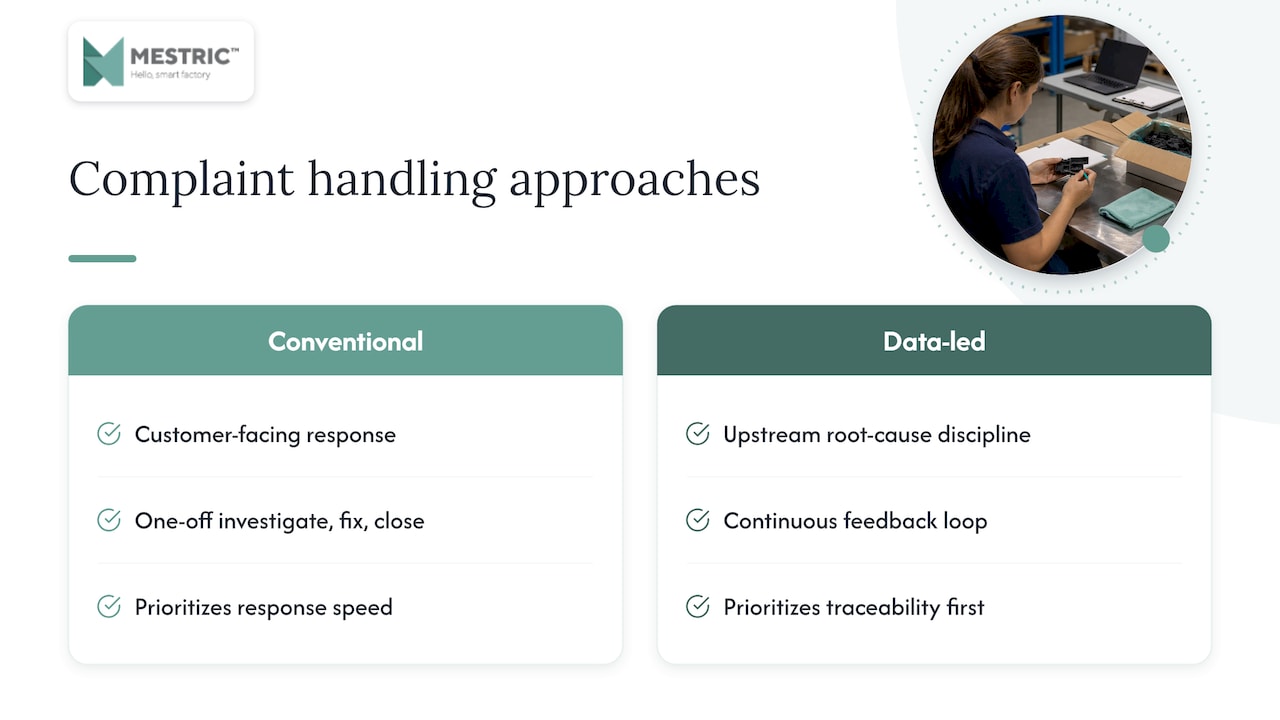
Most complaint-handling advice focuses on the customer-facing side: acknowledgement speed, tone, goodwill gestures. All of that matters, but it treats the symptom. The harder and more valuable work is upstream, in the root-cause and data discipline that stops the same defect from generating more complaints later.
The conventional advice also tends to treat RCA as a one-off event: investigate, fix, close the file. In practice, a corrective action that is not verified against real production data is a guess wearing a report’s clothing. The plants that actually bring complaint rates down treat RCA as a continuous feedback loop, where every closed case adjusts a work norm or a tolerance setting, not just a single file.
If you take one thing from this guide, prioritise traceability before you prioritise speed. A fast response built on incomplete data just produces a wrong answer delivered quickly. Get the data trail right first, and response time can improve as investigations stop starting from zero.
Everything in this guide depends on one thing: having the production data to trace a complaint back to its cause quickly. Mestric™ MES is designed to help address that gap. We connect directly to your equipment to capture real-time KPIs, downtime logs and quality parameters automatically, so containment, RCA and corrective action verification all draw on the same live shop-floor record instead of a reconstruction built after the fact.
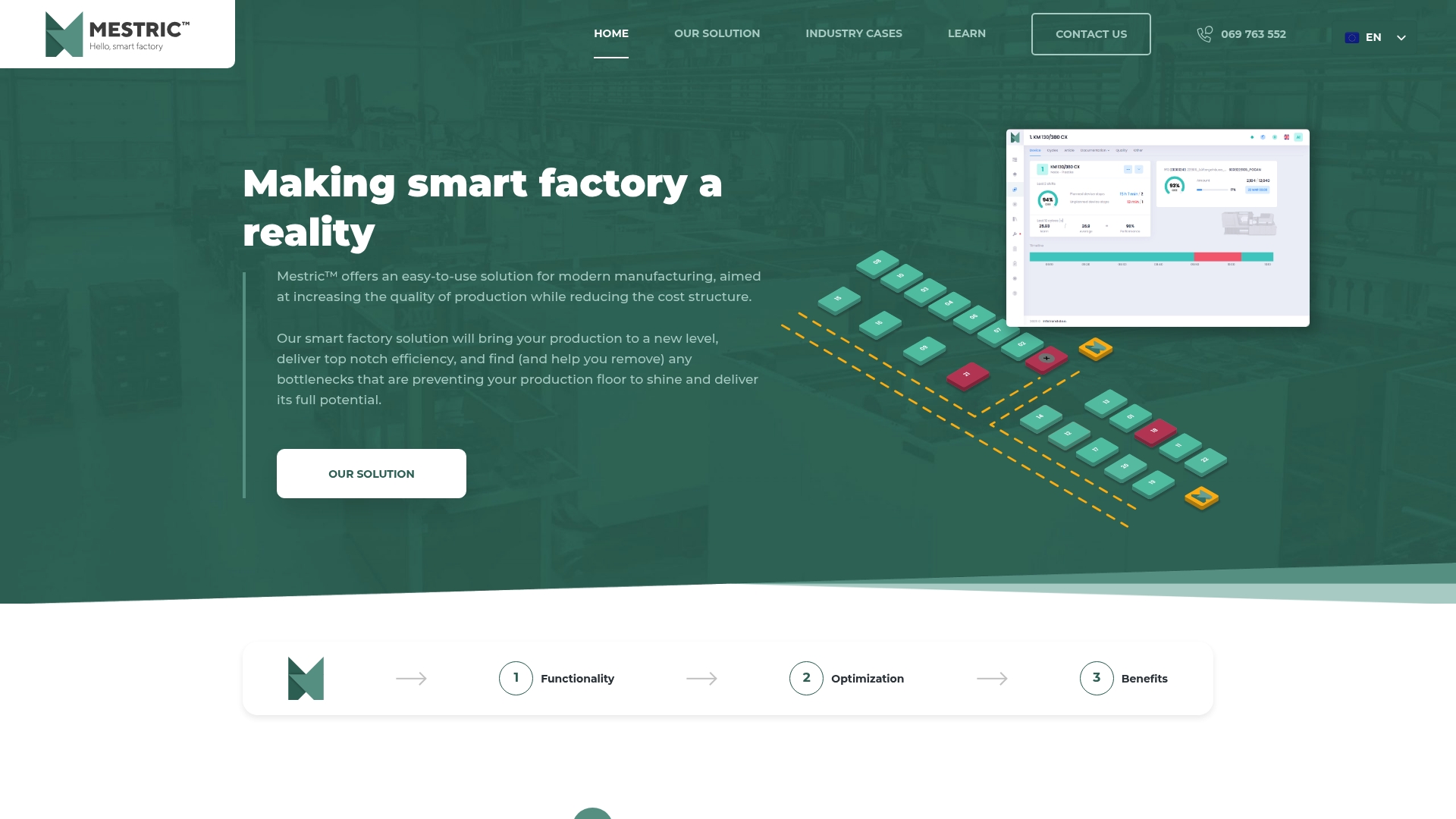
If you want to see how connected data can support investigations, we offer demonstrations. Explore our solution or get in touch to arrange a pilot for your plant.
Open a single, centralised record for the complaint the moment it arrives, capturing batch, line and shift details. This single step prevents duplicate handling and gives you the evidence base you need before root-cause analysis begins.
ISO 9001 auditing guidance requires three elements before closure: correction of the immediate problem, analysis of the root cause, and verified corrective action. Objective evidence must support all three; a promised fix without verification is not sufficient.
Use a why-based analysis for simple, single-cause problems, an Ishikawa (fishbone) diagram when multiple factors could be involved, and FMEA when the failure affects safety or a complex assembly. CQI-20 recommends matching the tool to the complexity of the problem rather than applying one method to every case.
Traceability lets you isolate the exact affected batch instead of quarantining broader stock, cutting containment costs directly. Live KPIs and machine telemetry also shorten investigation time by showing the conditions present before a failure occurred, which speeds root-cause analysis and corrective action.
Track complaints per million units, repeat complaint rate, mean time to containment, cost per claim, and the percentage of claims closed with verified corrective action. Reviewing these weekly during a pilot and monthly once the process stabilises keeps the improvement effort measurable.
For the standards behind this guide, see the ISO 9001 auditing guidance on nonconformity closure and AIAG’s CQI-20 problem-solving guidance.


 069 763 552