


TL;DR:
- Process standardisation establishes repeatable operating conditions to eliminate variation and ensure consistent quality. Combining frameworks like 5S, Lean Six Sigma, and ISO 9001 yields greater improvements in cost, quality, and efficiency when reinforced through ongoing organizational support. Sustaining standards long-term requires active management involvement, visual tools, structured audits, and continuous process updates based on performance data.
Process standardisation is defined as the practice of establishing and controlling repeatable operating conditions across a production facility to eliminate variation, reduce defects, and achieve consistent output quality. For manufacturing managers and engineers, it is the operational foundation that separates reactive firefighting from deliberate, measurable improvement. Frameworks including Lean TPS, Lean Six Sigma, and ISO 9001 have each codified this principle in different ways, yet they share a common premise: without a defined standard, there is no reliable baseline from which to improve. The evidence from 2026 case studies confirms that the benefits of standardised production extend well beyond quality control, reaching into cost reduction, workforce flexibility, and readiness for digital transformation.
The primary reason to standardise production processes is that variation is the root cause of most quality failures, cost overruns, and delivery delays in manufacturing. When each operator or shift approaches a task differently, the output reflects those differences in ways that are difficult to trace and expensive to correct.
The benefits of standardised production are well documented and span several dimensions:
Strokovni nasvet: When calculating the return on standardisation investment, include the cost of quality metrics from the outset. Tracking internal failure costs, external failure costs, and appraisal costs before and after implementation gives you a quantified business case that secures ongoing management support.
Two frameworks define the practical architecture of process standardisation in manufacturing: Lean TPS and ISO 9001:2015. Understanding what each actually requires, rather than what is commonly assumed, prevents the most frequent implementation mistakes.
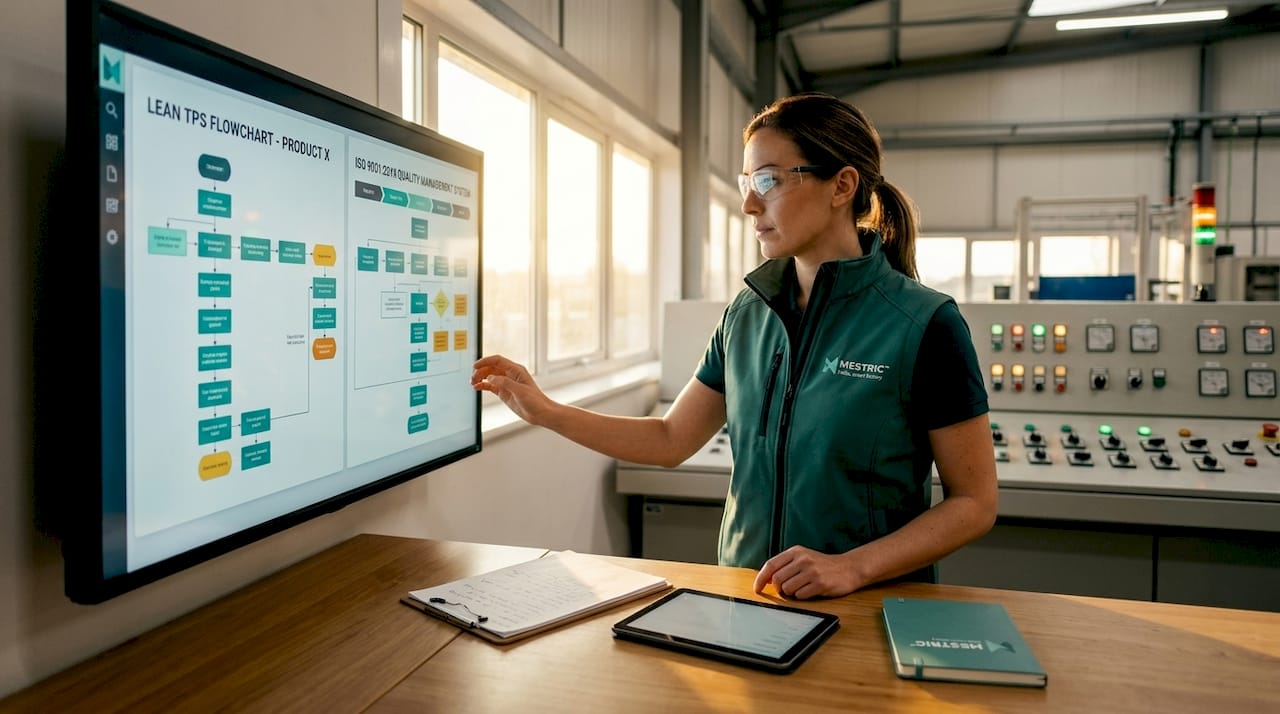
Lean TPS standardised work is not a documentation exercise. It defines the current best practice for a task in terms of three specific elements: takt time, task sequence, and explicit response actions for abnormal conditions. This distinction matters because many facilities produce work instructions that describe what to do but omit what to do when something goes wrong. Without that third element, operators improvise under pressure, and variation re-enters the process through the back door.
Lean TPS also reframes accountability. Rather than treating quality failures as individual errors, standardised work shifts responsibility to the system by making normal conditions visible and deviations into signals that require a structured response. This is a significant cultural shift for facilities accustomed to attributing defects to operator error.
ISO 9001:2015 approaches standardisation through documented information control. Clause 7.5 requires organisations to control the documented information needed for effective operation, but it deliberately avoids prescribing a fixed set of mandatory documents. The standard’s intent is that documented information supports job execution rather than audit compliance. This is a meaningful distinction: documentation that exists to satisfy an auditor is rarely consulted on the shop floor, whereas documentation designed to guide an operator is used daily and kept current.
“Effective QMS documentation genuinely supports job execution, not only audit evidence.” This principle, embedded in ISO 9001:2015’s approach to documented information, is the test every work instruction should pass before it is issued.
The practical implication is that your documentation system should be as lean as your production system. Version control, access management, and clear ownership of each document are non-negotiable. The volume of documents is not.
Different standardisation frameworks produce measurably different outcomes depending on how they are applied and combined. The table below draws on 2026 case study data to compare key performance impacts.
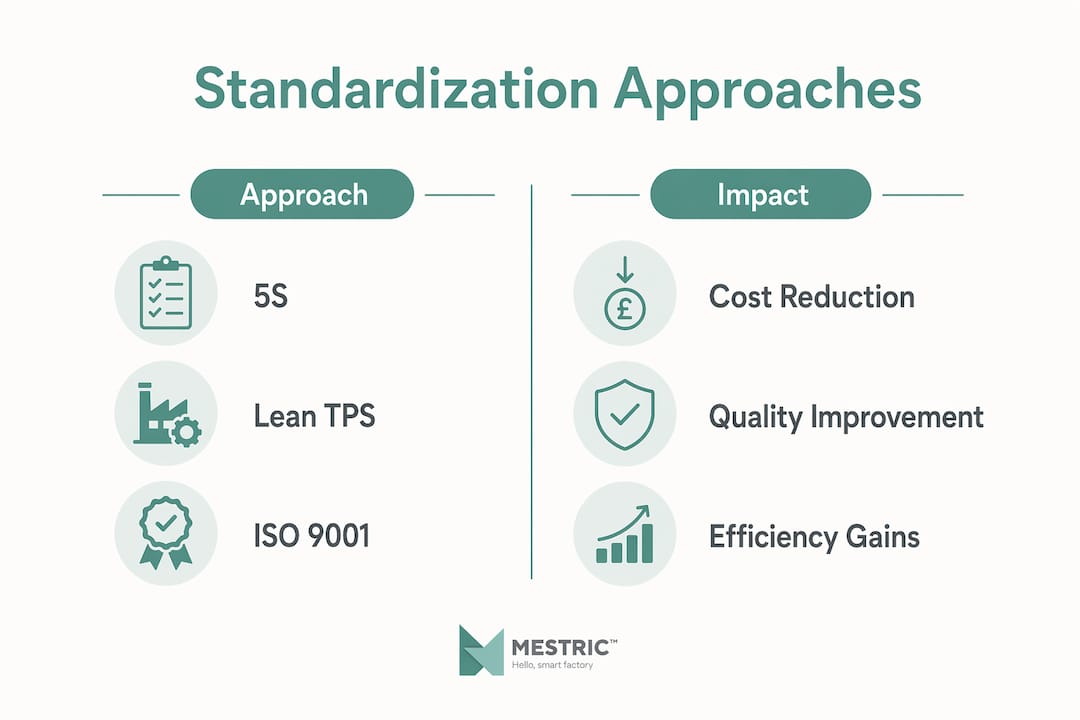
| Approach | Cost impact | Quality impact | Efficiency impact |
|---|---|---|---|
| 5S with facility layout optimisation | Reduced scrap and rework costs | Defect rates to zero during implementation | Consistent productivity KPI improvement |
| Lean Six Sigma with CoQ metrics | Failure costs reduced by 33%+ | First-pass yield up 18% | Lead time reduced by 29% |
| ISO 9001:2015 documented information control | Lower audit and rework overhead | Controlled process variation | Faster operator onboarding |
| Lean TPS standardised work | Reduced hidden defect costs | Deviations become visible improvement signals | Stable takt time adherence |
The data shows that combining approaches produces compounding gains. A facility that applies 5S to create physical order, then overlays Lean Six Sigma to quantify and reduce variation, then uses ISO 9001 to control the resulting documentation, achieves results that no single framework delivers alone.
Context matters when selecting your starting point. Facilities with high defect rates and poor physical organisation benefit most from 5S as the first intervention. Facilities with stable physical environments but inconsistent quality metrics are better served by Lean Six Sigma and Cost of Quality integration. Facilities seeking customer or regulatory certification will prioritise ISO 9001 documentation control. The frameworks are not mutually exclusive, and the most effective implementations treat them as complementary layers.
Strokovni nasvet: Before selecting a framework, map your current Cost of Quality. Categorise costs into prevention, appraisal, internal failure, and external failure. The category with the highest spend tells you where to focus first and which framework addresses that category most directly.
Establishing a standard is straightforward compared to sustaining it. The majority of standardisation efforts that fail do so not because the standard was poorly designed, but because the organisational systems needed to reinforce it were absent. System-wide reinforcement through training, management involvement, and visual verification routines is what separates a lasting improvement from a temporary one.
The following sequence gives manufacturing teams a practical path to implementation and sustainability:
The manufacturing process improvement literature consistently identifies management visibility and active participation as the single most important factor in sustaining gains. When supervisors and plant managers treat standard adherence as a daily priority rather than a periodic audit event, the culture shifts accordingly.
Process standardisation delivers measurable gains in quality, cost, and efficiency only when standards are paired with system-wide reinforcement mechanisms including training, visual management, and structured audits.
| Point | Details |
|---|---|
| Standardisation reduces variation | Defined task sequences and acceptance criteria eliminate the ambiguity that causes defects and rework. |
| Combined frameworks compound results | Applying 5S, Lean Six Sigma, and ISO 9001 together produces greater gains than any single framework alone. |
| Documentation must support operators | ISO 9001:2015 requires controlled documented information that guides job execution, not audit compliance. |
| Measurement standardisation is non-negotiable | Standardising CoQ metrics alongside processes captures the true financial and quality impact of improvements. |
| Sustainability requires organisational reinforcement | Training, management involvement, and visual tools are what sustain standards after initial implementation. |
I have worked with manufacturing teams that treated standardisation as a project with a completion date. They documented their processes, trained their operators, passed their ISO audit, and considered the work done. Within eighteen months, the standards had drifted, the documentation was out of date, and the defect rates had returned to their previous levels.
The insight that changed how I think about this is straightforward: a standard is not a destination. It is the current best practice, and it should be updated every time a better practice is identified. Lean TPS makes this explicit by placing standardised work at the foundation of all improvement activity. Without a stable standard, you have no verifiable baseline, and without a baseline, you cannot confirm that a change was actually an improvement.
What I find underappreciated in most standardisation discussions is the connection to Industry 4.0 and smart factory adoption. The Factory of the Future analysis from BCG in 2026 makes clear that companies succeeding in production redesign gain competitive advantage precisely because their standardised processes provide the stable data environment that machine learning and automation require. You cannot train an algorithm on chaotic, inconsistent process data. Standardisation is what makes your production environment legible to digital tools.
For facilities moving toward mixed human-robot environments, this connection becomes critical. Robots execute to a defined standard by design. When human processes are equally well defined, the interface between human and automated work becomes predictable and manageable. When they are not, the robot exposes the variation rather than eliminating it.
My honest view is that the facilities that will compete most effectively over the next decade are those that treat standardisation as an ongoing operational discipline rather than a compliance exercise. The smart factory trends emerging in 2026 reward exactly this kind of operational rigour.
— Andraž
Sustaining process standards across a facility requires real-time visibility into whether those standards are being met. Mestric provides exactly that through its Manufacturing Execution System, which connects directly with production equipment to track performance metrics, quality parameters, and downtime against your defined process standards.
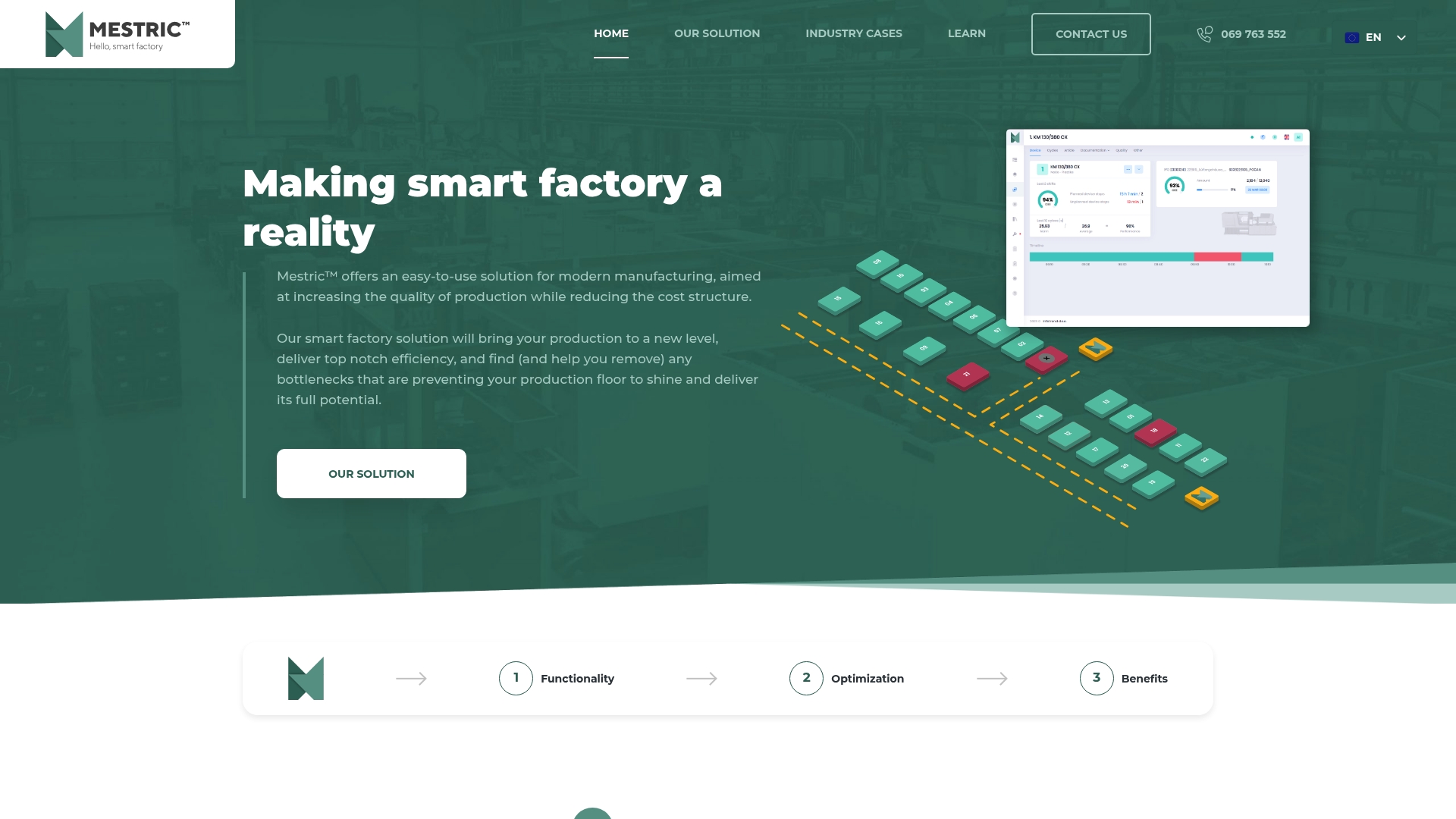
When you integrate Mestric with your Lean Six Sigma or Cost of Quality framework, you gain a live view of first-pass yield, failure costs, and process adherence without manual data collection. The platform’s AI-powered analytics identify where deviations are occurring and flag them before they become defects. For plant managers looking to move from reactive quality management to proactive process control, Mestric’s MES versus traditional manufacturing comparison shows precisely where the operational gains are captured. Book an onsite demonstration to see how connected machinery transforms your production data into decisions.
Standardising a production process means defining the current best practice for each operation in terms of task sequence, timing, and response to abnormal conditions. The goal is to eliminate variation so that output quality is consistent regardless of which operator or shift performs the task.
The main benefits include reduced defect rates, lower failure costs, faster operator training, and improved production flow. A 2026 Lean Six Sigma case study recorded failure cost reductions of over 33%, a first-pass yield increase of 18%, and a lead time reduction of 29% after standardisation was implemented with Cost of Quality metrics.
ISO 9001:2015 requires organisations to control the documented information needed for effective process operation, with a focus on accuracy and version control rather than volume. The standard is designed so that documentation supports operators in doing their jobs correctly, not simply to satisfy external auditors.
The right starting point depends on your current performance gaps. Facilities with poor physical organisation and high defect rates benefit most from 5S first. Facilities with stable environments but inconsistent quality metrics should prioritise Lean Six Sigma and Cost of Quality integration. ISO 9001 is most relevant when customer or regulatory certification is a requirement.
Sustaining standards requires system-wide reinforcement through structured operator training, regular audit schedules, visual management tools at the point of use, and active management participation. Case study evidence confirms that organisational collaboration and training are the primary factors in maintaining lasting improvements after initial implementation.


 069 763 552