

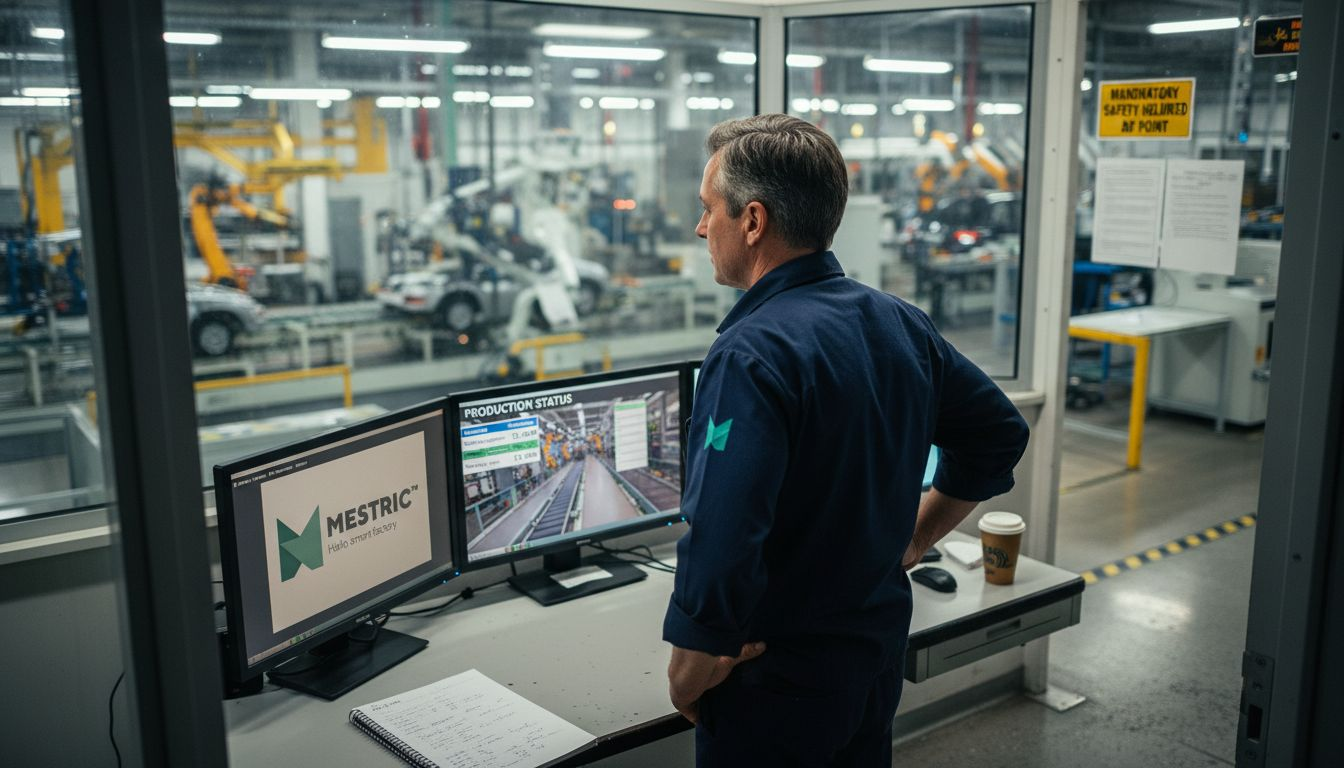
Production floors rarely wait for problems to announce themselves. In a world where downtime costs escalate and quality issues ripple through supply chains, waiting for manual reports is no longer an option. Real-time production monitoring systems offer continuous, immediate information about shop floor events, eliminating human delays and errors. This article clarifies what these systems are, why they matter for large-scale manufacturing across every country, and how they reshape operational efficiency and responsiveness.
| Point | Details |
|---|---|
| Real-Time Monitoring Enhances Decision-Making | Immediate access to production data allows teams to respond proactively, reducing reactive firefighting situations. |
| Automation Reduces Errors | Automated data capture eliminates human error, ensuring more reliable information for better operational insights. |
| Continuous Improvement is Enabled | Real-time data drive continuous improvements and optimisations in production processes and resource management. |
| Integration is Key for Efficiency | Seamless integration with existing systems enhances data flow, empowering informed decision-making across all manufacturing stages. |
Real-time production monitoring systems are the backbone of modern manufacturing operations. They automatically capture production data from your shop floor without requiring manual intervention, giving you immediate visibility into what’s actually happening at each workstation and production line.
These systems go far beyond simple data collection. They provide the continuous, immediate information you need to respond quickly to faults, equipment failures, and process deviations. Rather than discovering problems hours after they occur, real-time production data collection enables you to catch issues the moment they happen.
Manual data collection introduces human error at every step. Your operators record cycle times, equipment status, and quality readings by hand. Transcription mistakes happen. Data gets lost. Recordings arrive too late to matter. Real-time monitoring systems eliminate these problems by automating the entire process.
Here is a comparison of manual versus real-time production data collection methods:
| Aspect | Manual Data Collection | Real-Time Production Monitoring |
|---|---|---|
| Data Accuracy | Prone to human error | Highly reliable, automated |
| Reaction Time | Typically delayed | Immediate response possible |
| Resource Efficiency | Labour-intensive | Streamlined, minimal labour |
| Visibility | Limited, retrospective | Continuous, live insights |
| Issue Detection | Often after-the-fact | Issues spotted instantly |
Advanced monitoring tools integrate components like RFID and microcontrollers to track essential metrics automatically. No operator action required. No paper forms. No delays.
Key capabilities include:
Manufacturing has traditionally been reactive. Something breaks, you fix it. Production stops, you investigate. By then, you’ve lost time, material, and money. Real-time monitoring transforms this approach completely.
With immediate access to shop floor data, you shift to proactive management. You see trends developing. You identify bottlenecks before they cause slowdowns. You catch equipment degradation before failure occurs.
Real-time monitoring systems reduce unscheduled production stops and enable short-term and long-term planning based on data that’s understandable and useful for decision-making.
This capability matters because production data becomes actionable intelligence. Your team uses current information—not yesterday’s records—to make decisions that impact today’s output and quality.
Pro tip: Start by monitoring your highest-impact production lines first. Prioritise equipment that causes the most downtime when it fails, so you capture the greatest return from real-time visibility immediately.
Monitoring solutions come in different forms, each designed to address specific manufacturing challenges. The most common approach uses Real-Time Locating Systems (RTLS), which track the position of products and resources as they move through your production environment, giving you complete visibility of material flow.
Beyond location tracking, modern monitoring systems share core capabilities that make them effective across different manufacturing scenarios. These systems typically combine several technical components working together seamlessly.
Effective monitoring solutions rely on a consistent set of features. Wireless sensor networks and automated data capture form the foundation, eliminating manual data entry entirely. Your equipment talks directly to the system without operator involvement.
Key features include:
These capabilities translate into tangible operational benefits. Production control improves because you see exactly what’s happening right now. Quality management becomes data-driven rather than reactive. Logistics efficiency increases when you track materials in real time.
The systems work across different manufacturing environments and production scales. Whether you run batch processing, continuous production, or mixed-mode operations, the monitoring approach adapts to your specific needs.
Real-time monitoring solutions enhance production control, quality management, and logistics whilst providing the efficiency monitoring data needed for continuous improvement.
Integration with your existing systems matters because isolated data doesn’t help anyone. Your monitoring solution needs to feed information directly into your manufacturing execution system, enabling automated responses and informed decision-making.
Pro tip: Start by monitoring your material flow and critical equipment first, then expand to secondary processes once your team understands how to use the real-time data effectively.
Real-time data fundamentally changes how factories operate. Instead of discovering problems days later through batch reports, your team responds to issues as they happen. This shift moves manufacturing from reactive firefighting to proactive optimisation.
When machines, products, and systems communicate instantly, your factory becomes an interconnected network rather than isolated workstations. Cyber-physical systems, IoT, and AI integration enable factories to operate autonomously whilst remaining under human oversight. Machines optimise their own performance continuously.
Traditional factories follow fixed production schedules regardless of actual conditions. Real-time data enables adaptive manufacturing where processes adjust automatically to demand changes, supply disruptions, and equipment conditions.
Your factory becomes genuinely responsive. Demand spikes? Production adjusts within hours, not days. Equipment degradation detected? Maintenance schedules shift automatically before failure occurs. Quality issues arise? Root causes surface immediately for investigation.
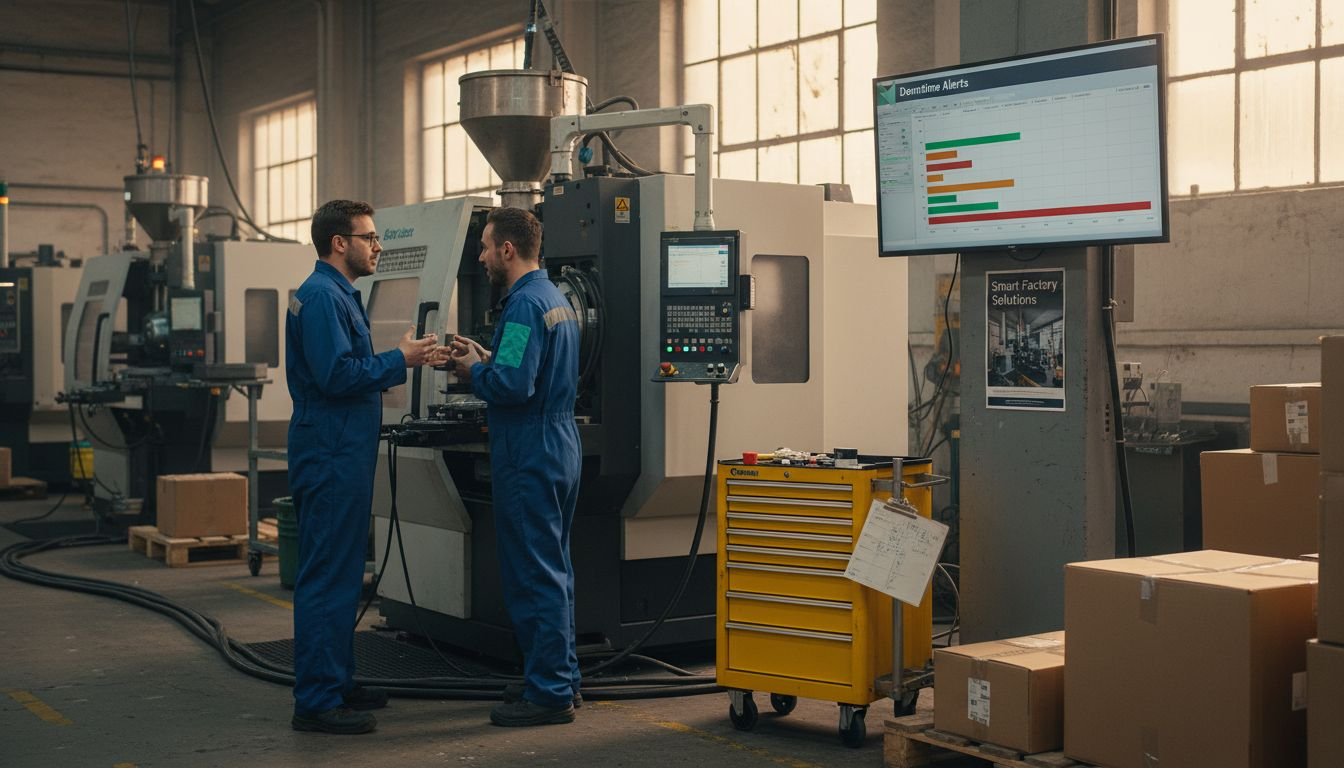
This responsiveness matters because markets move fast. Real-time data flow supports rapid reconfiguration and decision-making essential for dealing with demand volatility and supply chain disruptions. Your competitive advantage comes from speed.
Real-time data enables several critical operational shifts:
Traditional systems create information silos. Each department operates with incomplete visibility. Real-time monitoring provides enhanced visibility across all manufacturing stages, connecting shop floor operations, quality management, logistics, and planning.
This integration means your production managers, quality engineers, and logistics teams see the same data simultaneously. Decisions align because everyone operates from the same current information.
Real-time data transforms factories into smart, autonomous production systems that maximise operational performance whilst supporting better decision-making and continuous improvement worldwide.
The factory becomes a unified system where information flows freely and decisions cascade instantly through interconnected equipment and people.
Pro tip: Begin by establishing real-time visibility on your most critical production constraint first, then expand data integration gradually to other processes as your team develops confidence in the system.
Deploying real-time production monitoring systems introduces genuine technical and operational hurdles. Understanding these challenges upfront helps you plan realistic timelines and allocate appropriate resources. Implementation isn’t instantaneous, and it requires deliberate planning.
The most significant obstacles stem from the sheer volume of data your systems will generate. Data overload becomes a real problem when thousands of sensors fire simultaneously, each transmitting readings continuously. Your network infrastructure and storage systems must handle this throughput without bottlenecks.
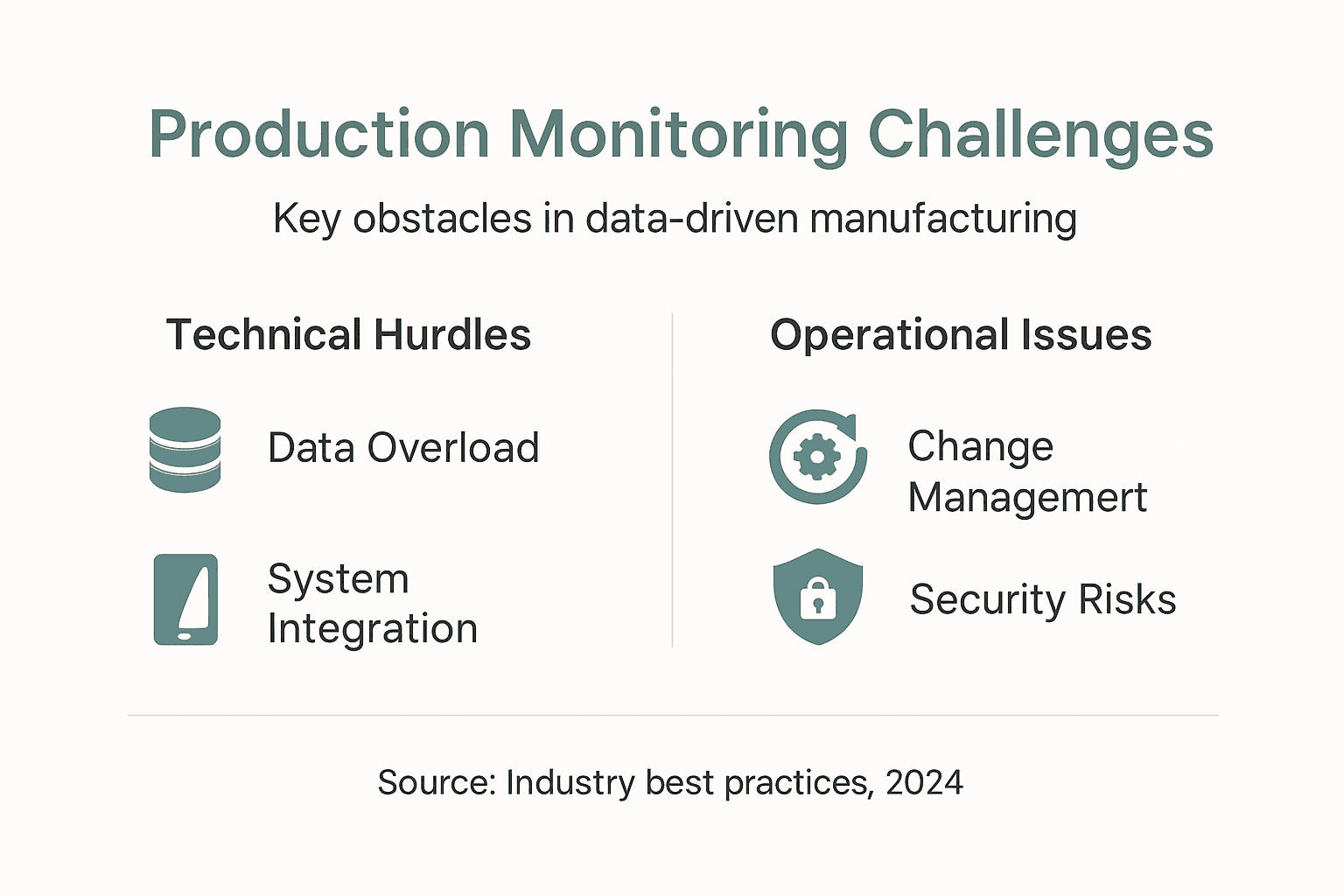
IoT-enabled sensor networks require robust frameworks addressing data management, communication protocols, and energy efficiency. These aren’t minor considerations. They form the backbone of reliable monitoring.
Key implementation obstacles include:
Your implementation must satisfy both organisational standards and regulatory frameworks. Data security regulations vary by region and industry. Manufacturing environments often fall under specific compliance regimes.
Compliance isn’t optional. It’s non-negotiable. Your monitoring system handles sensitive production data that competitors would value highly. Protecting this information is both ethical and legally required.
These frameworks demand that you establish data governance policies before deploying sensors. You cannot retrofit security later. It must be built in from the start.
To help you understand major implementation challenges and solutions, see the table below:
| Challenge | Potential Impact | Modern Solution |
|---|---|---|
| Data Overload | System slowdowns, loss | AI-driven analytics for sorting |
| Energy Efficiency | Frequent sensor downtime | Low-power wireless devices |
| Scalability | Difficult system expansion | Modular, cloud-native design |
| Security Compliance | Data leaks, fines | End-to-end encryption |
| Communication Protocols | Connectivity interruptions | Industry-standard protocols |
Robust implementation requires frameworks addressing data management, security compliance, and sustainable energy usage integrated from project inception, not added afterwards.
Advanced technologies address these implementation challenges directly. Blockchain provides immutable records of critical manufacturing events. 5G networks deliver higher bandwidth and lower latency than traditional wireless. AI systems process data overload intelligently, extracting insights from noise.
These aren’t hypothetical solutions. They’re proven approaches used in leading manufacturing facilities globally. Starting with these technologies from the beginning prevents costly retrofitting later.
Pro tip: Begin your implementation with a single, controlled pilot area rather than factory-wide deployment, allowing your team to address data management and security challenges at manageable scale before expanding.
Many manufacturing facilities implement real-time monitoring systems but fail to extract maximum value. The technology works fine, yet operational results disappoint. This gap between capability and outcome stems from predictable mistakes that are entirely avoidable.
The most costly pitfall is treating monitoring as a data collection exercise rather than a decision-making tool. You install sensors, gather readings, and then… nothing happens. Data accumulates but nobody acts on it. This wastes investment and creates cynicism about monitoring effectiveness.
Having real-time data means nothing if your team doesn’t respond to it promptly. Delayed detection of production anomalies allows small issues to become major problems. By the time someone investigates, you’ve lost hours of production and quality.
Proactive identification of production anomalies using real-time data is critical to avoid delayed detection of issues and productivity losses. This requires establishing clear alert thresholds and assigning responsibility for responding when alerts trigger.
Avoid these common patterns:
Monitoring systems are only valuable if your team trusts the data. Inaccurate readings destroy credibility. Your operators will ignore alerts if they’ve learned the sensors give false positives.
This trust must be earned through careful calibration and validation. Before deploying system-wide, verify sensor accuracy against manual measurements. Document cases where the system correctly identified problems. Build confidence gradually.
When trust erodes, everything fails. Operators override alerts. Managers question findings. The entire monitoring programme becomes suspect.
Root cause analysis in real-time further enhances manufacturing performance and reduces downtime, ensuring sustainable operational excellence. Simply identifying that something went wrong isn’t enough. You must understand why it happened.
Data-driven investigation prevents the same problem recurring. Without root cause clarity, you treat symptoms repeatedly whilst the underlying issue persists.
Employ data-driven online anomaly detection methods to address deviations promptly, mitigating risks associated with data inaccuracies and late interventions in diverse manufacturing environments.
This requires training your team in structured problem-solving. They need methods to trace production deviations back to root causes using real-time data.
Pro tip: Establish clear alert response procedures before deploying monitoring, defining who responds to which alerts and within what timeframe, preventing confusion when issues actually occur.
The article highlights the critical challenge of managing overwhelming data streams and reacting swiftly to production anomalies in real time. Many factories struggle with delayed detection, data accuracy, and integrating actionable intelligence to shift from reactive to proactive manufacturing. Mestric™ directly addresses these pain points by offering a digital platform that connects seamlessly with your equipment, delivering live performance tracking, quality monitoring, and AI-powered optimisation. This ensures immediate visibility into bottlenecks, downtime, and quality issues so your team can respond instantly and confidently.
Experience the transformation from static reporting to adaptive manufacturing with Mestric™. Its robust Manufacturing Execution System is designed to handle high-volume data, provide accurate insights, and support continuous improvement. With features tailored for ease of use and integration, you reduce manual errors, accelerate decision-making, and protect your production data securely. Explore how Mestric™ brings clarity and control to complex shop floor operations by visiting Mestric Digital Platform today.
Take the next step towards operational excellence and cost savings. Request a personalised demonstration and see how Mestric™ empowers your manufacturing to become proactive, agile, and data-driven now. Discover more about our solutions at Mestric™ and start your journey to real-time production monitoring that truly transforms your factory.
Real-time production monitoring systems automatically capture production data from the shop floor, providing immediate visibility into operations without manual intervention. They enable quick responses to faults, equipment failures, and process deviations.
Real-time monitoring reduces human error by automating data capture, ensuring highly reliable and accurate data. Manual methods are prone to transcription mistakes, lost records, and delayed reporting, which affect decision-making.
Key benefits include immediate access to shop floor data, proactive management of production issues, enhanced operational efficiency, improved quality control, and the ability to make informed, data-driven decisions that maximise productivity.
Manufacturers can ensure success by conducting pilot tests in controlled areas, establishing clear alert response procedures, training operators to trust the data, and integrating robust data management and security measures from the beginning.


 069 763 552