


TL;DR:
- Effective plant resource workflows allocate equipment, labor, and materials to maximize output and reduce waste. Proper planning, clear governance, and staged automation are essential for significant cost and cycle time improvements.
A plant resource utilization workflow is a structured process that allocates and manages equipment, labour, materials, and time in a manufacturing plant to maximise output and reduce waste. When designed well, it is the single most direct lever for cutting production costs and improving throughput. Workflow optimisation delivers documented cost reductions of 10–30% and cycle time reductions of 25–50%. Those figures represent real money on the production floor, not theoretical gains. The industry term for this discipline is resource management, and the workflow for plant resources sits at its operational core.
Building a sound resource management process starts before you touch any software. The first step is mapping every current process, including the informal workarounds your team has quietly built around broken procedures. Process mapping must capture undocumented workarounds to reveal where real workflow failures occur. Skipping this step means you will digitise problems rather than fix them.
Once you have an accurate process map, you need a resource taxonomy. This is a structured list of every asset, skill category, and material type your plant uses. Without it, scheduling tools have nothing reliable to work from. Pair the taxonomy with clear governance: approval workflows, utilisation targets, and escalation rules.
Key prerequisites for your workflow:
Governance frameworks that include approval workflows, utilisation targets, and skill taxonomies are vital to resource management success. Treating resource management as a strategic discipline rather than a purely technical one consistently improves outcomes.
| Prerequisite | Why it matters |
|---|---|
| Process map with workarounds | Reveals hidden inefficiencies before digitisation |
| Resource taxonomy | Gives scheduling tools accurate, reliable inputs |
| Governance framework | Prevents approval bottlenecks and accountability gaps |
| Baseline KPIs | Provides a measurable starting point for improvement |
| CMMS or MES platform | Centralises data and enables real-time decision-making |
Strokovni nasvet: Prioritise standardising the 80% of routine cases in your process map. Do not force your workflow to cover every edge case from day one. Complexity added too early creates fragile systems.
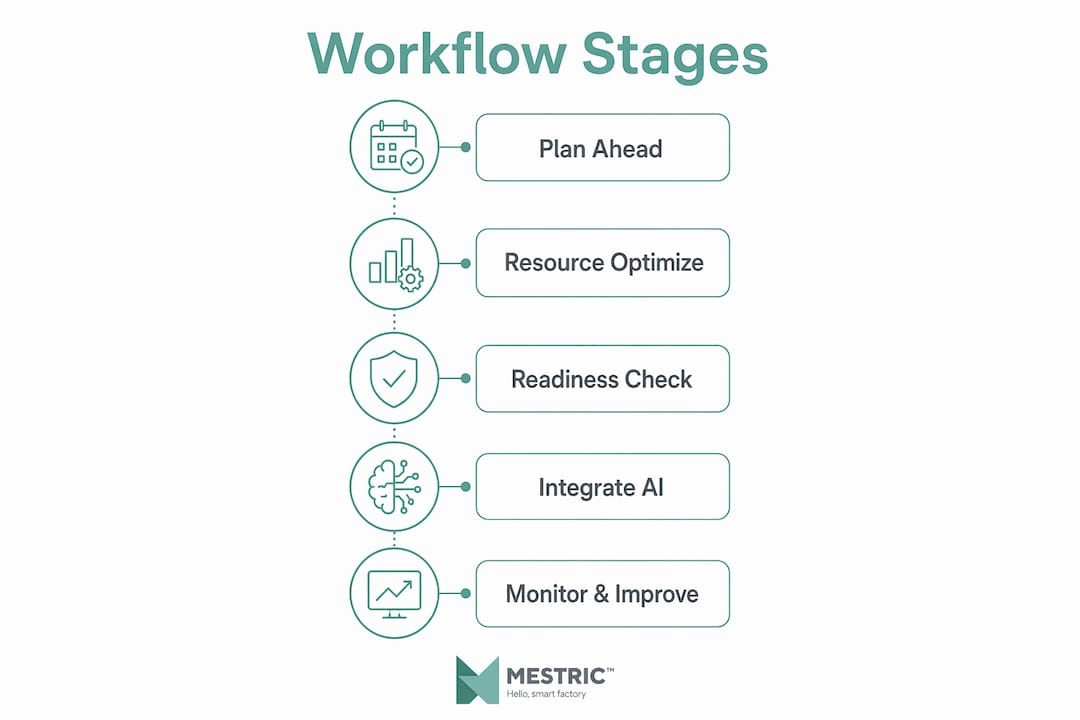
A well-executed resource workflow follows a defined sequence. Rushing the early stages is the most common reason plants fail to see lasting gains.

Structured outage workflows in industrial plants should begin 6–12 months before major production events. This lead time allows you to confirm contractor availability, order long-lead materials, and complete permit applications without last-minute scrambles. Contractor costs represent 40–60% of outage expenditure. Starting late turns that cost centre into an uncontrollable one.
A two-stage resource optimisation approach first defines a feasible resource pool, then refines the schedule within those constraints. The first stage eliminates options that exceed your capacity or budget. The second stage selects the most cost-effective schedule from the viable options. This method balances total resource costs against production makespan more effectively than single-pass scheduling.
Place a formal parts readiness gate 8 weeks before any major outage or production event. At this checkpoint, confirm that all materials are staged, permits are pre-approved, and contractor briefings are complete. Unproductive contractor time caused by permit delays and missing materials is the largest driver of cost overruns in plant operations. A readiness gate eliminates the most expensive surprises.
Automation belongs at the end of the implementation sequence, not the beginning. Integrating AI and automation in production workflows moves teams from 25% to 50% engagement on high-value work. That shift doubles the time available for activities that directly affect output quality and cost. Use AI-powered production tools to handle scheduling updates, exception alerts, and utilisation reporting automatically.
Numbered implementation sequence:
| Approach | Izid |
|---|---|
| Single-pass scheduling | Higher cost, frequent resource conflicts |
| Two-stage optimisation | Lower cost, enforced capacity limits |
| Manual permit management | Delays, unproductive contractor time |
| Pre-staged permits and materials | Reduced overruns, faster execution |
Strokovni nasvet: Do not automate a process you have not already stabilised. Apply the four-lever sequence first: eliminate unnecessary steps, synchronise handoffs, simplify the remaining steps, then automate what is left.
The most damaging mistake in plant efficiency optimisation is automating a broken process. Automating broken processes amplifies inefficiencies rather than removing them. The four-lever framework, which sequences elimination, synchronisation, simplification, and then automation, prevents this error. Apply it before you configure any software.
A second common failure is underestimating contractor coordination. Permit delays and unstaged materials account for the majority of unproductive contractor hours. Contractor costs at 40–60% of outage budgets make this a financial priority, not just an operational one. Pre-staging materials and obtaining permits before contractors arrive removes the two most frequent causes of idle time.
Common pitfalls and their fixes:
Lack of team buy-in negatively impacts efficiency gains as much as poor technical design. Change management is not a soft skill. It is a workflow requirement.
The 80/20 rule applies directly here. Focus your troubleshooting effort on the 20% of workflow steps that cause 80% of delays or waste. Fixing those few steps delivers the majority of your efficiency gain. Spreading effort evenly across all steps is a reliable way to see minimal results.
A step-by-step manufacturing workflow guide can help you structure team adoption and reduce resistance during rollout.
Continuous improvement in a sustainable resource workflow requires regular measurement, not occasional reviews. Real-time dashboards connected to your MES give you live visibility into utilisation rates, cycle times, and downtime events. That visibility turns reactive firefighting into proactive scheduling.
Capacity planning is a narrower concept within the broader resource management discipline. It aligns supply and demand continuously to reduce costs and delivery times. Build quarterly workflow reviews into your operating calendar. At each review, check whether your utilisation thresholds still reflect actual production demand and adjust targets accordingly.
Practices that sustain long-term workflow performance:
Strokovni nasvet: Set a utilisation ceiling, not just a floor. Sustained utilisation above 85–90% is a warning sign, not a success metric. It signals that your resource pool is too thin and that any disruption will cause a cascade.
The plants I have worked with that achieved lasting efficiency gains shared one characteristic: they treated their resource management process as a governance problem first and a technology problem second. The ones that bought software before defining rules consistently struggled with adoption and data quality.
The 80/20 principle is not just a productivity cliché. In plant operations, it is a diagnostic tool. When you map your workflow and find that three scheduling steps account for the majority of your delays, fixing those three steps is the entire project. Everything else is maintenance.
Change management is where most technical rollouts fail quietly. Operators who distrust a new system build workarounds within weeks. Those workarounds become invisible to your dashboards and your governance team. The result is a plant with two parallel workflows: the official one and the real one. Closing that gap requires consistent communication, visible leadership support, and a feedback loop that operators can actually use.
Technology adoption accelerates when the tool visibly reduces someone’s daily frustration. Mestric connects directly to production equipment and surfaces KPIs in real time. When an operator sees that the system caught a scheduling conflict before it caused downtime, trust builds fast. That trust is what makes continuous improvement self-sustaining rather than dependent on management pressure.
The governance framework is not a document you write once. It needs a named owner, a review schedule, and a clear process for updating rules when production conditions change. Plants that treat governance as a living system consistently outperform those that treat it as a completed project.
— Andraž
Mestric is a Manufacturing Execution System built for production environments where resource visibility and scheduling accuracy directly affect costs.
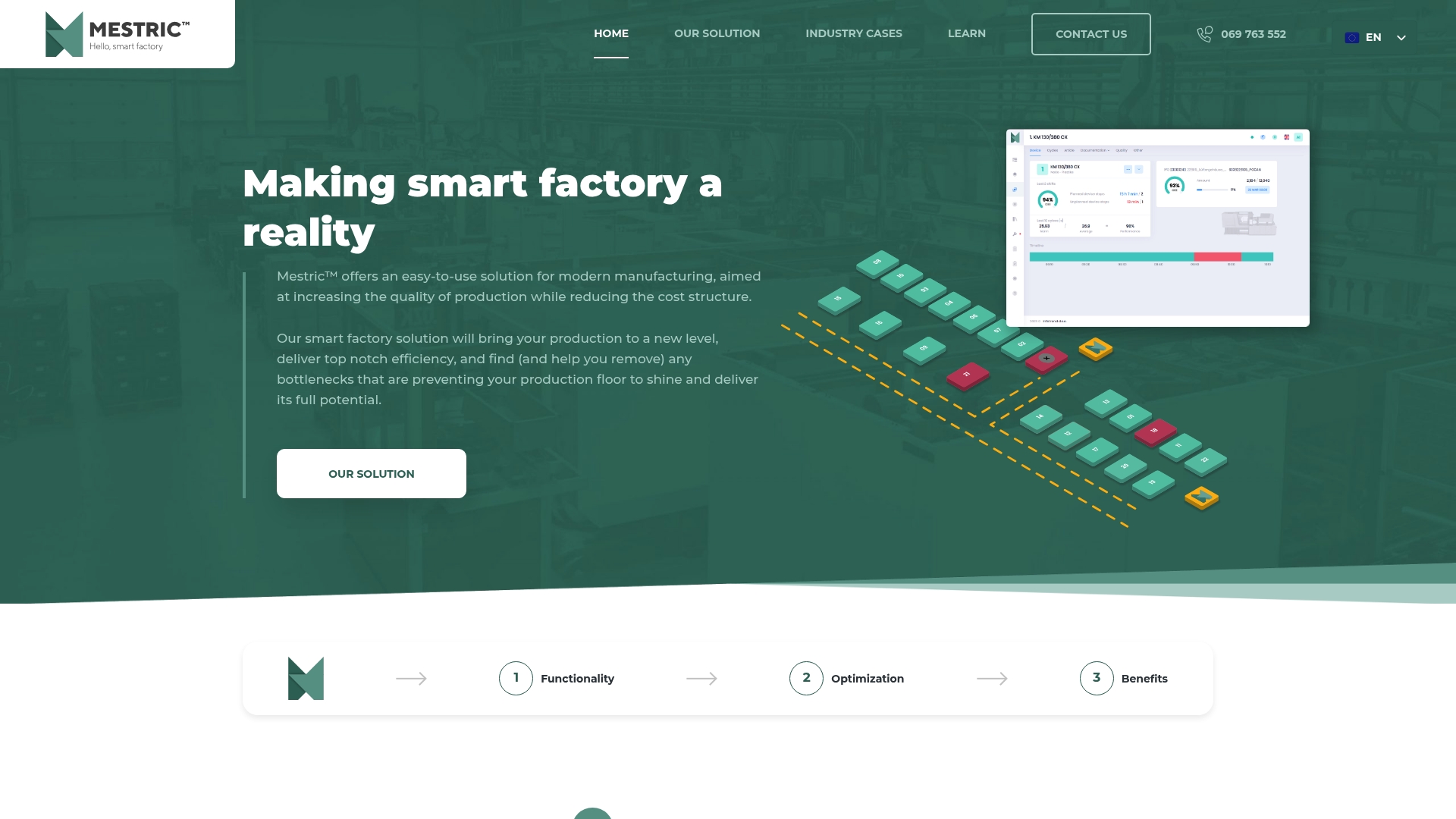
Mestric connects to your production equipment and delivers real-time performance tracking across all key resource KPIs, including utilisation rates, downtime events, and cycle times. Its AI-powered tools identify scheduling conflicts and capacity gaps before they become production problems. For plant operators moving from manual tracking to a structured digital workflow, Mestric provides the governance layer, the data layer, and the reporting layer in a single platform. You can see how MES compares to traditional manufacturing approaches and assess the operational gains available to your plant.
A plant resource utilization workflow is a structured process for allocating and managing equipment, labour, and materials in a manufacturing plant to maximise output and reduce costs. It combines process mapping, governance rules, scheduling tools, and performance metrics into a single operating system.
Structured workflows for major production events or outages should begin 6–12 months in advance, with a formal parts readiness gate set 8 weeks before the event to confirm materials, permits, and contractor readiness.
Track cycle time, utilisation rate, and first-time-right percentage as your core KPIs. Utilisation rate tracking identifies over- and under-loaded resources, which helps balance workloads and prevent both bottlenecks and burnout.
The most common cause is automating processes before stabilising them. A second cause is poor change management: when operators distrust the system, they build informal workarounds that make workflow data unreliable.
Capacity planning is a narrower activity focused on matching supply to demand at a point in time. Resource management is the broader discipline that continuously aligns people, equipment, and materials with production goals to reduce costs and delivery times.
A well-governed plant resource utilization workflow, built on accurate process maps, clear utilisation targets, and staged automation, consistently delivers cost reductions of 10–30% and cycle time improvements of 25–50%.
| Točka | Podrobnosti |
|---|---|
| Map processes before digitising | Include informal workarounds to reveal real workflow failures, not just the official process. |
| Start planning 6–12 months early | Early planning prevents contractor cost overruns, which represent 40–60% of outage budgets. |
| Use two-stage optimisation | Define a feasible resource pool first, then refine the schedule to control costs and capacity. |
| Govern before you automate | Approval rules and utilisation targets must be in place before software deployment. |
| Review quarterly and adjust | Set specific KPI thresholds that trigger workflow changes to keep performance gains from eroding. |


 069 763 552