


TL;DR:
- Factory automation is a cohesive system of sensors, controllers, software, and networks that enables real-time, minimal-touch manufacturing. Its success depends on integrating hardware with effective data management, workforce involvement, and strong operational leadership. Proper implementation leads to measurable gains in productivity, quality, and flexibility.
Most plant managers know factory automation involves machines doing work that people once did. But that framing misses most of what matters. What is factory automation, really? It is a coordinated system of sensors, controllers, software, and communication networks that monitors and directs manufacturing processes in real time, with minimal human intervention. Robots are one visible part of that picture. The rest, including programmable logic controllers, data pipelines, and quality feedback loops, is what actually determines whether automation delivers results or creates expensive complexity.
| Točka | Podrobnosti |
|---|---|
| Integrated systems | Factory automation combines sensors, controls, and software to coordinate manufacturing processes in real time. |
| Incremental deployment | Effective automation starts with targeted line-level projects then scales to enterprise-wide integration. |
| Tangible benefits | Automation measurably increases productivity, quality and can reduce skilled labour dependency. |
| Technology variety | Successful automation uses a blend of PLCs, robotics, vision systems, sensors, and data analytics tools. |
| Leadership matters | Strong leadership and workforce alignment are critical to unlocking automation’s full potential. |
Factory automation meaning becomes clear once you understand its building blocks. The technology does not operate as isolated machines. It works as an interconnected system where each component plays a specific role.
The four core elements are:
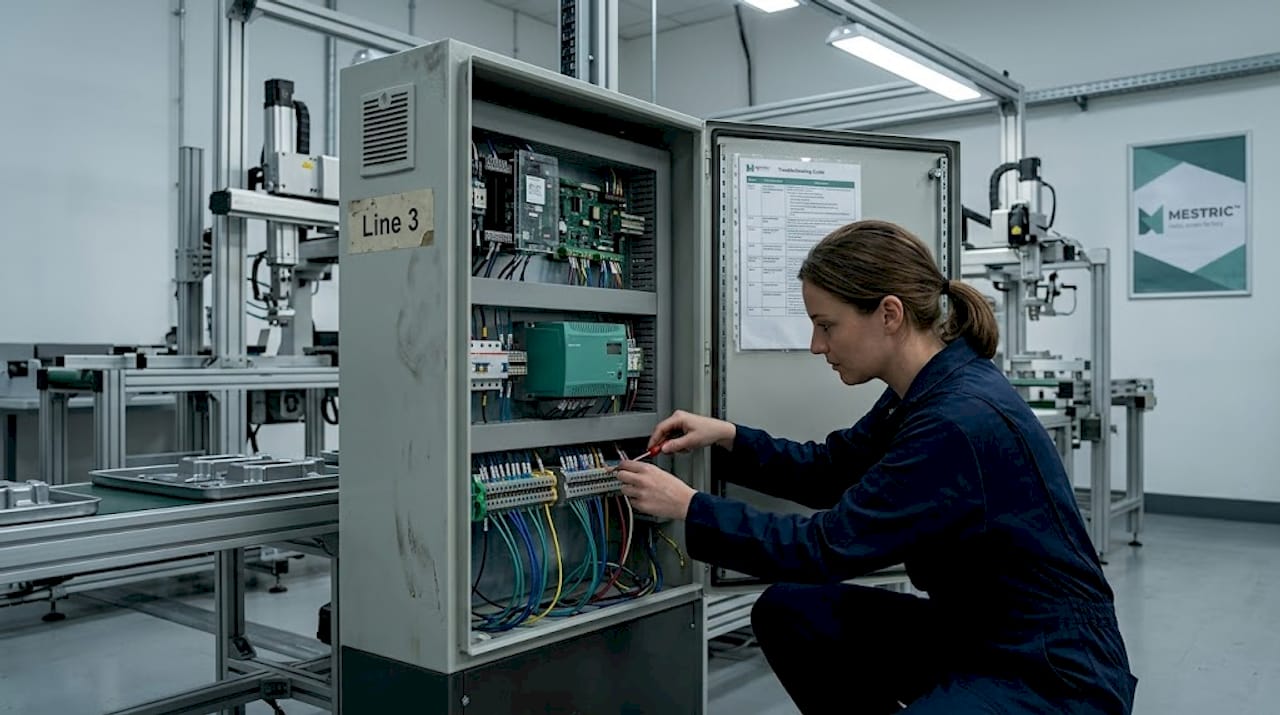
Automation relies on sensors, actuators, and controllers forming real-time feedback loops that control physical processes. When a sensor detects a temperature reading outside the acceptable range, the PLC responds within milliseconds. No human reaction time involved.
What connects all of this is the communication network. Industrial protocols such as Profibus, EtherNet/IP, and OPC-UA allow every device on the factory floor to share data with central systems. This connectivity is what transforms individual automated stations into a factory automation system capable of coordinated, plant-wide control.
For a broader view of how these elements fit into plant-level operations, plant automation essentials covers the operational context in detail.
Understanding the components is one thing. Knowing how to roll automation out across a live manufacturing plant is another challenge entirely.
Factory automation is usually incremental, starting with targeted lines or stations, then expanding to MES and ERP synchronisation as confidence grows. This is not a limitation. It is the right approach. Beginning with a single process, a packaging line or a quality inspection station, lets your team learn what works before committing capital at scale.
A realistic implementation sequence looks like this:
Strokovni nasvet: Do not underestimate the importance of data in automation. Plants that invest in data infrastructure early find every subsequent automation project easier and cheaper to execute.
Skipping the data and cyber-security foundations in pursuit of faster hardware deployment is one of the most common and costly mistakes in factory automation projects.
Once automation is implemented well, the operational gains are concrete and measurable. This is not theoretical.
Smart manufacturing automation leads to measurable improvements in output, productivity, and unlocked capacity, according to Deloitte’s 2025 Smart Manufacturing Survey.
The benefits of factory automation that matter most to plant managers include:
The visibility point deserves emphasis. Automated plants that capture and act on production data gain an advantage that compounds over time. Benefits of real-time monitoring include faster fault detection, reduced unplanned downtime, and better-informed decisions at every level of the operation.
Not all automation technology serves the same purpose. Choosing the wrong tool for a given process is expensive. Here is a practical comparison of the most common factory automation technologies.
| Technology | Primary use | Key advantage | Limitation |
|---|---|---|---|
| PLC | Process and machine control | Reliable, real-time logic execution | Limited data analytics capability on its own |
| SCADA | Plant-wide monitoring and supervisory control | Centralises data from multiple PLCs | Historically high cost and complexity |
| Industrial robots | Assembly, welding, pick-and-place | High speed and repeatability | High upfront cost, complex programming |
| Collaborative robots (cobots) | Flexible assembly alongside workers | Easy to reprogram, safer to deploy | Lower payload and speed than traditional robots |
| Machine vision systems | Quality inspection, dimensional measurement | Consistent defect detection at line speed | Sensitive to lighting and surface variation |
| IoT sensors and edge devices | Real-time data capture and condition monitoring | Low cost, widely deployable | Requires integration and data management layer |
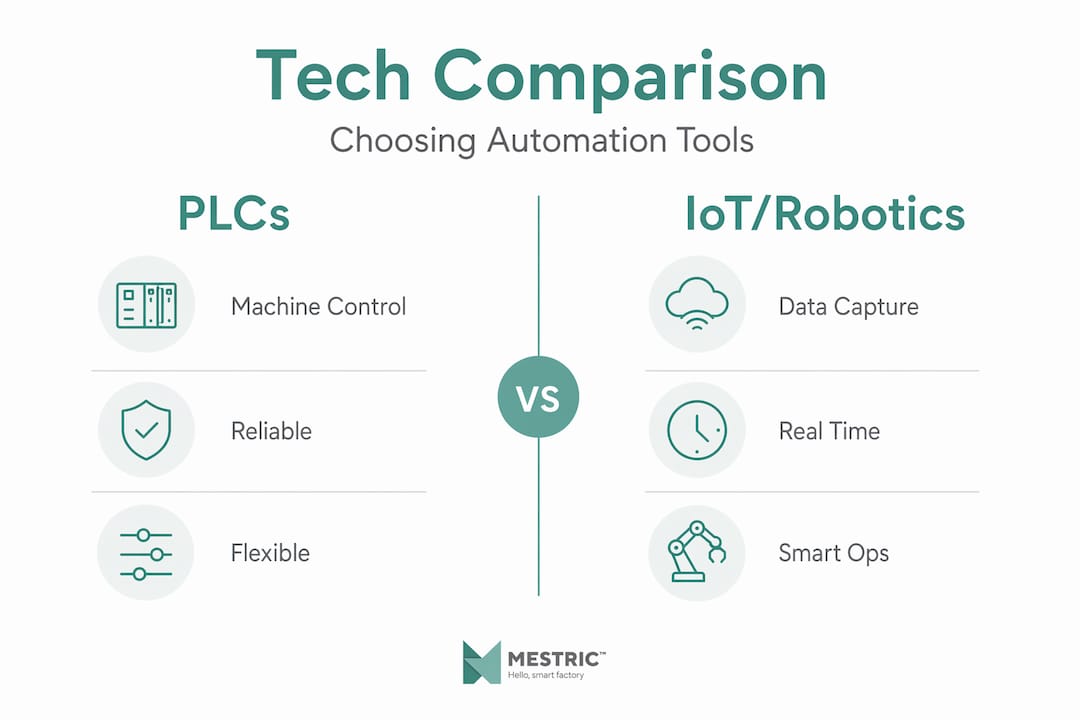
Investments in automation hardware, sensors, vision systems, and data analytics are current priorities across smart manufacturing programmes globally.
When selecting factory automation solutions, consider:
Understanding IoT in manufacturing is particularly useful when planning sensor networks and real-time data capture at scale.
Good technology deployed poorly still delivers poor results. These are the practices that separate successful automation programmes from expensive disappointments.
Manufacturers must align operations and technology leadership, focus on workforce upskilling, and build governance frameworks to successfully transform their operations.
Strokovni nasvet: Review current manufacturing trends for 2026 to understand which automation investments are generating the strongest returns across your industry sector right now.
Automation leadership at the plant level requires a clear vision, organisational commitment, and the willingness to learn from early deployments rather than treating them as one-time projects.
Here is an observation worth sitting with: the plants that struggle most with automation are rarely the ones that chose the wrong technology. They are the ones that treated automation as a technology project rather than an operational transformation.
We see this pattern consistently. A plant invests in capable automation hardware, the equipment performs as specified, and yet the expected gains do not materialise. Cycle times improve slightly. Quality metrics remain unchanged. Downtime is now tracked but not actually reduced. Six months in, leadership questions the investment.
The cause is almost always the same. The technology was deployed without changing how decisions are made, how teams collaborate, or how frontline workers interact with new systems.
Real transformation in smart manufacturing happens when operations and technology teams work together with strong leadership and a culture of genuine improvement. That statement sounds straightforward. Acting on it is harder than selecting a PLC or specifying a robot arm.
The uncomfortable truth is that most automation failures are change management failures wearing a technology mask. The data was always available. The process was always visible. The problem was that nobody changed what they did with the information.
Incremental automation works not just because it reduces financial risk. It works because it gives your organisation time to build the habits, skills, and decision-making processes that make each new automation investment more effective than the last. Technology sets the ceiling. People and processes determine how close you get to it. Explore automation leadership insights to understand what strong operational leadership looks like in practice.
If you are ready to connect your automation investments to measurable operational outcomes, Mestric gives you the platform to do it. Our Manufacturing Execution System integrates directly with automated equipment to give you real-time visibility across performance, quality, and costs, all in one place.
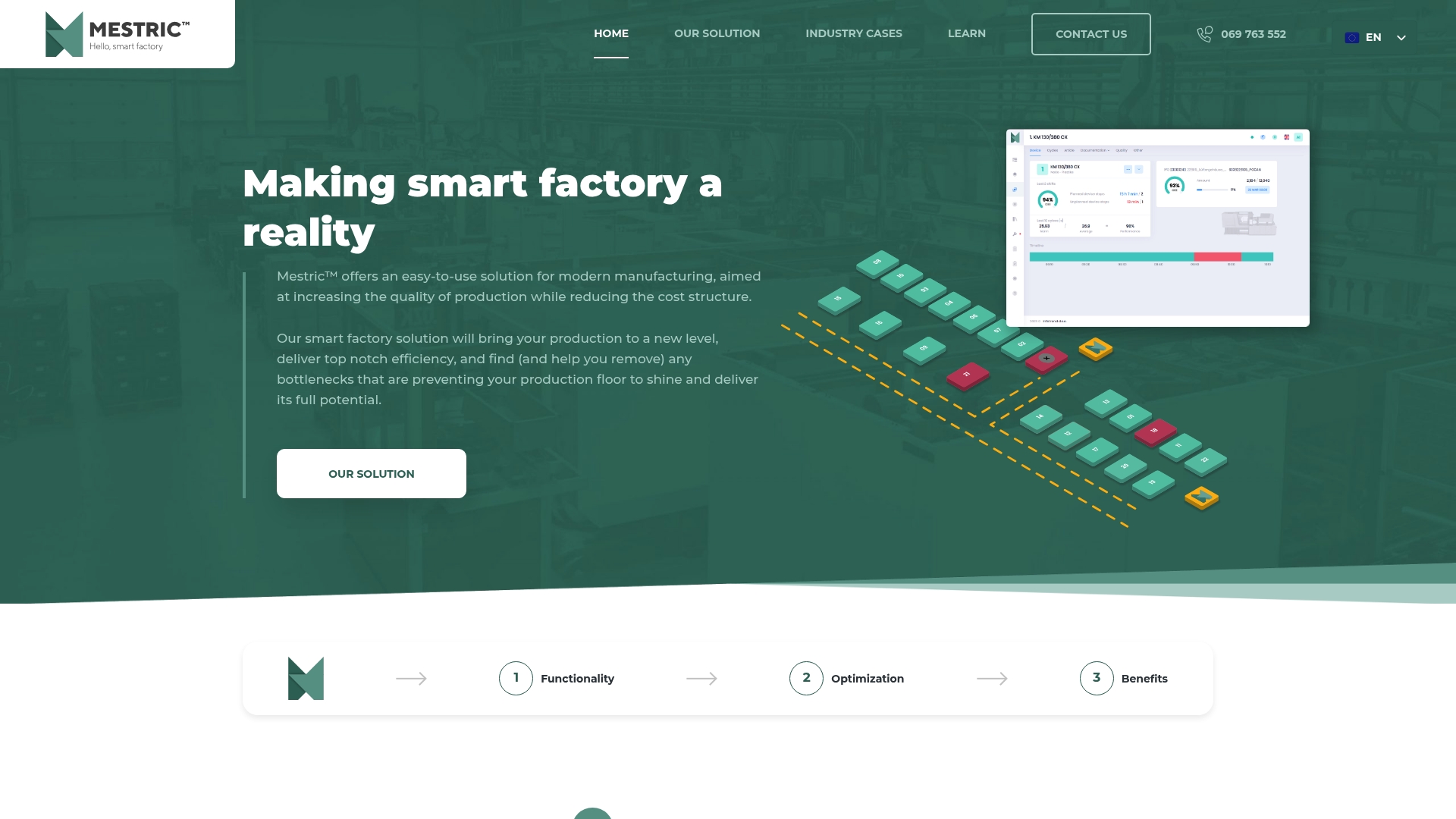
Whether you are evaluating MES versus traditional manufacturing approaches, exploring the full range of manufacturing software types available to you, or looking to strengthen your plant with real-time production monitoring, Mestric provides the tools and the data to support every stage of your factory automation journey. Book an onsite demonstration and see how connected equipment transforms decision-making on the factory floor.
Factory automation means using technology like sensors, controls, and robotics to run manufacturing processes with minimal human intervention for better consistency and efficiency. It is a coordinated system combining hardware, software, and communication networks that controls physical production processes in real time.
It improves productivity, reduces labour costs, ensures consistent quality, and allows for flexible and scalable manufacturing operations. Smart manufacturing automation delivers measurable improvements in output, productivity, and unlocked capacity.
Start incrementally by automating specific processes or lines, establish strong data and cyber-security foundations, and involve cross-functional teams for smooth adoption. Many deployments start with targeted stations before expanding to full MES and ERP synchronisation.
Key technologies include programmable logic controllers, sensors, actuators, robotics, human-machine interfaces, and communications networks for integrated control. Core components form real-time feedback loops that direct and monitor physical manufacturing processes.
People lead successful automation by aligning operations and technology, upskilling the workforce, and fostering a culture of continuous improvement. Transformation happens when operations and technology converge with strong leadership and genuine workforce engagement.


 069 763 552