


TL;DR:
- Choosing the right automation investments in manufacturing depends on assessing each trend’s measurable results, infrastructure needs, and operational fit. AI-driven scheduling and predictive maintenance offer rapid returns in plant efficiency, but successful scaling requires connected, high-quality data flows. Building a strong data infrastructure first is essential for realizing the full potential of plant automation in 2026 and beyond.
Choosing the right automation investments has never been more complex. The pace of change across production environments means that yesterday’s pilot project is today’s minimum viable standard. For manufacturing professionals weighing up examples of plant automation trends, the challenge is not a lack of options. It is knowing which trends deliver measurable results, which require significant infrastructure work, and which are still more promise than performance. This article gives you a clear, evidence-based view of what is actually working on the plant floor in 2026, with concrete industrial automation examples and guidance on where to focus.
| Point | Details |
|---|---|
| Integration is the primary barrier | 78% of manufacturers lack automated data flow between ERP, MES, and QMS systems, limiting AI scale. |
| AI scheduling delivers fast ROI | Automated production scheduling cuts downtime by at least 26% and pays back investment quickly. |
| Robotics are gaining spatial intelligence | Next-generation robots can now read gauges and execute complex physical tasks with visual reasoning. |
| Cross-industry trends offer real lessons | Precision agriculture automation shows how distributed, data-driven systems reduce costs by up to 30%. |
| Match trends to plant readiness | Adoption success depends on integration maturity, skill levels, and clear operational objectives. |
Before committing budget to any automation trend, you need a consistent framework for assessing fit. Not every trend that works for a high-volume automotive plant will translate to a mid-size food processing facility. Evaluation should cover five areas.
Strokovni nasvet: Before shortlisting any automation trend, map your current data flows between systems. If you cannot move production data from your shop floor to your ERP without manual intervention, address that first. Automation built on fragmented data rarely performs as advertised.
Automated production scheduling is consistently ranked by manufacturers as one of the highest ROI automation investments available today. The results are not marginal. 49% of manufacturers that automated scheduling cut downtime by at least 26%.
The mechanism is straightforward. AI scheduling engines ingest real-time data on machine availability, material supply, order priority, and workforce capacity. They then generate and continuously adjust production sequences in ways that human planners physically cannot match at the same speed. When a machine goes down or a material delivery is delayed, the schedule recalculates automatically rather than waiting for a planner to intervene.
For a deeper look at how to apply this in practice, Mestric has published detailed guidance on optimising production workflows with AI that walks through the practical steps.
Predictive maintenance is not a new concept, but the accuracy and lead time of current systems represent a step change from where the technology was three years ago. Predictive maintenance systems now identify equipment failures up to two weeks in advance with 92% accuracy, reducing unplanned downtime by 25%.

The most cited industrial automation example in this category is GE’s facility in Munich, where deploying predictive maintenance saved millions in repair costs and lost production. The system uses sensor data from equipment to detect anomalies in vibration, temperature, and electrical draw patterns before they develop into failures.
The practical takeaway for your plant: predictive maintenance delivers the most value on high-utilisation assets where unplanned downtime carries a disproportionate cost. Start with your three most critical bottleneck machines.
As of 2025, 24% of manufacturers have deployed generative AI at plant or network level. Operational AI co-pilots give production managers and engineers a conversational interface to query production data, surface anomalies, and receive recommendations without writing queries or navigating multiple dashboards.
The shift toward an autonomous enterprise model means specialised AI agents are beginning to execute end-to-end processes, compressing complex workflows that previously required days of manual co-ordination. For manufacturing, this translates into faster response to quality deviations, supply disruptions, and capacity constraints.
The honest caveat: generative AI performs well when your underlying data is clean, structured, and integrated. Plants with fragmented systems will see limited returns until their data infrastructure is addressed.
Deep learning quality inspection systems now detect defects with over 99% accuracy, outperforming human inspectors on repetitive visual tasks. Siemens implemented a computer vision system that reduced warranty claims by 40%, which is a result that directly affects both margin and customer satisfaction.
These systems work by training neural networks on thousands of images of conforming and non-conforming parts. Once deployed, cameras mounted at inspection stations assess every unit at line speed without fatigue-related variability. The output feeds directly into quality management data streams.
The cost of vision systems has fallen significantly, making them accessible to mid-scale plants that would have found them prohibitively expensive five years ago.
The most significant development in robotics during 2026 is the arrival of models with genuine spatial and visual reasoning. Gemini Robotics-ER 1.6 introduces enhanced spatial reasoning that enables robots to read complex instruments, including circular pressure gauges and sight glasses, accurately in real operating conditions.
This matters because traditional industrial robots are programmed to execute fixed, repeatable tasks in controlled environments. Embodied reasoning models blend visual reasoning and code execution to respond to real-time variation in their physical surroundings. The result is a robot that can operate in less structured environments and handle tasks that previously required human judgement.
The near-term plant automation applications include unstructured assembly assistance, autonomous inspection rounds, and handling of variable-geometry parts that defeat conventional pick-and-place systems.
Heavy single-unit robots have practical limitations: they compact soil in agriculture, create bottlenecks when a single unit fails, and struggle to scale incrementally. Swarm robotics address this with distributed fleets of smaller autonomous units. In agricultural settings, swarm systems reduce soil compaction by 60 to 80% and enable operations in conditions that ground heavy equipment cannot handle.
The manufacturing equivalent is fleets of autonomous mobile robots (AMRs) co-ordinating material movement across the plant floor. The fleet management system allocates tasks dynamically, reroutes units around obstacles, and maintains throughput even when individual units go offline for charging or maintenance. This built-in redundancy is a meaningful advantage over single-robot deployments.
Strokovni nasvet: When evaluating AMR fleet deployments, calculate your floor utilisation rate across all shifts first. Fleets add the most value in plants with high intra-facility material movement and multi-shift operation. Low-movement facilities rarely see the ROI they expect.
Cross-industry automation borrowing is an underused source of plant automation innovations. Precision agriculture technology offers some of the most data-rich examples of what targeted, sensor-driven automation achieves at scale. Over 25,000 precision weed management systems have been deployed across North America, delivering herbicide cost reductions of £12 to £28 per acre and total input savings of up to £65 per acre.
The underlying principle applies directly to manufacturing: apply the exact resource required, at the exact location needed, based on real-time sensor data rather than blanket schedules. In a plant context, this translates to targeted lubrication, precise material dosing, and condition-based consumable application rather than time-based maintenance cycles.
| Automation application | Input reduction | Operational benefit |
|---|---|---|
| Precision herbicide systems | Up to 90% chemical reduction | Lower input cost per unit area |
| Autonomous tractor fleets | 30% operational cost reduction | 10-hour shifts on single charge |
| Sensor-driven spray systems | 18% improvement in coverage | Reduced waste and rework |
Autonomous tractors operating 10-hour shifts on a single charge demonstrate a 30% reduction in operational costs compared to manual equivalents. The lesson for industrial plant automation is the value of continuous, unattended operation during off-peak hours.
In manufacturing, autonomous guided vehicles (AGVs) and overhead drones are being used for inventory counting, raw material movement, and finished goods staging. The data these vehicles collect during normal operation also feeds into layout optimisation models, identifying where physical plant configuration is creating unnecessary travel distances.
For plants exploring connected machinery benefits, vehicle telemetry is increasingly being integrated with MES platforms to give production managers a real-time picture of material flow alongside machine output.
Not every trend suits every plant. The table below provides a comparison of the key trends covered in this article across four practical dimensions.
| Trend | Integration complexity | Time to ROI | Best suited for |
|---|---|---|---|
| AI production scheduling | Medium | 3 to 9 months | Plants with variable demand |
| Predictive maintenance | Medium | 6 to 12 months | High-utilisation assets |
| Computer vision inspection | Low to medium | 6 to 18 months | High-volume, repetitive lines |
| Embodied reasoning robotics | High | 18 to 36 months | Unstructured assembly tasks |
| AMR fleet automation | Medium | 9 to 18 months | Multi-shift material movement |
For plants at an early stage of digital maturity, AI scheduling and predictive maintenance offer the fastest returns with manageable integration requirements. For plants with established MES and ERP connectivity, computer vision and AMR deployments unlock the next layer of efficiency.
The impact of AI on automation compounds over time. Plants that build strong data infrastructure now will find later deployments significantly faster and cheaper to implement.
I have worked closely with enough manufacturers to know that the gap between a compelling trend and a working deployment is where most of the difficulty lives. The benchmarks are real. The case studies are genuine. But context rarely travels with the headline figure.
In my experience, the single biggest predictor of automation success is not which technology you choose. It is whether your data flows are connected before you start. I have seen predictive maintenance pilots fail not because the algorithm was wrong, but because sensor data was sitting in a silo that the maintenance team could not access in time to act on the alert.
The other pattern I observe consistently: small pilots without orchestration tools rarely scale. You run a three-machine predictive maintenance pilot, it works, and then the moment you try to roll it out across 40 machines, the integration complexity multiplies and the project stalls. The pilots that do scale are the ones where someone built a connected data layer first, then added automation on top.
My honest advice: treat integration as the automation project, not the prerequisite you will sort out later. The trends in this article are real and the ROI figures are achievable. But they are achievable for plants that have done the infrastructure work, not just the technology selection.
— Andraž
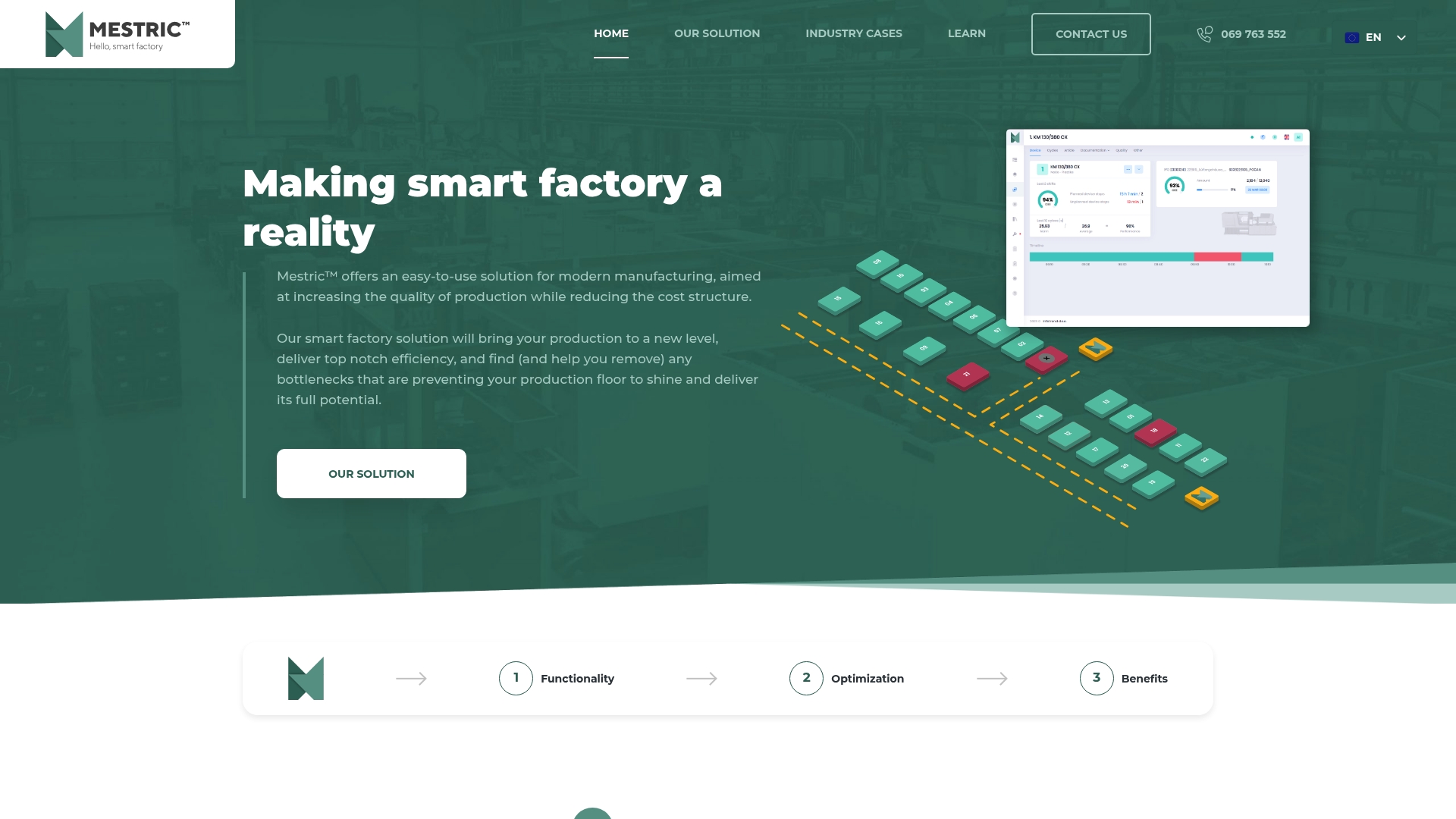
Identifying the right automation trends is only part of the work. Implementing them at scale requires a platform that connects your machinery, tracks production performance in real time, and gives you the data quality needed to make AI tools actually deliver. Mestric’s MES platform does exactly that. It links directly to your production equipment, monitors KPIs including downtime, quality parameters, and cost per unit, and surfaces AI-powered recommendations your team can act on immediately.
If you are weighing up where to start, the comparison between MES and traditional manufacturing approaches is a practical place to begin. You can also explore manufacturing efficiency workflows that show how connected plants achieve 15% cost reductions through better production visibility.
Book an onsite Mestric demonstration to see how the platform performs in a live production environment.
AI-driven production scheduling and predictive maintenance consistently deliver the highest ROI, with scheduling reducing downtime by at least 26% and predictive systems identifying failures up to two weeks in advance with 92% accuracy.
AI improves scheduling accuracy, maintenance prediction, and quality inspection. However, 78% of manufacturers lack the connected data infrastructure needed to scale AI recommendations effectively across ERP, MES, and QMS systems.
Embodied reasoning refers to a robot’s ability to interpret its physical environment using visual and spatial data. Systems like Gemini Robotics-ER 1.6 can read complex instruments and respond to unstructured tasks in real operating conditions.
AI production scheduling and computer vision quality inspection offer the lowest integration complexity and fastest payback, making them the most practical entry points for plants that are earlier in their digital transformation.
Audit your current data flows first. If critical production data requires manual transfer between systems, address integration before investing in AI or robotics deployments. Connected data infrastructure is what determines whether automation scales or stalls.


 069 763 552