

Legacy KPI benchmarks have quietly misled manufacturers for decades. The classic 85% OEE (Overall Equipment Effectiveness) target, for instance, stems from 1970s automotive data and was never designed to apply universally across every sector or production environment. Yet many plants still chase it. If your digital transformation feels stalled, or your data tells a story that does not match reality on the shop floor, the problem may not be your processes. It may be the metrics you are using to measure them. This guide explains what distinguishes a genuinely useful manufacturing KPI, how to avoid common tracking pitfalls, and how to build a measurement framework that actually drives improvement.
| Point | Details |
|---|---|
| Outdated KPIs can mislead | Using legacy metrics like classic OEE may confuse rather than improve your plant’s performance. |
| Tailor KPIs to your operations | Effective KPIs should align with your unique industry, processes, and improvement goals. |
| Track fewer, better KPIs | A small set of well-chosen KPIs delivers greater impact than tracking dozens superficially. |
| Review metrics regularly | Revisit and adjust KPIs as operations, technology, or market demands change. |
Tracking the wrong KPIs is not simply a data problem. It is a strategic one. When your measurement framework does not reflect your actual production environment, every decision built on that data is compromised from the start.
OEE is the most widely cited example. It is a powerful metric in the right context, but it is routinely misapplied. Pharma manufacturers, for instance, average just 35 to 40% OEE, not the so-called world-class 85%. Holding a pharmaceutical plant to an automotive benchmark does not reveal underperformance. It creates a false picture that can lead to misguided investment and wasted effort.
Measuring the wrong thing with precision is still measuring the wrong thing. Accuracy in data collection means nothing if the metric itself does not reflect your operational reality.
The consequences of poor KPI selection include:
This last point matters most during digital transformation. When legacy metrics are baked into reporting systems, they can actively block adoption of modern platforms. Teams become sceptical of new tools if those tools produce results that conflict with familiar, if outdated, targets.
Effective monitoring for operational excellence starts with asking whether your current KPIs actually reflect your production goals. Understanding the full range of manufacturing metrics types available to you is a practical first step toward building a more relevant framework.
Pro Tip: Before adding new KPIs to your dashboard, audit your existing ones. Remove any metric that cannot be directly linked to a business outcome or operational decision.
Not every measurable thing is worth measuring. A good KPI earns its place by being specific, actionable, timely, and directly relevant to your strategic objectives.
High-mix, low-volume sectors require entirely different KPI frameworks than high-volume, repetitive production lines. A job shop producing bespoke components cannot sensibly benchmark itself against a mass-production automotive plant. The metrics must fit the process.
Here is what separates a useful KPI from a misleading one:
The table below illustrates the difference between poorly chosen and well-designed KPIs:
| Poor KPI example | Why it falls short | Effective alternative |
|---|---|---|
| Overall OEE vs 85% target | Benchmark is sector-inappropriate | OEE benchmarked against your own historical baseline |
| Total units produced | Ignores quality and waste | First-pass yield rate |
| Machine uptime percentage | Does not account for planned downtime | Unplanned downtime per shift |
| Headcount per shift | Measures input, not output | Labour efficiency ratio |
Exploring the full range of types of manufacturing metrics helps you identify which categories apply to your environment. From there, your production optimisation steps become far more targeted and effective.
The goal is not to collect more data. It is to collect the right data and act on it with confidence.
When your KPIs are well chosen, the benefits are tangible and cumulative. Good measurement creates a feedback loop: you see what is happening, understand why, and act with precision.
Correct KPIs enable process improvement and give you a reliable way to monitor progress over time. Here is how that plays out in practice:
Statistic callout: Pharma manufacturers average 35 to 40% OEE. Automotive world-class targets sit at 85%. The gap is not a performance failure. It reflects entirely different process realities. Applying the wrong benchmark to either sector produces misleading conclusions.
Improving real-time manufacturing efficiency depends on having KPIs that reflect your actual production conditions. Without that foundation, even the most sophisticated analytics tools will surface the wrong priorities.

Pro Tip: Review your KPI set at least quarterly. As your product mix, customer demands, or production technology changes, your metrics should change with them. A KPI that was relevant twelve months ago may now be measuring something that no longer matters.
Using a structured productivity checklist alongside your KPI review helps ensure nothing important is overlooked during each assessment cycle.
Even experienced operations teams fall into predictable traps when building or maintaining their KPI frameworks. Recognising these patterns early saves significant time and resource.
The most frequent mistakes include:
Holding on to legacy OEE targets can obscure true bottlenecks in modern production lines. The metric itself is not the problem. The problem is applying it without adjusting for your specific context.
The table below outlines common mistakes and the recommended alternatives:
| Common mistake | Impact | Recommended alternative |
|---|---|---|
| Benchmarking against industry averages | Masks real performance gaps | Use internal historical baselines |
| Tracking output volume only | Ignores quality and rework costs | Track yield and defect rate alongside volume |
| Annual KPI reviews | Metrics become outdated quickly | Quarterly reviews with process change triggers |
| KPIs set by management only | Low frontline buy-in and accuracy | Co-design KPIs with operators and supervisors |
Pro Tip: Involve frontline staff in KPI design from the outset. Operators often have the clearest view of which measures reflect real performance and which do not. Their input improves both accuracy and buy-in.
A structured manufacturing optimisation checklist can help you audit your current KPI set systematically. Pairing this with monitoring for operational excellence principles ensures your framework stays aligned with your goals. For plants implementing new digital tools, reviewing how an efficiency workflow with MES integrates with your KPI strategy is a practical next step.
Here is a perspective that often gets lost in the push for data-driven manufacturing: more metrics do not mean better decisions. In fact, the opposite is frequently true.
When teams are presented with twenty KPIs, attention fragments. Nobody owns the numbers. Improvement efforts scatter across too many fronts and produce modest results everywhere rather than meaningful gains anywhere.
The manufacturers we see making the most consistent progress are not the ones with the most sophisticated dashboards. They are the ones who have been disciplined enough to ask: which three or four metrics, if improved, would have the greatest impact on our goals right now?
This is not about ignoring complexity. It is about recognising that focus is a competitive advantage. Resisting KPI bloat, especially during digital transformation when new data sources are suddenly available, is harder than it sounds. But it is worth it.
Mastering key metrics means understanding which ones genuinely move the needle for your operation, then building your measurement and reporting around those. A leaner, sharper KPI set produces clearer accountability, faster response times, and more motivated teams.
Understanding which KPIs to track is only the first step. Putting that knowledge into practice requires the right tools and a clear process for acting on what the data tells you.
Mestric™ is built to support exactly this kind of focused, effective KPI tracking. Our platform connects directly with your manufacturing equipment, giving you real-time visibility into the metrics that matter most to your operation. Whether you are evaluating MES vs traditional manufacturing approaches, exploring the range of manufacturing software types available, or looking for practical guidance on streamlining operations, our resources and platform are designed to make the next step straightforward. Get in touch to arrange an onsite demonstration and see how connected machinery transforms KPI tracking in your environment.
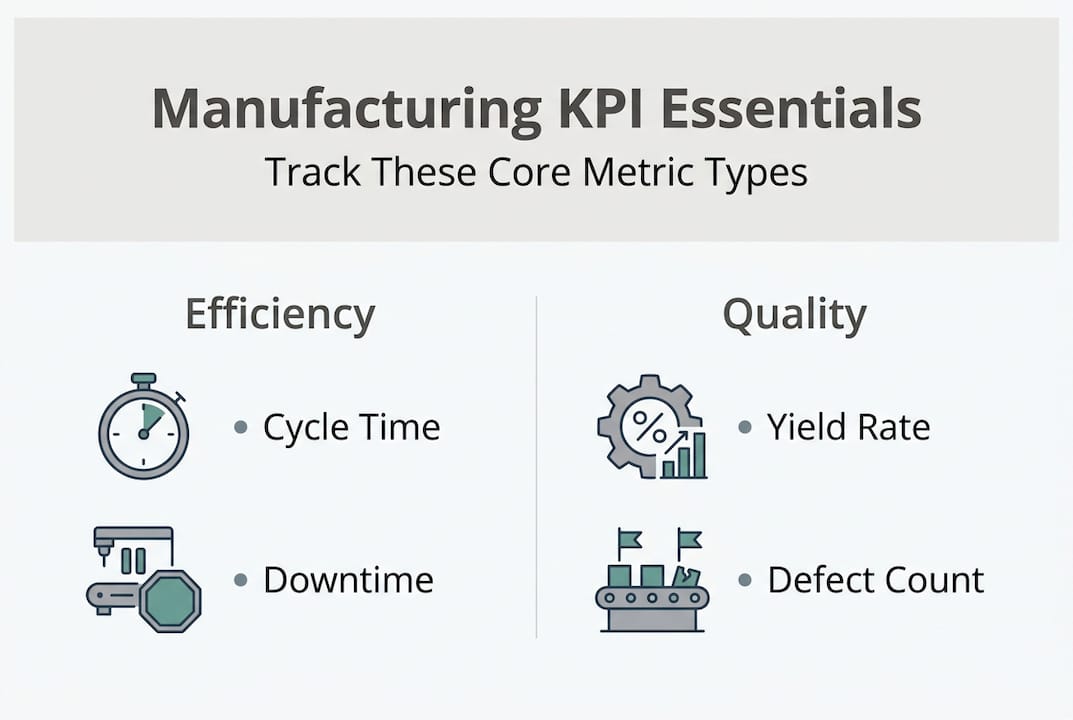
The most important KPIs are those aligned with your specific business goals and process characteristics, such as OEE, first-pass yield, cycle time, and quality rate. Benchmarks must be industry-specific to be genuinely useful rather than misleading.
Manufacturing KPIs should be reviewed at least quarterly, or more frequently when significant process changes occur. Regular reviews ensure your metrics stay relevant as your production environment evolves.
OEE can be misleading in low-volume or highly variable production environments where other KPIs better reflect operational success. High-mix, low-volume sectors need different KPI frameworks than high-volume industries.
Relying on outdated benchmarks can mask real opportunities for improvement and slow your digital transformation. Legacy metrics hinder digital transformation by creating resistance to new tools and obscuring the true state of your operations.


 069 763 552