


Kurzfassung:
- Adaptive manufacturing continuously learns and self-corrects by using real-time data, AI, and automation, unlike flexible manufacturing that only handles product variations. It reacts instantly to equipment, supply, and environmental changes, enabling higher quality, efficiency, and supply chain resilience through a closed-loop system. Successful adoption requires reorganizing operational models, starting with edge sensing, and gradually integrating autonomous decision-making.
Many manufacturers confuse flexible manufacturing with adaptive manufacturing, and the distinction costs them. Flexible systems let you switch products or batch sizes. Adaptive manufacturing goes further: it uses real-time data, AI, and automation in a continuous feedback loop to detect deviations, make decisions, and correct processes without human intervention. This guide covers the adaptive manufacturing definition, the technologies behind it, the benefits you can expect, and the practical challenges of adoption. If you are a production manager or operations decision-maker weighing your next investment, this is exactly what you need to read.
| Punkt | Details |
|---|---|
| Adaptive vs flexible | Adaptive manufacturing responds to equipment, supply, and quality changes in real time, not just product switches. |
| Core technology stack | AI, edge computing, IoT sensors, and digital twins form the foundation of any adaptive system. |
| Measurable gains | Pilots report up to 96.8% schedule compliance and 16.5% reductions in energy use from adaptive platforms. |
| Phased implementation | Start with edge sensing and anomaly detection before advancing to closed-loop control and autonomous scheduling. |
| Operating model shift | Adaptive manufacturing is a new way of running production decisions, not simply a technology purchase. |
The adaptive manufacturing definition centres on one idea: the production system learns and self-corrects. Rather than following a fixed programme, it continuously monitors conditions across the shop floor, identifies deviations from optimal states, and adjusts parameters autonomously.
This is not the same as flexible manufacturing. A flexible system is designed to handle different product variants or batch sizes. It is reconfigurable. Adaptive manufacturing is responsive. It reacts to a worn cutting tool, an unexpected spike in ambient temperature, or a late supplier delivery, and it does so in real time without waiting for a human to notice and intervene.
The concept has roots in control engineering but has become practically viable through three converging forces: affordable IoT sensors, sufficient edge computing power, and AI models capable of interpreting noisy industrial data at speed. As MIT Technology Review describes, production is shifting from rigid high-volume, low-mix workflows toward high-mix configurations where customisation and smaller batches are the norm. Adaptive systems are what make that shift economically sustainable.
Understanding how adaptive manufacturing works requires looking at each layer of its architecture. These components do not operate in isolation. They form a closed loop, from sensing to decision to action and back again.
Pro-Tipp: When evaluating adaptive manufacturing technology, ask vendors specifically about latency in their closed-loop architecture. A system that takes minutes to act on a detected deviation is reacting, not adapting.
The terms are frequently used interchangeably. They should not be. Here is a direct comparison to clarify where each approach fits and where it falls short.
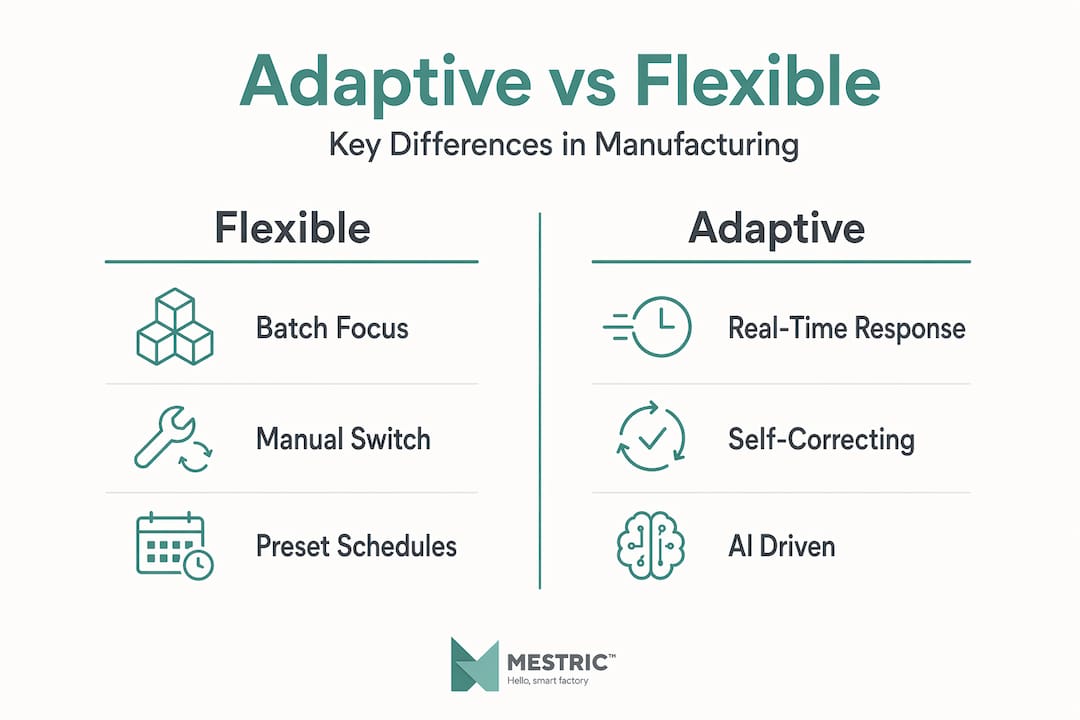
| Funktion | Flexible manufacturing | Adaptive manufacturing |
|---|---|---|
| Primary focus | Product switching, batch size variation | Real-time process correction across all variables |
| Response trigger | Pre-programmed changeover | Live data detecting any deviation |
| Decision-making | Human or rule-based | AI-driven, autonomous |
| Scope of responsiveness | Product type and volume | Equipment state, supply, environment, quality |
| Learning capability | Static once configured | Continuously improving |
| Implementation complexity | Mäßig | Higher, but modular by design |
Flexible manufacturing was the right answer to mass customisation in the 1990s and 2000s. It solved the problem of product variety. Adaptive manufacturing solves the problem of process uncertainty. A flexible line can run ten product variants. But if a spindle bearing degrades mid-shift on that line, a flexible system does not know. An adaptive one detects the vibration signature, adjusts cutting parameters, and flags the bearing for planned maintenance before it causes scrap or unplanned downtime.
For manufacturers moving toward high-mix production, this distinction matters enormously. Higher mix means more changeovers, more variables, and more opportunities for process drift. That is exactly where adaptive systems earn their cost.
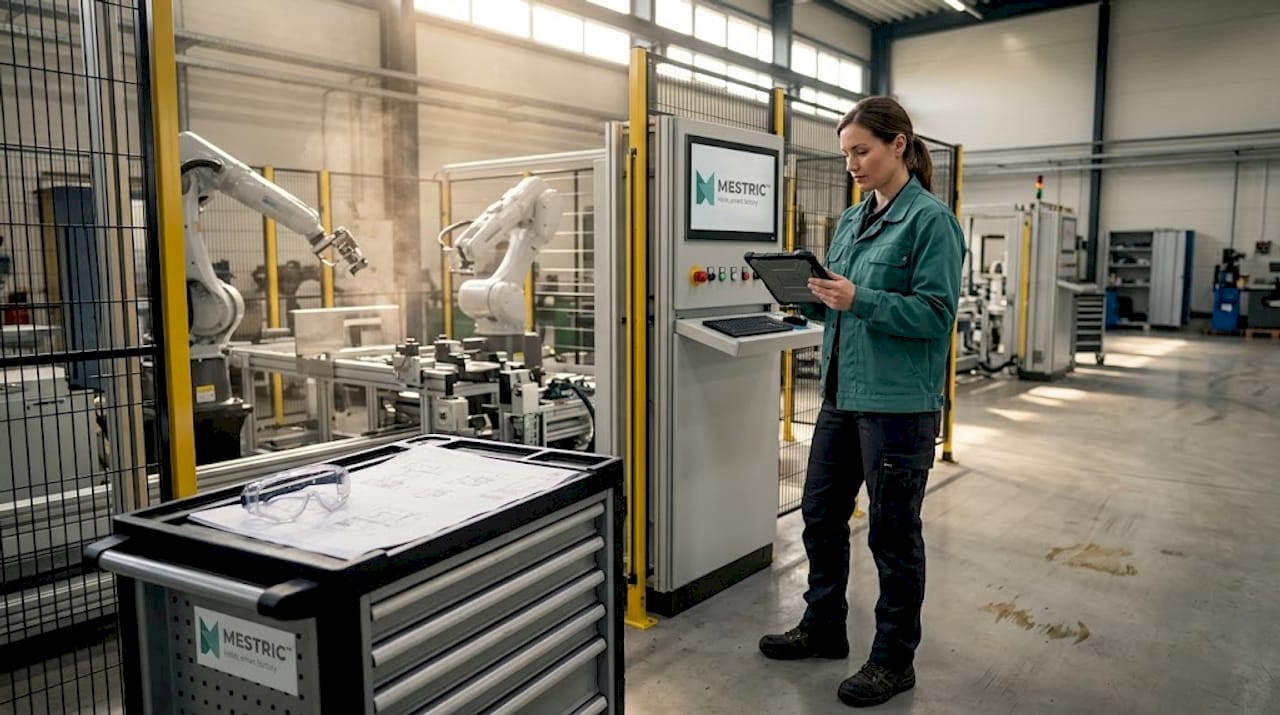
The business case for adaptive manufacturing is grounded in measurable outcomes, not theory. An AI-driven adaptive planning platform in a 12-week industrial pilot delivered 96.8% schedule compliance, a 16.5% reduction in specific energy consumption, and a 17.1% reduction in waste. Those are not incremental improvements.
Here are the primary categories of benefit:
Knowing why adaptive manufacturing matters is the straightforward part. Implementing it in a real facility with legacy equipment, mixed protocols, and existing software commitments is where most projects stall. Here is how to approach it sensibly.
Pro-Tipp: When piloting adaptive capabilities, pick a production line with a well-documented quality problem. The feedback loop will show results faster, which builds internal confidence and justifies the next phase of investment.
Industrial control hardware from suppliers such as automation components can be integrated into closed-loop feedback architectures, making brownfield upgrades more practical than many teams expect.
The next phase of adaptive manufacturing technology moves beyond single-facility optimisation toward networked, federated intelligence. Several trends are worth tracking closely.
As MIT Technology Review notes, adaptive production represents a paradigm shift toward autonomous, intelligent manufacturing systems, not a feature upgrade on existing equipment.
I have seen many manufacturers invest in the technology layer of adaptive manufacturing and then wonder why the results fall short of the pilot. The honest answer is usually the same: the operating model did not change.
Adaptive manufacturing is not a system you install and monitor from a distance. It requires you to rethink how production decisions are made, who has authority to act on them, and how quickly your organisation can respond when the system surfaces an anomaly. In my experience, the companies that get the most from it are the ones that treat adaptive production as a new operating model rather than a technology purchase.
The phased approach is genuinely the right one, but not just for technical reasons. It gives your operations team time to trust the system. A machine that automatically adjusts its own parameters is not something most operators are immediately comfortable with. That comfort comes from seeing correct decisions made consistently over time, and that takes months, not days.
The other thing I would say plainly: do not let perfect be the enemy of useful. You do not need a fully autonomous adaptive system to start capturing value. Even getting anomaly detection and alerting running on your highest-impact line will change how your team operates. Start there, measure it, and build from evidence.
— Andraž
If you are ready to move from understanding adaptive manufacturing to acting on it, Mestric gives you the real-time production visibility that makes adaptation possible.
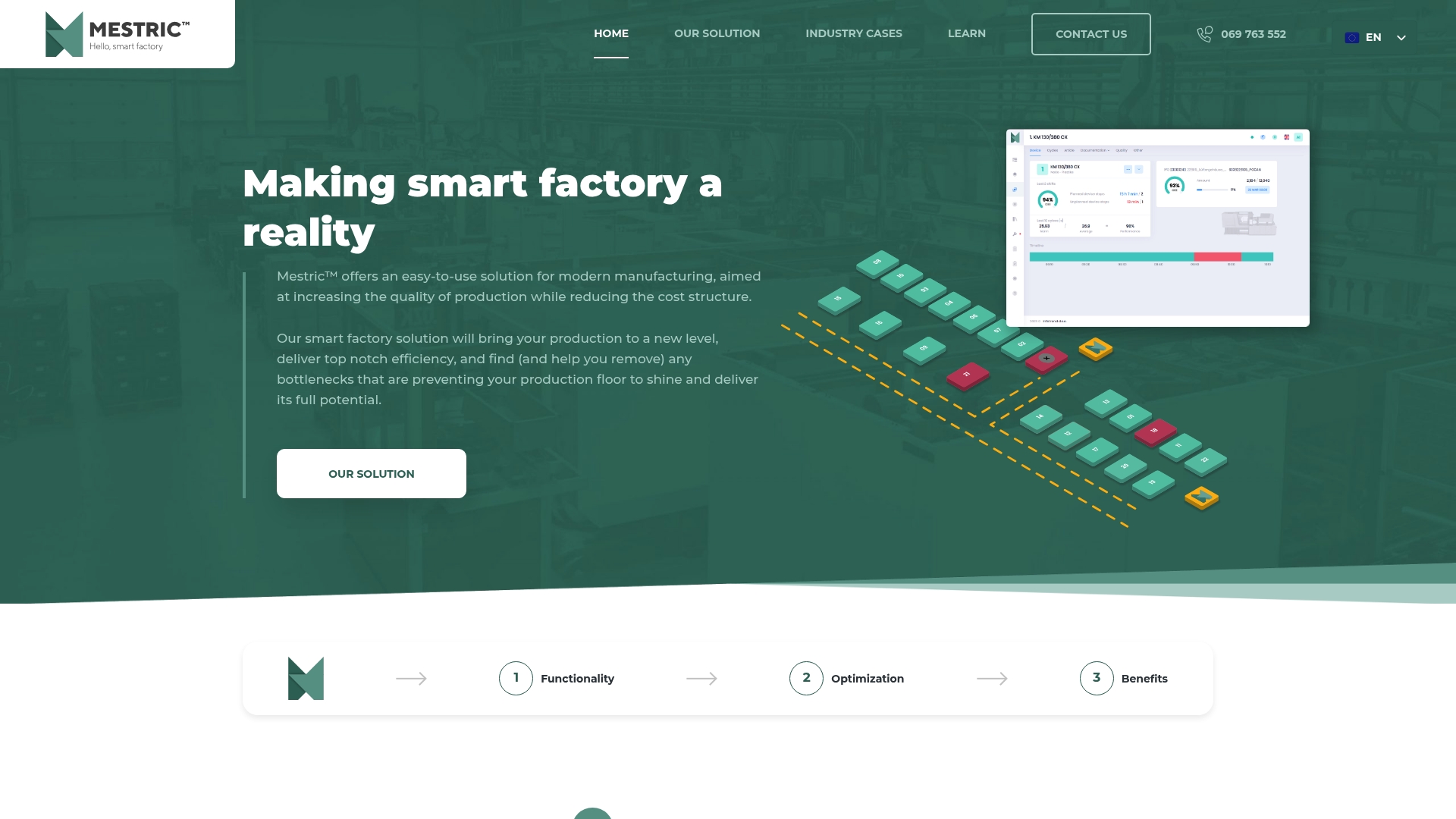
Mestric connects directly with your manufacturing equipment and delivers live KPIs across performance, quality, downtime, and cost, all in a single view. The platform’s AI-powered analytics identify bottlenecks and flag deviations before they affect your output, giving your team the data it needs to close the loop on process quality. Whether you are at the start of your digital transformation or looking to add adaptive capabilities to existing infrastructure, Mestric integrates with your current systems without requiring a full replacement. Explore the MES efficiency comparison to see how a modern execution system compares to traditional approaches, or browse the manufacturing software overview to understand how the tools fit together. Request a demonstration to see Mestric running on connected equipment in a production environment.
Adaptive manufacturing is a production approach that uses real-time data, AI, and automation in a continuous closed feedback loop to detect deviations and adjust process parameters autonomously, improving yield, quality, and throughput without manual intervention.
Flexible manufacturing focuses on switching between product types or batch sizes. Adaptive manufacturing responds in real time to changes in equipment condition, material quality, environmental factors, and demand, making it a broader and more dynamic capability.
The core technology stack includes IoT sensors for data capture, edge computing for low-latency processing, AI and machine learning for decision-making, and digital twins for simulation and replanning. Together, these form the closed-loop architecture that makes real-time adaptation possible.
Key benefits include improved yield and quality, greater throughput stability, reduced energy and material waste, and stronger supply chain resilience. One industrial pilot reported 96.8% schedule compliance and a 16.5% reduction in energy consumption using an AI-driven adaptive platform.
The recommended approach is staged: begin with edge sensing and anomaly detection on a high-impact production line, then build toward closed-loop control and eventually autonomous scheduling. This limits integration risk and delivers measurable value at each phase.


 069 763 552