


Kurzfassung:
- Manufacturing data governance is a structured framework of policies, roles, and tools that ensures data quality and trustworthiness. It helps prevent errors, improves operational efficiency, and supports regulatory compliance across industrial environments. Implementing tiered, automated governance practices rooted in strong data architecture enhances AI performance and overall manufacturing results.
Manufacturing data governance is defined as a formalised framework of policies, roles, validation rules, and tooling that controls how industrial data is created, maintained, and used across an organisation. Without it, production decisions rest on data that is incomplete, inconsistent, or simply wrong. The discipline sits at the heart of modern manufacturing data management, and its importance has grown sharply as AI and Industry 4.0 systems demand data that is not just available but trustworthy. This article covers the core components, the technical architecture, the automation practices, and the practical benefits of data governance in manufacturing, so you can build or improve your own approach with confidence.
Data governance in manufacturing is the structured discipline that assigns ownership, enforces quality standards, and defines how data flows from machine to decision. The term is sometimes used loosely, but the recognised industry definition centres on four pillars: clear data policies, validation processes, defined stewardship roles, and fit-for-purpose tooling. Each pillar addresses a different failure point in the data chain.

The stakes are high. Data governance is a critical operational strategy, not a compliance exercise, directly improving scrap rates, maintenance scheduling, and production throughput. That means a poorly governed dataset does not just create reporting headaches. It produces bad parts, missed maintenance windows, and flawed AI predictions.
Manufacturers also face regulatory pressure. Audit readiness requires that records are retained and traceable, and seven-year archiving is the standard recommendation for EDI and ERP data in manufacturing environments. That is a long time to maintain data integrity without a formal governance structure.
Effective EDI-ERP data governance rests on four pillars that apply equally to any manufacturing data domain.
Beyond these four pillars, leading manufacturers use tiered governance intensity to manage effort realistically. Tiered frameworks such as Gold, Silver, and Bronze assign the highest governance rigour to critical domains like Finance and Quality, while applying lighter-touch rules to lower-priority data. This prevents stakeholder burnout and keeps governance focused where it matters most.
Pro-Tipp: Start your tiered framework by listing your top five data domains by business risk. Assign Gold governance only to those. Everything else can start at Silver or Bronze and be upgraded as capacity grows.
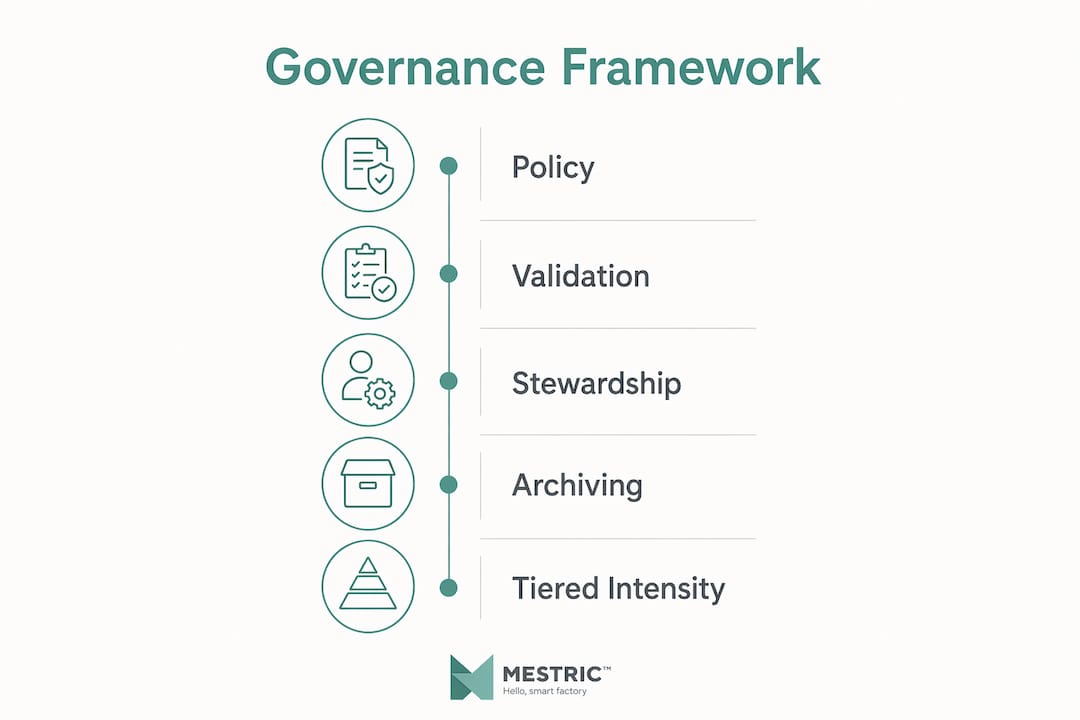
A governance framework is only as strong as the data architecture beneath it. Four structural practices make the difference between a framework that holds and one that collapses under real operational load.
Pro-Tipp: Do not attempt to connect analytics tools to raw system data before your asset master and taxonomy work is complete. Every report built on unresolved identifiers will need to be rebuilt.
| Architecture layer | Purpose | Common failure without it |
|---|---|---|
| Asset master | Stable enterprise-wide equipment IDs | Duplicate assets across reports |
| Event taxonomy | Unified status and failure vocabulary | Inconsistent downtime categorisation |
| Time normalisation | Aligned timestamps across MES, ERP, PLC | Unreliable time-series analytics |
| Archiving structure | Audit-ready retention with version history | Compliance gaps and data loss |
Understanding how digital manufacturing frameworks handle data architecture helps contextualise why these layers are non-negotiable in a modern plant.
Automated validation at the point of data ingestion is the single most effective practice for maintaining data quality in manufacturing. Validation rules that quarantine physically impossible data prevent erroneous inputs from ever reaching your analytics or AI models. A classic example: machine RPMs exceeding 500,000 are automatically blocked, because no production equipment operates at that speed. The rule costs almost nothing to implement and prevents corrupted training data from degrading AI model performance.
This matters because AI systems in manufacturing amplify whatever data quality exists beneath them. In cloud ERP and Industry 4.0 environments, governance failures do not stay contained. They scale. A single bad sensor reading that passes validation can propagate through predictive maintenance models, production schedules, and supplier orders before anyone notices.
Passive oversight is outdated. Automated validation and archive tools alert stakeholders in real time to data failures, transforming governance from a background compliance function into an active operational amplifier that protects every system that depends on your data.
The practical implication for your team is clear. Governance rules must be embedded in the data pipeline, not applied manually after the fact. EDI and ERP integrations need consistent validation schemas at every connection point. Archival processes must trigger automatically, not depend on someone remembering to run a script. The role of AI in manufacturing depends entirely on this foundation being solid before any model is trained or deployed.
The operational benefits of data governance in manufacturing are concrete and measurable across multiple functions.
Das role of data in manufacturing is not passive. Governed data actively drives efficiency gains across every function that touches production. Manufacturers who treat data quality as an operational priority, rather than an IT concern, consistently outperform those who do not.
Pro-Tipp: Track your root cause analysis cycle time before and after implementing governance rules. A reduction in that metric is one of the clearest early signals that your governance programme is working.
Successful implementation of data governance in manufacturing follows a pattern that is more cultural than technical. Real success comes when governance shifts from IT-driven fixes to business-led ownership, with C-suite engagement driving accountability from the top down.
Pro-Tipp: Pilot your governance framework on one plant and one data domain before scaling. A successful pilot creates internal advocates who make the broader rollout far easier to sell to sceptical stakeholders.
Integrating governance with manufacturing data integration strategy ensures that the infrastructure and the governance rules evolve together, rather than creating technical debt that undermines both.
Manufacturing data governance succeeds when it combines business-led ownership, automated validation at ingestion, tiered intensity frameworks, and a solid asset master architecture built before any analytics layer is deployed.
| Punkt | Details |
|---|---|
| Four governance pillars | Policies, validation, stewardship roles, and archiving tools form the non-negotiable foundation. |
| Tiered intensity frameworks | Gold, Silver, and Bronze tiers focus effort on critical domains and prevent stakeholder burnout. |
| Asset master and taxonomy first | Resolve equipment IDs and unify event vocabularies before building any analytics or AI layer. |
| Automated validation at ingestion | Rules that block impossible data points protect AI models and prevent errors from scaling. |
| Business-led ownership | C-suite engagement and defined steward roles transform governance from IT task to operational priority. |
I have spent years watching manufacturers invest heavily in analytics platforms and AI tools, only to find that the outputs are unreliable. The diagnosis is almost always the same: the data feeding those systems was never properly governed. The technology was not the problem. The foundation was.
What strikes me most is how rarely governance appears on the agenda at the leadership level. It gets delegated to IT, treated as a compliance checkbox, and reviewed only when something goes wrong. That is the wrong sequence entirely. The manufacturers who get the most from their digital investments are the ones where a senior leader genuinely owns data quality as a business outcome, not a technical deliverable.
The tiered intensity approach is the most pragmatic framework I have seen for making governance real in a manufacturing context. Trying to apply Gold-level rigour to every data domain simultaneously is a reliable way to exhaust your team and produce nothing. Starting with your highest-risk domains, getting those right, and expanding deliberately is how you build something that lasts.
The other shift worth making is treating governance as part of your digital transformation, not a prerequisite that must be completed first. Embed it into your ERP migration, your MES rollout, your PLM implementation. That is where the effort is already happening. That is where governance rules will actually stick.
— Andraž
Mestric connects directly to your manufacturing equipment and gives production managers a real-time view of quality parameters, downtime, and performance KPIs. That visibility depends on the same data quality principles covered in this article. Mestric’s platform enforces consistent data capture at the machine level, reducing the manual errors that undermine governance programmes before they get started. If you are building or improving your governance approach, the step-by-step production quality guide from Mestric gives you a practical framework for aligning quality monitoring with your data governance goals. You can also explore Produktionsqualitätsüberwachung to see how real-time data capture supports the kind of audit-ready, validated data records that governance frameworks require.
Manufacturing data governance is a formalised framework of policies, roles, validation rules, and archiving practices that controls how industrial data is created, maintained, and used. It assigns accountability for data quality to named individuals and enforces standards at every point in the data pipeline.
The four pillars are clear data policies, validation before data enters core systems, defined data steward roles, and fit-for-purpose archiving tools. All four are required for governance to be enforceable and audit-ready.
Building a manufacturing data foundation typically takes 6–12 months for multi-plant networks, with the first four weeks focused on core asset masters and event taxonomies.
AI models trained on ungoverned data produce unreliable outputs. Automated validation rules that block physically impossible data points at ingestion protect model integrity and prevent errors from scaling across connected systems.
Tiered governance intensity assigns Gold, Silver, or Bronze rigour to different data domains based on business risk. Gold governance applies to critical areas such as Finance and Quality, while lower-priority domains receive lighter-touch rules to preserve team capacity.


 069 763 552