


Kurzfassung:
- Connected production lines integrate machines, people, and systems in real time, enabling instant communication and adaptive manufacturing. They leverage technologies like MES, PLCs, SCADA, edge computing, OPC UA, and MQTT protocols to improve responsiveness, quality, and uptime. Successful implementation requires strategic planning, open standards, staff training, and leadership commitment to organizational change.
Automating a single machine or process is a solid start, but it is not the same as building a connected production line. Many manufacturers invest heavily in standalone automation and then wonder why the efficiency gains plateau. The real transformation happens when machines, people, software, and enterprise systems communicate in real time, creating a unified production environment that adapts instantly to change. This article explains exactly what connected production lines are, which technologies power them, what operational benefits you can expect, and how to move from a fragmented setup to a fully integrated operation.
| Punkt | Details |
|---|---|
| Real-time connectivity | Connecting production lines allows instant data sharing and rapid response, driving efficiency. |
| Advanced integration | Technologies like MES and edge computing bridge shop floor and business systems seamlessly. |
| Operational gains | Connected lines reduce downtime, improve quality, and increase flexibility in manufacturing. |
| Strategic implementation | Success requires both technical integration and organisational readiness for continuous improvement. |
| Leadership impact | Executive focus on culture and collaboration greatly amplifies the benefits of technological connectivity. |
A connected production line is a system where every machine, workstation, sensor, and software layer exchanges data continuously. It is not simply a group of automated steps. It is a living network that passes information from the shop floor to management dashboards, quality systems, and ERP (Enterprise Resource Planning) platforms without delay.
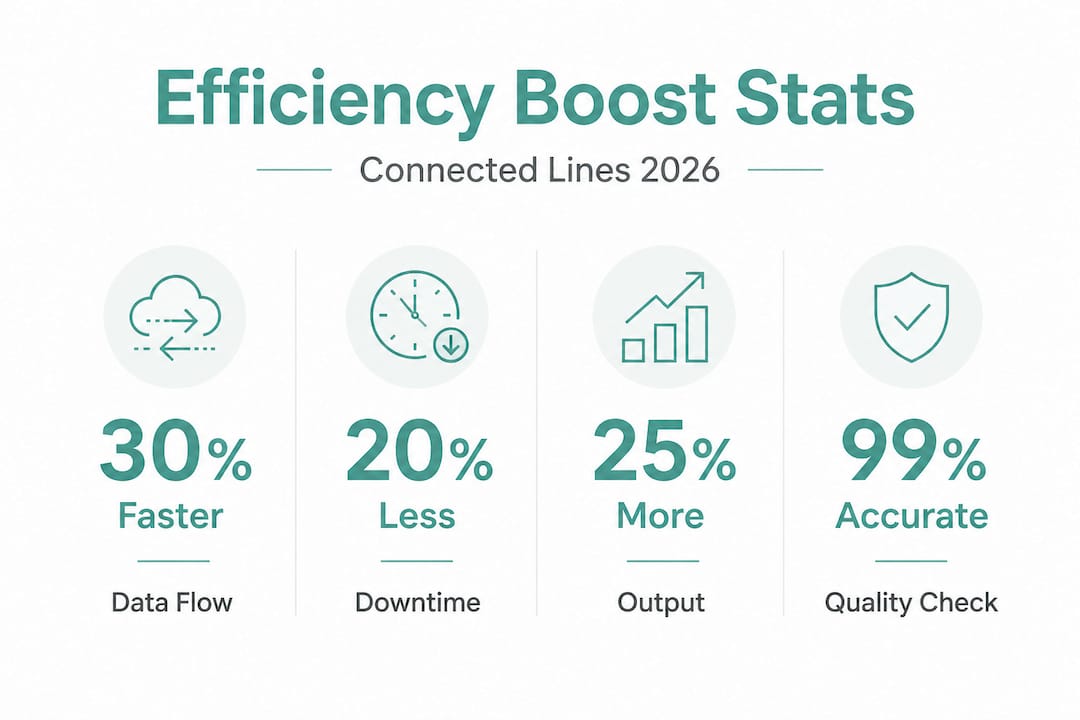
The difference between isolated automation and connected lines is significant. An isolated automated cell might press, weld, or assemble faster than a human operator, but it cannot tell the rest of the line what it is doing, flag a quality deviation upstream, or automatically adjust to a schedule change. A connected line does all of this in real time.
Core technologies include MES, PLCs, SCADA, edge computing, OPC UA, MQTT protocols for integration, enabling real-time data exchange between production control and enterprise systems. Here is a brief overview of each:
The business case for connected lines is compelling. Understanding Vorteile für vernetzte Maschinen shows how integrated systems improve responsiveness, reduce waste, and support faster decision-making. Companies that adopt these architectures gain agility when manufacturing efficiency trends shift demand patterns, product mixes, or supply conditions.
| Technology | Primary role | Key benefit |
|---|---|---|
| MES | Production management | Real-time order and quality tracking |
| PLC | Machine control | Reliable automation at machine level |
| SCADA | Facility monitoring | Centralised visibility across assets |
| Edge computing | Local data processing | Latency under 10 milliseconds |
| OPC UA / MQTT | Communication protocols | Secure, open data exchange |
Manufacturers that align these technologies with strong demand generation strategies are also better positioned to translate operational improvements into commercial outcomes.
Understanding the individual technologies is one thing. Knowing how they interact is what allows you to build a genuinely effective connected environment.
MES sits at the centre of the connected line. It collects data from PLCs and sensors, processes it against production orders and quality standards, and sends performance information to ERP and business intelligence systems. Without MES, the shop floor and the boardroom operate with different versions of reality.
PLCs and SCADA are the workhorses. PLCs execute the precise instructions that run individual machines, while SCADA provides an aggregated view of the entire facility. Together, they create a solid automation foundation that MES can build upon.
Edge computing is where speed matters most. Edge computing reduces latency to under 10ms, and IEC 61499 enables event-driven PLCs for flexible automation. This is critical in scenarios where a quality deviation, a machine fault, or a schedule change requires an immediate response measured in milliseconds rather than seconds.
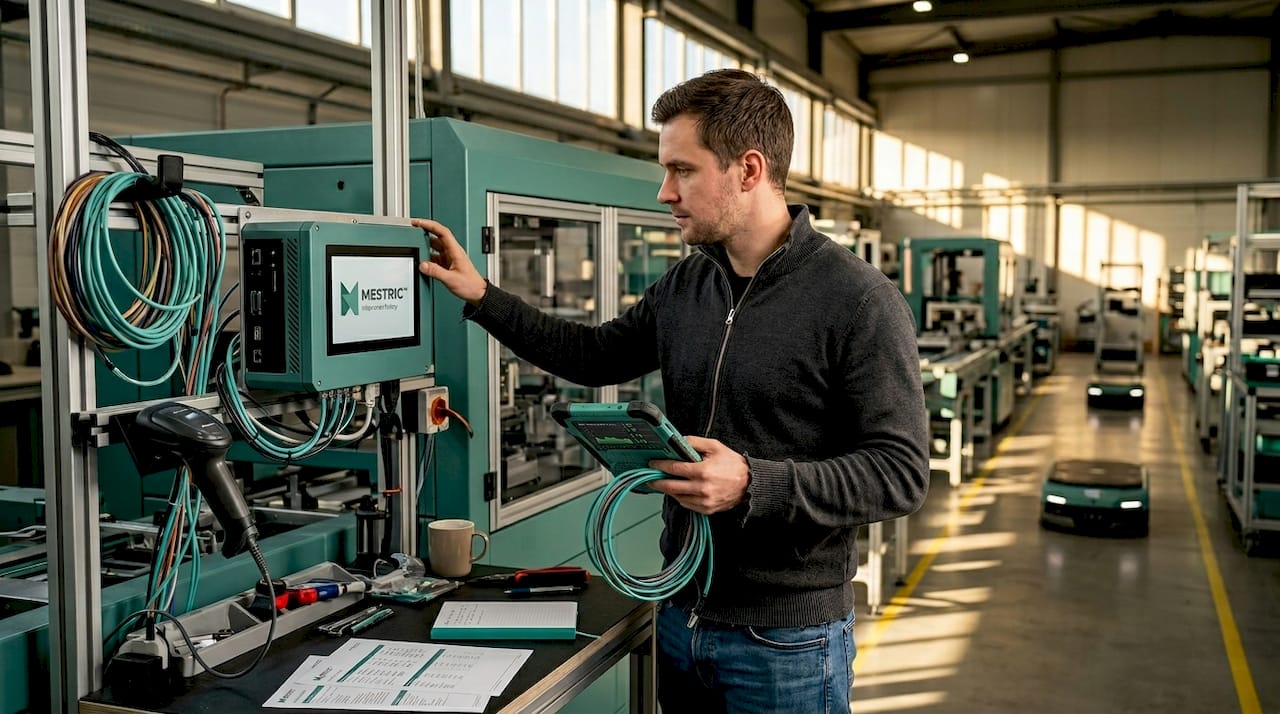
OPC UA and MQTT solve the interoperability problem. Legacy equipment, modern CNC machines, robots, and cloud systems all speak different languages. These open protocols act as translators, ensuring data flows reliably regardless of manufacturer or age of the asset.
| Funktion | Traditional setup | Connected line |
|---|---|---|
| Data flow | Manual or batch | Continuous, real time |
| Response to faults | Reactive | Predictive and instant |
| System integration | Siloed | Unified via MES and protocols |
| Flexibility | Low | High, via IEC 61499 |
| Visibility | Limited | Full facility overview |
Supporting Echtzeitüberwachung across assets becomes far simpler when these technologies are in place. Investing in data-driven manufacturing principles from the start ensures your technology choices align with long-term operational goals.
Pro Tip: When defining your system requirements, always specify open standards such as OPC UA and MQTT. Proprietary protocols may work well today but create expensive lock-in problems when you need to add equipment or upgrade systems in the future.
The technologies are the mechanism. The benefits are the reason executives invest. Here is what a fully connected production line actually delivers in practice.
Responsive production adjustments. Core technologies enable real-time data exchange between production control and enterprise systems. When demand shifts or a component goes out of specification, the connected line can adapt its schedule, speed, or routing in real time rather than waiting for a supervisor to investigate and instruct manually.
Improved product quality. Integrated quality monitoring captures data at every stage of production. Deviations are flagged immediately, often before a defective part reaches the next station. This is far more efficient than end-of-line inspection, which discovers problems only after waste has already been created. Quality monitoring for excellence is one of the clearest drivers of return on investment in connected systems.
Reduced downtime through predictive maintenance. Sensors on connected lines track vibration, temperature, power draw, and cycle times. Patterns in this data reveal when a component is approaching failure, allowing maintenance to be scheduled during planned stops rather than emergency breakdowns. Cost-cutting with MES is directly linked to the reduction in unplanned downtime that predictive approaches deliver.
“Connected production lines reduce unplanned downtime by enabling continuous monitoring and early warning of equipment degradation, turning reactive maintenance into a planned, controlled activity.”
Beyond these three core benefits, connected lines also improve traceability, reduce manual data entry errors, support faster product changeovers, and give leadership accurate real-time production data for faster, better-informed decisions.
Pro Tip: Use integrated dashboards to spot bottlenecks before they cause delays. If a particular station consistently shows rising cycle times or increasing reject rates, that is an early signal worth acting on before it affects the whole line.
The ability to quickly optimise manufacturing revenue depends directly on how quickly your teams can see, interpret, and respond to production data. Connected lines make that possible at a pace traditional setups simply cannot match.
Knowing the benefits is motivating. Knowing how to get there is essential. Implementation does not need to be a single large project. A staged, strategic approach is usually more effective and carries less risk.
Audit your current systems. Map every machine, sensor, and software system currently in use. Identify where data is captured, where it is lost, and where manual processes fill gaps that technology should cover. This audit is the foundation for every decision that follows.
Prioritise open protocols. Core technologies enable flexible production through collaborative control. When you specify OPC UA and MQTT from the outset, you create a system that can grow and adapt without costly rebuilds. Proprietary integrations that seem convenient today often become barriers within a few years.
Train your people in data-driven decision-making. Technology alone does not produce better outcomes. Operators, supervisors, and managers need to understand what the data means, how to interpret dashboards, and when to act on alerts. Investing in training at all levels is non-negotiable for sustained results.
Start with high-ROI lines. Rather than attempting a whole-facility rollout immediately, identify one or two production lines where the potential gains are clearest. Use these as pilots to learn, refine your approach, and build internal confidence before scaling.
Plan for integration with enterprise systems. The shop floor alone is only part of the picture. Connecting production data to ERP, quality management, and scheduling systems creates the feedback loop that drives genuine business agility.
Using MES tools for efficiency gives you a practical toolkit for each of these steps. A structured Leitfaden zur Produktionsoptimierung can also help leadership teams sequence their investments logically.
| Implementation step | Key action | Expected outcome |
|---|---|---|
| Systems audit | Map machines, data flows, gaps | Clear baseline for planning |
| Protocol selection | Specify OPC UA, MQTT | Future-proof integration |
| Staff training | Data literacy across all levels | Faster, better decisions |
| Pilot rollout | Select high-ROI lines first | Proven results before scaling |
| Enterprise integration | Connect to ERP and quality systems | Business-wide visibility |
Each step reinforces the next. An audit without training produces data nobody uses. Training without the right protocols creates skilled people working around poor systems. The steps are most powerful when treated as a connected sequence rather than isolated actions.
Most executive teams approach connected production lines as a technology project. They commission an audit, select vendors, approve a budget, and track installation milestones. The technology rarely fails them. What fails them is the assumption that technology alone is sufficient.
The manufacturers that extract the most value from connected lines are the ones that treat the investment as a catalyst for how they organise, decide, and collaborate. Connected lines generate enormous volumes of data, but data is only useful when the right people understand it, trust it, and act on it. That requires new behaviours, not just new software.
Agility is another area where leadership focus is often misplaced. Many executives measure agility by how quickly the system can respond to a machine event. Real agility is about how quickly your organisation can respond to a market event, a customer demand shift, or a supply disruption. The technology enables the speed. The culture determines whether you use it.
We have also observed that half-measures rarely deliver sustained results. Connecting three machines on one line while leaving the rest of the facility operating on clipboards and spreadsheets creates data islands that are only marginally better than nothing. The value of connectivity scales with the breadth of adoption. Leaders who commit to a full programme, even if delivered in stages, consistently outperform those who treat connectivity as a departmental experiment.
Transparency is the third area most executives underestimate. Connected lines make performance visible at every level, which is genuinely uncomfortable for teams that have operated with information asymmetry for years. Creating the right environment for that transparency, one where data is used to improve rather than to blame, is a leadership responsibility. Investing in digital tools for resource utilisation is a practical starting point for teams ready to take transparency seriously.
You now have a clear picture of what connected production lines are, what makes them work, and how to build one in your own facility. The next step is choosing a solution partner that understands manufacturing operations at the detail level, not just in theory.
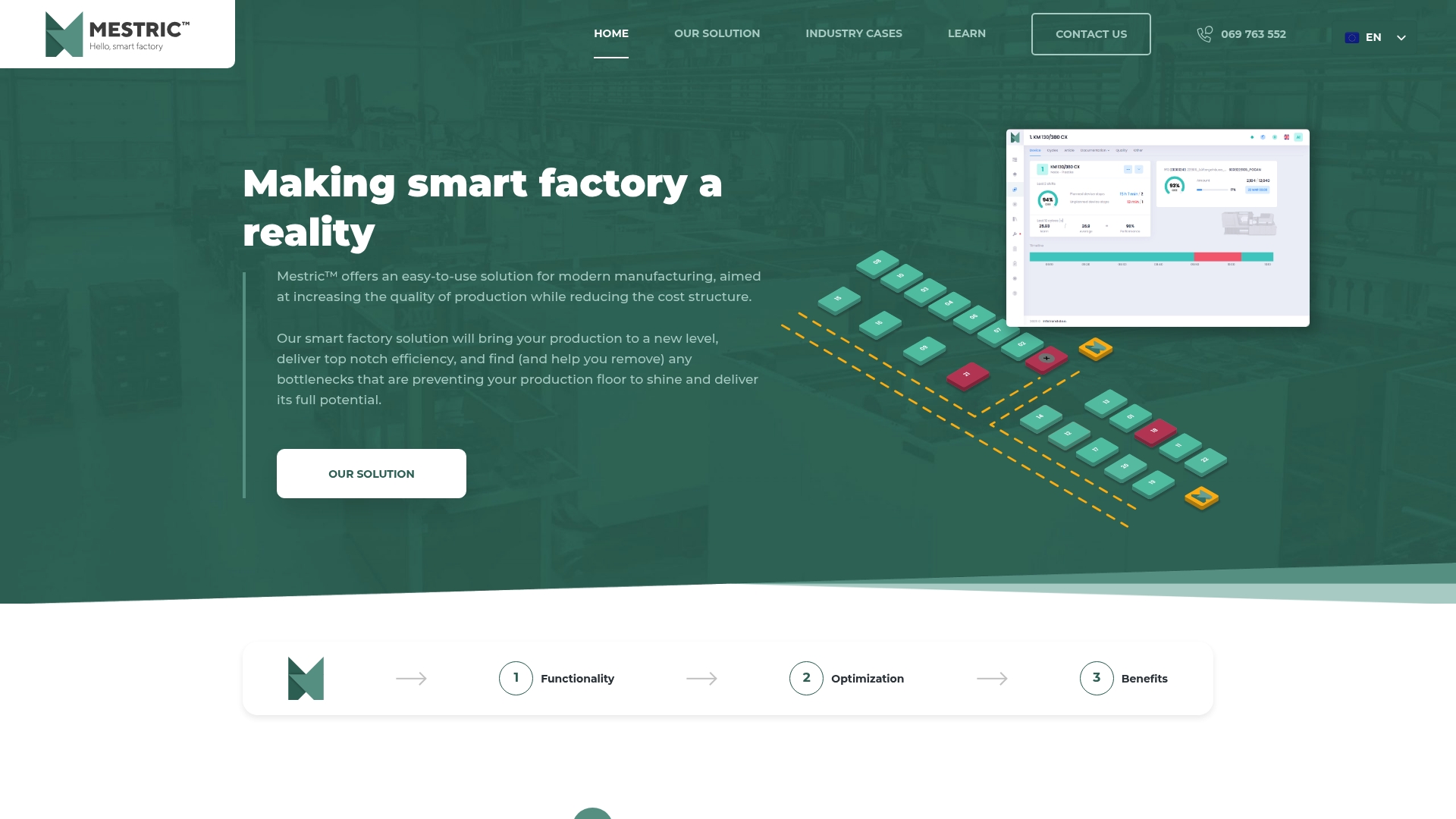
Mestric™ gives you a Manufacturing Execution System designed to connect directly with your production equipment, track performance in real time, and surface the insights that drive better decisions. Whether you are exploring the difference between MES vs. traditionelle Fertigung, looking for practical guidance on streamlining production efficiency, or assessing the broader landscape of manufacturing software types, Mestric™ has the tools and expertise to support your journey. Book an onsite demonstration and see connected production in action.
Connected production lines enable real-time data exchange between machines and enterprise systems, boosting both efficiency and responsiveness across the entire operation.
MES, PLCs, SCADA, edge computing, OPC UA, MQTT protocols all play a role, but MES and edge computing together provide the essential bridge between shop floor operations and business-level planning.
Edge computing reduces latency to under 10 milliseconds, making genuine real-time analytics and automatic responses to production events fully achievable.
Begin with a thorough connectivity audit, specify open standards such as OPC UA for all new integrations, and identify one or two high-ROI production lines to use as pilots before scaling across the facility.
Yes. Culture and cross-disciplinary collaboration are essential conditions for sustained benefits. Technology creates the capability; leadership and organisational behaviour determine whether that capability is actually used to its full potential.


 069 763 552