


Kurzfassung:
- Flexible manufacturing systems enable high-mix, mid-volume production without the traditional trade-offs of cost and complexity; success depends on disciplined implementation, robust data governance, and integrating Industry 4.0 technologies. When properly managed, FMS reduces lead times, improves asset utilization, and enhances quality, especially in markets demanding product variety and short lifecycles. However, ineffective discipline and poor-quality data can undermine potential gains, making organizational culture and process standards essential for sustained advantages.
Many executives assume that building flexibility into production means accepting higher costs, greater complexity, and reduced output. That assumption is wrong, and the most competitive manufacturers already know it. Flexible manufacturing systems (FMS) give you the ability to handle high-mix, mid-volume production without the painful trade-offs traditionally associated with variety. This article breaks down what FMS is, why it delivers real financial and operational returns, and what separates successful implementations from costly disappointments.
| Punkt | Details |
|---|---|
| System flexibility drives ROI | FMS offers rapid adaptation to changing demand with improved asset utilisation and responsiveness. |
| Discipline trumps pure tech | Lasting value comes from data quality, maintenance, and skilled teams, not just automation. |
| Industry 4.0 amplifies FMS | Digital tools boost productivity and quality when paired with a worker-centric approach. |
| Risks must be managed | Capex, complexity, and scheduling errors can quickly erode expected FMS benefits. |
Now that we’ve challenged the common assumptions about flexibility, let’s clarify exactly what flexible manufacturing systems are and how they operate.
An FMS is not simply a collection of modern machines. It is an integrated production environment designed to handle multiple product variants without major reconfiguration. Flexible manufacturing systems are designed to produce a high-mix portfolio by rapidly switching among products and variants using integrated CNC equipment, robotics, material handling, and centralised computer control with minimal manual intervention.
Think of it this way: a traditional dedicated line is efficient for one product at high volume. An FMS is efficient across many products at moderate volume. That distinction matters enormously when customer demand is fragmented, product lifecycles are shortening, and batch sizes are shrinking.
The core mechanisms of an FMS include four distinct types of flexibility:
Understanding the Vorteile für vernetzte Maschinen of linking these components with real-time data is what separates modern FMS implementations from earlier, more rigid approaches.
Here is a direct comparison of FMS against traditional systems:
| Funktion | Traditional dedicated line | Flexible manufacturing system |
|---|---|---|
| Product variety | Low (one or few variants) | High (multiple variants) |
| Changeover time | Long, often hours or days | Short, often minutes |
| Automation level | High but fixed | High and adaptive |
| Routing options | Single, fixed path | Multiple alternative paths |
| Skalierbarkeit | Difficult, costly | Modular, incremental |
| Best fit | Ultra-high volume, low variety | High-mix, mid-volume production |
| Response to demand shift | Slow | Fast |
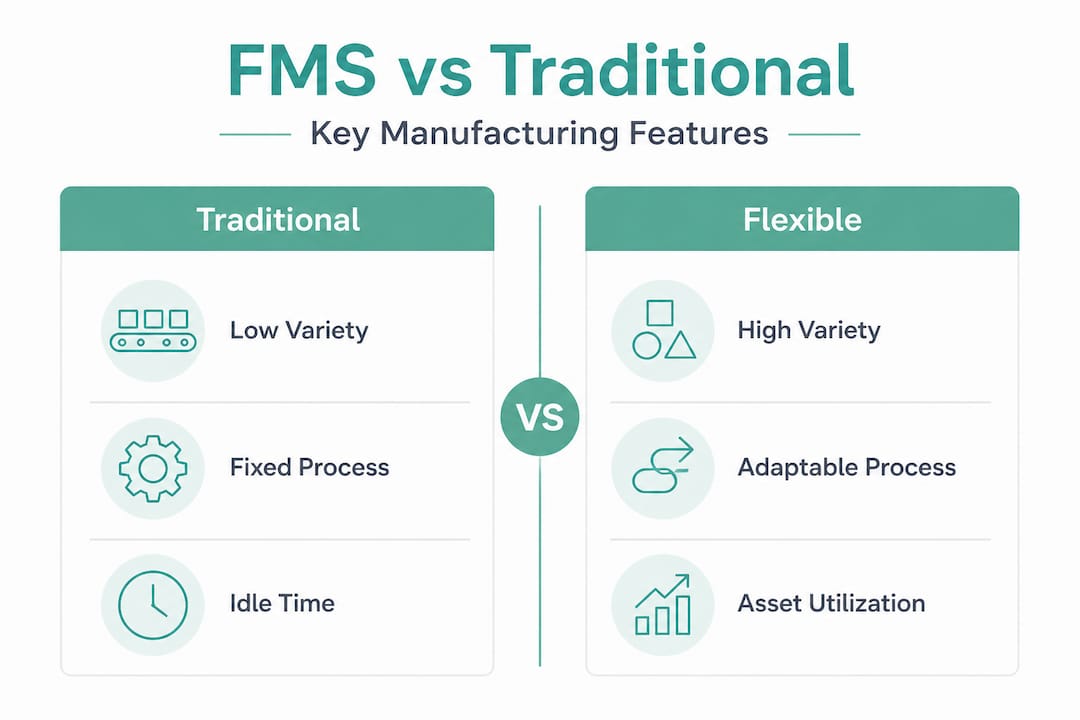
FMS is most relevant when you are producing families of related parts, serving customers who demand variety, or operating in markets where product lifecycles are short. If your plant runs one product at maximum volume indefinitely, a dedicated line may still win. For most modern manufacturers, that scenario is increasingly rare.
Understanding the components of FMS sets the stage for examining the tangible operational benefits executives can expect.
The most immediate benefit is lead-time reduction. A key operational reason for adopting FMS is reducing lead times and increasing responsiveness to demand and product changes without tearing down and rebuilding production processes. When you can switch between variants in minutes rather than hours, your ability to respond to a customer order, a design update, or a sudden demand spike improves dramatically.
Here are the most commonly reported operational outcomes from well-implemented FMS environments:
“Collapsing lead times and raising asset utilisation are not competing priorities in an FMS environment. They reinforce each other when the system is properly configured.”
MES-driven efficiency plays a critical role here. When your Manufacturing Execution System feeds real-time data into the FMS scheduling logic, the system can automatically re-route jobs to available machines, maintain target throughput, and flag exceptions before they become delays.
Pro Tip: Implement SMED (single-minute exchange of dies) methodology alongside your FMS rollout. SMED focuses on separating internal setup tasks (machine must be stopped) from external ones (can be done while machine runs). Even a 20 per cent reduction in changeover time compounds significantly across a high-mix production schedule, and it is one of the fastest cost-saving methods available without capital expenditure.
Asset utilisation is the other major win. In a traditional plant, machines often sit idle while waiting for a specific job or while changeovers are being completed manually. FMS changes this equation. Routing flexibility means alternative machines absorb work when the primary machine is busy. Volume flexibility means you are not running a machine at a loss just to keep it warm. Overall equipment effectiveness (OEE) scores typically improve by 15 to 25 per cent in the first year following a disciplined FMS implementation.

With operational value clear, it is vital to weigh the economic rationale and the risks that can undermine FMS success.
FMS is often justified economically by improving equipment utilisation and enabling automation to reduce labour and waste, but it requires disciplined implementation because complexity and scheduling risk can erode benefits. The economic case rests on three pillars: higher utilisation of expensive equipment, reduced direct labour through automation, and lower scrap and rework costs through standardised processes.
The capital expenditure for a full FMS implementation is significant. A mid-sized FMS cell with CNC machining centres, automated material handling, and centralised control can range from hundreds of thousands to several million pounds, depending on complexity. However, the return on investment (ROI) typically materialises within three to five years when the system is applied to the right product families and operated with the right disciplines.
The risks are real and worth naming directly. Here are the top factors that erode FMS benefits in practice:
FMS is not the right answer for every situation. Ultra-high-volume, low-variety products are better served by dedicated automated lines, where setup reduction matters less than raw throughput. Highly bespoke, one-off projects are often better handled by skilled manual or job-shop approaches. Streamlining manufacturing processes requires knowing which tool fits which problem.
Pro Tip: Before committing capital, conduct a thorough part-family analysis using group technology principles. Cluster your parts by geometry, process steps, and tooling requirements. Only those clusters that share enough commonality should enter the FMS. This single step, done rigorously, dramatically improves scheduling performance and reduces implementation risk. Pairing this with strong master data governance is how you streamline operations from day one rather than spending the first year correcting data errors.
The risks and returns of FMS are changed dramatically by the digital tools and approaches shaping Industry 4.0.
Industry 4.0 technologies applied in flexible manufacturing are associated, across multiple case studies, with higher productivity, higher-quality products, and improved economic performance. However, achieving sustainable value is linked to a worker-centric deployment approach rather than automation alone. That distinction is important. Organisations that treat Industry 4.0 as a pure automation play frequently see short-term gains followed by quality problems, morale issues, and process drift.
The digitalisation levers that raise FMS performance most reliably include:
The following table summarises outcomes from case study research comparing FMS implementations with and without a worker-centric Industry 4.0 approach:
| Metrik | FMS without worker-centric focus | FMS with worker-centric Industry 4.0 |
|---|---|---|
| Productivity improvement | 8 to 12% | 22 to 35% |
| Defect rate reduction | 10 to 15% | 30 to 45% |
| Time-to-market improvement | Marginal | 20 to 40% |
| Employee retention | Declining | Stable or improving |
| Sustainability of gains | 12 to 18 months | 3 to 5+ years |
The data is clear. Smart factory trends point consistently toward the same conclusion: technology alone does not sustain performance. Plants that invest equally in digital upskilling, operator engagement, and process transparency outperform those that simply add more automation.
Reducing manual errors is one of the most direct benefits of digital integration in FMS environments. When operators receive accurate, real-time guidance and machines report their own status, the margin for human error shrinks considerably. This is not about replacing people. It is about giving them better information to make faster, more accurate decisions.
Pro Tip: Start your Industry 4.0 FMS journey with digital upskilling for frontline teams before deploying new automation. Operators who understand why a system works the way it does are far more likely to maintain it correctly, escalate issues promptly, and adapt when conditions change. Follow the manufacturing trends shaping 2026 and prioritise human capability alongside technical investment.
Having seen how technology shapes outcomes, it is time for an honest look at what really unlocks FMS potential in the real world.
Here is an uncomfortable truth that most FMS implementation guides avoid: the majority of underperforming FMS installations are not suffering from insufficient technology. They are suffering from insufficient discipline. Scheduling logic breaks down because routing data is inaccurate. Quality problems persist because preventive maintenance is treated as optional. Changeover times creep back up because SMED gains are not standardised into operating procedures.
Technology amplifies whatever operating system you already have. If your data governance is weak, an AI scheduling tool will make poor decisions faster. If your maintenance culture is reactive, predictive analytics will generate alerts that nobody acts on. The plant automation guide principle holds: automation accelerates processes, but it does not fix the underlying disciplines they depend on.
The critical success disciplines for FMS are straightforward, though not easy:
“Treat FMS as a system plus an operating discipline, not simply as ‘add automated equipment.’ The technology is the enabler. The discipline is what makes the returns sustainable.” (Research insight, Flexible Manufacturing Systems Framework)
The plants that win with FMS are not always the ones with the most advanced equipment. They are the ones where scheduling is taken seriously, where master data is maintained with the same rigour as financial records, and where operators are genuine partners in continuous improvement. That combination of people, process, and technology is what produces durable competitive advantage.
After examining the human and operational foundation of FMS, here is how to move from insight to action.
If you are evaluating whether flexible manufacturing is the right direction for your plant, the next step is to connect your operational data to your decision-making. Mestric™ makes that connection practical and immediate.
Mestric™ is a Manufacturing Execution System built for exactly this environment: high-mix, efficiency-focused production where real-time visibility drives better decisions. You can explore how MES vergleicht sich mit der traditionellen Fertigung approaches, learn how to streamline production operations with connected data, and access the manufacturing software guide to understand which digital tools belong in your technology stack. Request an onsite demonstration and see how connected machinery performs in a real production setting.
FMS delivers routing, machine, volume, and expansion flexibility, enabling quick adaptation to product mix and demand shifts without major reconfiguration.
FMS may not suit ultra-high-volume, low-variety products or highly bespoke, one-off projects where dedicated lines or manual approaches are more efficient and cost-effective.
Industry 4.0 in FMS supports higher productivity and quality, but sustainable outcomes depend on a worker-centric deployment that combines digital tools with frontline engagement and upskilling.
Complexity and scheduling risk can erode FMS benefits when data quality, maintenance discipline, and part-family selection are not rigorously managed from the outset.


 069 763 552