


Sobald eine Nichtkonformität auftritt, halten Sie sie zurück, erfassen Sie die 5W1H-Fakten (wer, was, wo, wann, warum) und weisen Sie einen namentlich bekannten Verantwortlichen mit einer Eindämmungsfrist zu, die in Stunden, nicht in Tagen gemessen wird. Diese Abfolge schützt Ihren Prüfpfad, bevor sie Ihren Produktionsplan schützt. Alles andere – Untersuchung, CAPA, Überprüfung, Dokumentation – baut auf dieser ersten Reaktion auf.
Kurzfassung:
- Das Eingrenzen von Nichtkonformitäten innerhalb von Stunden und das Aufzeichnen der 5W1H-Details verhindert Prozessunterbrechungen und bewahrt wichtige Audit-Nachweise.
- Die Ursachenanalyse sollte der Komplexität des Problems entsprechen, wobei die Beweissammlung Fotos mit Referenzen zur Gewährleistung von Klarheit und Audit-Bereitschaft umfassen sollte.
- Wirksame CAPA-Pläne müssen Ursachen, Maßnahmen, Verantwortliche, Fälligkeitstermine und Verifizierung Metriken spezifizieren, mit regelmäßigen Nachbereitungen nach 30, 60 und 90 Tagen.
- Die Führung umfassender Aufzeichnungen, einschließlich Protokollen, Untersuchungsakten, CAPA-Dokumentation und Verifizierungsergebnissen, ist für Audits und die rechtliche Verteidigung von entscheidender Bedeutung.
- Digitale Arbeitsabläufe automatisieren das Reklamationsmanagement und ermöglichen eine schnellere Erkennung, Eskalation sowie Trendanalyse, wodurch die Wiederauftretensraten im Laufe der Zeit gesenkt werden.
Das Fehler- und Abweichungsmanagement (Nonconformity Management) ist der strukturierte Prozess des Erkennens, Eindämmens, Analysierens und Korrigierens jedes Produkts oder Prozesses, das oder der eine definierte Anforderung nicht erfüllt. Es ist keine einzelne Maßnahme, sondern ein Lebenszyklus: Eindämmung, Ursachenanalyse, Korrektur- und Vorbeugemaßnahmen (CAPA), Verifizierung und Dokumentation. Die ISO 9001:2015 legt die grundlegende Erwartung fest, dass Organisationen auf Abweichungen reagieren, die Notwendigkeit von Korrekturmaßnahmen bewerten und dokumentierte Nachweise darüber aufbewahren müssen, dass die Maßnahme wirksam war.
Qualitätsteams in Slowenien und in der gesamten EU betrachten dies als mehr als nur Papierkram. Hersteller tragen eine fortlaufende rechtliche Verantwortung für die Konformität ihrer Produkte, und in regulierten Kategorien eine Benannte Stelle kann erforderlich sein um die Einhaltung von Vorschriften zu bewerten, bevor ein Produkt auf den Markt kommt. Wenn man den Prozess falsch angeht, besteht das Risiko nicht nur aus einem fehlgeschlagenen Audit. Es ist ein Rückruf, eine Geldstrafe oder ein Kunde, der nicht mehr bestellt.
Der Rest dieses Leitfadens führt durch jede Phase dieses Lebenszyklus, von der ersten Stunde nach der Erkennung bis hin zu den Kennzahlen, die Ihnen zeigen, ob Ihr Programm wiederkehrende Probleme tatsächlich reduziert.
Geschwindigkeit ist hier wichtiger als Feinschliff. Das Ziel ist es, das nicht konforme Produkt daran zu hindern, sich weiter im Prozess oder aus der Tür heraus zu bewegen, während gleichzeitig Fakten festgehalten werden, die sonst innerhalb weniger Tage verschwimmen.
Pro-Tipp: Geben Sie jedem Bediener ein einseitiges Eindämmungsformular mit Ankreuzkästchen für die W-Fragen-Felder. Ein leeres Textfeld lädt zu vagen Einträgen ein; ein strukturiertes Formular liefert Ihnen selbst von jemandem, der zwischen Maschinen hetzt, einen verwertbaren Datensatz.
Die Eindämmung verschafft Zeit. Eine Ursachenanalyse ist das, was das Wiederauftreten des Problems tatsächlich stoppt, und Aufsichtsbehörden weisen konsequent darauf hin: Nichtkonformitäten sind Signale für ein systemische Prozessschwäche, kein isoliertes Pech, und die Behebung des Symptoms ohne die Ursache garantiert einen erneuten Besuch desselben Defekts.
Die Wahl der richtigen Methode hängt von Schweregrad und Komplexität ab, nicht von der Gewohnheit.
Die Qualität der Beweismittel entscheidet darüber, ob Ihre Ergebnisse eine Prüfung überstehen. Sammeln Sie Maschinenprotokolle, Chargen- und Losaufzeichnungen, zeitgestempelte Fotografien des Mangels und seines Kontexts sowie Zeugennotizen, die erstellt wurden, während die Erinnerung noch frisch ist. Bringen Sie Ihre Dokumentation in eine solche Reihenfolge, dass ein Leser ohne Vorkenntnisse des Vorfalls der Kette von der Entdeckung bis zur Ursache lückenlos folgen kann.
Pro-Tipp: Fotografieren Sie den Mdefect neben einer Referenzprobe oder einer kalibrierten Skala. Ein Foto ohne Größen- oder Farbreferenz ist ein weitaus schwächerer Beweis als eines mit, und Gutachter bemerken den Unterschied sofort.

When the root cause traces back to a supplied part or a design decision outside your control, escalate to the supplier or design authority early. Waiting until your internal investigation is “finished” only delays a fix that was never yours to make alone.
A corrective and preventive action plan fails when it stays vague. Every CAPA record needs the same core fields, filled out with specifics rather than intentions.
Prioritise by three factors: immediate safety risk, regulatory or customer impact, and likelihood of recurrence. A low-frequency but high-severity issue often outranks a frequent but trivial one.
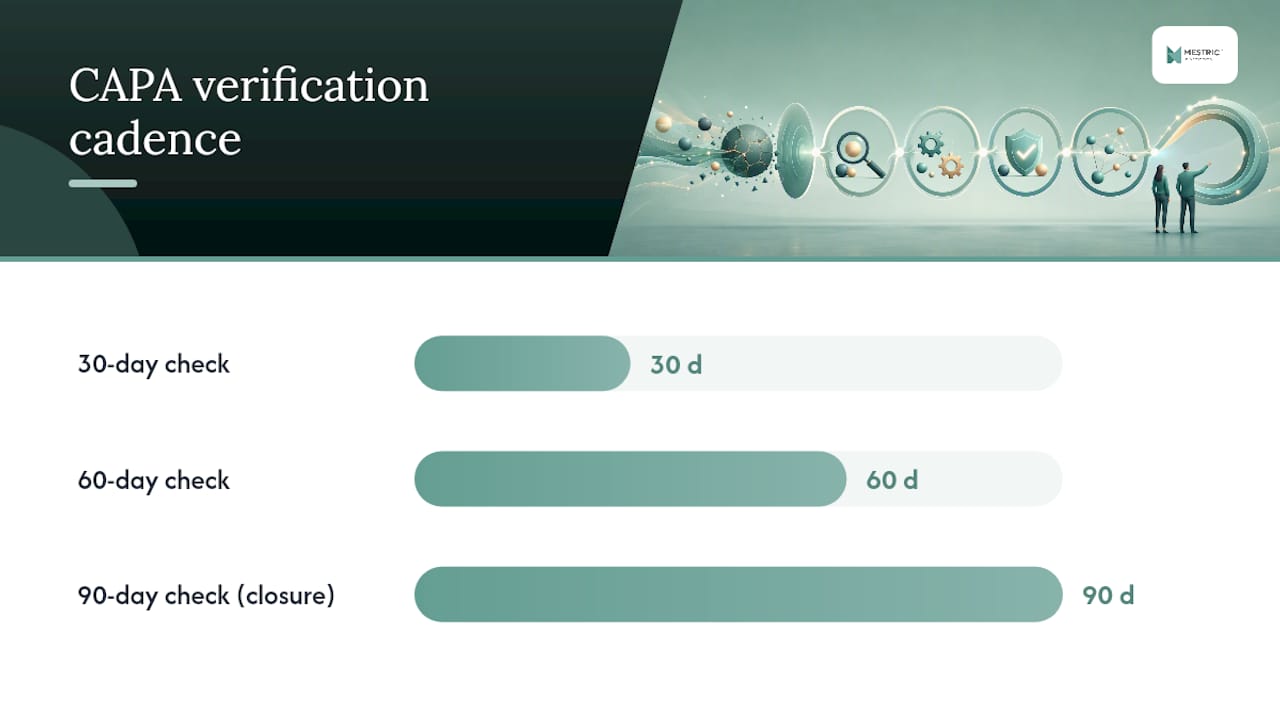
Set verification checkpoints on a fixed cadence, commonly at 30, 60, and 90 days, checking the metric against target each time before you consider the CAPA closed. A CAPA that “looks fixed” after week one but has no 90-day check is not verified, it is assumed.
Some CAPAs outgrow the quality team’s authority. Escalate to management, trigger a recall, or notify a regulator when the nonconformity affects product already in the field, involves a safety-critical function, or repeats after a prior CAPA claimed closure.
Your evidence pack needs four elements at minimum: the detection log, the investigation file, the CAPA evidence, and the verification report. Miss one, and an auditor, or a lawyer, has grounds to question whether the whole process happened at all.
Store these records somewhere accessible for inspection, not buried in a personal inbox or a shared drive nobody indexes. Manufacturers keep conformity documentation as part of a technical file precisely because responsibility for conformity does not transfer away just because a component was outsourced.
The real cost isn’t the fine. Recall, remediation and reputational repair routinely dwarf the regulatory penalty itself when documentation cannot demonstrate that a nonconformity was properly controlled.
Small teams do not need enterprise software to manage this well. A shared folder structure, a numbering convention, and one person accountable for filing within 24 hours of closure covers most SME needs without the overhead of a dedicated records department.
Paper forms and spreadsheets lose the fight against nonconformities the moment volume rises. A digital nonconformance system automates triage, links CAPA actions to their originating event, sends reminders before deadlines slip, and builds an audit trail nobody can edit after the fact.
Capture at the point of detection should include a photo, a timestamp, the operator’s name, the machine ID, and the lot number as mandatory fields, not optional extras. Skipping any of these makes later reconstruction unreliable, which is exactly the weakness auditors probe for.
What a connected system adds over a form:
Three KPIs matter most for management visibility: mean time to close a nonconformity, recurrence rate for the same defect code, and CAPA effectiveness (the percentage of CAPAs that pass their verification checkpoint on the first attempt).
| KPI | What it tells you |
|---|---|
| Mean time to close | Whether containment and investigation are moving fast enough to limit exposure |
| Recurrence rate | Whether root-cause work is finding real causes, not just plausible ones |
| CAPA effectiveness | Whether verification is rigorous or rubber-stamped |
Mestric™ connects directly to shop floor equipment, so quality monitoring data, downtime, and defect capture sit in one dashboard rather than three disconnected systems. Teams considering a digital shift can request an onsite demonstration to see how it handles a live production line.
Nonconformance handling stalls when everyone assumes someone else owns the next step. Define roles explicitly:
Track three metrics on a recurring cadence: open nonconformity ageing (how long items sit unresolved), recurrence rate by defect code, and CAPA verification pass rate. Review monthly at minimum; weekly if volumes are high or a safety issue is open.
Feed lessons back into training records, document control, and supplier scorecards. A recurring supplier defect that never reaches the next supplier review is a governance gap, not bad luck.
Reactive detection, waiting for a complaint or a failed shipment, is the most expensive way to find a defect. Proactive methods catch problems while they are still cheap to fix.
In-process inspection at defined hold points remains the backbone: checking dimensions, visual defects, or functional parameters at the stage where a defect is easiest to isolate, rather than only at final inspection. Statistical process control charts flag when a parameter drifts outside control limits before it produces an actual reject, giving operators a warning rather than a post-mortem.
Layered process audits, short, frequent checks by supervisors or peers rather than annual formal audits, catch the small procedural drift that precedes a bigger failure. A missed torque check or a skipped visual inspection rarely causes a defect on its own, but repeated over weeks it usually does.
Machine telemetry adds a layer inspection alone cannot reach. Vibration, temperature, or cycle-time anomalies often precede a quality failure by hours or days, giving maintenance and quality teams a chance to intervene before product is affected at all. Connected sensors reporting into a central dashboard turn this from a lucky catch into a routine control.
Incoming material inspection deserves equal weight. A supplier’s raw material or component nonconformity introduced early in the process can generate dozens of downstream rejects before anyone traces it back, so sampling plans on incoming goods pay for themselves quickly in avoided rework.
Not every nonconformity deserves the same urgency, and treating them all equally wastes resource on trivial issues while safety-critical ones wait in a queue.
A simple risk matrix scoring severity against likelihood of recurrence gives a defensible starting point. Severity should weigh safety impact, regulatory exposure, and customer visibility; likelihood should weigh how often the underlying process condition occurs and how quickly it would be caught if it did.
Failure Mode and Effects Analysis (FMEA) scoring, using severity, occurrence, and detection ratings, works well for recurring process risks where you want a numeric comparison across many potential failure modes rather than a single incident. It is slower to run than a matrix but produces a ranked list that survives scrutiny when resource allocation gets challenged.
Customer-facing severity should always weigh heavier than internal severity for an equivalent technical defect. A cosmetic flaw that a customer will notice and complain about often deserves faster action than a slightly more severe defect caught entirely inside your own process, simply because of the reputational and commercial exposure attached.
Re-score periodically, not just at the point of first detection. A nonconformity that seemed isolated can look very different once a second or third occurrence appears on the same defect code, and your prioritisation should shift with that evidence rather than staying anchored to the original assessment.
Silence is the costliest communication choice you can make once a nonconformity touches a supplier’s material or a customer’s shipment.
With suppliers, raise the issue formally and specifically: defect description, quantity affected, lot or batch reference, and a requested response timeframe. A supplier corrective action request (SCAR) format works well because it forces the same discipline you apply internally, root cause, corrective action, verification, onto the supplier relationship rather than accepting a vague apology and a promise to “look into it.”
For behavioural or procedural noncompliance involving people rather than parts, a documented, progressive approach protects everyone involved. Start with a private conversation, move to documented retraining if the issue persists, then a formal performance-improvement plan, and only escalate formally if none of that resolves it. Skipping straight to formal escalation without that documented trail weakens your position if the matter is ever challenged.
With customers, the calculus differs by severity. A cosmetic issue caught before shipment may need no customer communication at all. A safety-relevant defect that has already shipped needs proactive notification, ideally before the customer discovers it independently, along with a clear statement of what you are doing about it and by when. Customers tolerate problems far better than they tolerate finding out about them from someone else first.
A programme that only reacts well but never reduces volume is treading water. The metrics that show genuine improvement track trend, not just individual case handling.
Total nonconformities per production volume, normalised so growth in output does not disguise a worsening defect rate, gives you the headline trend. Falling steadily over quarters is the goal; flat or rising despite active CAPA work signals that root causes are not actually being fixed.
Recurrence rate by defect code, the percentage of closed CAPAs that see the same defect reappear within a defined window, is the single most honest measure of whether your root-cause analysis is doing its job. A high closure rate paired with high recurrence means CAPAs are closing on paper, not on substance.
Cost of poor quality, scrap, rework, warranty claims, and containment labour combined, translates the whole programme into a number finance will actually engage with, and tends to justify further investment in detection tooling once the trend is visible.
Run this as a cycle, not a one-off review: measure, investigate the metrics that move the wrong way, adjust training or process controls, then measure again the following quarter. Organisations serious about this treat every nonconformity as a signal pointing at a systemic gap worth fixing upstream, not an isolated event to close and forget.
The recurring failure isn’t the RCA method, it’s delayed evidence capture. By the time someone writes up “what happened,” memory has already softened the details that matter. Siloed teams and unclear ownership compound it: everyone assumes quality owns the record, quality assumes production does.
The fix rarely needs new software first. A standardised one-page evidence form, an immediate-photo rule, and a named-owner policy for every open item close most of the gap before you spend a single euro on tooling.
— Andraž
Mestric™ gives you a faster route to the same outcome this guide describes: connected detection, automated CAPA routing, and dashboards that turn scattered incident records into a trend you can actually manage. Instead of stitching together spreadsheets, paper forms, and email reminders, you get one system that captures photos, timestamps, and machine telemetry at the point of detection and routes them straight to the right owner.
An onsite demonstration can show this in action on live equipment: real-time capture from the shop floor, QC dashboards tracking mean time to close, and CAPA workflows with built-in verification checkpoints. Most teams start with a focused pilot, one production line, one shift, and a single KPI such as recurrence rate targeted for measurable reduction within 90 days.
If you manage quality on a line where nonconformities are still tracked on paper or in a spreadsheet nobody trusts, request a demo and see how Produktionsqualitätsüberwachung can replace that guesswork with a system you can actually audit.


 069 763 552