


Zero-defect manufacturing (ZDM) is a data-driven quality assurance framework that ensures no defective products leave the production site. It does this by embedding quality control at every stage of production rather than relying on end-of-line inspection to catch problems after they occur. The 2025 CEN-CENELEC Workshop Agreement formalises this approach, defining ZDM as a system that applies 100% product inspection and proactive defect prevention through four foundational strategies: Detect, Predict, Repair, and Prevent.
For quality managers and production teams, the practical implication is clear. You are not simply inspecting more. You are redesigning how quality is built into the process itself.
ZDM is built on a straightforward premise: defects cost far more to fix after the fact than to prevent at an earlier stage. Rather than accepting a statistical tolerance for failure, ZDM targets the elimination of root causes before a defective product can reach the next stage of production, let alone the customer.
The four foundational strategies operate in paired combinations:
Traditional quality management relies heavily on sampling and post-production inspection. ZDM replaces that reactive posture with continuous, in-process monitoring of every unit. The 2025 CEN-CENELEC Workshop Agreement distinguishes between several inspection types within a ZDM system: final inspection, in-process inspection, incoming inspection, off-line inspection, at-line inspection, in-line inspection, and on-machine inspection. Each serves a different point in the production cycle, and a mature ZDM system uses all of them in combination.
One clarification worth making early: ZDM does not claim that defects will never form. It claims that the system is designed to detect and eliminate root causes before a defect manifests in a finished product, using sensor-based, real-time process interventions.
The strategic logic of ZDM draws on decades of quality management thinking, but it updates that thinking with real-time data and digital tools. Philip Crosby’s original Zero Defects philosophy, developed in the 1960s, centred on human motivation and the idea of “doing the job right first time.” That principle remains valid. What has changed is the infrastructure available to support it.

ZDM distinguishes sharply between two approaches to quality. Defect compensation accepts that defects will occur and manages their consequences, typically through rework, scrap, or replacement. Defect prevention targets the conditions that produce defects and removes them. ZDM prioritises prevention, but it does not ignore compensation entirely. The Detect-Repair pairing is still part of the framework because no system is perfect from day one.
Six Sigma focuses on project-based statistical variation reduction, using tools like DMAIC (Define, Measure, Analyse, Improve, Control) and Statistical Process Control (SPC) to identify and reduce sources of variation. Total Quality Management (TQM) takes a broader, organisation-wide approach to quality culture and continuous improvement. ZDM complements both by embedding their statistical controls into daily operational practice through connected systems and real-time data monitoring. Where Six Sigma identifies the improvement, ZDM enforces and sustains it on the production floor every shift.
Crosby’s four absolutes of quality management remain a useful reference point: quality means conformance to requirements; prevention is the system of quality; the performance standard is zero defects; and the measurement of quality is the price of non-conformance. ZDM operationalises these absolutes through technology, but the human dimension still matters. Operators who understand why a process step exists and what a deviation looks like are faster to respond than any alert system working alone.
Pro Tip: When introducing ZDM principles to your team, start with the Detect-Repair pairing. It produces visible, measurable results quickly and builds the operational confidence needed before moving to the more complex Predict-Prevent approach.
Key principles that underpin a working ZDM system:
The gap between ZDM as a philosophy and ZDM as a daily operational reality has narrowed considerably because of Industry 4.0 technologies. Computer vision, AI, IoT, and big data analytics now enable non-destructive inspection at every production phase, fast defect detection, and predictive maintenance at a scale that was not feasible with manual methods.

Camera-based inspection systems using convolutional neural networks can scan components at production speed, identifying surface defects, dimensional deviations, and assembly errors with a consistency no human inspector can match across a full shift. The AI model learns from labelled defect images and improves its accuracy over time. In automotive body panel production, for example, vision systems detect paint imperfections measured in fractions of a millimetre, flagging them for rework before the panel moves to the next station.
Industrial IoT sensors embedded in machinery and tooling capture process variables continuously: temperature, vibration, pressure, torque, and cycle time. When a variable drifts outside its control limits, the system generates an alert before a defect occurs. This is the practical foundation of the Predict-Repair strategy. The sensor data also feeds Statistical Process Control charts automatically, removing the manual data-entry step that has historically delayed corrective action.
A digital twin is a virtual model of a physical asset or process, updated in real time from sensor data. In a ZDM context, the digital twin allows engineers to simulate the effect of a process change before applying it to the live line, and to monitor asset health against a known-good baseline. Predictive maintenance algorithms running on the twin can forecast tool wear or bearing degradation days in advance, scheduling intervention during planned downtime rather than waiting for an unplanned failure.
A Manufacturing Execution System (MES) connects all of these technologies into a single operational view. It receives data from sensors, vision systems, and ERP platforms, and presents quality KPIs, downtime events, and process deviations to production managers in real time. Mestric’s MES platform, for instance, connects directly with manufacturing equipment to track performance metrics, quality parameters, and cost analysis in one place, with AI-powered tools that identify bottlenecks and support immediate corrective decisions. Understanding digital manufacturing integration helps contextualise why the MES layer is so central to making ZDM work at scale.
Key technologies enabling ZDM in practice:
The business case for ZDM is grounded in cost reduction, quality improvement, and long-term competitiveness. Implementing ZDM leads to error prevention, reduced production costs, less material waste, improved product quality and customer satisfaction, and enhanced sustainability across economic, environmental, and social dimensions.
The sustainability dimension deserves particular attention. ZDM’s connection to zero waste, zero emissions, and zero accidents is not incidental. The same data infrastructure that prevents defects also provides the visibility needed to reduce energy consumption and improve resource utilisation across the plant.
ZDM is not a plug-and-play solution. The challenges to adoption are real and worth understanding before you begin, because underestimating them is the most common reason implementations stall.
Quality management, metrology, and condition monitoring have each developed their own vocabularies over decades. A “defect” in quality management terminology does not map cleanly onto a “fault” in condition monitoring or a “non-conformance” in metrology. This lack of a common language creates friction when you try to integrate data from different systems. The CEN-CENELEC Workshop on ZDM terminology, which produced its 2025 Workshop Agreement, exists specifically to address this. The agreement draws on ISO 704, ISO 860, and ISO 10241-1/2 to propose harmonised definitions that can be used across disciplines.
Effective ZDM requires harmonising data flow between traditionally isolated functions like quality control, metrology, and production monitoring, enabling a common quality language and real-time defect management.
The research community is currently focused on three areas. First, predictive modelling that can handle the complexity of multi-variable, multi-stage production processes without requiring impractically large training datasets. Second, further harmonisation of ZDM terminology and standards to enable interoperability between systems from different vendors. Third, frameworks for extending ZDM principles to small and medium-sized manufacturers who lack the data infrastructure of large enterprises.
Statistic callout: The first academic articles explicitly mentioning ZDM in an Industry 4.0 context appeared in 2013, and the field has developed over time with research spanning industrial IoT, non-destructive testing, deep learning, and AI in manufacturing quality management.
The clearest way to understand ZDM in operation is to follow a quality event from detection to resolution in a connected production environment.
Consider a machined component production line. An in-line measurement system checks a critical dimension on every part as it exits the machining centre. The MES receives each measurement in real time and plots it on a control chart. When the process mean begins drifting towards the upper control limit, the MES generates an alert before any part falls outside tolerance. The operator receives the alert on a dashboard, identifies that a cutting tool is approaching the end of its service life, and schedules a tool change at the next available break. No defective parts are produced. No batch is scrapped.
This is the Predict-Prevent strategy in practice, enabled by the integration of sensor data, SPC logic, and MES alerting. Mestric’s platform supports exactly this kind of workflow, tracking quality parameters, downtime, and cost metrics in real time and surfacing the information production managers need to act before problems escalate. You can explore how real-time production monitoring transforms manufacturing outcomes in more detail.
Best practices for MES-driven ZDM implementation:
Pro Tip: Integrate your MES quality data with your ERP system so that scrap and rework costs are captured automatically against production orders. This gives you the cost-of-poor-quality data needed to build a business case for further ZDM investment.
Zero Defects as a formal programme originated in the United States in the early 1960s, developed within the aerospace and defence industry. The Martin Company, working on the Pershing missile programme, introduced it as a management initiative to reduce the error rate in complex assembly work. The core idea, as articulated in the original programme documentation, was that “Zero Defects is a management tool aimed at the reduction of defects through prevention. It is directed at motivating people to prevent mistakes by developing a constant, conscious desire to do their job right the first time.”
Philip Crosby later incorporated Zero Defects into his “Absolutes of Quality Management,” giving it a broader theoretical framework and extending its application beyond defence manufacturing. The programme enjoyed significant popularity in American industry from 1964 into the early 1970s, then faded as quality management attention shifted to statistical methods associated with W. Edwards Deming and Joseph Juran.
The concept was revived in the 1990s, particularly in the automotive industry. Large automotive manufacturers, under cost pressure, reduced their own inspection operations and demanded that suppliers demonstrate dramatically improved quality performance. Zero Defects re-emerged as a performance goal, though more as a supply chain requirement than a structured internal programme.
The modern ZDM framework represents a third phase. Zero Defects originated in the 1960s with Crosby’s focus on human motivation and has evolved into a technologically driven framework integrating AI and computer vision for modern automated manufacturing quality assurance. The first academic articles explicitly connecting ZDM with Industry 4.0 appeared in 2013, and the field has developed rapidly since, producing dedicated research programmes, funded EU projects, and the CEN-CENELEC standardisation effort that produced the 2025 Workshop Agreement.
The trajectory is clear: from a motivational management programme, through a statistical quality goal, to a data-centric operational system that embeds quality within the production line itself.
Measuring performance in a ZDM system requires a different set of metrics from traditional quality management. Defect rate at final inspection is still relevant, but it is a lagging indicator. ZDM demands leading indicators that signal process health before defects occur.
Statistical Process Control charts, particularly X-bar and R charts for variable data and p-charts for attribute data, remain the backbone of in-process quality monitoring. Pareto charts identify which defect types account for the largest share of failures, directing improvement effort where it will have the most impact. Failure Mode and Effects Analysis (FMEA) maps potential failure modes before they occur, feeding directly into the Predict-Prevent strategy. Measurement System Analysis (MSA) validates that the measurement tools themselves are accurate and consistent, a prerequisite for reliable ZDM data. You can find practical quality monitoring tool examples that apply directly to these measurement needs.
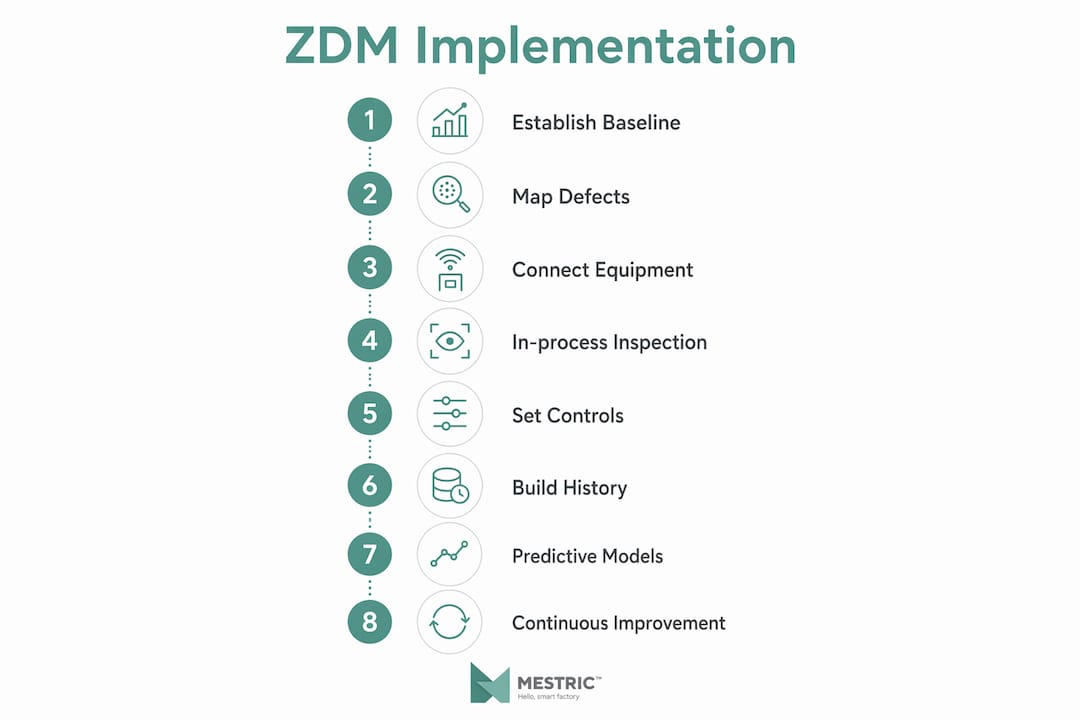
Implementing ZDM is a phased process. Attempting to deploy all four strategies simultaneously across an entire facility rarely succeeds. A structured, step-by-step approach produces better results and builds the organisational capability needed for the more advanced predictive stages.
Step 1: Establish your baseline. Before changing anything, measure your current defect rate, first-pass yield, scrap cost, and rework hours. You need this data to set realistic targets and to demonstrate improvement later.
Step 2: Map your process for defect opportunities. Conduct a detailed FMEA for each production stage. Identify where defects most commonly occur, what causes them, and what the current detection method is. This map becomes your ZDM implementation priority list.
Step 3: Connect your equipment. Install sensors and data collection systems on the machines and process steps that your FMEA identified as highest risk. Without real-time data, you cannot move beyond the Detect-Repair pairing.
Step 4: Implement in-process inspection at critical points. Replace or supplement end-of-line sampling with in-process checks at the stages where defects originate. Use automated measurement systems where production speed makes manual checking impractical.
Step 5: Set control limits and configure alerts. Define the acceptable range for every critical process variable and configure your MES or monitoring system to alert operators when limits are approached, not just when they are breached.
Step 6: Build your data history. Run the connected system for a sufficient period to accumulate the process data needed to train predictive models. The length of this phase depends on production volume and the variability of your process.
Step 7: Deploy predictive models. Once you have sufficient data, apply machine learning or statistical forecasting to predict process drift and defect occurrence. Start with the highest-risk process steps identified in your FMEA.
Step 8: Review and improve continuously. ZDM is not a project with an end date. Schedule regular reviews of your quality KPIs, update your FMEA as products and processes change, and retrain predictive models as new data accumulates. Exploring step-by-step production optimisation approaches can help you structure this continuous improvement cycle effectively.
Mestric’s MES platform is built for exactly the kind of connected, data-driven production environment that ZDM requires. It connects directly with your manufacturing equipment, tracks quality parameters, downtime, and performance metrics in real time, and surfaces the KPIs your team needs to act before defects occur rather than after.
If you are ready to move from end-of-line inspection to genuine in-process quality control, Mestric gives you the tools to do it. Explore how MES compares to traditional manufacturing approaches and what that shift means for your production quality in practice.
Zero-defect manufacturing works because it embeds quality control within the production process itself, using real-time data and predictive tools to eliminate defects before they reach the finished product.
| Point | Details |
|---|---|
| ZDM is prevention-first | The framework targets root causes before defects occur, not just end-of-line inspection. |
| Four paired strategies | Detect, Predict, Repair, and Prevent operate in combinations, with Predict-Prevent being the most advanced. |
| Industry 4.0 is the enabler | Computer vision, IoT sensors, AI, and MES platforms make 100% in-process inspection practical at production speed. |
| Terminology harmonisation matters | CEN-CENELEC’s 2025 Workshop Agreement addresses the lack of common language across quality, metrology, and condition monitoring disciplines. |
| Implementation is phased | Start with baseline measurement and Detect-Repair, then build towards predictive models as data accumulates. |


 069 763 552