

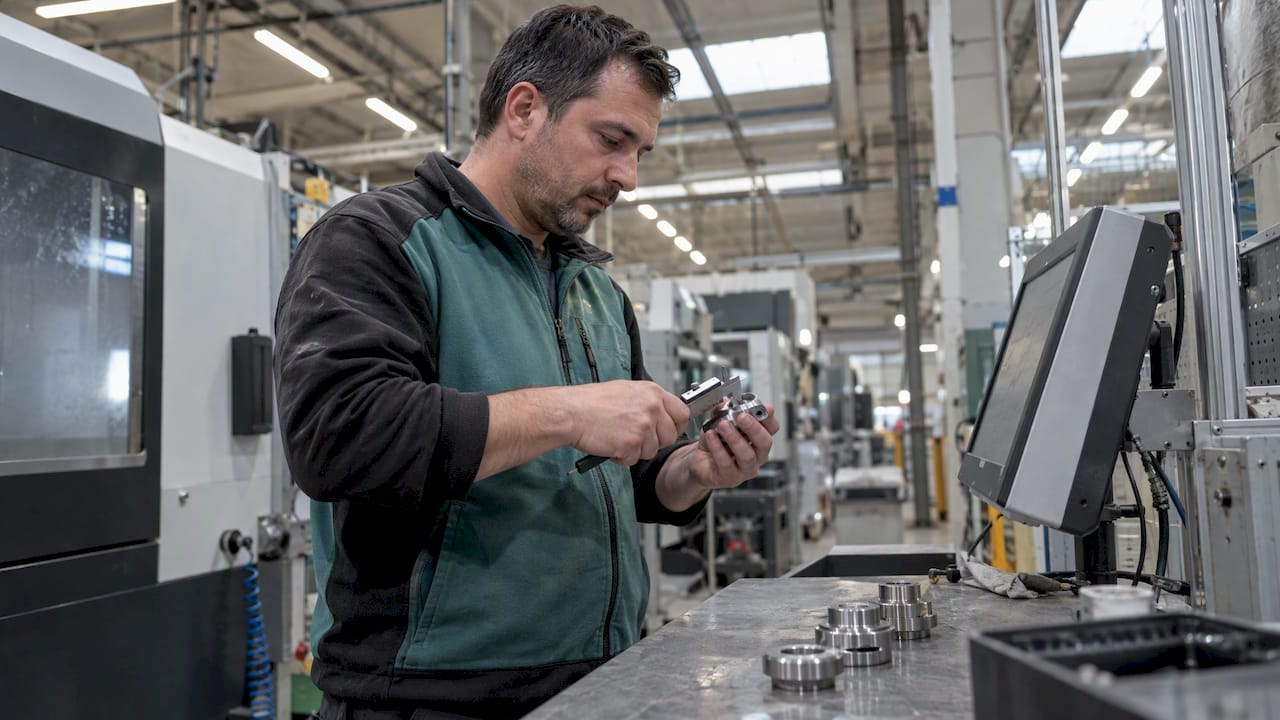
Digital quality records are inspection, measurement and process data that are captured, stored and controlled electronically, ideally straight from the machine or the operator’s terminal, and not typed in later from paper. A scanned PDF of a paper form is not one. A real digital record is timestamped, linked to a batch, machine and operator, and available to the people who need it while the shift is still running. This guide explains what to digitise first, what auditors will look for, and how to start without disrupting production.
A quality record answers a simple question: what was measured, by whom, when, on which product, and was it within tolerance? On paper, that is a checklist, a control card or a batch report. In a digital system, it is a data entry with the same meaning but with extra properties.
A useful digital record has five properties:
Many plants stop at the first step of digitisation: they scan forms or move them into spreadsheets. That is a legitimate improvement in storage, but it does not change when problems become visible. A UK engineering publication makes a similar point: isolated digital documents still complicate communication without a digital thread joining drawing, product and report.
Paper and Excel both work, until volume, variety or customer demands grow. The typical problems are the same in most plants:
Slovenian examples exist. A master’s thesis at the University of Maribor describes the case of the manufacturer Megras, which moved from traditional record-keeping to digital work records. It shows how typical the starting point is, even in established production companies.
The cost is hard to see because it is spread across many small tasks: ten minutes of copying per shift, an hour of searching before an audit, a day of sorting after a complaint. Before you buy anything, measure those minutes. They become your baseline.
A common worry is that digital records create new audit risk. In practice, the standard asks for equivalent control, whatever the medium. The ISO 9001 Auditing Practices Group, which advises auditors, notes that the growing dependence on electronic media means auditors need new approaches to examining electronic documented information.
In practical terms, expect questions like these:
There is a second, subtler point. When processes run inside software, the auditor must also understand the “virtual environment” that produces the record. The APG guidance on auditing digital processes stresses that the challenge is not only capturing data but trusting the software logic that defines the process. So control the settings: who can change a tolerance limit, a calculation rule or an alarm threshold? Those changes should be as controlled as a change to a paper work instruction.
A short checklist before an audit:
If you need to certify against a standard that is being revised, check the current edition and your certification body’s transition guidance, as requirements for documented information can be reworded between editions.
Not every form deserves digitisation on day one. Rank candidates by how much they cost when they go wrong and how easy they are to capture.
| Record type | Typical source | Why it pays off early |
|---|---|---|
| In-process measurements (dimensions, weight, temperature) | Gauges, sensors, operator entry | Deviations are visible before parts go out of tolerance |
| First-piece and start-up approvals | Operator terminal | Clear sign-off, no lost forms |
| Scrap and rework reasons | Operator terminal, machine | Feeds Pareto analysis of the real causes |
| Downtime and stoppage reasons | Machine signals plus operator input | Links quality problems to machine behaviour |
| Batch and material traceability | Barcodes, ERP, work orders | Fast containment when a complaint arrives |
| Final inspection results | Test stations | One place for customer reports |
The first two rows are usually the best start. They change behaviour on the line immediately, which builds trust among operators.
Once data is captured at the source, three things become possible that paper cannot do.
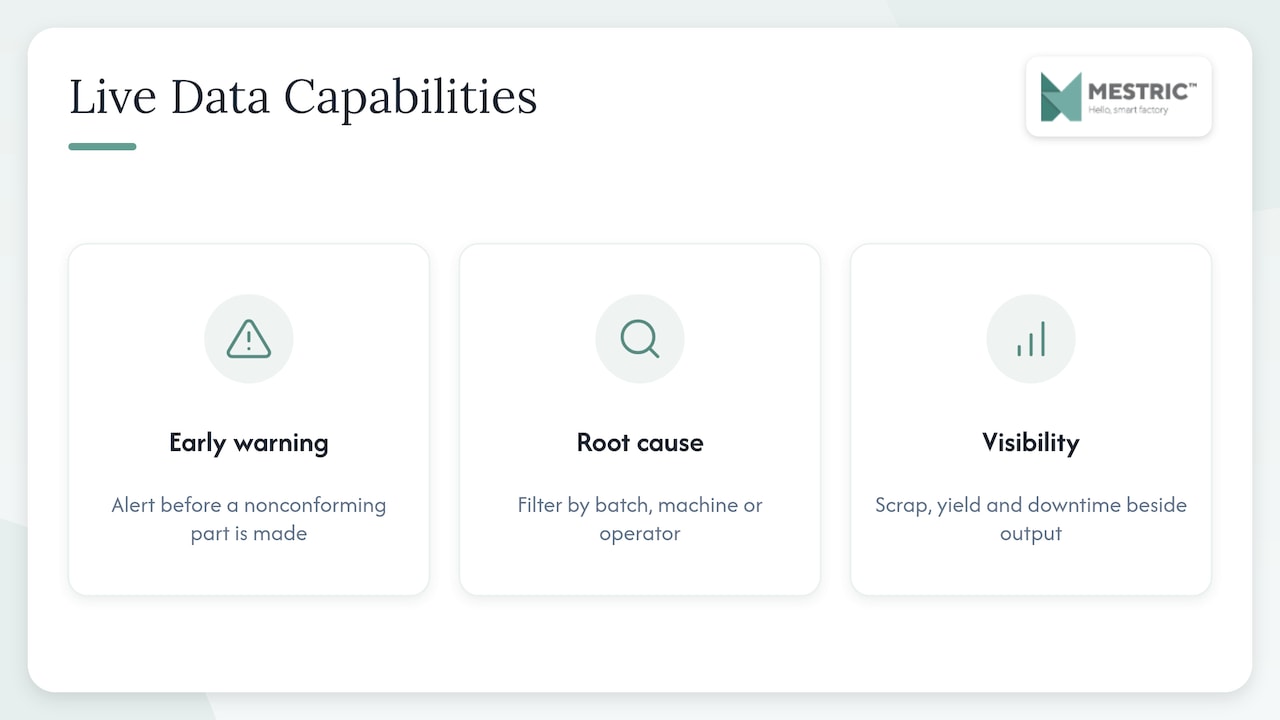
Early warning. If a value drifts toward its limit, the system can alert the operator before a nonconforming part is made. This is the idea behind statistical process control (SPC) run in real time instead of on a weekly printout.
Fast root-cause analysis. When every record carries batch, machine and operator, you can filter by one of them and see whether defects cluster. Our guide to batch traceability for quality teams describes a 90-day pilot approach using GS1 and ISA-95 concepts.
Management visibility. Scrap rate, first-pass yield and downtime appear on the same screen as output. For the logic behind this, see why monitoring manufacturing quality matters for operational excellence und real-time production tracking benefits.
The European research community treats this as a route to zero-defect manufacturing. The Horizon 2020 project Data Reliability and Digitally-enhanced Quality Management for Zero Defect Manufacturing starts from the observation that smart factories produce large amounts of data that must be reliable before it can improve quality. The same logic applies to a small plant: data you cannot trust is worse than no data.
We build a manufacturing execution system, so we are not neutral. But the pattern we see in quality work is consistent, and it is not about software features.
First, the biggest gain comes from moving the moment of recording. When a measurement is stored when it is taken, and linked to the machine, the rest follows: dashboards, alerts, traceability and shorter audits. Digitising the report at the end of the shift gives you a tidier archive, but not a faster reaction.
Second, operators decide whether a system succeeds. If entering a value takes longer than writing it down, they will find a way around it. That is why ease of use is not a luxury in an MES. Where possible, the machine should deliver the data itself, and people should only add what a machine cannot know, such as a defect reason.
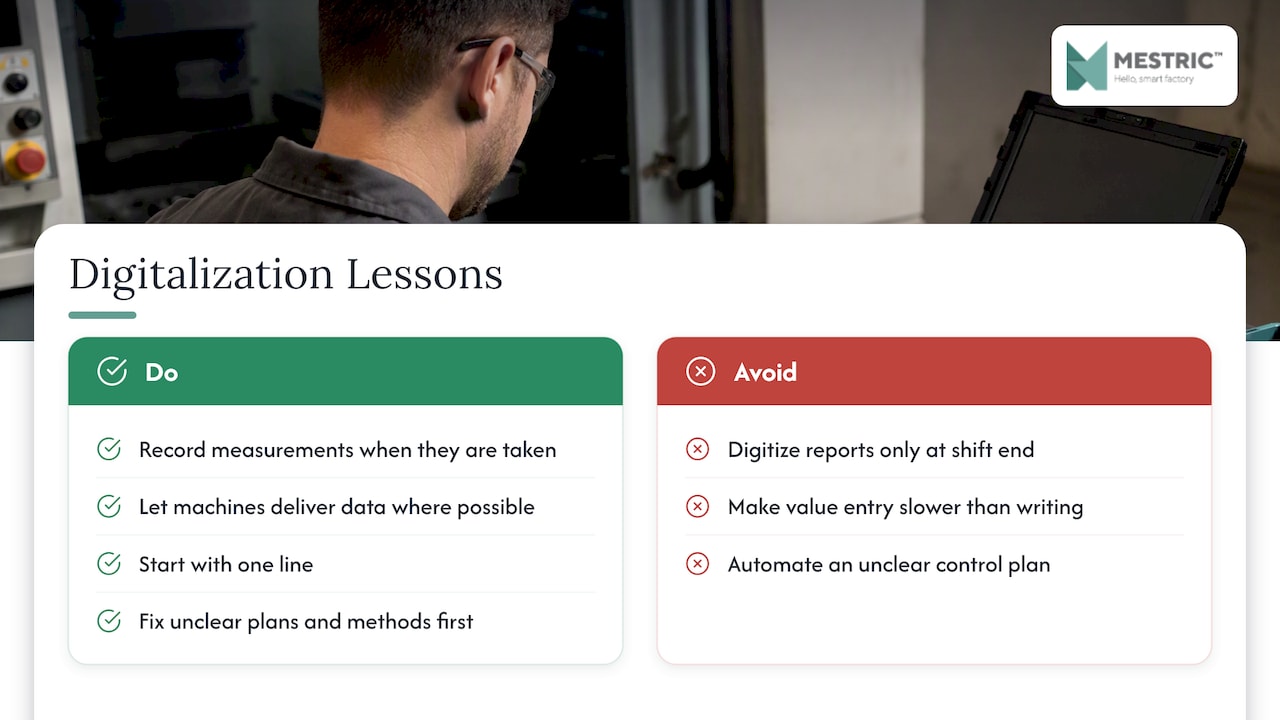
Third, start with a line, not a factory. One line with clear quality characteristics gives you a result in weeks, and a story you can show to colleagues. Our quality monitoring workflow guide follows that logic step by step.
Finally, be honest about what a platform cannot do. It will not fix an unclear control plan or a missing measurement method. Fix those first, and the digital record will show the truth rather than automate confusion.
— Andraž
In Slovenia, the obstacle is rarely a lack of software. The Institute of Macroeconomic Analysis and Development (UMAR) concluded in its conference material that profound digital transformation of companies is slow, and it names an unsystematic approach and low awareness of its importance among the reasons.
For a quality manager, that translates into four practical decisions:
This is also where financing can matter. Slovenian public calls for digital transformation of business have existed, so check current calls on the websites of the Ministry of the Economy, Tourism and Sport and the Slovenian Enterprise Fund before you plan the budget. We do not state conditions here, because they change by call.
This is a realistic outline for one production line.
Pick a line with a visible quality problem, such as recurring scrap or frequent customer complaints. List the forms used on it. For two weeks, measure how long recording and reporting take, and how long it takes to find one specific batch record. Write the numbers down.
For each quality characteristic, define the unit, the limits, the measurement method, the frequency and who is responsible. Decide which values come from machines and which from people. Agree on a short list of defect and downtime reasons, no more than fifteen or so, so operators can choose quickly.
Connect the machines and set up operator input. Run the digital records alongside paper for a few weeks. Compare the two, correct the definitions, and remove fields nobody uses. Check access rights and the correction rule now, not before the audit.
Repeat the baseline measurement. Compare time spent, time to trace a batch, and scrap trends. Retire the paper forms on the pilot line, and write down what you would change before the next line. If the pilot worked, extend it in the same pattern.
A quality management module, an ERP and an MES overlap, and it is worth knowing which does what. Our overview of seven types of manufacturing software explains the roles. In short: the ERP plans orders and materials, a quality system manages documents and procedures, and the MES works at the machine, collecting what happens in real time and tying it to the order. Digital quality records are strongest where the three share data. For a wider comparison, read MES vs. traditionelle Fertigung.
Quality tools also differ in what they capture. Our article on examples of quality monitoring tools and the one on quality monitoring examples that cut waste show practical cases, and manufacturing quality control tips cover the basics that should be in place before any software.
Mestric™ MES connects directly to production equipment and collects performance, downtime and quality data automatically. Production managers see KPIs on live dashboards, and AI-powered tools suggest where processes and quality can improve. We show how this works in practice through an on-site demonstration with connected machinery, so you can judge it against your own line rather than a slide deck. Pricing is not published, and we agree it with you after the demonstration. Read more about the Mestric™ MES solution or start from mestric.com.
Not in the sense that matters for control. A scan preserves the form, but the data inside it cannot be searched, analysed or linked to a batch automatically. It is a good archive step, not a change in how fast you detect problems.
Yes, provided the control is equivalent to what you would apply to paper. The ISO 9001 Auditing Practices Group guidance asks auditors to examine electronic documented information with suitable methods. Prepare role-based access, change history, backup and a clear correction rule.
Yes. An MES layer can collect data at the machine and share it with the ERP, so you do not have to replace anything to begin. Start with one line and decide on wider integration after the pilot.
It depends on the line and the data you already have. A pilot of about 90 days is enough to measure time saved on reporting and the time to trace a batch. Treat any promise of fixed savings with caution until you have your own baseline.


 069 763 552