


TL;DR:
- Shop floor visibility provides real-time tracking of production activities, enabling proactive management and quicker responses. Integrating MES, IoT, and ERP systems improves data accuracy, flow, and decision-making. Proper implementation enhances efficiency, quality, and resource utilization across manufacturing operations.
Shop floor visibility is defined as the real-time ability to track and understand every activity on the manufacturing floor, from equipment status and job progress to quality output and workforce utilisation. Without it, production managers rely on delayed reports, verbal updates, and gut instinct. The manufacturing sector saw a 28% increase in digital transformation technology adoption in 2025. That figure reflects how urgently manufacturers are moving away from fragmented, after-the-fact data towards live operational insight. Understanding what is shop floor visibility is the first step towards building a production environment that responds to problems before they become costly.
Shop floor visibility is the capability to see the current status of your production operations, equipment, and workflows with accuracy and immediacy. The industry term for the broader concept is manufacturing visibility, which encompasses not just what is happening on the floor but also why it is happening and what action to take next. Manufacturing visibility connects people, systems, and machines into a single operational picture.

The practical difference this makes is significant. Without visibility, a production manager learns about a bottleneck when an order is already late. With it, the same manager sees queue times building at a work centre and intervenes hours earlier. This shift from reactive troubleshooting to proactive control is the core value of shop floor transparency.
Traceability, the ability to track product location, process parameters, and production status at any moment, is a foundational measure of how mature a manufacturing system’s visibility actually is. Low delay time in delivering accurate information is what separates genuine transparency from a dashboard that shows yesterday’s numbers dressed up as live data.
Three technologies form the backbone of shop floor data visibility: Manufacturing Execution Systems (MES), Internet of Things (IoT) sensors, and Enterprise Resource Planning (ERP) systems. Each plays a distinct role, and their value multiplies when they work together.
Manufacturing Execution Systems (MES)
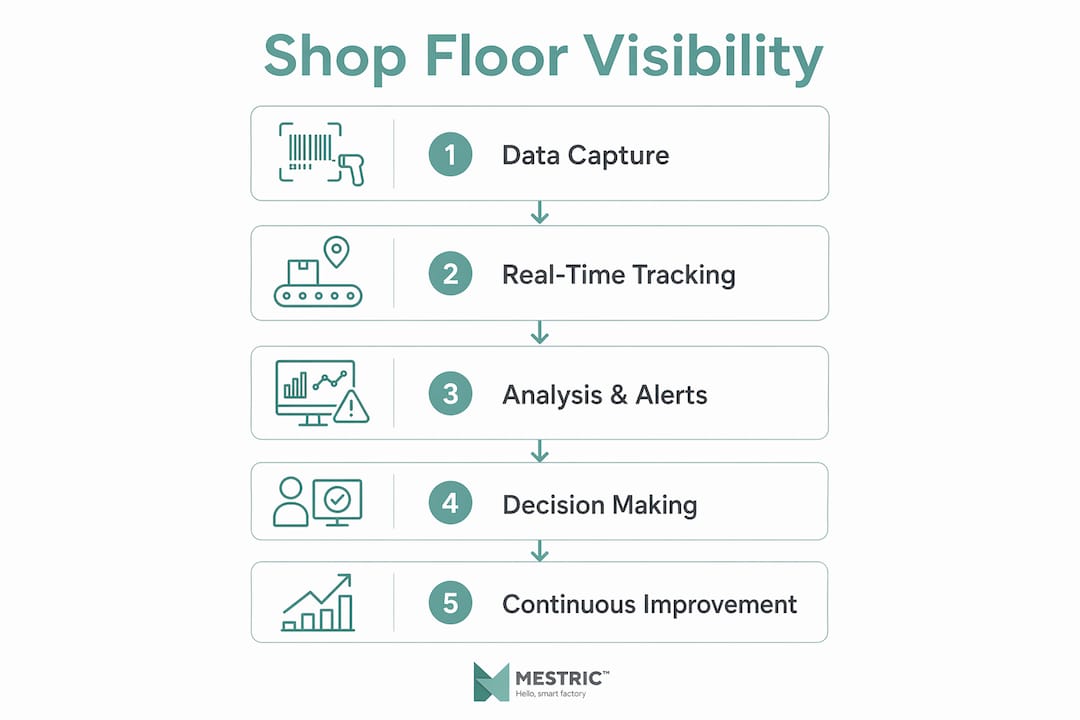
A MES tracks executed orders, equipment utilisation, and product flow in real time. This is the critical gap ERP systems cannot fill on their own. An ERP knows what was planned; an MES records what actually happened, including actual start times, run durations, quality output, and current operation status. Mestric is built on this MES foundation, connecting directly with manufacturing equipment to surface live KPIs including performance metrics, downtime, and quality parameters.
IoT sensors and machine monitoring
IoT sensors attach to individual machines and feed continuous data on temperature, cycle times, vibration, and output rates. This granular data feeds into dashboards in near real time, giving production teams visibility at the machine level rather than just the order level. The role of IoT in manufacturing has expanded rapidly as sensor costs have fallen and connectivity has improved.
ERP integration
ERP systems hold the planned production schedule, materials data, and financial records. When MES and IoT data feed into the ERP, managers can compare planned versus actual performance across the entire value chain. Integrating manufacturing data removes the silos that cause delays and unseen inefficiencies.
Overcoming data challenges
Plants without integrated systems operate with fragmented data silos where production logs, downtime records, and quality information exist separately. The result is delayed decisions and missed problems. Data overload is an equally real risk when too many signals flood a central system. Edge computing addresses this by processing data locally at the machine level before sending only relevant summaries upstream, reducing delay and improving responsiveness.
Pro Tip: Start integration at the MES layer first. Once you have accurate execution data, connecting IoT feeds and ERP records becomes far more straightforward.
Effective shop floor visibility produces measurable improvements across production tracking, quality control, and resource utilisation. The benefits are not abstract. They show up in delivery reliability, scrap rates, and machine uptime.
“Manufacturing visibility provides the ability to understand what is happening now, why it is happening, and what actions to undertake next across the value chain.”
The analogy that resonates most with production managers is the difference between driving with a rearview mirror and driving with a clear windscreen. End-of-shift reports are the rearview mirror. Real-time shop floor data is the windscreen. You can only steer effectively when you can see what is ahead.
Shop floor visibility translates directly into better workflow management by giving production teams a live view of job status, equipment effectiveness, and emerging bottlenecks. The improvement is not theoretical. It changes how managers spend their time and where they focus attention.
Every job on the floor has a routing, a sequence of work centres it must pass through. Visibility tools show exactly where each job sits in that routing at any moment. When a job stalls at a particular work centre, the system flags it immediately rather than waiting for a supervisor to notice. This is the foundation of real-time production tracking and the reason it drives measurable efficiency gains.
Overall Equipment Effectiveness (OEE) is the standard metric for measuring how productively a machine is being used, combining availability, performance, and quality into a single score. Effective visibility enables managers to monitor OEE, job status, and quality metrics in real time, providing early warning of delays and inefficiencies. Trending OEE data over time also reveals which machines are candidates for maintenance or replacement.
A well-designed dashboard presents the right information to the right person without requiring them to dig through reports. Production managers need order status, equipment alerts, and quality flags. Shift supervisors need queue times and operator assignments. Mestric’s approach is to surface these KPIs directly from connected equipment, removing the manual data entry that introduces errors and delays.
Pro Tip: Design dashboards around decisions, not data. Ask what action each metric should trigger, then build the display around that answer.
| Visibility metric | What it tells you | Why it matters |
|---|---|---|
| OEE score | Combined availability, performance, and quality | Identifies underperforming equipment before downtime occurs |
| Job routing status | Current work centre for each active order | Flags stalled jobs and queue buildups in real time |
| First-pass yield | Percentage of units passing quality check first time | Signals process drift before scrap accumulates |
| Queue time by work centre | Time jobs wait before processing begins | Reveals bottlenecks and capacity imbalances |
Managing bottlenecks requires knowing where they are before they cause a delay. Queue time data by work centre is one of the most direct indicators of where the floor is under pressure. When queue times at one work centre consistently exceed others, that is where capacity investment or process adjustment is needed.
Implementing shop floor visibility successfully requires more than installing sensors or buying software. The organisations that get the most from visibility tools follow a clear set of practices that prioritise integration, usability, and staff capability.
Shop floor visibility is the real-time connection between your production data and your decisions, and it requires integrated MES, IoT, and ERP systems to deliver genuine operational control.
| Point | Details |
|---|---|
| Define visibility clearly | Shop floor visibility means real-time tracking of equipment, jobs, and quality, not end-of-shift reports. |
| Integrate before you display | Connect MES, IoT, and ERP data into one source of truth before building dashboards. |
| Focus on proactive control | Visibility shifts management from reacting to problems to preventing them before they affect output. |
| Use OEE and queue time | These two metrics together reveal equipment performance and workflow bottlenecks most directly. |
| Keep interfaces simple | Dashboards designed around decisions, not data volumes, get used consistently by production teams. |
I have spent years working with manufacturing teams across different sectors, and the pattern is consistent. The plants that struggle most are not short of data. They are short of connected data. They have a spreadsheet for downtime, a separate system for quality records, and an ERP that knows the plan but not the reality. The gap between those systems is where delays, waste, and poor decisions live.
What surprises me is how often the solution is framed as a technology problem when it is actually a process problem. The technology to connect these systems has existed for years. The harder work is agreeing on which metrics matter, training people to act on them, and resisting the urge to add complexity once the basics are working.
The future direction is clear. AI-assisted decision-making will increasingly sit on top of visibility platforms, moving from “here is what is happening” to “here is what you should do about it.” But that only works if the underlying data is clean, connected, and current. Visibility is not the end goal. It is the foundation everything else is built on.
— Andraž
Mestric is a Manufacturing Execution System built specifically for production teams that need live operational data without the complexity of enterprise-scale implementations.
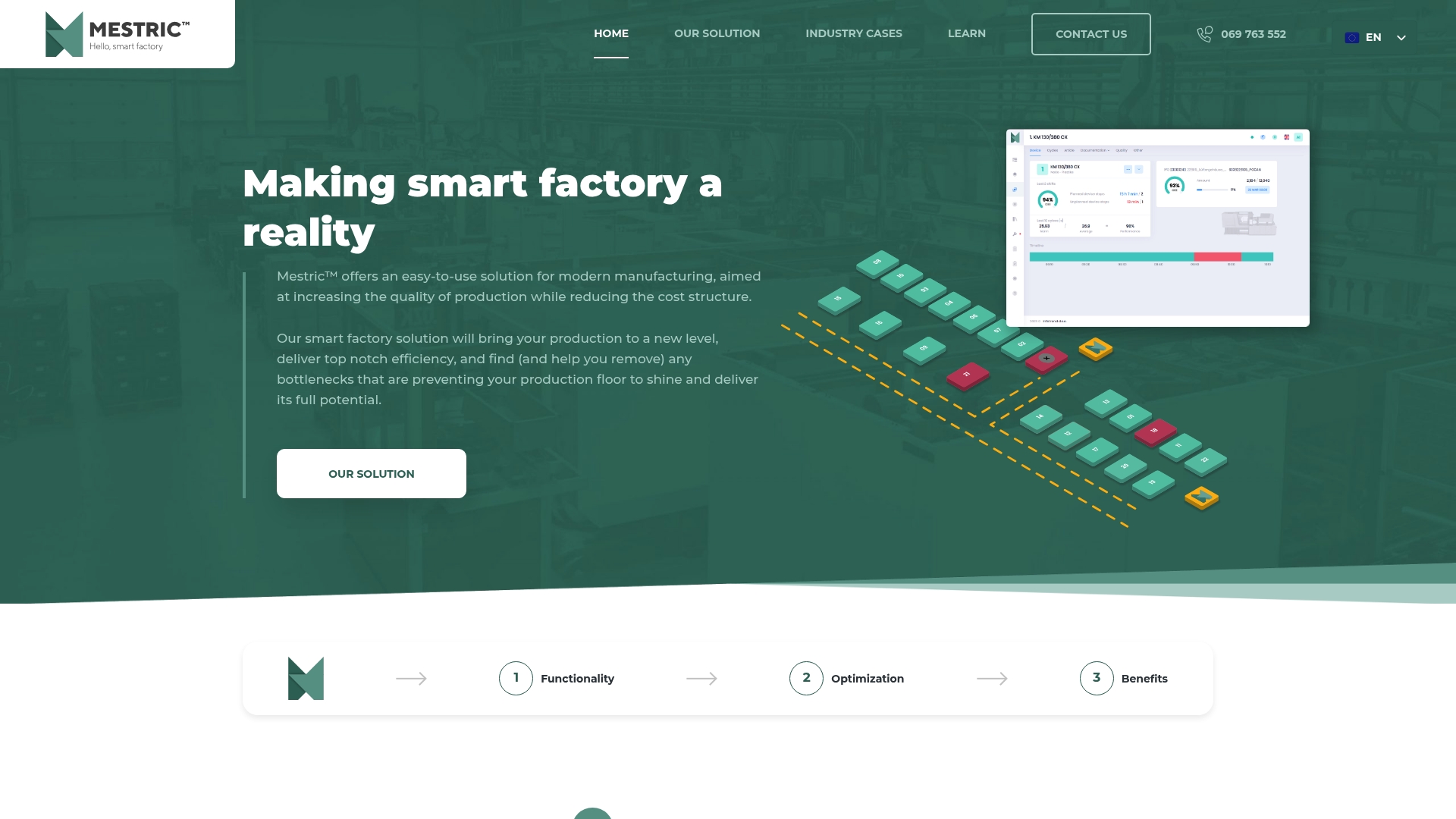
The platform connects directly with manufacturing equipment to surface KPIs including OEE, downtime, quality parameters, and cost analysis in real time. AI-powered tools sit on top of that data to identify bottlenecks and support faster decisions. For production managers looking to move from reactive troubleshooting to data-driven control, Mestric’s MES approach to efficiency provides a practical starting point. You can also explore production optimisation step by step to see how visibility connects to broader operational improvements. Request an onsite demonstration to see how connected machinery performs in a real production environment.
Shop floor visibility is the real-time ability to track equipment status, job progress, quality output, and workforce activity on the production floor. It gives production managers an accurate, live picture of operations rather than delayed or fragmented reports.
Manufacturing Execution Systems (MES), IoT sensors, and ERP integration are the three core technologies. Together they create a single source of truth that connects planned production with actual execution data.
Visibility tools show the current routing status of every active job, flagging stalled orders and queue buildups as they happen. This allows managers to intervene before delays affect delivery schedules.
OEE (Overall Equipment Effectiveness) measures availability, performance, and quality in a single score. Monitoring OEE in real time provides early warning of equipment issues and helps prioritise maintenance before breakdowns occur.
Start by integrating MES, IoT, and ERP data into one system, then build dashboards around the decisions your team needs to make. Train staff to act on what they see, and keep the interface simple enough that it gets used consistently every shift.


 069 763 552