


TL;DR:
- Shop floor control manages real-time work orders, resources, and progress to ensure manufacturing efficiency. It enables immediate problem detection, supports decision-making, and reduces downtime and waste. Successful implementation depends on integrating systems, training staff, and emphasizing real-time decision-making.
Shop floor control (SFC) is defined as the system that manages real-time production work orders, resources, and progress to ensure manufacturing operations run smoothly and efficiently. Also referred to in industry literature as production floor management or shop floor management, SFC sits at the heart of daily factory operations. It connects what your planning team schedules with what actually happens on the production line. Without it, deviations between planned and actual output go undetected until they become costly failures. For plant managers and supervisors, understanding SFC is the first step towards consistent output, reliable quality, and measurable efficiency gains.
Shop floor control is the operational layer that translates production plans into executed work. It tracks every work order from release to completion, monitors the status of machines and operators, and flags problems the moment they appear. Think of it as the system that keeps your production floor honest.

The core purpose of SFC is deviation management: detecting and responding immediately to discrepancies between planned and actual production performance. That capability directly reduces delivery failures. When a machine goes down or a batch falls behind schedule, SFC surfaces the problem in real time rather than at the end of a shift report.
SFC also integrates with Manufacturing Execution Systems (MES) and ERP platforms to provide real-time production visibility across scheduling, resource allocation, and quality control. That integration is what gives plant managers a single, accurate picture of the floor at any given moment.
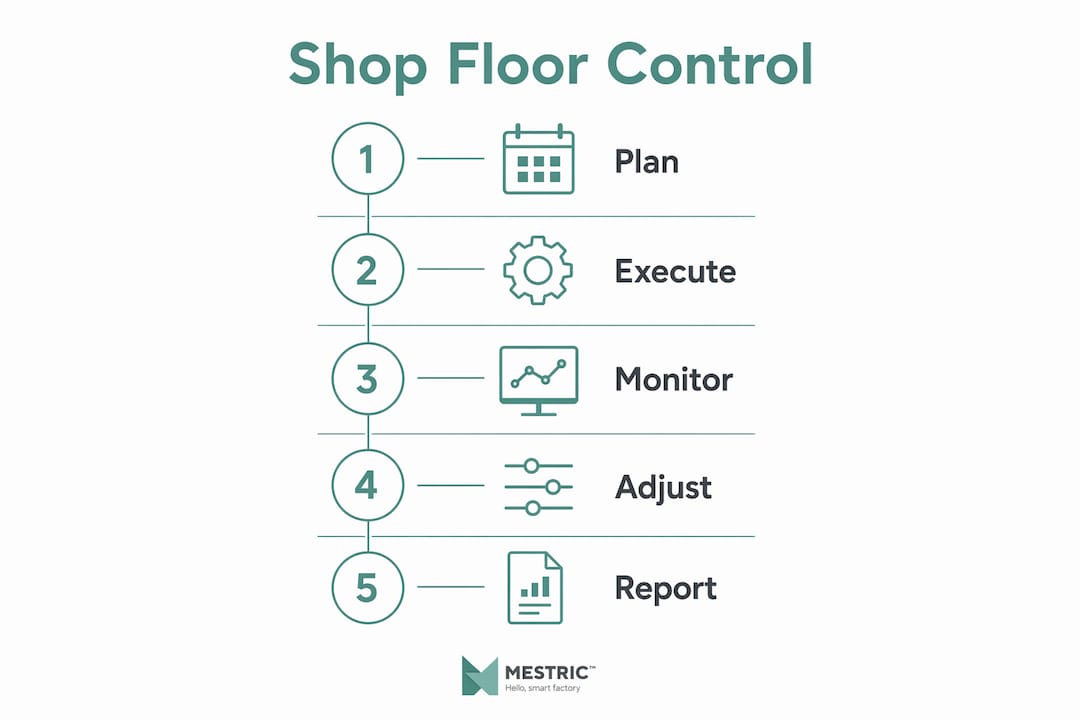
Effective SFC is built from several interdependent functions. Each one contributes to the overall goal of keeping production on plan.
Pro Tip: Set up automated alerts for any work order that falls more than 10% behind its planned cycle time. Early warnings give supervisors time to reallocate resources before a delay becomes a missed delivery.
The combination of these functions means SFC does not just record what happened. It gives you the information to act while there is still time to change the outcome.
This is the question most plant managers ask when they first encounter SFC. The three systems are related but operate at different levels of the manufacturing organisation.
ERP (Enterprise Resource Planning) handles high-level business planning: customer orders, procurement, finance, and master production scheduling. It is the system that tells the factory what to make and when. MES (Manufacturing Execution System) sits one level below ERP and manages the full production lifecycle, from order release through to finished goods. SFC is a focused function within MES that handles floor-level execution specifically.
One useful way to frame it: ERP is the brain for planning, while SFC acts as the nervous system, executing those plans in real time and sending feedback upward. ERP and SFC are distinct but complementary, with ERP focused on business planning and SFC managing real-time execution and feedback.
| System | Primary focus | Typical users | Data horizon |
|---|---|---|---|
| ERP | Business and supply chain planning | Finance, procurement, planning | Days to months |
| MES | Full production lifecycle management | Production managers, quality teams | Hours to days |
| SFC | Real-time floor execution and control | Supervisors, machine operators | Minutes to hours |
Understanding where SFC sits in this hierarchy matters for implementation. If you try to use ERP alone to manage floor-level execution, you lose the real-time responsiveness that SFC provides. If you deploy SFC without connecting it to your ERP, you lose the planning context that makes floor decisions meaningful. For a deeper look at how MES and SFC compare with traditional approaches, the distinction becomes even clearer in practice.
Implementing SFC is not a software project. It is an operational change that requires clear process ownership, accurate data, and a workforce that understands why the system exists.
Pro Tip: Pilot SFC on one production line before rolling it out across the facility. A contained pilot surfaces integration issues and training gaps without disrupting the entire operation.
A common pitfall is treating SFC as a reporting tool rather than a control tool. The value is not in the data it collects. The value is in the decisions that data enables, in real time, on the floor.
The business case for SFC is grounded in measurable outcomes. Large manufacturing facilities lose an average of 27 hours of production per month due to unplanned downtime. That figure represents a significant share of available capacity, and SFC’s early bottleneck detection directly addresses it.
Beyond downtime, SFC reduces lead times and work-in-progress inventories while improving on-time delivery rates. Shorter lead times mean faster customer response. Lower WIP means less capital tied up on the floor. Both outcomes improve financial performance without requiring capital investment in new equipment.
Quality management benefits equally. SFC monitors production parameters in real time, so deviations from specification are caught at the point of occurrence rather than at final inspection. That shift from reactive to proactive quality control reduces scrap, rework, and warranty costs. You can read more about the role of production quality monitoring in achieving these outcomes.
The efficiency gains from SFC also support lean manufacturing directly. By tracking takt time and enforcing standardised work sequences, SFC makes waste visible. Visible waste gets addressed. That is the foundation of any sustained improvement programme.
Key production KPIs that SFC enables you to track and act on include:
Shop floor control is the real-time execution layer that connects production planning to factory floor outcomes, and its absence is measurable in lost hours, missed deliveries, and undetected quality failures.
| Point | Details |
|---|---|
| SFC defined | SFC manages real-time work orders, resources, and progress to keep production on plan. |
| Distinct from ERP and MES | SFC handles floor-level execution; ERP manages business planning; MES covers the full production lifecycle. |
| Unplanned downtime cost | Large factories lose an average of 27 hours of production monthly. SFC’s bottleneck detection reduces this directly. |
| Implementation priority | Connect machines, integrate with ERP, and train supervisors before rolling out to the full facility. |
| Quality and efficiency gains | SFC reduces lead times, WIP inventory, and scrap by catching deviations at the point of occurrence. |
I have worked with manufacturing teams at various stages of digital maturity, and the pattern I see most often is this: a facility invests in SFC software, configures the dashboards, and then uses it almost exclusively as a reporting tool. Shift supervisors check the numbers at the end of the day. Managers review the weekly summary. Nothing changes on the floor in real time.
That is not shop floor control. That is shop floor observation.
The distinction matters enormously. SFC only delivers its full value when it drives decisions in the moment, not in the debrief. A deviation alert that fires at 10:00 AM and gets acted on by 10:15 AM prevents a missed delivery. The same alert reviewed at 5:00 PM is just a record of what went wrong.
The human element is where most implementations succeed or fail. Supervisors need to trust the data, understand what the alerts mean, and have the authority to act on them without waiting for approval. Change management is not a soft concern here. It is the primary implementation risk.
I am also watching the integration of AI into SFC with genuine interest. Systems that can predict bottlenecks before they occur, rather than simply detecting them after the fact, represent a meaningful step forward. The role of AI in manufacturing is moving from novelty to operational necessity faster than most plant managers expect. The facilities that treat SFC as a living control system rather than a reporting layer will be the ones best positioned to absorb those capabilities when they arrive.
— Andraž
Mestric is a Manufacturing Execution System built specifically for production teams that need real-time visibility and control without the complexity of enterprise platforms.
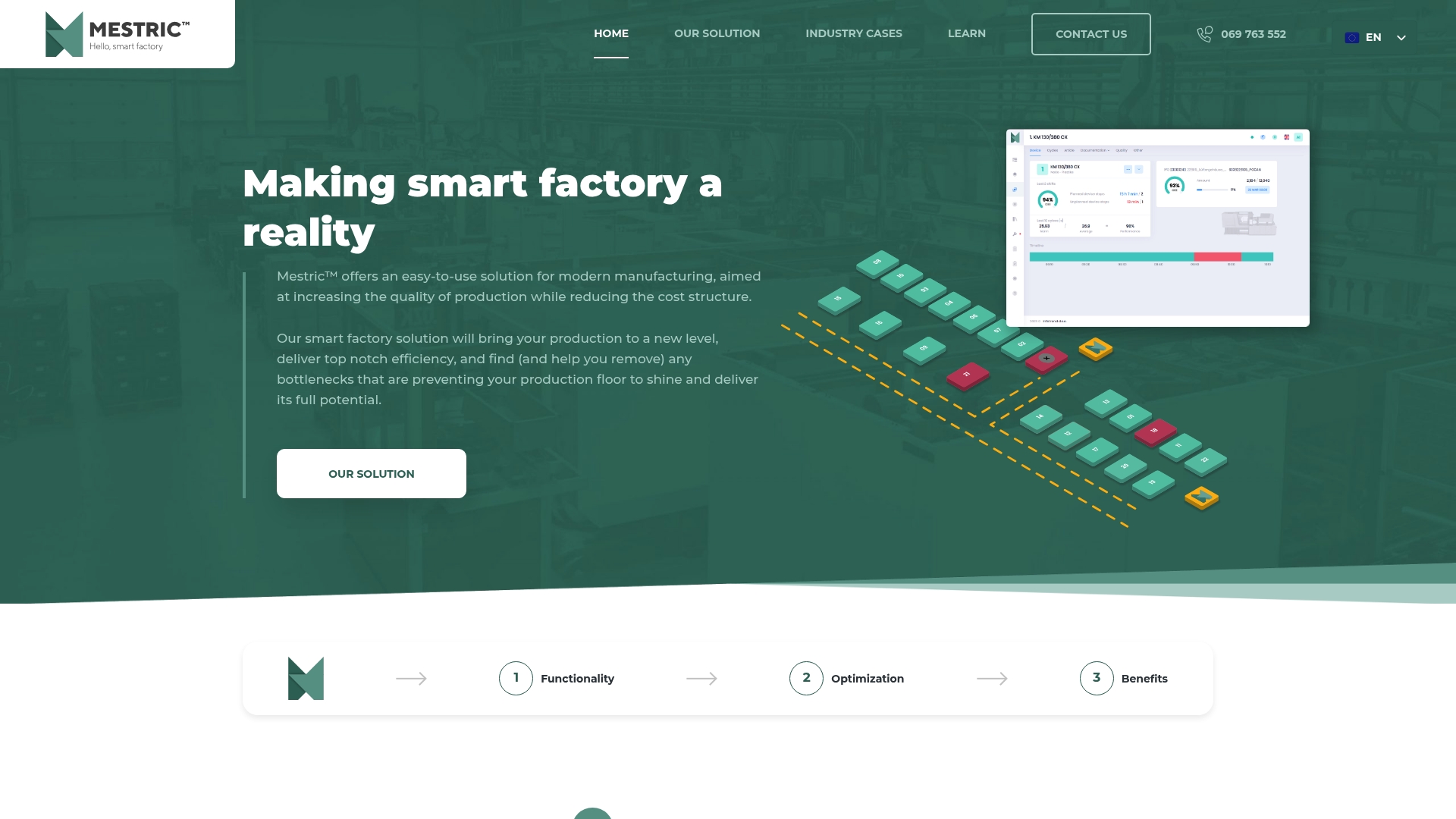
Mestric connects directly with manufacturing equipment to capture live KPIs including machine utilisation, downtime, quality parameters, and throughput. Those metrics feed into AI-powered analysis that identifies bottlenecks and flags deviations before they escalate. The system integrates with ERP platforms, so the data flowing between planning and execution stays accurate and current. For plant managers assessing how MES compares to traditional manufacturing approaches, Mestric offers an onsite demonstration that shows exactly how connected machinery performs in a real production environment. If you are building the case for SFC investment, the production KPIs and examples Mestric tracks give you the numbers to make that argument clearly.
Shop floor control is the system that manages real-time work orders, resources, and production progress on the factory floor. It ensures that planned production schedules are executed accurately and that deviations are detected and corrected immediately.
MES covers the full production lifecycle from order release to finished goods, while SFC is the floor-level execution function within MES. SFC focuses specifically on real-time work order management, resource tracking, and deviation response.
SFC reduces unplanned downtime, shortens lead times, lowers work-in-progress inventory, and improves on-time delivery rates. It also supports quality management by catching production deviations at the point of occurrence rather than at final inspection.
SFC supports lean production by monitoring takt time, controlling workflow, and enforcing standardised work practices to reduce waste. It makes inefficiencies visible in real time, which is the foundation of any sustained lean improvement programme.
The primary implementation risk is treating SFC as a reporting tool rather than a real-time control system. Supervisors must have the training, the data access, and the authority to act on alerts immediately for SFC to deliver its full value.


 069 763 552