


TL;DR:
- Choosing the wrong MES type can reduce production efficiency and compliance. Proper matching of platform, deployment, and manufacturing model ensures operational success.
Manufacturing Execution Systems (MES) are classified primarily by deployment architecture and manufacturing model suitability, and choosing the wrong type directly undermines production efficiency and compliance. The benefits of MES systems only materialise when the platform matches your operational reality. Leading platforms in 2026 include Siemens Opcenter, GE Vernova Proficy, and Tulip, each designed for distinct manufacturing contexts. Understanding the types of MES solutions available is the first step towards selecting a system that genuinely fits your facility.

The three core deployment architectures for MES solutions are on-premise, cloud-based, and hybrid. Each carries distinct trade-offs in security, scalability, and management overhead that directly affect your IT team and production floor.
On-premise MES guarantees data residency and offline functionality. This makes it the right choice for facilities with strict data sovereignty requirements or unreliable internet connectivity. You retain full control over customisation, but you also carry the full burden of infrastructure maintenance and upgrades.
Cloud-native MES platforms are scalable and favoured by multi-location producers for centralised visibility and remote management. Updates are handled by the vendor, which reduces internal IT demands considerably. The trade-off is dependency on internet connectivity and a shared-responsibility model for data security.
Hybrid MES combines on-premise security with cloud accessibility, making it well suited for companies that need real-time remote access alongside offline operation. This architecture is increasingly common in automotive and electronics manufacturing, where both data sensitivity and multi-site coordination matter.
Key considerations when choosing a deployment type:
Pro Tip: Audit your IT capability and network infrastructure before committing to a deployment model. A cloud MES deployed at a facility with poor connectivity will create more problems than it solves.
MES selection depends primarily on manufacturing model: discrete, process, or hybrid. Each model places fundamentally different demands on the system, and a mismatch between platform and model is one of the most common causes of failed MES implementations.
Discrete manufacturing emphasises machine monitoring and flexible scheduling. Production involves distinct, countable units, such as automotive components or electronic assemblies. MES platforms for this model prioritise real-time work order tracking, machine utilisation, and quality inspection at each production stage. Siemens Opcenter is a widely deployed example in this category.
Process manufacturing focuses on continuous flow or batch production, common in food, chemicals, and pharmaceuticals. Process manufacturing focuses on batch traceability and regulatory compliance, which means the MES must handle recipe management, lot genealogy, and deviation tracking. GE Vernova Proficy is a strong fit here, particularly in energy-intensive process environments.
Pharmaceutical and aerospace manufacturers face the most demanding MES requirements. Electronic batch records, full auditability, and 21 CFR Part 11 compliance are non-negotiable. The MESA standard guides MES design but must be balanced against industry-specific compliance requirements, such as pharma’s emphasis on batch traceability. Platforms like Siemens Opcenter and Aegis FactoryLogix are built with these constraints in mind.
Some facilities combine discrete and process operations, for example a plant that blends chemicals and then fills discrete containers. MES platforms serving hybrid models must handle both scheduling paradigms without forcing you to run two separate systems. Flexibility in data modelling and workflow configuration is the key differentiator here.
Enterprise MES platforms, specialist MES, and composable platforms represent the three primary functional categories. Understanding these categories helps you match platform capability to your operational complexity and budget.
Enterprise platforms such as Siemens Opcenter and AVEVA MES are built for complex, multi-site manufacturing environments. They offer comprehensive functionality across production scheduling, quality management, genealogy, and performance analytics. The implementation timeline is typically longer and the total cost of ownership is higher, but the depth of capability justifies this for large manufacturers.
Industry-specific MES solutions provide pre-configured features that save implementation time but can be rigid if your production deviates from standard assumptions. Examples include PAS-X for pharmaceutical batch manufacturing and Solumina by iBase-t for aerospace and defence. These platforms come with built-in compliance frameworks, which is a significant advantage in regulated sectors. The risk is that customisation outside the intended model becomes expensive and slow.
Composable low-code MES platforms like Tulip provide flexibility suited for manufacturers who cannot justify a large enterprise rollout. You build workflows using visual tools rather than custom code, which dramatically reduces deployment time. Rhize is another platform in this category, targeting manufacturers who want modular, API-first architectures. Composable MES are rising, favoured by manufacturers seeking agile, modular deployments rather than traditional monolithic systems.
Connected worker platforms sit at the intersection of MES and workforce management. They digitise paper-based work instructions, capture operator inputs in real time, and feed data back into production analytics. Tulip operates in this space as well, making it a dual-category platform. These solutions are particularly effective in assembly-intensive discrete manufacturing where human process steps are the primary source of variability.
Not every facility needs an enterprise platform. Mid-market MES solutions target single-site manufacturers with moderate complexity. They typically offer production scheduling, basic quality tracking, and OEE (Overall Equipment Effectiveness) monitoring at a fraction of the cost of enterprise systems. The trade-off is limited scalability and fewer integration options with ERP systems like SAP or Oracle.
| MES category | Best fit | Compliance strength | Flexibility |
|---|---|---|---|
| Enterprise (Siemens Opcenter, AVEVA) | Multi-site, complex discrete or pharma | High | Moderate |
| Industry-specific (PAS-X, Solumina) | Pharma, aerospace | Very high | Low |
| Composable/low-code (Tulip, Rhize) | Agile, mid-size manufacturers | Moderate | Very high |
| Connected worker platforms | Assembly-intensive discrete | Low to moderate | High |
| Mid-market MES | Single-site, moderate complexity | Moderate | Moderate |
The right MES type is determined by four factors: your manufacturing model, your deployment constraints, your IT capability, and your integration requirements. Treating any one of these as secondary leads to costly rework after go-live.
Start by mapping your manufacturing model to the platform categories above. A pharmaceutical batch facility has no business evaluating a connected worker platform as its primary MES. A small electronics assembler does not need the overhead of Siemens Opcenter.
Practical selection criteria for production managers:
Scenario guidance:
For facilities in highly regulated sectors, manufacturing compliance consulting can clarify which MES certifications are mandatory before you begin vendor evaluation.
Pro Tip: Run a pilot on one production line before committing to a full rollout. A six-week pilot reveals integration gaps and user adoption issues that no vendor demo will show you.
The MES market is consolidating with AI integration and composable architectures as the primary differentiators going forward. Understanding where each major platform sits today helps you make a decision that remains sound over a three-to-five-year horizon.
Siemens Opcenter aligns well with highly regulated pharma and complex discrete manufacturing. Its strength is depth of functionality and a mature integration layer with Siemens’ broader digital manufacturing portfolio. The weakness is implementation complexity and cost, which can be prohibitive for mid-size manufacturers.
GE Vernova Proficy targets process industries and energy-intensive environments. Its real-time data historian and process analytics capabilities are industry-leading, but it is less suited to discrete assembly operations.
Tulip occupies a distinct position as a low-code, connected worker platform. It deploys faster than any enterprise alternative and is well suited to manufacturers who need to digitise manual processes quickly. Its compliance capabilities are more limited, which makes it a poor fit for pharmaceutical or aerospace primary MES requirements.
Aegis FactoryLogix targets electronics manufacturing specifically, with strong support for IPC standards and complex PCB assembly traceability. It is a specialist platform with limited applicability outside electronics.
| Platform | Deployment | Industry fit | Compliance | Implementation complexity |
|---|---|---|---|---|
| Siemens Opcenter | On-premise, hybrid | Pharma, discrete | Very high | High |
| GE Vernova Proficy | On-premise, hybrid | Process, energy | High | High |
| Tulip | Cloud | Discrete, assembly | Moderate | Low |
| Aegis FactoryLogix | On-premise, cloud | Electronics | High | Moderate |
| Rhize | Cloud | Agile, mid-market | Moderate | Low |
The choice between on-premise and cloud MES also influences IT staffing, data governance, and integration complexity with existing systems. Factor these operational costs into your total cost of ownership calculation, not just the licence fee.
The most effective MES selection process starts with your manufacturing model and deployment constraints, then narrows to platform categories that match your compliance and scalability requirements.
| Point | Details |
|---|---|
| Deployment architecture matters | Choose on-premise, cloud, or hybrid based on your IT capability and data security requirements. |
| Match platform to manufacturing model | Discrete, process, and regulated industries each require fundamentally different MES capabilities. |
| Composable MES suits agile manufacturers | Low-code platforms like Tulip reduce deployment time and cost for mid-size operations. |
| Industry-specific MES reduces compliance risk | Pre-configured platforms for pharma or aerospace save time but limit flexibility outside their intended model. |
| Pilot before full rollout | A production-line pilot reveals integration and adoption issues before they become costly problems. |
I have seen production managers spend six months evaluating MES platforms only to select the wrong one, not because they lacked information, but because they evaluated features rather than fit. The vendor demo always looks compelling. The real test is whether the platform’s data model matches how your facility actually operates.
The shift towards composable and cloud-based MES is real and accelerating. But I would caution against treating cloud deployment as automatically superior. Several manufacturers I have spoken with have moved workloads back on-premise after discovering that latency in cloud-connected SCADA integrations caused unacceptable delays in real-time production decisions.
The other pitfall I see repeatedly is underestimating the importance of manufacturing software variety. Production managers sometimes evaluate MES in isolation, without considering how it fits within a broader stack that includes ERP, quality management, and maintenance systems. The best MES type for your facility is the one that integrates cleanly with what you already have, not the one with the longest feature list.
My honest advice: define your non-negotiable requirements first, whether that is batch traceability, multi-site visibility, or low-code flexibility, and eliminate any platform that cannot meet them natively. Then evaluate the shortlist on total cost of ownership and vendor support quality. The platform you can actually implement and sustain is always better than the one that looks best on paper.
— Andraž
Choosing between the types of MES solutions available is a significant decision, and getting it wrong is expensive. Mestric is built specifically for production managers who need real-time performance tracking, quality monitoring, and productivity analytics without the complexity of a traditional enterprise rollout.
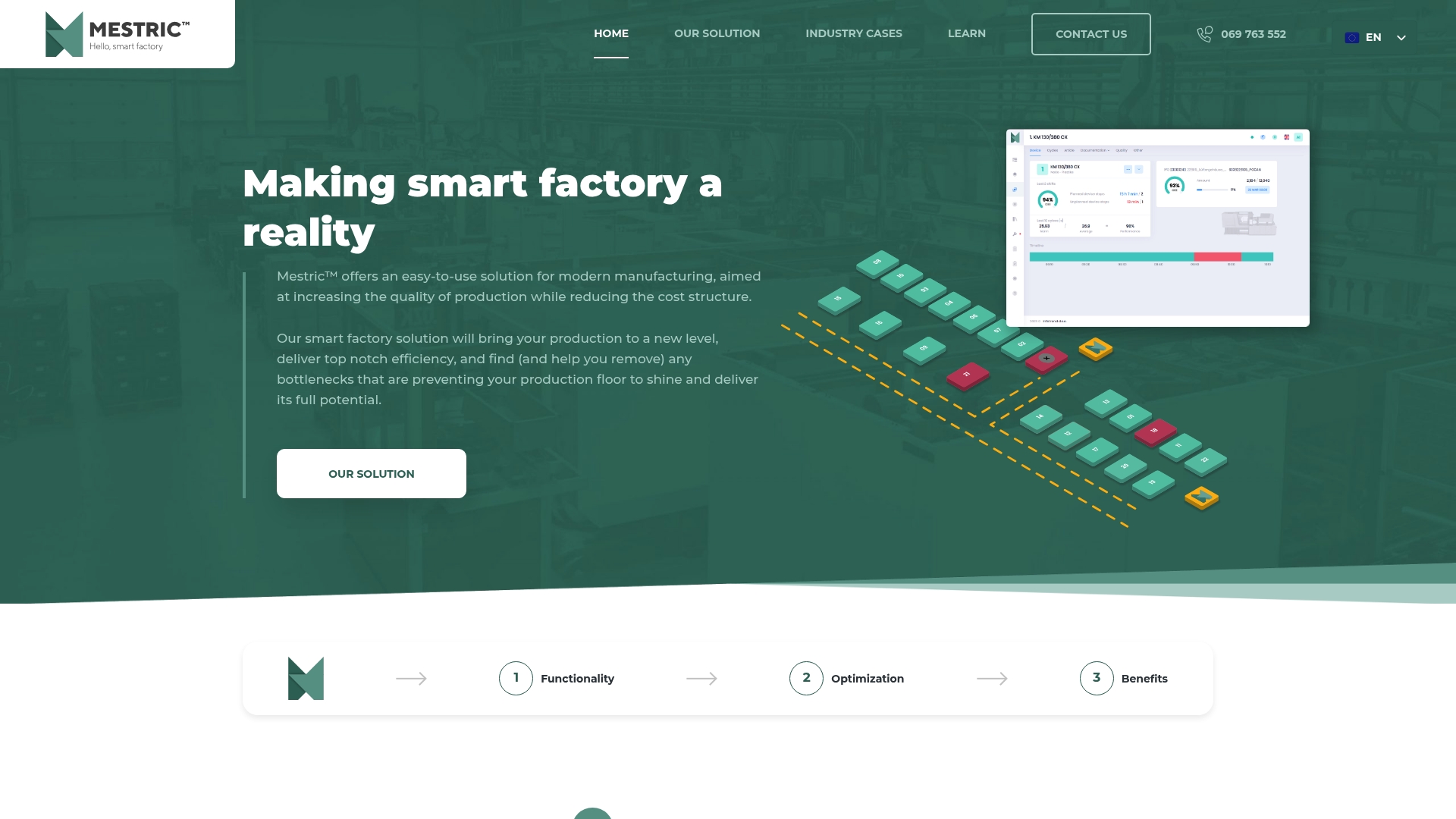
Mestric connects directly with your manufacturing equipment and delivers KPIs including downtime, quality parameters, and cost analysis through an AI-powered interface. Whether you are evaluating your first MES or replacing a legacy system, Mestric offers an onsite demonstration that shows exactly how connected machinery performs in your production environment. If you are ready to see the difference a well-matched MES makes, explore how MES improves efficiency and request your demonstration today.
MES solutions are categorised by deployment architecture (on-premise, cloud, hybrid) and by manufacturing model fit (discrete, process, regulated). Enterprise, industry-specific, and composable platforms represent the three primary functional categories.
Discrete manufacturing is best served by platforms with strong machine monitoring, work order tracking, and flexible scheduling, such as Siemens Opcenter or composable platforms like Tulip for smaller operations.
Cloud-based MES can support regulated industries, but the platform must hold relevant certifications such as 21 CFR Part 11 compliance for pharma. Many regulated manufacturers use hybrid deployments to balance accessibility with data security.
A composable MES uses low-code, modular tools that allow faster deployment and easier customisation, while an enterprise MES offers deeper, pre-built functionality suited to complex, multi-site environments with higher compliance demands.
The most common mistake is evaluating MES platforms on feature lists rather than on fit with your manufacturing model, deployment constraints, and existing system integrations.


 069 763 552