


TL;DR:
- Manufacturers now see digital transformation and cloud adoption as essential for maintaining competitiveness.
- Effective cloud integration relies on governance, data unification, and organizational change management to succeed.
Manufacturers face relentless pressure to do more with less. Tighter margins, complex supply chains, and rising customer expectations have made the role of cloud in manufacturing far more strategic than simply moving data off-site. 90% of manufacturers now consider digital transformation essential to staying competitive, and cloud technology sits at the centre of that shift. This guide explains what cloud adoption actually looks like on the factory floor, what it delivers, and what it takes to get it right.
| Point | Details |
|---|---|
| Cloud underpins digital transformation | Manufacturers adopting cloud gain real-time visibility, AI readiness, and supply chain agility. |
| Governance matters more than architecture | Data fragmentation and missing governance frameworks cause more cloud failures than technical issues. |
| Hybrid cloud-to-edge is the practical standard | Combining cloud with edge computing resolves latency and security concerns specific to production environments. |
| Cybersecurity cannot be an afterthought | Nearly half of manufacturers faced a cyber incident in the past year, making secure cloud design non-negotiable. |
| Pilot before you scale | Incremental, validated deployment reduces risk and builds organisational confidence in cloud-based systems. |
Cloud computing in manufacturing refers to the use of remote, internet-connected servers to store, process, and manage operational and business data. In an industrial context, this goes well beyond hosting software. Cloud solutions for manufacturing connect production equipment, quality systems, ERP platforms, and supply chain networks into a unified data environment.
The cloud deployment models relevant to factories include:
Cloud adoption in manufacturing has accelerated sharply. Manufacturing trends in 2026 show that cloud-enabled AI is reshaping production planning, predictive maintenance, and quality control at a pace that was not realistic five years ago. The shift is not uniform, though. Many plants operate with a mix of legacy OT systems and newer IT platforms, making the integration architecture as important as the technology itself.
The business case for cloud technology in factories is now well established. Cloud-based manufacturing systems deliver measurable improvements across productivity, quality, cost, and equipment effectiveness, as manufacturers report when tracking outcomes from their cloud investments.
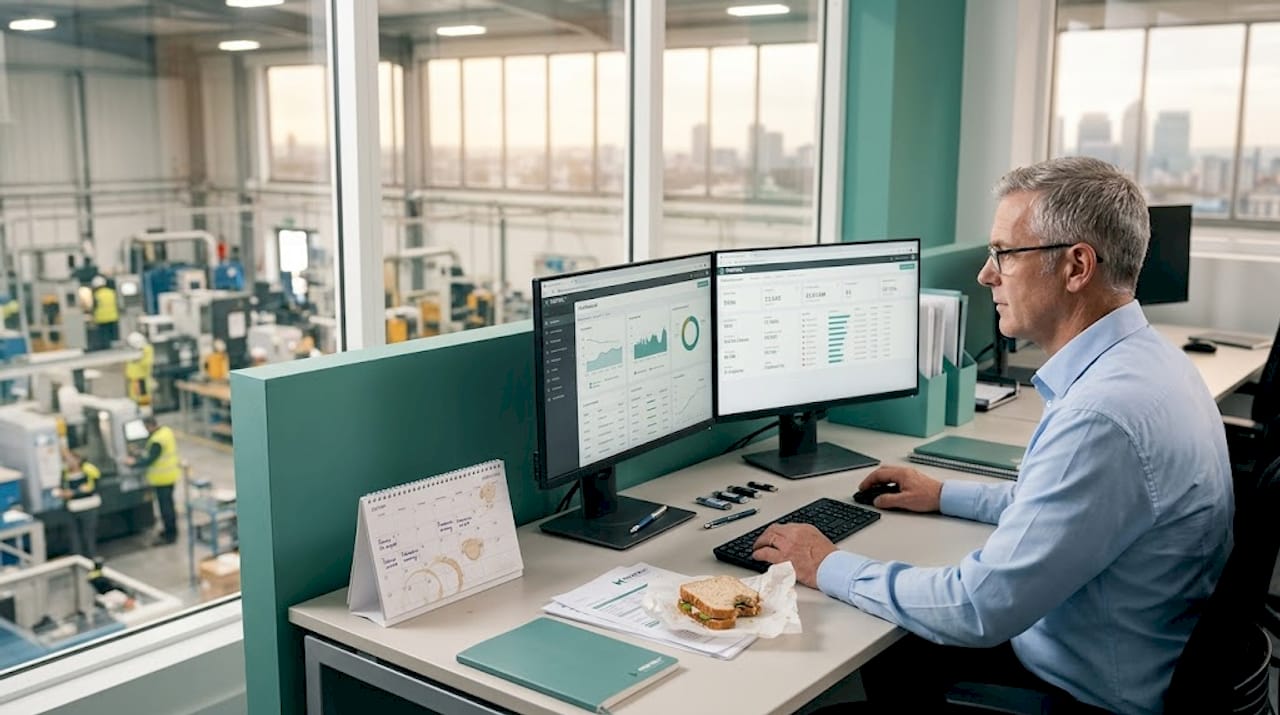
The most cited example of cloud impact at scale is Volkswagen. Their Industrial Cloud platform connects 122 factories worldwide, delivering 30% productivity improvements and targeting €1 billion in supply chain savings. The platform works by unifying OT and IT data across the entire manufacturing network, creating visibility that was previously impossible to achieve.
| Benefit area | What cloud enables | Example outcome |
|---|---|---|
| Productivity | Real-time machine data and automated scheduling | 30% improvement at Volkswagen |
| Supply chain | Shared data across suppliers and logistics partners | €1 billion savings target (VW) |
| Quality | Continuous monitoring and faster defect detection | Reduced rework and scrap rates |
| Decision making | Centralised dashboards and AI-assisted analysis | Faster, evidence-based responses |
| Equipment effectiveness | Predictive maintenance from sensor data | Reduced unplanned downtime |
Cloud also unlocks AI at a practical scale. AI in manufacturing is evolving from isolated tools into what analysts describe as an enterprise nervous system, enabling autonomous decisions on the factory floor. Without cloud infrastructure to aggregate and process data at scale, most AI applications in production remain too limited to generate significant value.
Pro Tip: Before selecting a cloud platform, map every data source on your production floor, including PLCs, SCADA systems, and quality inspection tools. A clear data inventory prevents the fragmentation issues that undermine even well-funded cloud programmes.
The technical side of cloud adoption in manufacturing is rarely the main obstacle. The harder problems are organisational and architectural. Understanding these challenges before you begin saves considerable time and cost.
The most significant barrier is data fragmentation. When OT and IT systems have never been designed to communicate, migrating their data to the cloud without first establishing a unified governance framework creates a garbage-in, garbage-out problem. Data that is inconsistent, unlabelled, or duplicated at the source becomes exponentially worse when scaled across a cloud platform.
IT/OT convergence also requires personnel changes that many organisations underestimate. Transitioning to software-defined factories means replacing industrial PCs on the shop floor with thin clients connected to centralised servers. This shifts responsibility from OT technicians working in isolation to multidisciplinary teams where IT and production engineers collaborate continuously. The cultural shift is as demanding as the technical one.
Cybersecurity is a specific and growing concern. 46% of manufacturers experienced at least one cyber incident in the past 12 months. Cloud-connected factories increase the attack surface, particularly when legacy OT equipment with limited security protocols is linked to internet-facing platforms.
Key challenges to plan for:
“Success in cloud manufacturing depends on execution discipline, not just architecture ambition. Validated redundancy in networking and fault tolerance are what protect production continuity when systems fail.”
Based on lessons from Audi’s software-defined factory rollout
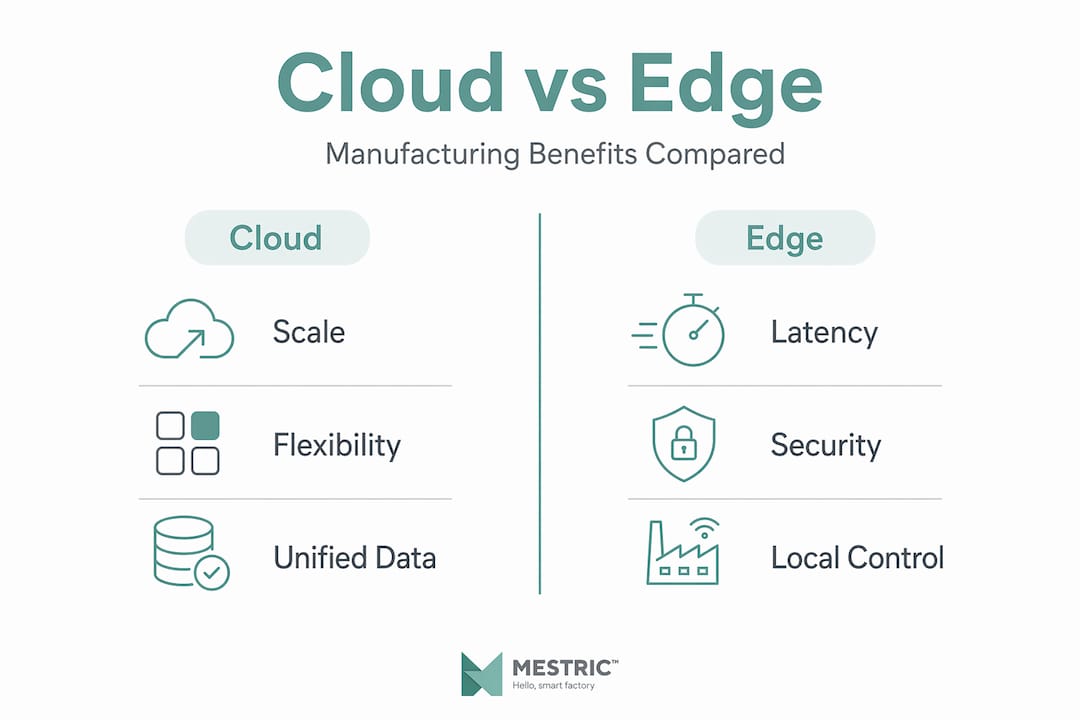
The most capable manufacturing environments in 2026 do not rely on cloud alone. They use cloud-to-edge architectures that push processing closer to where data is generated, and pull intelligence from the cloud where scale is needed.
Here is how a cloud-to-edge model typically operates in a manufacturing context:
Hybrid cloud-to-edge strategies reduce latency, lower bandwidth demands, and strengthen security for AI workloads. Edge systems provide the near-instant response times that production safety and uptime require, while the cloud supplies the analytical depth that isolated edge nodes cannot match alone.
The role of IoT in manufacturing is closely linked here. IoT sensors are the primary data source for both edge and cloud systems, and their density on the production floor determines how granular the intelligence becomes. More sensors, properly governed, translate directly into sharper production insights.
You do not need to transform your entire facility at once. Effective cloud adoption follows a pilot-and-scale methodology that limits disruption while building confidence and evidence internally.
Start here:
Pro Tip: Treat your first cloud pilot as a learning programme, not a proof of concept. Document every integration issue, governance gap, and data quality problem you encounter. That documentation becomes the blueprint for your full-scale rollout.
I have seen enough cloud migrations to say this with confidence: most manufacturers underestimate the organisational challenge and overestimate the technical one. The technology is mature. The harder work is getting your data house in order and aligning people across IT, OT, and operations before a single server is provisioned.
What I find most underappreciated is the concept of orchestration. Connectivity is not enough. You can link every machine on your floor to a cloud platform and still get very little value if the data flows are poorly governed and the workflows are not designed around decisions. The manufacturers who are genuinely benefiting from cloud in 2026 are the ones who have built systems where data moves purposefully, feeds real decisions, and closes the loop back to the production line.
The agentic AI direction is real and it matters. Manufacturing’s 2026 inflection point is about systems that do not just report what happened but act on what is happening. Cloud is the foundation that makes that possible. But the factories that will lead are not just cloud-connected. They are cloud-orchestrated, with governance, security, and AI working together as a single operating model.
Start with one problem. Solve it properly. Then scale what works.
— Andraž
If this article has reinforced anything, it is that digital transformation in manufacturing requires tools that connect equipment data, surface real-time insights, and support the decisions that matter on the production floor.
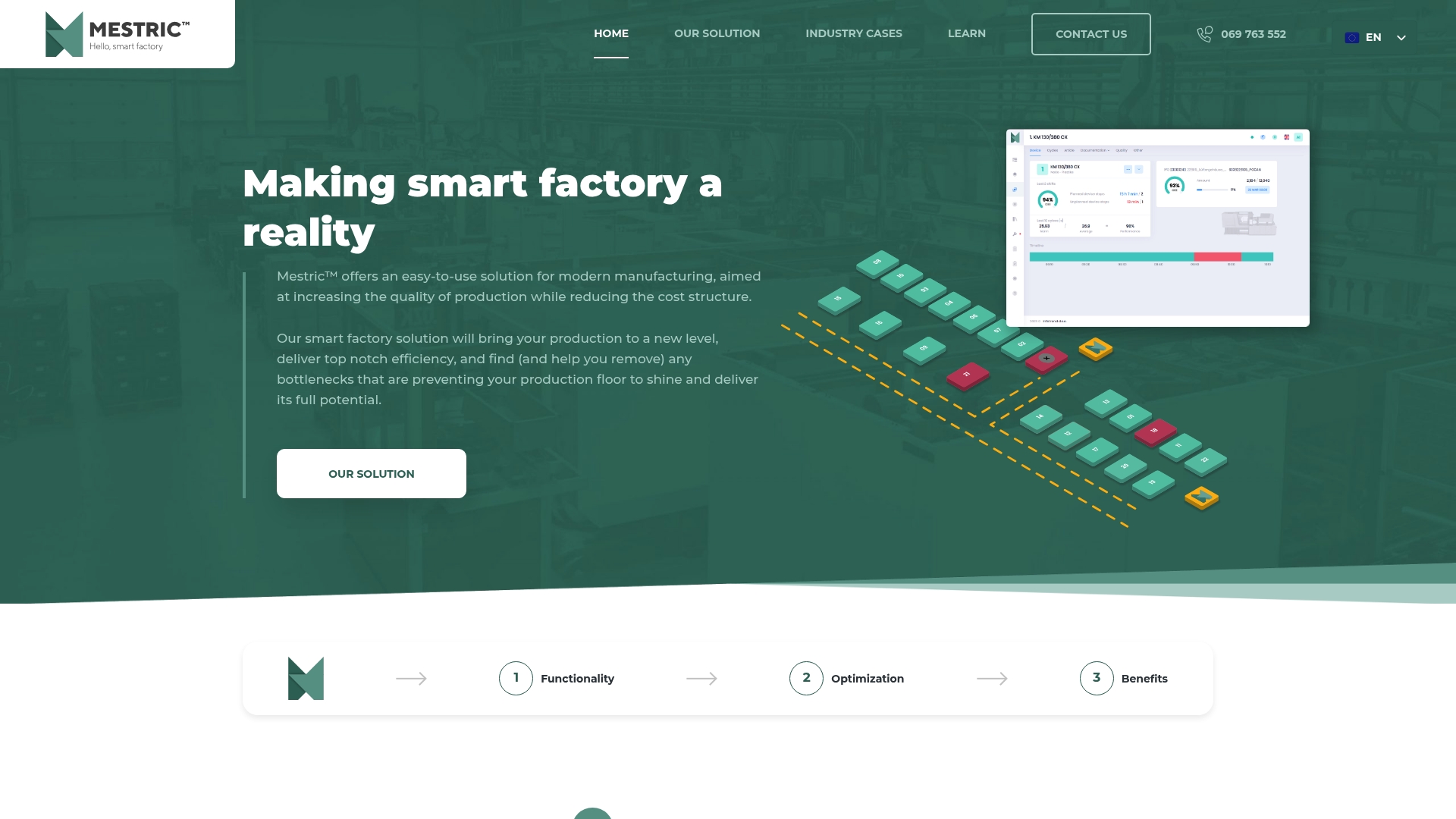
Mestric is built exactly for that. As a Manufacturing Execution System designed for modern production environments, Mestric connects directly with your machinery and provides live KPIs across performance, quality, downtime, and cost. Whether you are starting your cloud adoption journey or looking to get more from your existing infrastructure, understanding how MES compares to traditional manufacturing approaches is a practical starting point. You can also explore manufacturing software types to understand where cloud-based MES fits within your broader technology stack.
Cloud computing in manufacturing connects production equipment, quality systems, and business data into a unified platform, enabling real-time monitoring, AI-driven analysis, and cross-facility visibility. It supports better decisions, lower costs, and faster responses to production issues.
Cloud-based manufacturing systems deliver measurable improvements in productivity, equipment effectiveness, supply chain coordination, and quality control. Volkswagen’s Industrial Cloud, for example, achieved 30% productivity gains and targets €1 billion in supply chain savings across 122 plants.
A cloud-to-edge strategy processes time-critical data locally at the machine using edge computing, while sending aggregated data to the cloud for analytics and AI model training. This reduces latency, lowers bandwidth use, and improves security for production environments.
Applying zero-trust network architecture, segmenting OT systems from cloud-facing layers, and enforcing data governance frameworks are the primary mitigation strategies. With 46% of manufacturers experiencing a cyber incident in the past year, secure architecture is a requirement, not an option.
Start by identifying a specific operational problem, clean and label your OT and IT data to build a digital thread, then deploy a validated pilot on a single line or production cell before scaling. Organisational alignment across IT and production teams is as important as the technology itself.


 069 763 552