

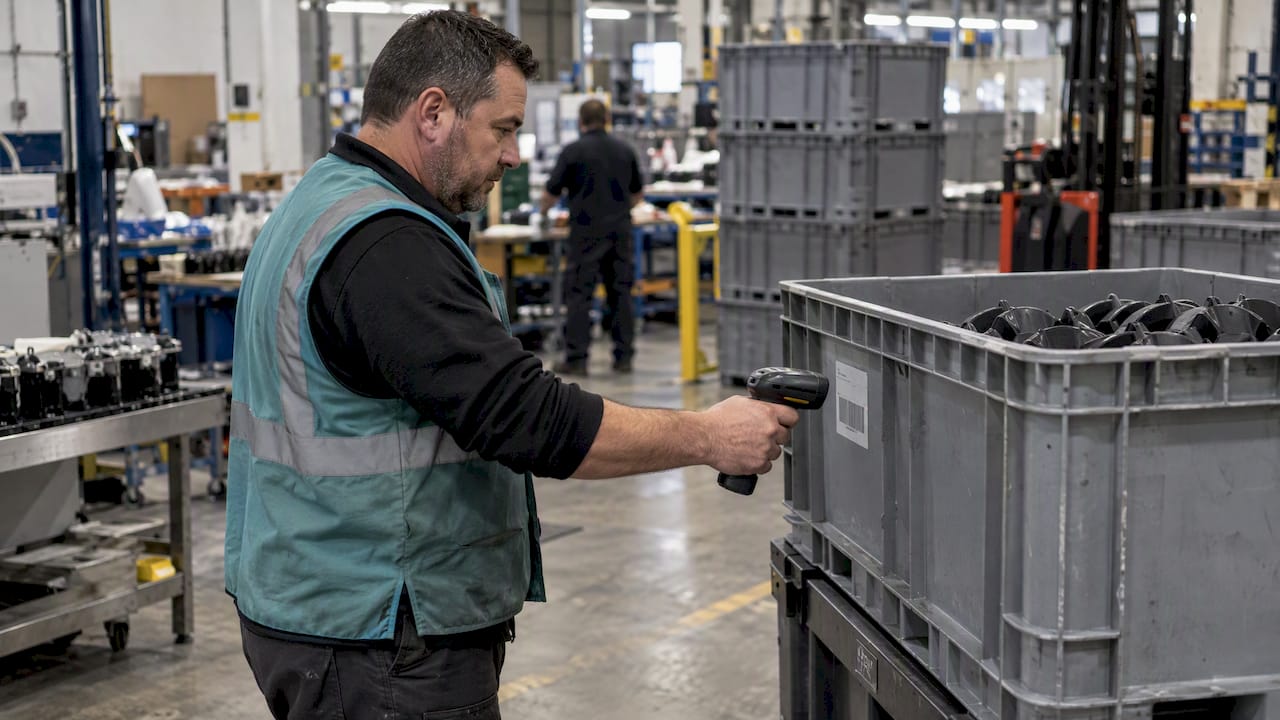
Production traceability lets you locate any affected lot within minutes, produce auditable records for an audit or recall, and give your team real visibility across every stage of manufacturing. Standards such as GS1 and the EU’s Digital Product Passport now shape how this data must be structured, and platforms like Mestric™ show how the principles translate into daily shop-floor practice.
TL;DR:
- Use GTIN plus a lot number for batch tracking, GTIN plus a serial number for unit tracking, and SSCCs for pallets or cases.
- At each critical tracking event, record the timestamp, operator, machine, process step, consumed source lot, and relevant certificates; use shared identifiers across trading partners.
- Use barcodes or QR codes for lot tracking, RFID where direct scanning is impractical, and machine integration for high risk or high volume processes.
- Pilot one representative production line with five to seven tracking events, measure trace time, automatic capture, and accuracy, then expand after several weeks.
- For covered product groups, the EU registry went live on July 20, 2026, and the first implementation deadline for some products is February 18, 2027.
Traceability means recording who did what, with which materials, on which machine, at what time and why, so you can reconstruct the full history of any item you produce. It covers two levels: lot or batch traceability, where you group items made under the same conditions, and serial-level traceability, where you track individual units. The right level depends on your risk profile and your customers’ requirements.
What was once a compliance nicety has become a competitive requirement. When a defect surfaces, traceability lets you isolate exactly which units are affected instead of recalling an entire production run.
Industry commentary on material traceability echoes this shift: traceability now sits at the centre of quality management, not at its edge.
GS1 structures traceability around two concepts: Critical Tracking Events (CTEs), which are the points in your process where an item changes hands, location or state, and Key Data Elements (KDEs), the specific data you capture at each CTE. Getting this right from the outset avoids rework later, particularly once customers or regulators start asking for interoperable data.
The GS1 Global Traceability Standard recommends that identifiers stay attached to the item throughout its life cycle, and that trading partners agree on a common traceable item level, often called the one-up, one-down principle, so that data flows cleanly between you, your suppliers and your customers.
Different processes call for different capture methods, and matching the method to the line matters more than chasing the newest technology.
Our guide on automating production tracking walks through how automotive plants apply these choices in practice.
Pro Tip: Start by automating capture for your two or three highest-risk CTEs, and keep the rest manual until your data model is proven.

A pilot keeps the project manageable and gives you evidence before you commit to a full rollout.
| Pilot stage | Typical focus | What to measure |
|---|---|---|
| Scoping | Select line, define CTEs and KDEs | Number of CTEs identified |
| Capture | Label items, connect automated and manual data points | Percentage of events captured automatically |
| Validation | Review data quality and trace a sample item end to end | Time-to-trace for a test lot |
| Scaling | Extend to further lines once metrics are met | Recall scope reduction over time |
Our batch traceability pilot guide sets out a 90 day structure for teams that want a concrete timeline to follow.
Auditable records depend on consistent retention and version control: every CTE record should be timestamped, attributed to an operator or system, and stored in a format you can retrieve quickly when an inspector or customer asks for it.
Three everyday scenarios show what good traceability data actually does for you.
Each case depends on the same foundation: consistent identifiers, captured events and data you can query quickly.
An MES connects directly to your equipment so CTEs and KDEs are captured automatically rather than typed in after the fact. An MES links to machines and sensors on your line, builds live KPI dashboards from that data, and keeps an auditable log of every event without extra data entry from your operators.
Our overview of manufacturing execution systems sets out where an MES fits among the other systems on your floor.
Pick one pilot line, keep the scope tight, and prove a measurable win before expanding. Use standards-based identifiers from day one so you never have to retrofit them. Then measure the operational impact, because that evidence is what secures wider buy-in.
— Andraž
Running a focused pilot gives you a live view of traceability in practice before you commit to a full rollout. We connect to your existing equipment, capture CTEs and KDEs automatically, and build a sample trace you can follow from raw material to finished unit within days rather than months.
We also work alongside specialist partners: when packaging is part of your traceability chain, Gather Packaging’s guidance on material traceability is a useful reference for data carriers on packaging components.
Visit our solution page to see what a pilot on your line could look like, or request an onsite demonstration to watch connected machinery capture traceability data in a working production environment.
Lot traceability groups items made under the same conditions and tracks them as a batch, while serial traceability follows each individual unit. Most manufacturers use lot traceability for raw materials and serial traceability for finished goods that carry higher risk or regulatory requirements.
Critical Tracking Events (CTEs) are the points in your process where an item changes state, location or custody, and Key Data Elements (KDEs) are the specific data captured at each event, such as timestamp, operator and machine ID. This structure comes from GS1’s traceability standard and underpins interoperable data exchange between you, your suppliers and your customers.
A pilot on a single line with five to seven defined CTEs typically runs for several weeks before you have enough data to validate the model and decide on scaling. Our batch traceability pilot guide sets out a 90 day structure you can adapt to your own line.
The Digital Product Passport is an EU registry that indexes unique product identifiers for product groups covered by the Ecodesign for Sustainable Products Regulation. The Registry became operational on 20 July 2026, with the first implementation deadline for certain product types set for 18 February 2027.
Yes, we connect directly to your production equipment to capture traceability events automatically and build live KPI dashboards from that data. We offer an onsite demonstration so you can see connected machinery and sample traceability data in a real production environment before committing to a pilot.


 069 763 552