


TL;DR:
- Manufacturing IT infrastructure models include on-premises, cloud, hybrid, and hyperconverged systems, each suited to specific operational needs. Proper integration of layers like ERP, MES, and IIoT is essential for operational efficiency, but many manufacturers struggle with data silos. Segregating IT and OT networks with security measures reduces cyber risks and protects production continuity.
Manufacturing IT infrastructure determines how well your factory can collect data, execute production orders, and respond to problems in real time. The four primary models are traditional on-premises, cloud, hybrid, and hyperconverged infrastructure (HCI). Each serves distinct operational needs, and choosing the wrong one creates bottlenecks that no amount of software can fix.
IT infrastructure components typically include hardware, software, networking, data centres, and cloud services. In manufacturing, these components are arranged into one of four deployment models, each with different trade-offs between control, cost, and flexibility.
The right model depends on your production environment, regulatory obligations, and the age of your existing equipment. Many facilities run more than one model simultaneously across different parts of the plant.

A modern manufacturing IT stack has five interlocking layers. Understanding how they connect is what separates a well-planned IT architecture in manufacturing from a collection of disconnected tools.
The five core layers:
Integrating these layers is where most manufacturers struggle. Data silos between ERP and shop-floor systems remain one of the most common operational barriers reported across the industry. The ISA-S95 hierarchical model provides a practical framework: real-time machine control operates at the network edge with sub-10ms latency requirements, while ERP and business analytics reside in the cloud where latency tolerance is high.
Scaling manufacturing IT is harder than scaling a standard enterprise network. Production lines cannot simply go offline for an upgrade cycle.
Common challenges:
Strategies that work:
Strokovni nasvet: When planning an infrastructure upgrade, sequence your changes so that ERP data models are stable before you begin MES integration. An unstable ERP schema forces repeated MES re-mapping, which multiplies project time and cost.
Reducing production downtime during upgrades requires treating the migration as a phased programme, not a single project. Each phase should have a defined rollback plan before work begins.
IT and OT networks have fundamentally different risk profiles. A breach that disrupts a business application is recoverable; a breach that reaches a PLC controlling a production line can cause physical damage, safety incidents, or extended unplanned downtime.
Bridging ERP systems with shop-floor OT networks requires strict physical and logical isolation to prevent production-impacting security breaches. The two most widely used models for achieving this are the Purdue Model and the DMZ (demilitarised zone) architecture.
Key security best practices for manufacturing IT infrastructure:
Statistic: The UK government’s Cyber Security Breaches Survey consistently identifies manufacturing as one of the sectors most exposed to cyber incidents, with phishing and ransomware the most common attack vectors. Logical IT/OT segregation is the primary architectural control that limits the blast radius of a successful attack.
Security best practices recommend logically isolating IT and OT networks using industrial firewalls, data diodes, and intrusion prevention systems to defend smart factory environments. The role of IoT gateways in this architecture is to act as controlled translation points, not open conduits.
Manufacturing environments run a wide variety of applications across diverse hardware: ruggedised terminals on the shop floor, engineering workstations in design offices, and management dashboards on standard laptops. Managing all of these as separate installations creates a maintenance burden that grows with every new device added to the network.
Application virtualisation addresses this by centralising application delivery so that the software runs on a server and is streamed to the end device, regardless of its specification or operating system.
Parallels Remote Application Server (RAS) features relevant to manufacturing:
Why this matters in manufacturing specifically:
Strokovni nasvet: Before deploying a virtualised application delivery platform in a manufacturing environment, audit which applications have hard dependencies on local hardware interfaces such as USB-connected measurement devices. These will need a gateway or protocol bridge rather than pure virtualisation.
Connecting ERP, MES, and OT/IIoT systems into a coherent stack requires more than point-to-point integrations. The architecture needs to handle data normalisation, prevent duplication, and maintain low latency where production demands it.
Integration best practices:
Real-time production data flowing from MES into analytics platforms gives quality teams the visibility to act on defects before they propagate through a batch. According to the American Society for Quality, manufacturing quality costs can represent up to 15–20% of sales revenue; effective IT-enabled quality tracking and monitoring reduces waste and enhances operational excellence.
Mestric’s MES connects directly with manufacturing equipment to provide real-time KPIs including performance metrics, downtime, quality parameters, and cost analysis. For manufacturers building or refining their IT stack, connected production lines that feed live data into a well-integrated MES are where the operational gains become measurable.
UK manufacturers face a layered compliance environment that directly shapes IT infrastructure decisions. Getting this wrong creates audit exposure, not just operational risk.
Key frameworks and obligations:
Infrastructure decisions such as where data is stored, how networks are segmented, and which access controls are applied all have direct compliance implications. Cloud deployments in particular require careful review of data residency: UK GDPR requires that personal data transferred outside the UK meets adequacy or appropriate safeguard requirements.
Cost structures vary significantly across the four infrastructure models, and the right budget approach depends on your production scale, growth plans, and existing asset base.
Traditional on-premises: High upfront capital expenditure on servers, networking hardware, and data centre facilities. Ongoing costs include maintenance contracts, hardware refresh cycles (typically every five to seven years), and internal IT staffing. This model suits manufacturers with stable, predictable workloads and strict data sovereignty requirements.
Cloud infrastructure: Shifts spend from capital to operational expenditure. You pay for compute and storage as consumed, which suits variable production volumes. The risk is cost unpredictability at scale; cloud bills can grow quickly if workloads are not monitored and right-sized.
Hybrid infrastructure: Combines both cost structures. Capital spend covers on-premises OT and edge infrastructure; cloud spend covers ERP, analytics, and collaboration tools. This is the most common model for mid-sized UK manufacturers and generally offers the best balance between control and flexibility.
Hyperconverged infrastructure (HCI): Reduces hardware complexity and can lower total cost of ownership compared to traditional three-tier server architectures, particularly for manufacturers consolidating multiple ageing server estates. Licensing costs for HCI software platforms need factoring into the total cost of ownership calculation.
When budgeting, account for integration costs separately. Connecting legacy PLCs and SCADA systems to modern cloud or analytics platforms often requires edge gateway hardware, middleware licences, and specialist integration work that is not included in platform pricing. ERP migrations, as a reference point, average 18–24 months in duration for mid-sized manufacturers, which gives a sense of the project overhead involved in major infrastructure changes.
Two technologies are changing the architecture of manufacturing IT systems more than any others right now: edge computing and AI integration.
Edge computing addresses the fundamental latency problem in manufacturing. Real-time machine control, vision inspection, and machine-to-machine messaging require sub-10ms response times that cloud infrastructure cannot reliably deliver over a WAN connection. Edge computing in manufacturing places compute capacity at or near the production line, processing time-critical data locally while synchronising non-urgent data to cloud analytics in batch. The ISA-S95 model formalises this split: edge handles real-time control, cloud handles planning and reporting.
AI integration is moving from pilot projects into production deployments across UK manufacturing. The most mature applications are predictive maintenance, where AI models trained on machine sensor data identify failure patterns before breakdowns occur, and quality inspection, where computer vision systems detect defects faster and more consistently than manual checking. Predictive maintenance algorithms trained on your own asset data typically outperform generic vendor models within 6–12 months of deployment, once sufficient operational data has accumulated.
Digital twins are gaining traction in process and discrete manufacturing alike. A digital twin creates a virtual model of a physical asset or production line, fed by real-time IIoT data, allowing engineers to simulate changes before implementing them on the live floor. The IT infrastructure requirement for digital twins is significant: high-bandwidth IIoT connectivity, low-latency edge processing, and cloud storage for historical simulation data all need to be in place.
The role of IoT in manufacturing underpins all three of these technologies. Without reliable, low-latency sensor data flowing through a well-architected IIoT network, neither edge AI nor digital twins can deliver their potential.
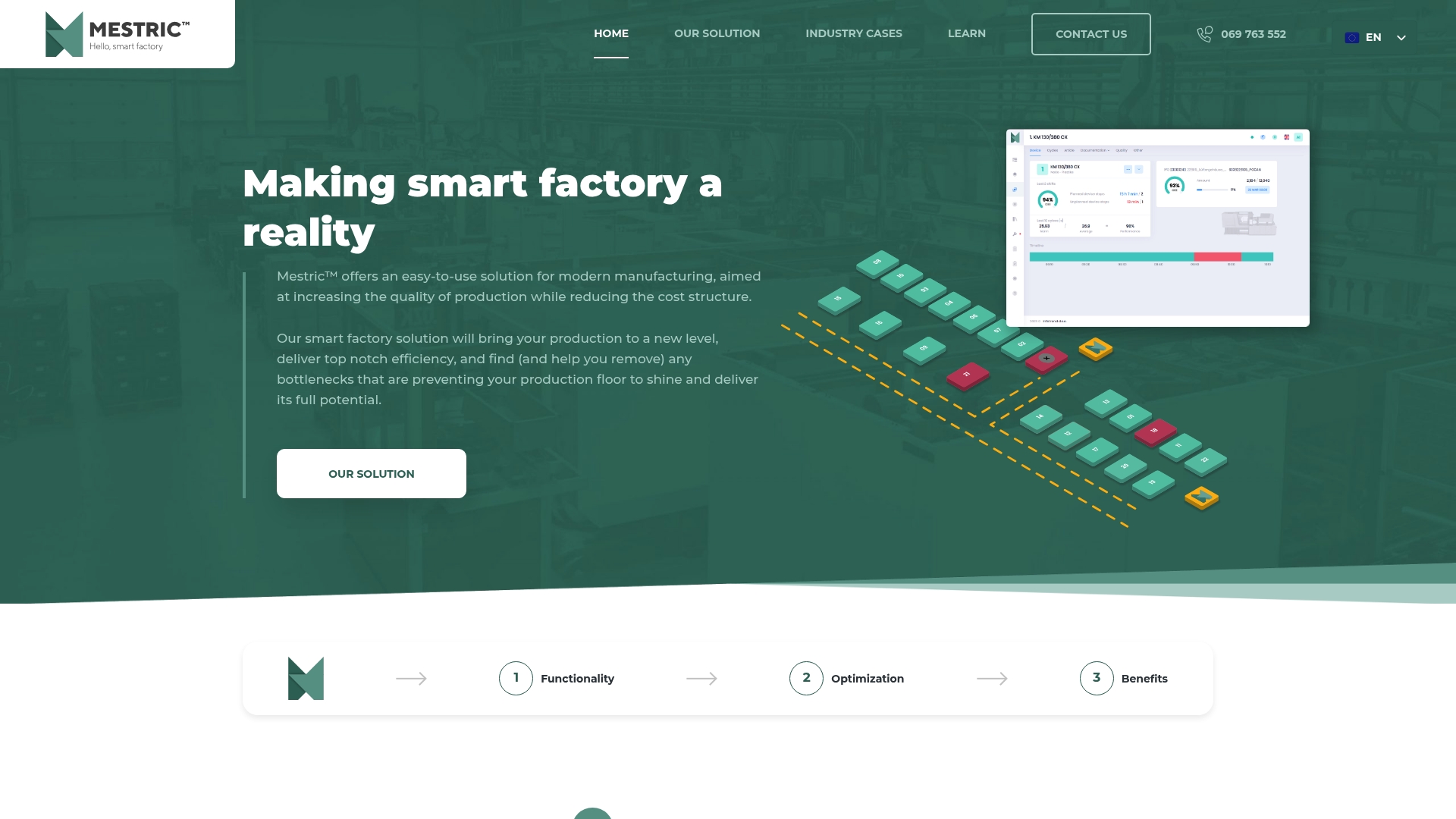
Mestric’s MES sits at the centre of the manufacturing IT architecture described throughout this guide. It connects directly with your production equipment, translates real-time machine data into actionable KPIs, and feeds quality and performance metrics into the analytics layer where decisions get made.
If you are evaluating how MES compares to traditional manufacturing approaches or want to understand which types of manufacturing software belong in your IT stack, Mestric’s resources give you the detail you need to make the right call. Book an onsite demonstration to see how connected machinery changes what your production data can tell you.
Manufacturing IT infrastructure choices directly determine your factory’s ability to scale, secure operations, and integrate real-time production data with business systems.
| Točka | Podrobnosti |
|---|---|
| Four primary models | Traditional, cloud, hybrid, and HCI each suit different operational and compliance needs. |
| Five-layer stack | ERP, MES, IIoT, OT/IT convergence, and analytics must interlock for full operational visibility. |
| IT/OT segregation | Purdue Model and DMZ architecture limit ransomware blast radius across production networks. |
| Quality cost exposure | Quality-related costs can represent up to 15–20% of sales revenue; effective IT-enabled quality tracking and monitoring reduces waste and enhances operational excellence. |
| Scale incrementally | Modular, software-defined hybrid deployments minimise downtime risk during infrastructure upgrades. |


 069 763 552