


If you are budgeting for a manufacturing execution system in Slovenia, expect a pilot deployment on one or two lines to cost a modest amount covering licence, basic integration, and support, a mid-size plant rollout across several machines to require a moderate investment in the first year, and an enterprise deployment across multiple sites to require a substantial budget once integration and support are included. Most of that spread comes down to how many machines you connect and how deep the integration goes, not the software licence itself.
Licence and subscription fees are typically OPEX; integration, hardware, and initial customisation usually sit under CAPEX, though the split should be agreed before signing. If you want a number specific to your plant, request a scoped demo and pilot quote from a local provider such as Mestric™ rather than relying on published averages.
MES pricing in Slovenia depends far more on integration scope and support terms than on the software licence itself, and a phased pilot is the lowest-risk way to prove the numbers before scaling.
| Point | Details |
|---|---|
| Budget by scope, not licence | Pilot deployments run €8,000-€25,000; mid-size plants €25,000-€90,000; enterprise rollouts exceed €150,000. |
| Separate CAPEX from OPEX early | Agree the split during solution design so integration and hardware don’t blur with ongoing subscription costs. |
| Watch integration and support costs | Integration can account for 20-40% of total cost, and weak SLAs often cost more than a pricier support tier. |
| Calculate ROI on real KPIs | Track downtime, yield, and labour savings against payback period, not vendor promises. |
| Start with a Mestric™ pilot | Mestric™ offers demo-first, scoped pilot quotes with three months of support to validate ROI before full rollout. |
Ask five vendors for a quote and you will get five different pricing structures, because the industry standard term for this category, manufacturing execution system (MES) software, still lacks a common pricing convention. Most enterprise-grade MES platforms remain quote-only, which is precisely why searches for cena MES Slovenija rarely turn up a straight answer.
Three models dominate. Subscription/SaaS spreads cost as a monthly or annual fee per user, per machine, or per interface, keeping the expense in OPEX and easing initial cash flow. Perpetual licence plus maintenance asks for a larger upfront payment (CAPEX) followed by an annual maintenance fee, usually 15-20% of the licence value, for updates and support. Per-machine or per-interface pricing charges by the number of connected assets rather than users, which suits plants with many machines and few operators on the system.
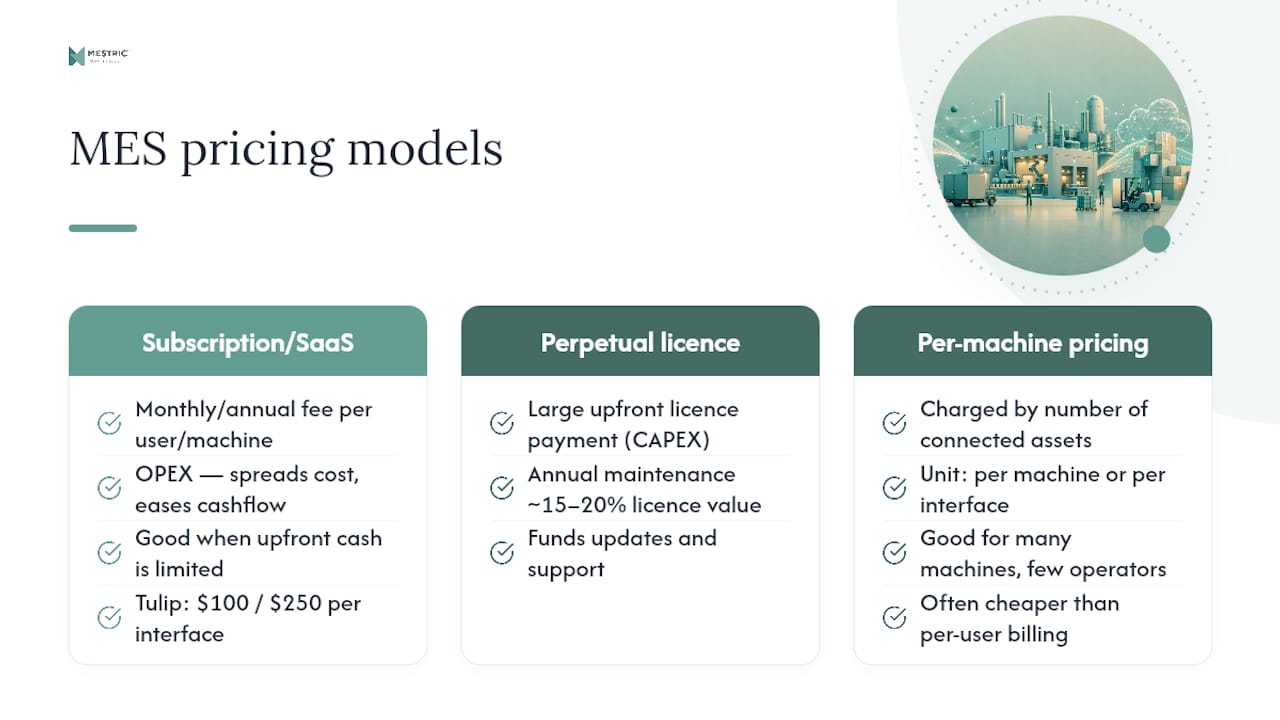
Tulip, one of the few vendors that publishes rates, lists $100 per interface per month for its Essentials tier and $250 per interface per month for Professional, giving a rare public benchmark in a market where most competitors quote privately. That gap between published and unpublished pricing is the norm, not the exception, across the sector.
Hybrid models are becoming common too: a lower base subscription with usage-based add-ons for extra modules such as quality monitoring or predictive maintenance. Before comparing offers, always check the unit of charge the vendor uses, because a per-interface model can be considerably more economical for a plant with fifteen machines and three operators than a per-user model would be.
Scope is the single biggest lever. A single-line pilot tracking downtime and quality costs a fraction of a multi-site rollout feeding data into a group-wide ERP system. The number of machines and sites you connect multiplies licence fees directly in per-machine pricing models, and it multiplies integration effort in almost every model.
Integration with existing ERP and SCADA systems is usually the largest hidden driver. Procurement guidance on enterprise MES pricing notes that integration alone can account for 20 to 40% of total implementation cost, and professional services often equal one to two times the software licence. If your plant runs older PLCs or a legacy ERP, budget for this at the top end.
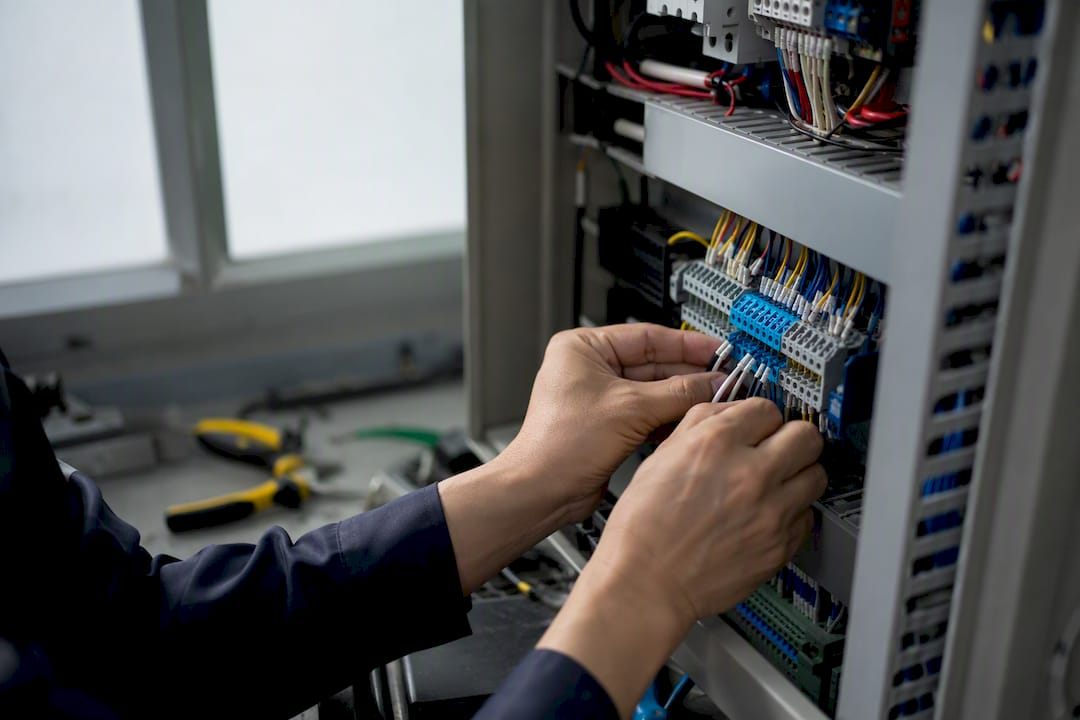
Hardware and sensors add a further layer. Machines without existing data outputs need retrofitted sensors, gateways, or edge devices before any software can read them, and that cost sits outside the MES quote entirely in most contracts.
Customisation, training, and support round out the picture. A platform configured to your exact quality parameters and shop-floor terminology costs more to deploy than an out-of-the-box setup, but it also gets adopted faster on the floor. Training for operators and supervisors is frequently underestimated in Slovenian tenders, and ongoing support tiers, from email-only to on-site engineers, vary the annual OPEX significantly.
Most successful MES deployments in Slovenia follow three distinct stages, and skipping any of them is where budgets usually go wrong.
The pilot stage typically runs four to eight weeks. It covers connecting one or two machines, setting up basic KPI tracking, and validating that data quality is good enough to trust. This is the cheapest and lowest-risk phase, and it should produce measurable results before you commit further budget.
The rollout stage extends the same configuration across the rest of the plant or site, usually taking two to four months depending on how many machines need integration and whether ERP or SCADA connections are involved. This is where most of the CAPEX gets spent: hardware installation, network upgrades, and data migration from legacy systems.
The stabilisation stage follows rollout and often gets ignored in planning. It covers three to six months of operators and supervisors actually using the system daily, refining dashboards, adjusting alert thresholds, and training new starters. Vendors who disappear after go-live leave this stage unsupported, which is why support terms matter as much as the initial quote.
Total time from signed contract to a stable, fully adopted system typically runs six to twelve months for a mid-size plant. Enterprise rollouts across multiple sites in Slovenia commonly take twelve to eighteen months, staged site by site rather than all at once.
The quoted licence price is rarely the number you end up paying. Integration with PLCs and existing ERP systems, plus long-term maintenance and validation work, frequently costs more than the software itself over the system’s lifetime, particularly in regulated production environments.
Watch for these five areas before signing anything:
Guidance on CAPEX versus OPEX allocation for industrial software warns that leaving this split undecided until after signing creates budget disputes later, because one-off implementation tasks get mixed up with ongoing running costs. Decide the allocation during solution design, not during the finance department’s year-end review.
The basic formula is simple: payback period = total implementation cost ÷ annual savings. The hard part is estimating annual savings honestly, and that requires tracking the right KPIs from day one.
Three KPIs drive most of the payback calculation. Downtime reduction is usually the fastest win, because MES platforms convert many small, previously invisible stoppages into measurable data, letting supervisors respond to problems in minutes rather than discovering them at shift-end. Yield improvement comes from catching quality deviations earlier, reducing scrap and rework. Labour savings come from automating manual data collection, freeing supervisors from paperwork so they can spend time on the floor instead.
A realistic estimate for a mid-size Slovenian plant might see downtime fall by a meaningful margin within the first two quarters, simply because problems that used to go unnoticed for hours now trigger an alert within minutes. Combine that with even modest yield gains and the role real-time data plays in manufacturing quality, and payback on a pilot investment often falls within twelve to eighteen months.
Pro Tip: Track your baseline downtime and scrap rate for at least four weeks before the pilot starts. Without a genuine “before” number, you cannot prove the “after” savings to anyone signing off the next budget round.
A strong procurement process protects you from the hidden costs covered above, and it starts with questions most Slovenian buyers forget to ask until it is too late.
Before requesting a quote, clarify:
Require every vendor to put pricing structure, exclusions, and SLA terms in writing before you compare offers side by side. Verbal assurances about “everything being included” rarely survive contact with an actual invoice.
Slovenia’s MES market includes a mix of large enterprise-focused vendors and smaller local integrators who specialise in scoped, plant-specific projects. Local market coverage shows pricing tiers tracking functional scope closely: high-end systems provide extensive feature sets, while lower-cost platforms cover core tracking and quality functions and can be upgraded as the plant grows.
Mestric™ positions itself as a demo-first, pilot-friendly option built specifically for manufacturers who want real-time performance tracking, quality monitoring, and downtime analysis without committing to a multi-year enterprise contract before seeing results on their own floor. Its onsite demonstration model lets production managers see connected machinery in a real working environment before any budget is signed off, which matters in a market where quotes are rarely comparable on paper alone.
Larger enterprise-grade platforms suit multi-site groups with dedicated IT teams and complex ERP landscapes, but they typically come with longer sales cycles and higher minimum contract values. Smaller local integrators fill a useful niche for single-site, feature-limited deployments, though depth of ongoing support varies considerably between providers. For most mid-size Slovenian manufacturers weighing MES ROI calculation against implementation risk, a phased, demo-led approach reduces the chance of overcommitting before the numbers are proven.
Support quality is where MES contracts quietly succeed or fail, and it is rarely visible in the headline price. Enterprise vendors based outside Slovenia often route support through regional call centres with response times measured in business days, which becomes a real problem when a production line stops at 2am on a Saturday.
Locally based providers, including Mestric™, generally offer faster response because support staff work in the same time zone and often speak the language of your shift supervisors directly, removing translation friction during a live incident. That matters more than it sounds: a three-minute phone call in Slovene during a live stoppage beats a ticket queued in a foreign-language support portal.
When comparing support levels, ask each vendor for their actual SLA document, not a marketing summary. Look specifically at coverage hours (24/7 versus business hours only), guaranteed first-response time, and whether on-site visits are included or billed separately. A cheaper subscription with weak support can cost more in unplanned downtime than a slightly pricier one with a genuine same-day SLA.
Slovenian manufacturers operate under general EU industrial and data protection frameworks, and MES platforms handling production and personal data must align with GDPR requirements for how operator and quality data is stored and accessed. This applies regardless of vendor size, and it should be confirmed in writing during procurement rather than assumed.
Sector-specific rules add further requirements. Food, pharmaceutical, and automotive suppliers often need traceability and audit-trail features that satisfy specific quality standards their customers require, and these obligations should be scoped into the MES contract explicitly rather than treated as a “nice to have” add-on later. Data retention periods, access logging, and change-history tracking all fall under this umbrella.
Before signing, confirm with your vendor how the platform handles data residency (where servers are hosted), user access controls, and audit logging, since these directly affect whether the deployment satisfies your customers’ own compliance audits.
Every MES budget I have reviewed in Slovenian factories underestimates one line item: long-term maintenance. Buyers focus on the licence number and treat everything after go-live as an afterthought.
My recommendation stays the same across plant sizes: separate licence, integration, and maintenance into distinct budget lines, and start with a phased pilot rather than a full-site commitment. A pilot that fails costs a fraction of a full rollout that fails.
Pro Tip: Decide who owns CAPEX and who owns OPEX before the contract is drafted, not during the finance review. Integration and hardware belong in CAPEX; subscription and support belong in OPEX, but only a written agreement stops that line blurring later.
Mestric™ gives Slovenian manufacturers a way to see real numbers on their own shop floor before any large budget gets approved, rather than trusting a generic vendor deck. A scoped pilot quote costs a fraction of an enterprise contract, and it gives you the exact data your finance team needs to justify the next stage of spending.
Request a site or remote demo and Mestric™ will scope a pilot quote sized to your plant, covering:
The results from a Mestric™ pilot, including measurable downtime and yield figures, can go straight into your formal CAPEX or OPEX approval process rather than sitting as a theoretical estimate. Get in touch to request a pilot quote or book an on-site presentation for your Slovenian plant.
What does an MES system typically cost in Slovenia?
A pilot deployment on one or two machines usually runs €8,000-€25,000, a mid-size plant rollout €25,000-€90,000, and an enterprise multi-site deployment often exceeds €150,000 in the first year once integration and support are included.
Is MES pricing usually CAPEX or OPEX?
It depends on the model. Subscription and support fees are typically OPEX, while perpetual licences, hardware, and initial integration usually fall under CAPEX. Agree the split with your vendor before signing, since unclear allocation creates budget disputes later.
How long does it take to implement an MES in a Slovenian factory?
A pilot typically takes four to eight weeks, full rollout two to four months, and stabilisation a further three to six months. Mid-size plants generally reach a stable system within six to twelve months of signing.
What is the biggest hidden cost in MES projects?
Integration with existing ERP and SCADA systems and PLCs is usually the largest unplanned expense, often accounting for 20 to 40% of total implementation cost according to enterprise MES pricing guidance.
How do I calculate ROI on an MES investment?
Divide total implementation cost by annual savings from downtime reduction, yield improvement, and labour savings to get your payback period. Most Slovenian pilots that track these KPIs from day one see payback within twelve to eighteen months.
Should I choose subscription or perpetual licence pricing?
Subscription (SaaS) pricing spreads cost as OPEX and suits plants wanting lower upfront risk, while perpetual licences suit organisations preferring to own the asset outright despite the larger initial CAPEX outlay and ongoing maintenance fees.


 069 763 552