

The six highest-impact examples of AI-driven process control are predictive maintenance, anomaly detection, ML-augmented model predictive control (MPC), reinforcement-learning closed-loop optimisation, digital-twin simulation, and vision-based quality control. Each has demonstrated measurable returns in UK and international plants: energy reductions, yield improvements, and significant cuts in unplanned downtime. The IChemE roundtable report confirms that AI and machine learning are already widely used for monitoring and design in process industries, though full autonomous executive control remains less common and requires careful, staged deployment.
What success looks like in a pilot:
Where to start, given common UK plant constraints:
If your plant has 12+ months of clean historian data and a non-safety-critical unit, start with predictive maintenance or anomaly detection. Both require no closed-loop authority and deliver fast, auditable value. If you have a well-instrumented reactor or compressor train and an existing MPC layer, ML-augmented MPC is the fastest route to energy and yield gains. For plants with limited historical data, build a digital twin first and use it to generate training data before any live deployment.
The clearest way to evaluate machine learning process control is to map each technique to the process section and industry where it has already delivered results. The table below does exactly that.
| Use case | Core technique | Relevant industries | Typical process section | Short-term pilot outcome | Medium-term roll-out benefit |
|---|---|---|---|---|---|
| Prediktivno vzdrževanje | Supervised learning on vibration/time-series | Oil & gas, chemicals, metals | Compressors, pumps, heat exchangers | Fault detection weeks before failure | MTBF improvement, reduced emergency maintenance spend |
| Anomaly detection | Unsupervised/multivariate statistical models | Pharmaceuticals, food & beverage, chemicals | Reactors, fermenters, packaging lines | Early warning of process drift | Fewer quality excursions, reduced batch losses |
| ML-augmented MPC | Hybrid mechanistic + ML models | Chemicals, cement, oil & gas | Distillation columns, kilns, crackers | Tighter constraint adherence | Energy and yield gains at full-scale |
| RL closed-loop optimisation | Reinforcement learning agents | Oil & gas, utilities, metals | AGR units, chiller plants, furnaces | Stable setpoint tracking in shadow mode | Resource usage reduction, improved stability |
| Digital-twin simulation | Physics-based + data-driven twin | All process industries | Virtual commissioning of any unit | Safe training environment for AI agents | Faster model updates, reduced commissioning risk |
| Vision-based quality control | Convolutional neural networks (CNN) | Food & beverage, pharmaceuticals, metals | Packaging, tablet inspection, strip casting | Reject rate reduction in pilot cell | Sustained quality improvement, fewer complaints |
Vibration sensors and process historians feed supervised models that learn the normal signature of rotating equipment. When the signature drifts, the model flags an impending failure days or weeks before it would appear on a standard alarm. In oil and gas compressor trains, this approach has consistently moved maintenance from calendar-based to condition-based scheduling, cutting emergency callouts and reducing parts inventory. For UK plants operating under the Pressure Systems Safety Regulations, earlier fault detection also supports the written scheme of examination by providing documented evidence of equipment condition.
Multivariate statistical models, including principal component analysis (PCA) and autoencoders, monitor dozens of process variables simultaneously and flag combinations that deviate from normal operating space. A pharmaceutical fermentation suite, for example, can detect a subtle temperature-pH interaction that precedes a batch failure hours before any single-variable alarm would trigger. The modern ML survey confirms that unsupervised approaches are among the most mature for industrial monitoring, with relatively modest data requirements compared to deep learning alternatives.
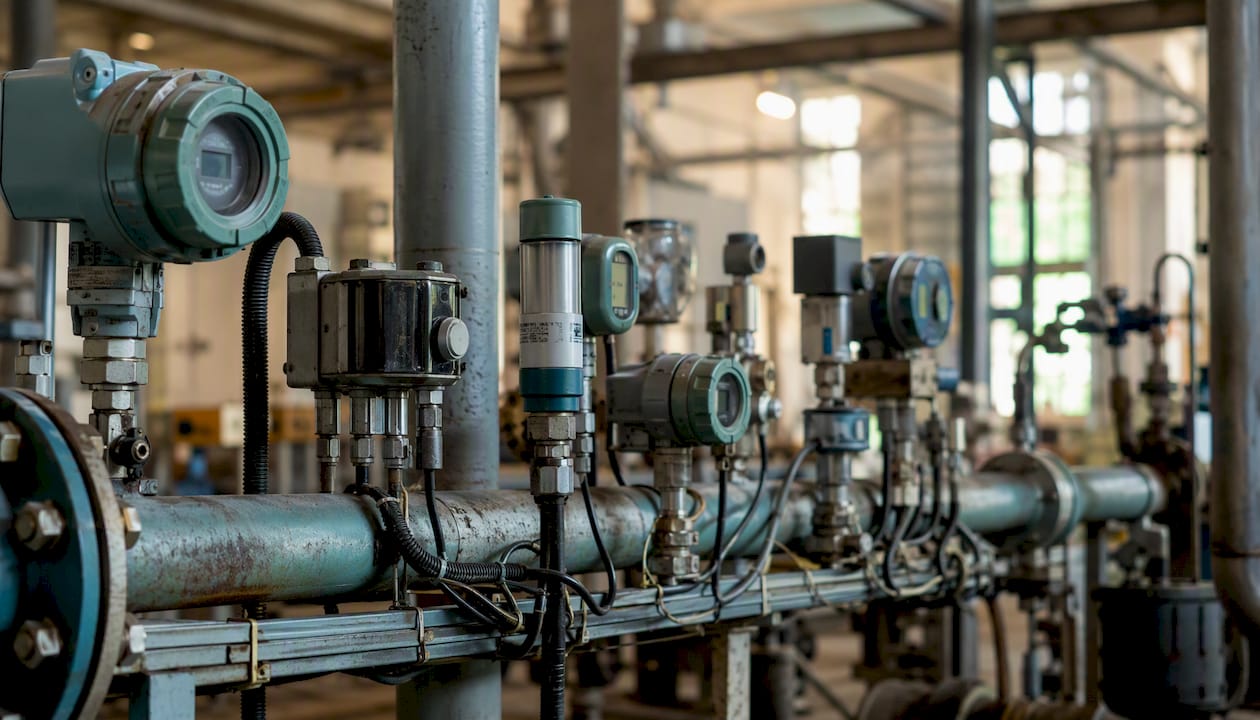
Classical MPC relies on a linear or nonlinear mechanistic model of the process. Adding a machine learning layer, typically a Gaussian process or neural network trained on recent plant data, corrects for model-plant mismatch in real time. The result is tighter constraint adherence and better setpoint tracking across a wider operating range. Cement kilns and distillation columns are the most common UK applications, where even a 1–2% improvement in energy efficiency translates to material cost savings at scale.
RL agents learn a control policy by interacting with a simulator and then transferring to the live plant in advisory mode before taking closed-loop authority. Yokogawa deployed coordinated autonomous RL agents at Aramco’s Fadhili Gas Plant, reporting 10–15% reductions in amine and steam usage and approximately 5% power reduction in the acid gas removal unit after progressive commissioning phases. That staged approach, simulator training followed by shadow advisory then autonomous transfer, is now the accepted industry template.
A digital twin combines a physics-based process model with data-driven corrections to create a virtual replica of a plant unit. Engineers use it to train AI agents safely, test control strategies without production risk, and run what-if scenarios for debottlenecking. Process mining and digital twins together provide continuous measurement and rapid iteration, reducing time-to-value and supporting governance reporting. For UK plants with limited live data, the twin also generates synthetic training data for supervised and RL models.
Camera systems paired with CNN models inspect products at line speed, classifying defects that human inspectors miss under fatigue or poor lighting. In food and beverage packaging, vision systems routinely catch seal failures, label misalignments, and foreign-body contamination. In pharmaceutical tablet inspection, they replace manual AQL sampling with 100% inspection at production rates. Explore quality monitoring tools that integrate with MES platforms to log every inspection result against the batch record automatically.
UK-specific notes across all use cases:
A three-phase roadmap covers the journey from initial scoping to full autonomous deployment: Discover and simulate → Pilot in shadow/advisory mode → Phased autonomous roll-out.
Pilot checklist before you start:
Validation pass/fail criteria: The pilot passes if KPI improvements are statistically significant over the shadow period, the AI operates within the safety envelope on more than 99% of control actions, and operator intervention frequency is stable or declining. Any constraint breach triggers an automatic review before the next phase.
A well-structured AI pilot needs more than a model. It needs a data capture layer, a KPI dashboard, an operator workflow, and an audit log. That is precisely where MES integration adds value, and where Mestric fits into the technology stack.
The integration flow:
The Merck chiller case illustrates what this looks like at scale: Phaidra’s RL-based Virtual Plant Operator delivered a 16.2% energy saving in an initial demonstration, then expanded to coordinated multi-agent control across four chiller plants, improving both energy efficiency and thermal stability. The staged approach, demo then full roll-out, mirrors the three-phase roadmap above.
Compliance and safety features in the Mestric pilot workflow:
Strokovni nasvet: Request that your AI vendor provides a simulator or digital-twin environment before signing any deployment contract. If they cannot demonstrate the control policy in simulation first, the risk of an unplanned constraint breach during live commissioning rises significantly.
AI is commonly used for process monitoring, soft sensing, and design optimisation in UK industry. Full autonomous executive control, where an AI agent writes setpoints to a live DCS without operator confirmation, remains less common and is concentrated in energy-intensive industries with strong economic incentives and mature data infrastructure.
The IChemE roundtable identifies a skills gap as the primary adoption barrier: most UK plants lack engineers who can both understand the process and build or validate ML models. The recommendation is to invest in internal capability alongside any vendor engagement, rather than outsourcing the entire AI function.
The modern ML survey confirms that reinforcement learning and hybrid modelling are the most promising directions for closed-loop control, but both face practical constraints. RL requires large amounts of interaction data, which is why simulator pre-training is non-negotiable. Hybrid models reduce data requirements but still need a validated mechanistic model as the foundation.
Where to invest based on your situation:
The AI in manufacturing landscape is moving quickly, but the plants that will sustain gains are those that treat AI adoption as an engineering discipline, not a software purchase.
AI-driven process control delivers the fastest, most auditable returns when pilots start narrow, with clean historical data, a defined safety envelope, and a baseline KPI measurement window of at least eight weeks before any model is deployed.
| Točka | Podrobnosti |
|---|---|
| Start with monitoring, not control | Predictive maintenance and anomaly detection require no closed-loop authority and deliver fast, auditable value from existing historian data. |
| Baseline KPIs before anything else | Measure energy intensity, yield, reject rate, and MTBF for at least 8 weeks before deploying any model, or you cannot prove improvement. |
| HAZOP involvement is non-negotiable | Involve your process safety team at the reward function and safety envelope design stage, not after the model is built. |
| Shadow testing builds operator trust | Run every AI model in read-only shadow mode for 4–8 weeks before any advisory or closed-loop transfer. |
| Mestric as the MES integration layer | Mestric connects machine data to AI services, provides KPI dashboards, and maintains the audit log that governance and safety reviews require. |
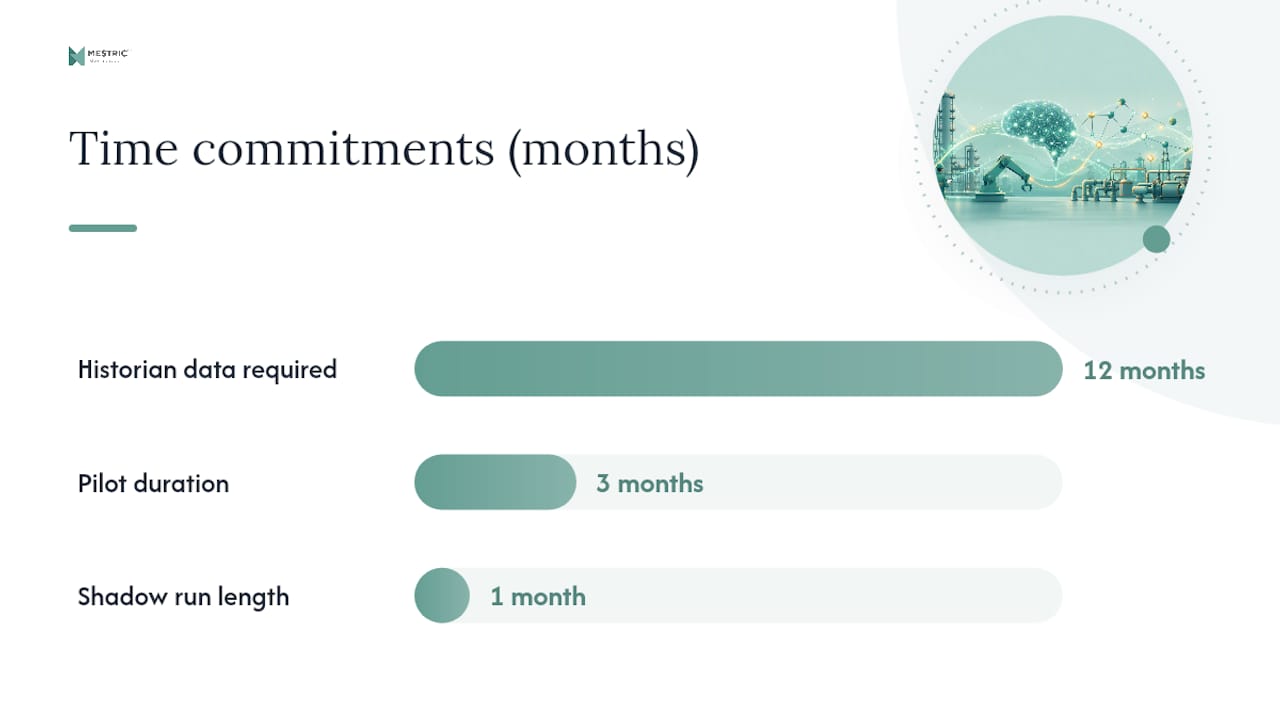
The most common mistake in AI pilot scoping is choosing a unit that is too large, too safety-critical, or too data-poor to deliver a clean result in a reasonable timeframe. The right starting point is a single, well-instrumented unit with at least 12 months of clean historian data, no ATEX classification that would complicate sensor installation, and a process safety team willing to engage early.
Narrow scope is not a compromise. A tightly scoped pilot on a single compressor or heat exchanger, run over three months with rigorous KPI tracking, will generate more credible evidence than a broad deployment across an entire unit that produces ambiguous results.
Practical tips for scoping:
Suggested three-month pilot timeline:
At the end of month three, you should have a clear answer: does the AI improve the target KPI by a statistically significant margin within the safety envelope? If yes, proceed to phased closed-loop transfer. If not, the shadow data will tell you exactly where the model needs improvement before you take that step.
Running a credible AI pilot on a UK shopfloor requires more than a model. You need clean, timestamped machine data, a KPI dashboard that updates in real time, a safe shadow-testing workflow, and an audit log that satisfies both your process safety team and your procurement function. Mestric provides all of that in a single MES platform that connects directly to your plant equipment via OPC-UA.
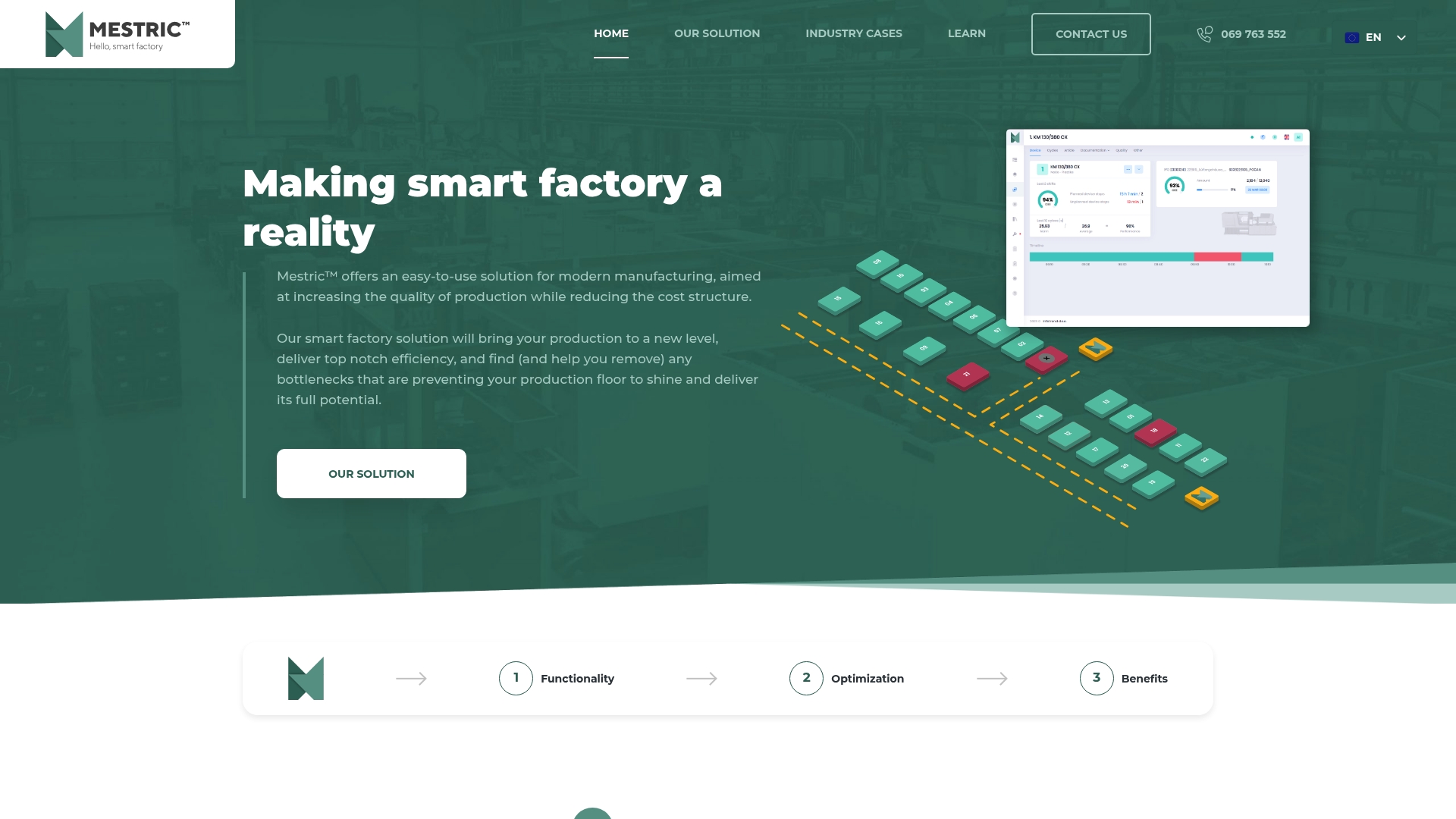
Where many AI projects stall at the data-collection stage, Mestric’s real-time production tracking gives your team a live view of energy intensity, yield, throughput, and reject rate from the moment the pilot starts. The audit log captures every AI recommendation and operator action automatically, so your governance documentation builds itself as the pilot runs. Shadow testing is built into the workflow: the AI layer runs in read-only mode until your team is ready to move to advisory, with a documented rollback procedure at every stage.
To see how Mestric integrates with your plant systems and supports a structured AI pilot, book an on-site demonstration at mestric.com.
The sources below cover the full range of AI process control topics, from foundational algorithms to live deployment case studies.
IChemE AI/ML in process plant operation roundtable report: — Start here for UK-specific adoption context, skills gap analysis, HAZOP recommendations, and governance guidance. Essential reading for any UK plant team scoping a pilot.
Modern Machine Learning Tools for Industrial Processes: A Survey (arXiv/ar5iv): — The most comprehensive academic survey of supervised, unsupervised, hybrid, and RL approaches for process monitoring and control. Consult this for algorithm selection and understanding data requirements.
Yokogawa/Aramco Fadhili Gas Plant deployment (Business Wire): — The most detailed public account of a multi-agent RL deployment in a live gas plant, including the staged commissioning approach and reported resource savings. Reference this when presenting the business case for RL-based control to plant leadership.
Microsoft AI toolkit for business operations (Microsoft Inside Track): — Covers process mining, digital twins, and human-in-the-loop design for measurable AI-enabled process improvements. Useful for governance and continuous improvement frameworks.


 069 763 552