


The most common IIoT data management challenges facing UK manufacturers are security and device identity, scalability and storage architecture, data quality and normalisation, integration with legacy OT systems, real-time processing latency, device lifecycle management, data governance and ownership, and network connectivity constraints. Each one has a direct mitigation.
Industry forecasts point to rapid growth in global IoT data volumes, making storage and integration planning non-negotiable from day one. Organisations that treat these challenges as a single programme rather than isolated IT tickets consistently reach production-grade data quality faster.
Strokovni nasvet: Map your top three operational KPIs before scoping any IIoT data project. Every architecture decision, from connector choice to storage tier, should trace back to those KPIs.
Effective IIoT data management requires governance embedded at design, edge-first architecture, and named ownership at every data lifecycle stage.
| Točka | Podrobnosti |
|---|---|
| Govern at design, not retrospectively | Assign data owners and define tag naming before the first connector goes live. |
| Edge-first architecture | Deploy store-and-forward buffering and stream processing at the edge to handle connectivity gaps and latency requirements. |
| Security controls are non-negotiable | Apply mTLS, hardware root of trust, and network segmentation from day one; reference the NIST Cybersecurity Framework for a structured baseline. |
| Pilot scope drives success | Limit the first pilot to one line, one KPI, and 3–6 tags per asset; validate data availability above 98% before expanding. |
| Connector coverage is the primary vendor criterion | A platform with a tested, published connector matrix for your specific assets is worth more than advanced analytics features built on unreliable data. |
Industrial data does not behave like CRM records or ERP transactions. It arrives at high frequency, often thousands of tags per second, carries tight timing requirements, and only makes sense when paired with equipment context: asset ID, production order, shift, and process state. Strip that context and the numbers are meaningless.
Several industrial realities compound the problem:
Two scenarios illustrate the cost of ignoring these realities. In a batch process, a reactor temperature reading without a linked batch ID and recipe version is uninterpretable for quality review. In a remote pumping station on intermittent cellular, a connectivity drop causes a data gap that looks like a process event unless the historian explicitly flags the outage. Both cases produce data that exists but cannot be used, which is the most common reason analytics projects stall.
The role of IoT in manufacturing extends well beyond sensor collection. The real value comes from contextualised, governed data that feeds reliable KPIs.
Technical blockers account for the majority of IIoT project delays. The following subsections break each one down with its cause, a practical mitigation, and a question to put to any supplier.
Cause: Production sites run heterogeneous stacks. A single line may require a Modbus TCP connector for an older drive, an OPC UA server for a newer PLC, and a REST API for a cloud-enabled sensor. Maintaining this connector library is an ongoing engineering task, not a one-time integration.
Mitigation: Prioritise platforms with a published, tested connector matrix. Deploy IoT gateways at the edge to handle protocol translation locally, and require store-and-forward buffering so a network outage does not create a data gap. ETSI IoT standards provide interoperability baselines worth checking against vendor claims.
Vendor question: “Show me your connector matrix and tell me how you handle backfill after a 30-minute outage.”
Cause: High-frequency sensor data grows fast. Storing everything in a relational database is expensive and slow for range queries. Keeping all data in a hot tier is cost-prohibitive at scale.
Mitigation: Use a purpose-built time-series database (such as InfluxDB or TimescaleDB) for the hot tier covering recent operational windows, and push aged data to a cold object store. Define retention policies at ingest, not retrospectively.
Vendor question: “What is your default retention policy, and how do you handle the hot-to-cold transition without query gaps?”
Cause: Sensors drift, cables degrade, and PLCs occasionally output out-of-range values. Without validation at ingest, bad data propagates into KPI dashboards and model training sets.
Mitigation: Apply range checks, rate-of-change limits, and null-handling rules at the edge or message bus layer. Flag suspect readings rather than silently dropping them, so analysts can distinguish a genuine process event from a sensor fault.
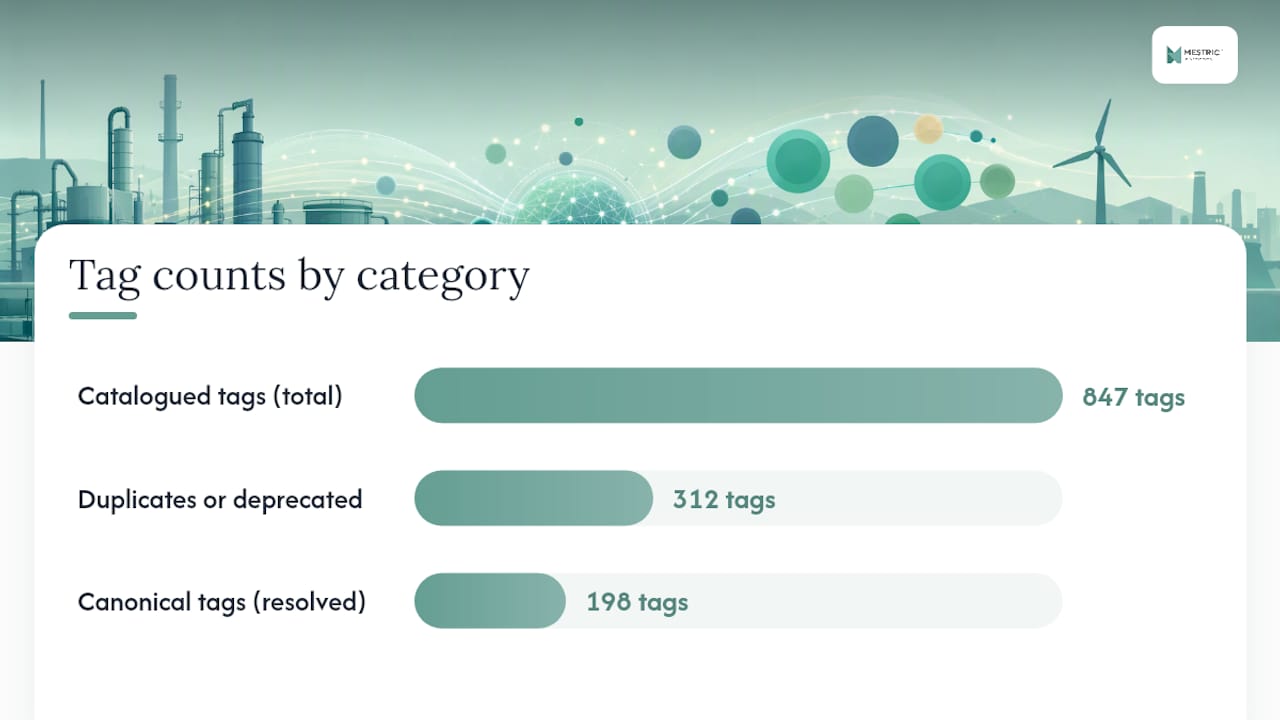
Cause: Tag names change when equipment is upgraded or when a new engineer reconfigures a PLC. A tag that was Line1_Temp_01 becomes L1_T_001 after a firmware update, silently breaking every downstream query.
Mitigation: Maintain a canonical tag registry with versioned mappings. When a tag changes, the registry maps the old name to the new one and records the change date.
Strokovni nasvet: *Automate tag-mapping suggestions using string-similarity matching, but require a human review cycle before any mapping goes live in production.
OPC UA is the preferred open standard for OT-to-IT data exchange, but many legacy assets only support Modbus, PROFINET, or proprietary historian APIs. A well-designed integration strategy uses a message broker (such as MQTT with Sparkplug B) as a canonical transport, normalising all protocols behind a single event bus before data reaches the MES or analytics layer.
Cause: Control-loop feedback and safety alarms require sub-second determinism. Routing all data to a cloud platform before acting on it introduces unacceptable latency.
Mitigation: Run stream processing at the edge for deterministic alarms and local control feedback. Send aggregated, contextualised events to the cloud or MES for batch analytics and long-range optimisation. This separation of concerns keeps latency predictable without over-engineering the cloud layer.
The primary controls for IIoT security are device identity and attestation, transport and at-rest encryption, network segmentation, and secure firmware provisioning. These address the most common IIoT data security concerns before any regulatory layer is applied.
UK manufacturers operating under the UK GDPR (retained post-Brexit) must treat any telemetry that contains personal identifiers, such as operator badge IDs or biometric access logs, under full GDPR obligations: lawful basis, data minimisation, and data subject rights. The ICO is the supervisory authority for UK operations.
Operators of essential services (energy, water, transport, digital infrastructure) also fall under the Network and Information Systems (NIS) Regulations 2018, which require appropriate technical and organisational measures and mandatory incident reporting to the relevant competent authority.
Security posture callout: The NIST Cybersecurity Framework’s five functions, Identify, Protect, Detect, Respond, and Recover, give IIoT teams a risk-based structure that maps directly onto OT environments and is widely accepted by UK auditors and insurers as a credible baseline.
Strokovni nasvet: Key management at the edge is the most commonly neglected control. Store private keys in a hardware security module (HSM) or TPM rather than in a file system. A compromised edge device with a file-based key exposes every asset on that segment.
A minimal but production-grade IIoT data architecture has five layers: edge collectors and gateways, a message bus or streaming layer, a time-series store with cold archive, a metadata registry, and an analytics layer. Each layer has a defined owner and a defined contract with the layers adjacent to it.
| Stage | Activity | Responsible role |
|---|---|---|
| Ingest | Protocol translation, store-and-forward buffering | OT engineer / gateway owner |
| Validation | Range checks, null handling, duplicate detection | Data steward |
| Contextualisation | Tag-to-asset mapping, batch/order linkage, shift annotation | Data steward + OT owner |
| Storage | Hot tier (time-series DB), cold tier (object store) | Platform / IT owner |
| Access | API governance, query optimisation, access control | Analytics owner |
| Archival | Retention enforcement, legal hold, deletion policy | Data owner + compliance |
Good manufacturing data governance requires four named roles, not just a policy document:
Tag naming, change control, and schema publication should follow a written process. When a new asset is commissioned, the OT owner registers it in the metadata registry before the first data point arrives. This is the governance-at-design principle: a poorly structured I/O list at commissioning produces a fragmented tag database that no amount of downstream tooling can fully repair.
A Unified Namespace (UNS) approach, where all assets publish to a single canonical topic hierarchy (site/area/line/asset/tag), makes the metadata registry self-documenting and dramatically reduces the connector maintenance burden as the plant scales.
The answer is to separate concerns from the start. Streaming analytics handles deterministic alarms and low-latency control feedback. Batch analytics handles model training, long-range trend analysis, and optimisation.
Mixing the two in a single pipeline is the most common architecture mistake. It forces latency trade-offs that satisfy neither use case.
Common pitfalls include label leakage from misaligned production context, models trained on noisy historical sets that include periods of known sensor faults, and deploying a model without a rollback path. Real-time production data is the fuel for these models, but only when it arrives clean, contextualised, and on time.
Decision-makers planning a first pilot benefit from a tight scope and clear success criteria. The following checklist keeps pilots deliverable within a quarter.
Ask every supplier these questions before shortlisting:
Vendor red flags: no published connector matrix, opaque data models with no API access, no support for local edge processing, and inability to provide referenceable manufacturing deployments.
Costs are dominated by integration engineering, connector maintenance, and change management, not by sensor hardware. A project that looks affordable at the sensor level routinely doubles in cost once connector complexity and governance work are accounted for.
Projects that underfund governance in year one typically spend twice as much correcting data quality issues in year two.
Prioritise connector coverage, edge processing capability, and transparent data models over analytics demos. A platform that cannot reliably collect data from your existing assets is not a platform; it is a proof-of-concept tool.
A discrete manufacturer running three assembly lines faced a familiar problem: each line had a historian, but tag names were inconsistent across lines, shift context was missing from every record, and the MES received data 15 minutes late because the integration used a scheduled file export.
The resolution followed a clear sequence:
Measurable outcomes from this pattern include a reduction in manual data reconciliation effort, faster root-cause identification when a quality event occurs (because the production order and shift are already attached to the relevant time window), and improved data availability as the store-and-forward buffer eliminates gaps from short network outages.
Mestric’s MES platform serves as the integration target in this pattern, receiving contextualised, validated events and surfacing them as KPI dashboards and quality alerts. The role of data in manufacturing is only realised when the data arriving at the MES is clean, contextualised, and timely.
IIoT data continuity planning covers three distinct failure modes: edge device failure, network partition, and central platform outage. Each requires a different response.

Edge device failure is mitigated by store-and-forward buffering with a local queue large enough to cover the mean time to repair for your edge hardware. Size the buffer for at least 72 hours of data at peak polling frequency.
Network partition between OT and IT is the most common failure mode in industrial environments. Edge gateways should continue local processing and alarm detection during a partition, and backfill the central platform automatically when connectivity is restored. Test backfill behaviour explicitly during commissioning.
Central platform outage requires a defined recovery time objective (RTO) and recovery point objective (RPO) agreed with the platform vendor. For production-critical KPI dashboards, an RTO of four hours or less is a reasonable starting point. Verify that the vendor’s backup and restore procedures have been tested, not just documented.
Continuity planning should also address data integrity: backups must be verified with checksums, and restore procedures must be tested on a schedule. An untested backup is not a backup.
Technology is rarely the primary reason IIoT data projects fail to deliver value. Organisational adoption challenges, specifically the gap between what the data team builds and what the production team trusts and uses, account for a significant share of stalled projects.
Several patterns recur:
OT and IT teams operate in separate silos. OT engineers prioritise uptime and distrust changes to production systems. IT teams prioritise security and standardisation. Without a shared governance model and a named integration owner who spans both, decisions stall and connectors go undeployed.
Production staff do not trust the dashboards. If a KPI dashboard shows a number that contradicts what the shift supervisor observed on the floor, the supervisor will stop using the dashboard. Data quality issues that are invisible to the analytics team are very visible to the people whose performance is being measured.
Training is treated as a one-time event. A single training session at go-live does not build lasting capability. Embed data literacy into shift handover processes and make the data steward role a recognised part of the organisational structure, not a temporary project role.
Change management is scoped too narrowly. Deploying a connector is a technical task. Changing how a production manager makes decisions is an organisational change. Projects that treat the two as equivalent consistently underestimate the time and effort required for adoption.
Practical steps to improve adoption: involve production staff in defining the KPIs the dashboards will show; run a two-week parallel run where staff use both the old process and the new dashboard before switching; and appoint a change champion on each line who is accountable for adoption, not just awareness.
Three implementation pitfalls appear repeatedly across IIoT projects, and they are worth naming directly.
Over-collecting data without context. The instinct to collect everything and decide later what is useful produces tag databases with thousands of signals and no metadata. The data exists but cannot be queried reliably. Start with the minimum tag set needed to compute your primary KPI, and add sources only when a specific analytical question demands them.
Underestimating connector complexity. A connector that works in a lab environment against a test PLC often behaves differently against a production asset under load, with firmware variations and network latency. Budget for connector testing, monitoring, and maintenance as an ongoing operational cost, not a one-time project task.
Treating governance as an afterthought. Governance applied retroactively to an existing tag database is expensive and incomplete. The most effective approach is to embed naming conventions, ownership assignments, and validation rules at the point of automation design, before the first data point is collected. This is the single highest-leverage action available to a project lead planning a first pilot.
Author tip: Start with the one asset hierarchy that feeds your primary KPI and scale out from there. A single well-governed line with clean, contextualised data delivers more analytical value than a full-site deployment with inconsistent tagging and no ownership model.
The following sources are directly relevant to IIoT data management practice in the UK context:


 069 763 552