

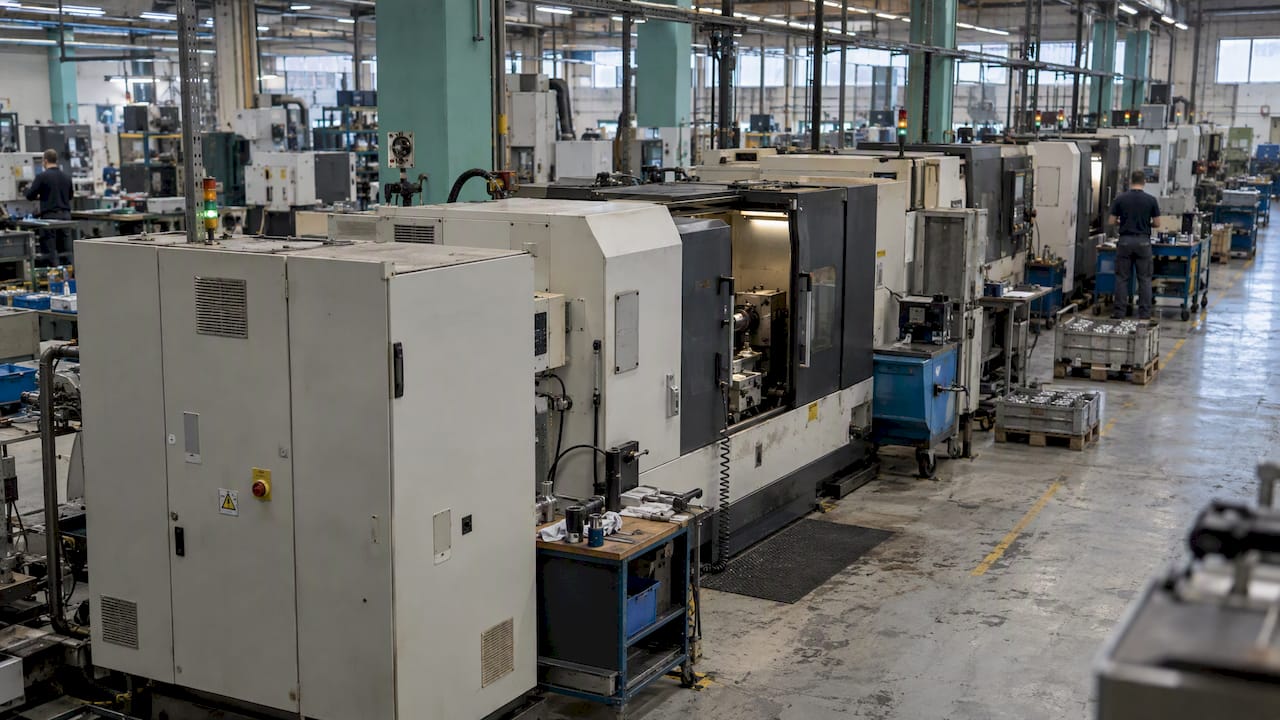
An Industry 4.0 plan is a sequenced, costed roadmap that links each digital investment to a business problem in your plant. It starts with an honest view of where you are today. It then moves through a pilot to scaled rollout, with cybersecurity, training and KPIs built in from the start. This guide shows you how to write that plan, step by step, for a Slovenian manufacturer.
Most plans fail because they begin with technology. The NIST Manufacturing Extension Partnership guide to Industry 4.0 technologies frames the plan around the business first. A useful plan answers six questions:
Write these answers on a few pages. A short plan that your production manager, your CIO and your CEO all accept is worth more than a long strategy nobody reads.
Begin on the shop floor. Walk through the production workflow and note where information is written by hand, retyped, or simply missing. Our guide on assessing current production workflows and data gives a practical way to do this.
Then measure digital maturity in a structured way. Slovenian companies have local support for this:
You are not behind if the result is modest. The 2022 European Manufacturing Survey analysis of Slovenian firms found that most Slovenian manufacturers sit at lower Industry 4.0 readiness levels. The same practitioners add that maturity is a process of continuous improvement. Treat the assessment as the entry point to a longer collaboration, not a one-off score.
A plan needs targets that finance and operations both understand. A UNIDO assessment reported by the Enterprise Europe Network found that fewer than one in ten surveyed firms had a defined vision or documented roadmap, and that investment was often reactive. It recommended a structured, costed transformation plan instead of isolated technology purchases.
Turn your priorities into objectives like these:
| Business priority | Example objective | KPI to track |
|---|---|---|
| Capacity without new machines | Raise availability on the bottleneck line | OEE, machine occupancy |
| Fewer stoppages | Make every stop visible and categorised | Downtime by cause (Pareto chart) |
| Quality | Catch deviations at the machine, not at final inspection | Scrap rate, complaints |
| Cost | See cost per order in near real time | Cost per unit, labour and material variance |
| Delivery | Shorten and stabilise lead times | Cycle time, on-time delivery |
NIST also advises tying KPIs to financial results, including production volume, scrap, utilisation and cycle time, so you can track return on investment. Record the baseline value for each KPI before you change anything. Without a baseline, you cannot prove improvement later.
Our Preglednica za optimizacijo proizvodnje can help you structure this list.
The most useful rule in the whole roadmap is a simple one: lean first, Industry 4.0 second. Slovenian lean practitioners explain in their Lean 4.0 article that processes should be stabilised with 5S, standard work and TPM before you add digital solutions. Otherwise you produce a lot of precise data about a chaotic process.
In practice this means:
This stage is cheap, it improves results on its own, and it makes the later data meaningful. The same source suggests a phased order: diagnostics, then a pilot project, then scaling up to a full smart factory. For a broader view of the cost side, see our guide to cost-saving methods in manufacturing.
NIST lists the technology families a manufacturer may consider: IoT, big data and AI, robotics and automation, simulation, system integration, cloud computing and cybersecurity. Its advice is to prioritise those that answer a business need. It also notes that older equipment can be connected with after-market smart sensors, so you do not need to replace a working machine to get its data.
Slovenia’s strategy for the digital transformation of the economy names AI, IoT, big data, blockchain, cybersecurity and predictive analytics as fourth industrial revolution technologies. It also warns that limited investment in them can hold back a comprehensive transformation.
A useful way to sequence them is the seven-level reference model described in this academic implementation study. It runs from security, through computerisation, connectivity, visibility and transparency, to predictive capacity and finally adaptability. The lesson is that each level rests on the one below. You cannot predict failures if you cannot yet see what your machines are doing.

The connectivity and visibility levels are where most plants get the largest early gains. A Manufacturing Execution System collects data automatically from machines, shows live KPIs and links production events to orders. NIST makes the point that integration is easier when your existing production systems already communicate well. An MES is the layer that makes that communication happen on the shop floor. If you are comparing system types, our overview of seven types of manufacturing software explains how MES, ERP and PLM differ, and MES versus traditional manufacturing shows what changes day to day.
Pick one line or one cell with a clear problem, typically the bottleneck. Define three or four KPIs, record the baseline, and run the pilot long enough to see real variation across shifts.
A good pilot has:
Simulation can reduce risk before any physical change. In one EDIH success story from Slovenia on robotisation, pre-validation by simulation was expected to cut initial implementation costs by 15 to 20% and estimated downtime during implementation by 50%, and to reveal mechanical and spatial conflicts early.
When the pilot meets its targets, copy the setup to the next line with the same KPI definitions. Consistent definitions are what allow you to compare lines and plants. Our step-by-step production optimisation guide covers the rollout logic in more detail.
Connecting machines creates new exposure, so security belongs at the base of the roadmap. In Slovenia, the new Information Security Act (ZInfV-1) took effect on 19 June 2025. It transposes the EU NIS 2 Directive and introduces risk-management and incident-reporting duties for entities within its scope. Check with your legal or security lead whether your company is covered.
The official ZInfV-1 questions and answers add two points relevant to manufacturers. Entities must define minimum information security requirements for direct suppliers and assess supplier vulnerabilities. And a supplier being ZInfV-1 compliant does not automatically make it “trusted”: you still carry out your own supply chain risk assessment.
In your plan, include at least:
Operators and supervisors decide whether data is entered, read and used. Budget real time for training, and involve shift leaders early. Slovenian lean practitioners suggest that a substantial share of project effort should go to training and upskilling, and that skipping it is a common reason projects fail. Whatever share you choose, put it in the budget as its own line.
An Industry 4.0 programme rarely needs one large purchase. It is more often a series of smaller steps, each paid back before the next begins. That is another reason to phase the plan.
Several funding routes exist, and they change from year to year:
Call conditions, budgets and deadlines change, so always read the current call text on the official page before you plan around it.
We talk to plant managers who already have machines, an ERP and a long wish list. The pattern we see most often is not a lack of technology. It is a lack of reliable, shared numbers from the floor.
So our advice is plain. Do not start with AI. Start with visibility: know, minute by minute, what each machine is doing, why it stops and what it costs. When that data is automatic and trusted, a plant manager’s week changes. Meetings move from arguing about whose figures are right to deciding what to fix first. Only then do process optimisation and AI recommendations, such as suggested process parameters, have good data to work with.
We also believe a plan should be small enough to start next month. One line, a handful of KPIs and a clear owner will teach you more than a two-year strategy document.
— Andraž
Mestric™ MES connects directly to your equipment and collects data automatically. It gives production managers live KPIs for performance, downtime, quality and cost, with AI-powered optimisation on top. It suits the visibility step of your roadmap, and it is easy enough for shop floor teams to adopt. We also offer a demonstration at our demo centre, so you can see connected machinery in a production setting before you decide. Read more about Mestric™ MES.
If you want to understand the monitoring side first, start with real-time performance tracking or our guide to factory digitalisation.
Review the KPIs you set in step 2 at fixed intervals, and compare each with its baseline. A sensible set for most plants:
A Slovenian lean consultancy reports a case in which an automotive supplier with 240 employees combined lean stabilisation with Industry 4.0 steps and saw OEE rise and unpredictable downtime fall. Treat such cases as illustrations, not promises: your results depend on your starting point. Use your own baseline as the benchmark, and share the dashboard with the shop floor so improvement is visible to the people who produce it. For method, see our productivity analytics guide.
There is no fixed duration, because it depends on your starting maturity and number of lines. A realistic structure is diagnostics first, a pilot on one line, then rollout in waves. Plan reviews at the end of each phase rather than a single end date.
Start with a digital maturity assessment such as DIGI-Start, and consider SRC-EDIH services, including testing a solution before you invest. In parallel, stabilise your basic processes with 5S and TPM. Then pick one bottleneck line for a pilot.
Not necessarily. NIST notes that older equipment can be integrated using after-market smart sensors. Check each machine’s signal options first, then decide whether a sensor, a controller connection or a replacement makes sense.
It applies to entities within the scope of the law, which transposes the EU NIS 2 Directive. Ask your legal or information security officer to check your status against the official text and the Office for Information Security guidance. Even if you are not directly covered, customers may pass requirements down to you.
Most plants begin with OEE and downtime by cause, because they show where capacity is being lost. Add scrap rate and cost per unit once the first two are reliable.


 069 763 552