


TL;DR:
- Edge computing processes manufacturing data locally to enable rapid decisions and maintain operations during network outages. It reduces latency, improves predictive maintenance, and supports resilient, hybrid factory architectures. Successful deployment requires strong governance, industrial-grade hardware, and careful integration of legacy equipment.
Edge computing in factories is defined as processing manufacturing data locally, on or near the production floor, to enable rapid, reliable decision-making without full reliance on distant cloud servers. The role of edge computing in factories has moved from experimental to essential, particularly as production lines generate more sensor data than cloud pipelines can handle cost-effectively. Factory managers who understand this shift gain a direct advantage: faster responses, lower bandwidth costs, and production lines that keep running even when the internet does not. This guide covers the practical impact, key applications, and integration realities you need to act on.
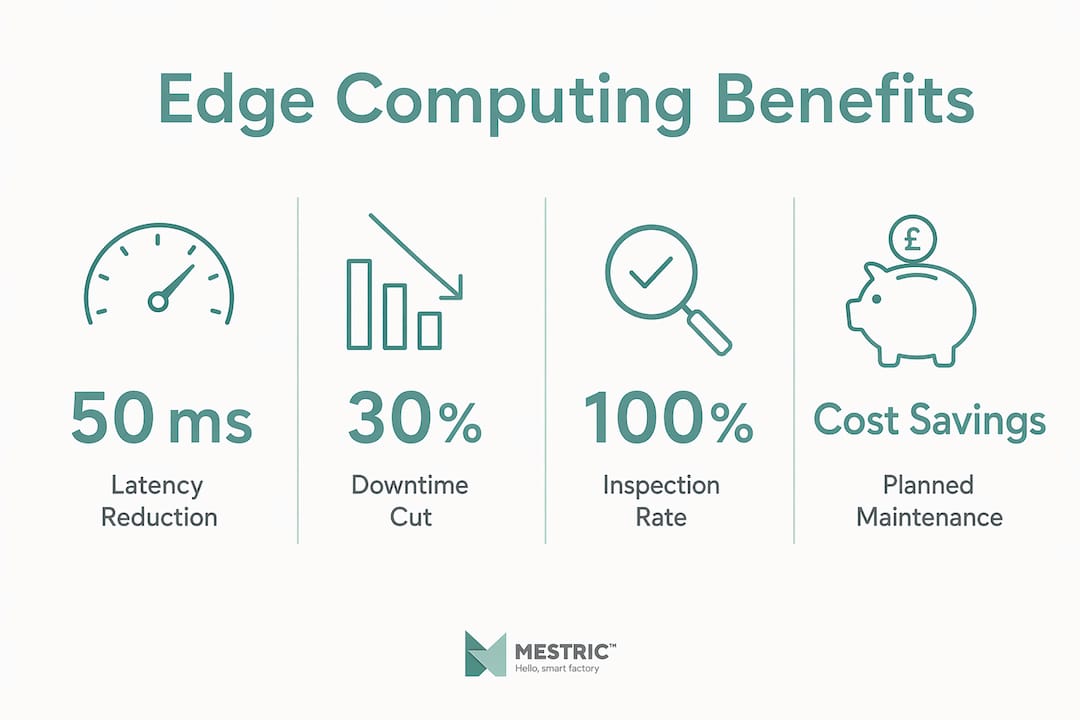
Latency is the single biggest technical argument for edge computing on the shop floor. A 50-millisecond delay can cause equipment failure, while local edge nodes process telemetry in microseconds. That gap is not a minor performance difference. It is the difference between a controlled shutdown and a damaged machine.
Cloud-based control systems send data to a remote server, wait for a response, and then act. For administrative tasks, that round trip is acceptable. For safety-critical systems, it is not. A robotic arm on an automotive line, for example, needs to respond to a collision signal in under 10 milliseconds. No cloud architecture reliably delivers that.
Edge nodes eliminate the round trip by processing data where it is generated. The result is near-instant local control, which directly reduces equipment failure rates and protects product quality. Factories running real-time monitoring on edge infrastructure report fewer unplanned stoppages because the system reacts before a fault escalates.
Key latency-related benefits of edge processing include:
Predictive maintenance is the most immediate and impactful edge computing use case available to factory managers today. Local algorithms analyse vibration, temperature, and acoustic data from sensors continuously. When readings drift outside normal parameters, the system flags a potential failure and schedules maintenance during planned downtime rather than waiting for a breakdown.

The financial logic is straightforward. Emergency repairs cost significantly more than planned ones, and unplanned downtime carries additional costs in lost output, rescheduling, and customer penalties. Predictive maintenance using edge-localised algorithms converts reactive fire-fighting into a scheduled, manageable process.
Quality control is the second major application. Machine vision systems mounted at inspection points capture high-resolution images of every unit produced. Edge nodes analyse those images locally and filter out irrelevant data before transmitting results upstream. Factories achieve 100% inspection rates this way, transmitting only relevant insights rather than raw image files. That approach saves substantial bandwidth costs while maintaining complete quality records.
The practical applications worth prioritising are:
Pro Tip: When deploying machine vision at an inspection station, configure the edge node to transmit only defect images and summary statistics to the cloud. Transmitting full image streams consumes bandwidth that adds up quickly across a multi-line facility.
Production resilience is where edge computing earns its place in the business case, not just the technical architecture. Production lines maintain operation without crashing during WAN failures, which is critical for high-volume manufacturing environments. Edge nodes run autonomously, buffer events locally, and reconcile data with the cloud once connectivity restores.
The cost argument is equally strong. Raw sensor data from a large factory can run into terabytes per day. Sending all of it to the cloud is expensive. Edge nodes perform data triage locally, forwarding only processed results and exception reports. That approach cuts data transmission costs significantly without sacrificing analytical depth.
Designing for resilience over raw compute power, and ensuring offline capability during WAN failure, distinguishes stable edge production systems from those prone to crashes. Systems must buffer events and operate autonomously to avoid production stoppages during connectivity issues.
A hybrid edge-to-cloud architecture delivers the best outcome for most factories. Edge handles latency-sensitive processes and local control. The cloud handles enterprise analytics, AI model training, and long-term data storage. The two are not competing options. They are complementary layers of the same production system.
Operational resilience benefits of edge infrastructure include:
For a deeper look at how cloud and edge complement each other in manufacturing setups, the architecture choices matter as much as the hardware.
Deploying edge computing in a factory is not a plug-and-play exercise. The most common failure point is not the technology. It is governance. Successful edge implementations require unified IT and OT governance covering infrastructure lifecycle management, remote software updates, and container orchestration. Without it, edge deployments become unmanaged islands that create operational burdens rather than solving them.
Hardware selection is the second critical decision. Industrial-grade fanless PCs designed for high heat dissipation outperform standard server hardware in factory environments. Standard server GPUs fail quickly under thermal stress on the shop floor. Specifying the wrong hardware leads to frequent replacements and unplanned downtime, which defeats the purpose of the investment.
Pro Tip: Before specifying edge hardware, map the thermal environment of each deployment location. A node positioned near a furnace or press requires different thermal ratings than one in a climate-controlled control room.
The table below summarises the key integration considerations and the recommended approach for each:
| Challenge | Recommended approach |
|---|---|
| IT/OT governance gaps | Establish a joint IT/OT team with shared ownership of edge infrastructure from day one |
| Hardware thermal failure | Specify industrial-grade fanless PCs rated for the operating temperature of each location |
| Overestimating compute elasticity | Design for resilience, not cloud-like scalability; prioritise offline operation capability |
| Security and data governance | Apply device lifecycle management, encrypted communications, and regular firmware updates |
| Remote management complexity | Use container orchestration tools to manage software updates across distributed edge nodes |
The role of IoT gateways in connecting legacy equipment to edge nodes is also worth addressing early in the deployment plan. Many factories have older machines that do not natively support modern communication protocols, and IoT gateways bridge that gap without requiring full equipment replacement.
Edge computing in factories delivers its greatest value when deployed as part of a hybrid architecture that pairs local real-time control with cloud-based analytics, supported by unified IT/OT governance and industrial-grade hardware.
| Point | Details |
|---|---|
| Latency reduction is critical | Edge nodes process data in microseconds, preventing equipment failures that cloud delays cannot avoid. |
| Predictive maintenance delivers fast ROI | Local sensor analysis schedules repairs proactively, converting costly emergency downtime into planned maintenance. |
| Resilience requires offline capability | Edge nodes must buffer events and operate autonomously during WAN outages to prevent production stoppages. |
| Hybrid architecture is the standard | Edge handles real-time control; cloud handles enterprise analytics and AI training. They work together, not separately. |
| Governance determines deployment success | Unified IT/OT management of edge infrastructure lifecycle is the most overlooked factor in successful deployments. |
The conversation around edge computing in manufacturing often gravitates toward fully autonomous “dark factories,” where lights-off production runs without human intervention. I understand the appeal of that vision. Fully autonomous dark factories remain a long-term goal limited by data processing costs and energy demands. Edge computing is the technology that moves factories meaningfully toward that goal today, not the technology that delivers it overnight.
What I have seen consistently is that the factories gaining the most from edge deployments are not the ones chasing full automation. They are the ones using edge to make their people faster and better informed. An operator who receives a real-time alert about a developing bearing fault, rather than discovering it after a breakdown, is a more effective operator. Edge computing enables that.
The misconception I encounter most often is treating edge and cloud as an either/or decision. Manufacturers who frame it that way end up either over-investing in edge compute capacity they cannot use, or under-investing and losing the resilience benefits entirely. A hybrid model is not a compromise. It is the correct architecture for most production environments.
My honest recommendation: start with one high-value use case, predictive maintenance or quality inspection, deploy edge infrastructure for that process specifically, and measure the outcome before scaling. That approach builds internal competence and produces a business case that justifies the next phase of investment.
— Andraž
Mestric connects directly with manufacturing equipment to deliver real-time performance tracking and quality monitoring across your production lines. The platform is built for factory managers who need clear visibility of KPIs, downtime, and quality parameters without building a complex data infrastructure from scratch.
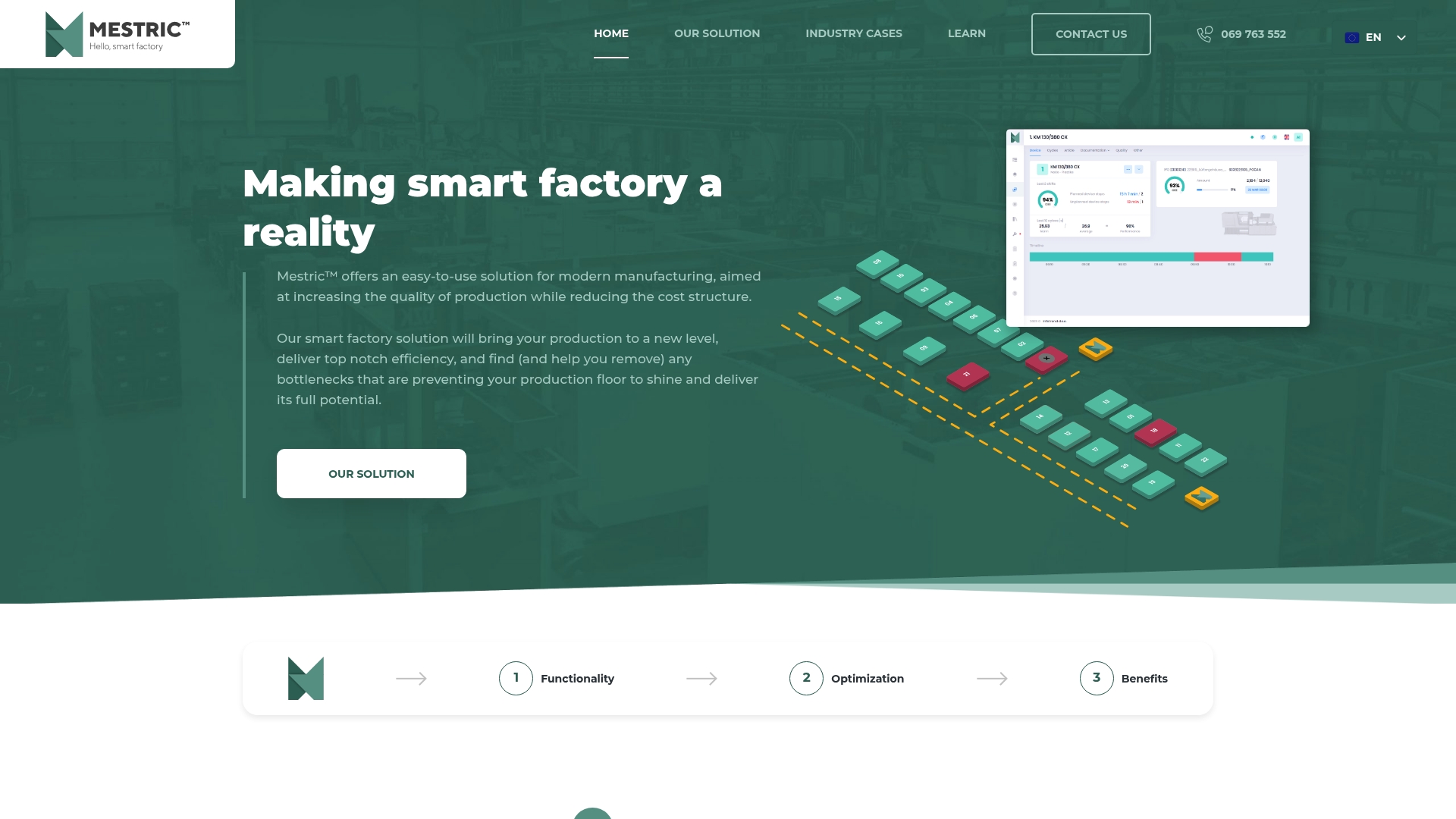
Where edge computing generates the raw data, Mestric provides the analytical layer that turns it into decisions. The platform integrates AI-powered tools that identify bottlenecks, flag quality deviations, and support production planning based on live data. If you are evaluating how a Manufacturing Execution System fits into your production efficiency goals, Mestric offers an onsite demonstration that shows exactly how connected machinery benefits your specific environment.
Edge computing in a factory means processing production data locally, on or near the shop floor, rather than sending it to a remote cloud server. This enables real-time control, faster responses, and continued operation during network outages.
Edge nodes analyse sensor and camera data locally at inspection points, enabling 100% inspection rates without transmitting large raw data volumes to the cloud. Only relevant results and defect records are forwarded upstream.
Yes. Edge nodes are designed to operate autonomously during WAN or internet outages, buffering events locally and reconciling data with the cloud once connectivity is restored. This is a core design requirement for production-grade edge systems.
Industrial-grade fanless PCs with high heat dissipation ratings are the standard for factory floor deployments. Standard server hardware fails quickly under the thermal stress of production environments.
IoT sensors and gateways generate the data that edge nodes process. The role of IoT in edge computing is foundational: without connected sensors feeding real-time data to local nodes, edge processing has nothing to act on.


 069 763 552