


TL;DR:
- Data integration consolidates manufacturing systems into a unified view, improving real-time decision-making and operational visibility. It breaks down silos, reduces errors, boosts efficiency, and enables predictive maintenance by sharing accurate, timely data across departments. Adopting standardized protocols and strong security measures ensures reliable, secure factory data flow that enhances responsiveness and competitiveness.
Data integration in manufacturing is the consolidation of information from disparate systems, including ERP, MES, IoT sensors, and supply chain platforms, into a unified operational view that supports real-time decisions. When your factory runs on disconnected systems, you are effectively managing with partial sight. Integrated data removes that blind spot.
The core role of data integration in factories is to break down silos and create a single source of truth across every department. Production metrics, maintenance logs, inventory levels, quality records, and supplier data all flow into one platform. The result is operational visibility that was simply not possible when each system held its own version of the truth.
Key systems involved in manufacturing data integration include:
When these systems share data in real time, production managers gain the ability to act on current information rather than yesterday’s reports. That shift from reactive to informed decision-making is what drives measurable gains in efficiency, quality, and cost control.
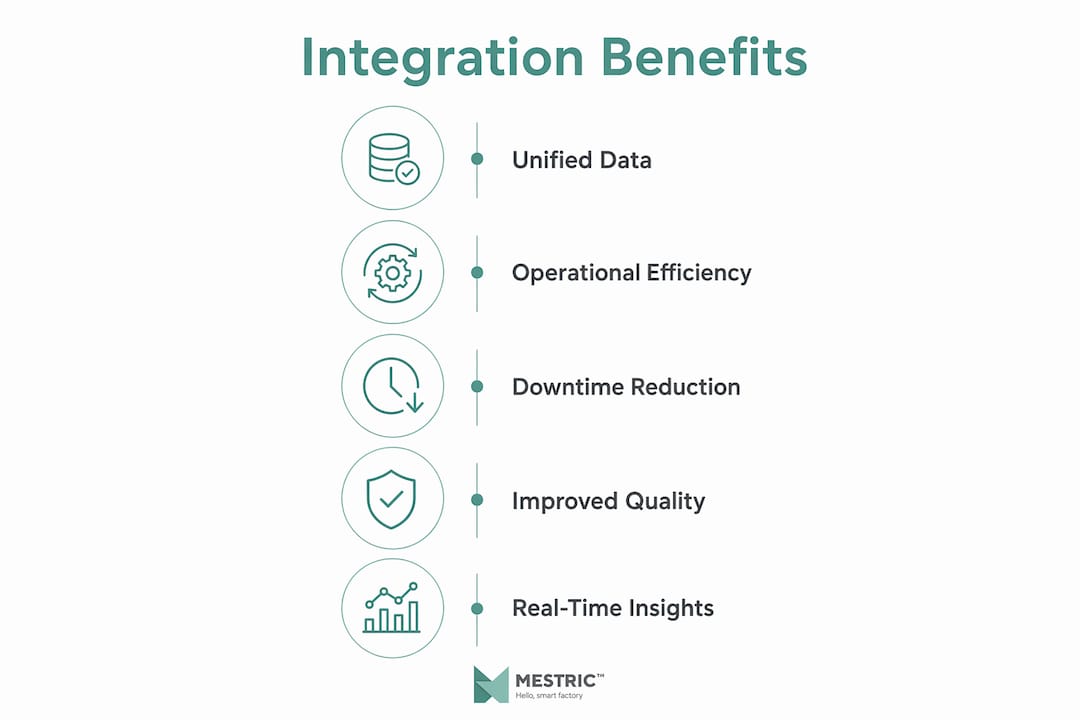
Connecting your factory’s data systems produces practical, measurable advantages across production, quality, and supply chain management. These are not theoretical gains. They show up in reduced downtime, fewer errors, and faster responses to operational problems.
Pro Tip: Start by integrating the data sources that cause the most operational pain, typically downtime tracking and inventory levels. Targeted integration of high-value datasets delivers faster returns than attempting a full system overhaul from day one.
The importance of data integration becomes clearest when you compare factories that have unified their data with those still running on siloed systems. The difference in response speed and decision quality is substantial.
Manufacturing generates data across every stage of production, but not all of it carries equal weight. Understanding which data categories matter most helps you prioritise integration efforts and avoid building pipelines that add complexity without adding insight.
The most operationally valuable data types to unify include:
Diverse data sets improve transparency and coordination when integrated, but only when the underlying data is clean and consistently defined across systems. A unified view built on inconsistent records produces misleading conclusions.
There is no single method that suits every factory. The right integration approach depends on how quickly you need data to move, how compatible your existing systems are, and how much latency your operations can tolerate. Four main approaches are used in manufacturing environments.
Regardless of the method chosen, data cleansing and metadata management are prerequisites for reliable integration. Without a consistent data model and clear definitions across systems, integrated analytics produce conflicting outputs that undermine confidence in the data.
A practical example: connecting an ERP system to an MES platform via API allows production orders to flow automatically to the shop floor, while actual output data returns to the ERP without manual entry. Add real-time streaming from IoT sensors, and you have a live picture of production performance aligned with business planning data.

The clearest way to understand the impact of data integration is to look at where it changes outcomes in practice. These use cases reflect the most common and high-value applications in UK manufacturing environments.
Pro Tip: When implementing predictive maintenance, begin with your highest-cost or most failure-prone equipment. Integrating sensor data for two or three critical machines delivers faster, more visible returns than attempting to connect every asset at once.
The role of automation in factories amplifies these benefits further. Automated data flows remove the human steps that introduce delays and errors, allowing integrated systems to act on information faster than any manual process could.
Data integration projects in manufacturing are rarely straightforward. Understanding the obstacles in advance lets you plan for them rather than discover them mid-project.
The most common failure mode in manufacturing integration projects is not technical. It is the absence of clear data governance and cross-functional ownership from the start.
Getting integration right the first time saves considerable cost and disruption. These practices reflect what Gartner’s strategic guidance and industry experience consistently identify as the factors that separate successful programmes from stalled ones.
The technology layer is what makes integration physically possible. Each component plays a specific role in moving, transforming, and presenting data across factory systems.
APIs and middleware underpin real-time data exchange across the factory floor. Without them, even well-designed integration architectures revert to batch transfers and manual reconciliation.
The combination of these technologies, when properly configured and governed, creates the data synchronisation in manufacturing that turns raw operational data into decisions.
For UK manufacturers looking at what integrated data actually produces in a real factory setting, Mestric™ MES provides a concrete reference point. The platform connects directly with production equipment, ERP systems, and IoT devices to deliver live KPIs across performance, downtime, quality, and cost, all in a single interface.

Mestric™ gives production managers visibility into machine occupancy, output rates, and defect parameters without waiting for end-of-shift reports. When a machine drops below target performance, the system flags it immediately. Maintenance teams can respond before the issue escalates into unplanned downtime. That kind of real-time production insight is only possible when shop floor data, equipment sensor feeds, and production schedules are integrated into one platform.
The AI-powered analytics within Mestric™ go further than reporting. The system analyses production patterns to identify bottlenecks, flag quality deviations, and surface optimisation opportunities that would not be visible from individual system reports. For UK factories navigating the pressures of rising energy costs, skills shortages, and tightening quality standards, that analytical layer translates directly into competitive advantage.
Pro Tip: When evaluating an MES platform for your factory, ask specifically how it connects with your existing ERP and what data it surfaces without requiring manual configuration. The fastest path to value is a platform that integrates with what you already have.
The World Economic Forum’s analysis of advanced manufacturing highlights that the most resilient factories automate what is stable and repetitive while keeping people at the centre of decisions that require judgement. Mestric™ is designed around that principle. Automated data collection and AI-generated insights handle the analytical heavy lifting, while production managers retain control of the decisions that matter.
UK manufacturers adopting integrated MES platforms report improvements in downtime management, quality monitoring accuracy, and cost visibility. The shift from disconnected spreadsheets to a unified production platform removes the information delays that cause reactive rather than proactive management. To understand how this compares with traditional approaches, the MES vs traditional manufacturing comparison sets out the operational and financial differences clearly.
Manufacturing data integration does not happen in a technical vacuum. A set of established standards and communication protocols defines how systems exchange data reliably and consistently across factory environments.
OPC UA (OPC Unified Architecture) is the dominant standard for industrial data exchange between shop floor equipment and higher-level systems. It provides a platform-independent, secure framework for communicating machine data from PLCs, SCADA systems, and CNC equipment to MES and ERP platforms. OPC UA is widely adopted across UK and European manufacturing and is the recommended protocol for Industry 4.0 connectivity.
MQTT (Message Queuing Telemetry Transport) is a lightweight messaging protocol used extensively in IoT applications. It suits environments where sensors and devices need to transmit data efficiently over constrained networks, making it a common choice for connecting factory floor sensors to cloud-based analytics platforms.
REST APIs have become the standard for connecting modern cloud applications. Most contemporary ERP, MES, and CRM platforms expose REST APIs, enabling straightforward integration without proprietary middleware.
ISA-95 is the international standard for integrating enterprise and control systems in manufacturing. It defines the data models and functional hierarchies that describe how business systems like ERP interact with production systems like MES. Following ISA-95 when designing integration architecture reduces ambiguity and makes future system changes easier to manage.
EDI (Electronic Data Interchange) remains widely used for exchanging structured business documents, including purchase orders and invoices, between manufacturers and their supply chain partners. EDI standards such as EDIFACT are particularly prevalent in UK and European supply chains.
Adopting recognised standards reduces integration complexity, lowers the risk of vendor lock-in, and makes it easier to onboard new systems as your factory evolves. Factories that build integration on proprietary protocols often find themselves constrained when upgrading equipment or switching platform providers.
Connecting multiple factory systems into a unified data platform increases operational visibility, but it also expands the attack surface. Security and data privacy cannot be afterthoughts in an integration project.
Network segmentation is the first line of defence. Operational Technology (OT) networks, which carry data from production equipment and sensors, should be separated from IT networks carrying business data. A flat network where shop floor devices and corporate systems share the same infrastructure creates unnecessary exposure.
Access controls and role-based permissions determine who can view, modify, or export integrated data. Production operators need access to real-time machine performance data. They do not need access to financial records or customer data. Defining permissions by role, and reviewing them regularly, limits the damage any single compromised account can cause.
Data encryption in transit and at rest protects integrated data from interception and unauthorised access. All data moving between factory systems, whether via API, iPaaS, or direct database connections, should be encrypted using current standards such as TLS 1.3.
UK GDPR compliance applies wherever integrated data includes personal information, including employee records, shift logs linked to named individuals, or customer data flowing from CRM systems. Manufacturers must ensure that data flows across integrated systems are mapped, that retention periods are defined, and that personal data is not retained longer than necessary.
Audit trails and monitoring provide visibility into how integrated data is accessed and modified. Logging data access events and setting alerts for unusual activity makes it possible to detect a breach or misuse quickly rather than discovering it weeks later.
Supplier and third-party risk extends to any external platform connected to your integration architecture. Cloud-based iPaaS providers, ERP vendors, and IoT platform suppliers all represent potential entry points. Reviewing the security certifications and data handling practices of third-party providers before connecting them to your factory data is a standard due diligence step.
The human-machine collaboration that makes integrated factories effective also requires that the people operating these systems understand their security responsibilities. Technical controls alone are insufficient without training and clear protocols for how integrated data should be handled.
Data integration in factories creates a unified, trusted operational view that directly improves production efficiency, decision-making speed, and quality outcomes across every department.
| Point | Details |
|---|---|
| Unified data creates a single source of truth | Connecting ERP, MES, IoT, and SCM systems eliminates conflicting records and gives every team the same accurate picture. |
| Phased integration reduces risk | Starting with high-value datasets like downtime and inventory data delivers faster returns and builds organisational confidence. |
| Data governance is the foundation | Clean data, consistent definitions, and clear ownership are prerequisites for reliable integrated analytics. |
| Mestric™ MES delivers live factory visibility | The platform connects production equipment, ERP, and IoT feeds to surface real-time KPIs, quality data, and AI-generated insights. |
| Security must be built in from the start | Network segmentation, role-based access, encryption, and UK GDPR compliance protect integrated data across all connected systems. |
The conversation around data integration in manufacturing often gets framed as a technology question. It is not. It is an operational question about how quickly your factory can recognise a problem and act on it.
Factories that still rely on manual data transfers between systems are not just slower. They are making decisions based on information that is hours or days old by the time it reaches the person who needs it. The gap between what is happening on the shop floor and what management can see is where inefficiency lives, and where quality problems compound before anyone notices.
What strikes me about the most effective integration programmes is that they are not the most technically ambitious ones. They are the ones where operations and IT teams agreed early on which data actually matters, cleaned it up, and built reliable pipelines around it. A factory with three well-integrated systems outperforms one with ten loosely connected ones every time.
The World Economic Forum’s analysis of advanced manufacturing makes a point that often gets overlooked: the factories achieving the best results are not choosing between automation and human judgement. They are automating the repetitive and stable parts of data collection and analysis, then putting that information in front of people who can act on it. That is precisely what a well-implemented MES integration does.
UK manufacturers face a specific set of pressures in 2026, including energy costs, supply chain fragility, and a tightening labour market. Data integration does not solve all of those problems, but it removes the information delays that make each of them harder to manage. When your production data, inventory position, and quality metrics are all current and accessible in one place, you spend less time finding out what is happening and more time deciding what to do about it.
The technology is mature. The standards are established. The case for integration has been made repeatedly by Gartner, the World Economic Forum, and by the factories that have done it. The remaining question is not whether to integrate your factory data, but where to start.


 069 763 552