

TL;DR:
- Manual errors significantly impact manufacturing costs, downtime, and customer satisfaction.
- Reducing errors through automation, standardization, and real-time monitoring yields measurable efficiency gains.
- Combining automation with human oversight offers the most effective approach to minimizing manual errors.
Manual errors are not minor inconveniences. They are one of the most significant drains on manufacturing performance, and many executives still underestimate their true scale. 20-30% of unplanned downtime in production environments is attributed directly to manual errors, translating into scrap costs, rework hours, compliance penalties, and damaged customer relationships. This article walks you through the real financial impact, the measurable benefits of reducing errors, and the practical strategies that leading manufacturers are using today to close the gap between where they are and where they need to be.
| Point | Details |
|---|---|
| Error reduction saves costs | Minimising manual errors lowers scrap, rework, recalls, and operational penalties. |
| Automation boosts efficiency | Smart automation and predictive maintenance halve downtime and defect rates while improving output. |
| Human input still crucial | The best results come from combining technology with human oversight for catching edge cases and driving continuous improvement. |
| Proven real-world solutions | Case studies show rapid, measurable gains from machine vision and digital process controls. |
Manual errors do not stay contained to a single workstation. They ripple outward. A misrecorded measurement, a skipped inspection step, or an incorrectly labelled batch can trigger a cascade of downstream problems, each one adding cost and complexity.
Multi-billion dollar automotive recalls and 20-30% of all unplanned production downtime can be traced back to manual errors. This is not a marginal issue.
The table below illustrates the core cost categories linked to manual errors:
| Error type | Typical business impact |
|---|---|
| Incorrect data entry | Rework, schedule delays, compliance failures |
| Missed quality checks | Defective shipments, customer complaints, recalls |
| Assembly mistakes | Increased scrap rates, warranty claims |
| Incorrect process parameters | Material waste, energy losses, equipment wear |
| Inaccurate reporting | Poor decisions, missed efficiency opportunities |
Beyond the financials, repeated errors wear down team morale. When operators see the same problems surfacing week after week, confidence in processes falls. Trust between departments erodes. Customer satisfaction follows closely behind, particularly when defective products make it to market. Working to reduce manual errors in your operation is therefore not only a financial decision. It is a cultural one.
Here are the five most significant business impacts manufacturing executives should be tracking:
The good news is that each of these impacts is measurable, which means each one is also reducible. Improving manufacturing efficiency starts with knowing exactly where errors originate. Even understanding that prototyping reduces costs by catching design flaws early signals the same principle: catching errors earlier in any process is always cheaper than correcting them later.
With the sheer costs outlined, it becomes necessary to understand the real benefits of reducing these errors.
When you reduce manual errors systematically, the gains compound quickly. Fewer defects mean fewer recalls. Fewer recalls mean lower costs and stronger customer relationships. Stronger customer relationships mean higher revenue and better reputation. The chain of improvement is logical and well-supported by data.
Smart factory automation combined with predictive maintenance can reduce unplanned downtime by up to 50%, cut defect rates by 30-50%, and improve throughput by 10-30%. These are not incremental gains. They are transformational results that shift the competitive position of an entire facility.
Here is how that improvement chain typically unfolds in practice:
The comparison below shows what manufacturers typically experience before and after a structured error reduction programme:
| Metric | Before error reduction | After error reduction |
|---|---|---|
| Defect rate | 4-6% | 1-2% |
| Unplanned downtime | 20-30% of production time | 10-15% of production time |
| Rework costs | High and unpredictable | Reduced by 30-50% |
| Throughput | Inconsistent | Improved by 10-30% |
| Customer complaints | Frequent | Significantly reduced |
Using a manufacturing optimisation checklist helps you move through these stages in a structured way, without overlooking areas that are quietly costing you money. Consistent monitoring of manufacturing quality gives you the visibility needed to act fast when deviations occur.
Pro Tip: Set a baseline error rate for your three most error-prone processes today. Even rough data gives you a starting point for benchmarking gains and identifying where automation or standardisation will deliver the fastest return.
Now that the benefits are clear, let us look at how manufacturers are actually putting these improvements into practice.
Knowing that errors are costly is one thing. Knowing how to reduce them is another. The following strategies are backed by real results and are applicable across most manufacturing environments.
High-impact methods for reducing manual errors:
The results from real-world deployments are striking. Bosch implemented machine vision at their Czech plant, raising their error catch rate from 85% to 99-100% and dramatically reducing the distribution of defective components. That jump from 85% to near-perfect detection represents the difference between isolated defect slippage and a fully controlled quality process.
Bosch’s machine vision deployment demonstrates that targeted technology investment in inspection can achieve near-total error elimination, not just incremental improvement.
For teams looking at quality control tips and practical starting points, the key is to avoid trying to fix everything at once. Focusing on cost-saving MES strategies helps prioritise the areas where the financial return is clearest. Understanding approaches like plastic injection quality control shows how sector-specific quality methods can dramatically reduce waste in specific processes.
Pro Tip: Start your automation pilot in the single most error-prone process in your facility. A focused pilot delivers fast ROI, builds organisational confidence, and gives you concrete data to justify broader investment.
Although technology makes impressive gains possible, it is not just about machines. Leadership must also consider the best operational models.
Automation is powerful, but it is not a complete answer on its own. Pure automation can be brittle, manual processes retain human intuition but scale poorly, and hybrid systems that combine both are widely considered optimal for most manufacturing environments.
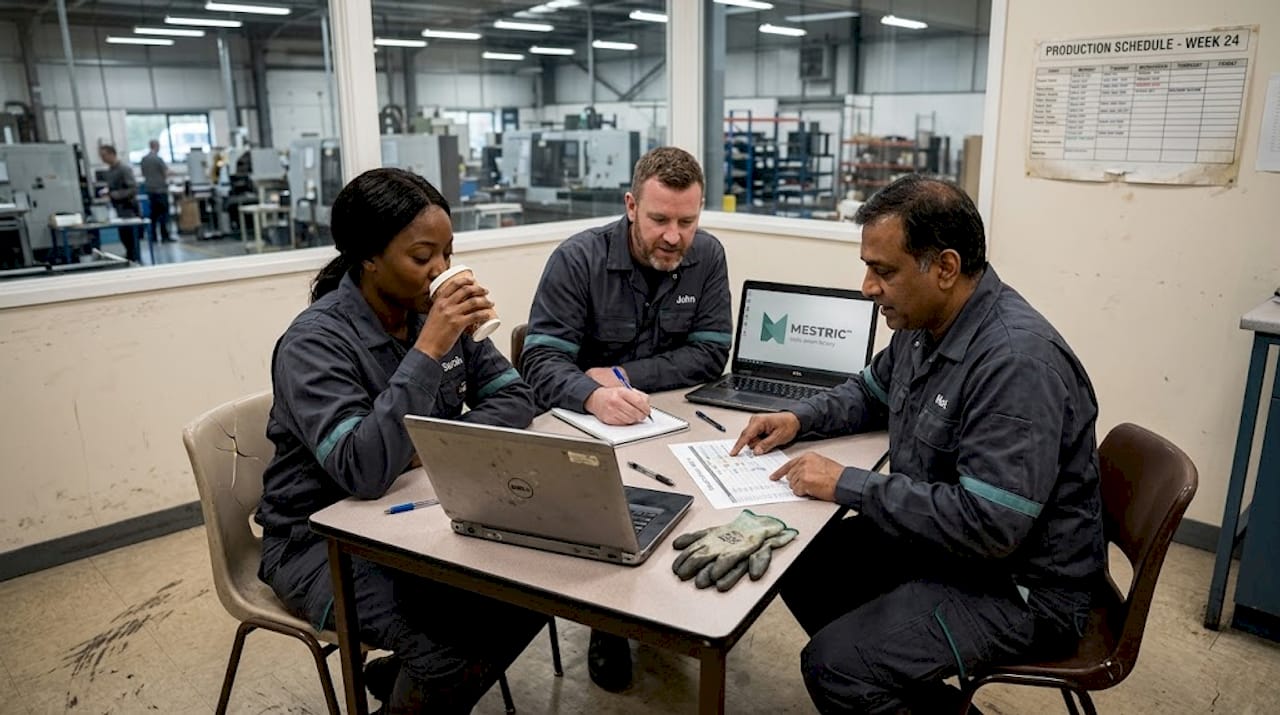
The table below maps out when each approach makes most sense:
| Approach | Strengths | Limitations | Best used for |
|---|---|---|---|
| Manual | Flexible, context-aware, low upfront cost | Fatigue-prone, inconsistent at scale | Complex problem-solving, exception handling |
| Automated | Consistent, fast, scalable | Brittle with unexpected variation | Repetitive, high-volume, high-precision tasks |
| Hybrid | Balances consistency with adaptability | Requires clear role definition | Most real-world production environments |
Here is when to use each model in practice:
Manufacturing will always require human expertise at some level. Operators notice things sensors cannot. Supervisors make contextual decisions that rules-based systems struggle with. The goal is not to remove people but to remove people from the tasks where error rates are highest and where automation can outperform. Automated production tracking in automotive environments is a strong example of hybrid deployment where real-time data supports rather than replaces operator decision-making. Understanding nuances like CNC quality control further illustrates how precision processes benefit from a layered approach.
Having navigated the complexity of process choices, let us draw together the key lessons for manufacturing leaders.
Here is what we observe consistently: manufacturers focus on the visible cost of errors, the scrap pile, the rework hours, the occasional recall. They rarely account for the compounding costs that sit beneath the surface.
Reputational damage does not show up on a cost report. Neither does the erosion of a continuous improvement culture when teams become desensitised to recurring problems. Missed growth opportunities because capacity is tied up in firefighting instead of scaling production are rarely attributed to manual errors, yet they often should be.
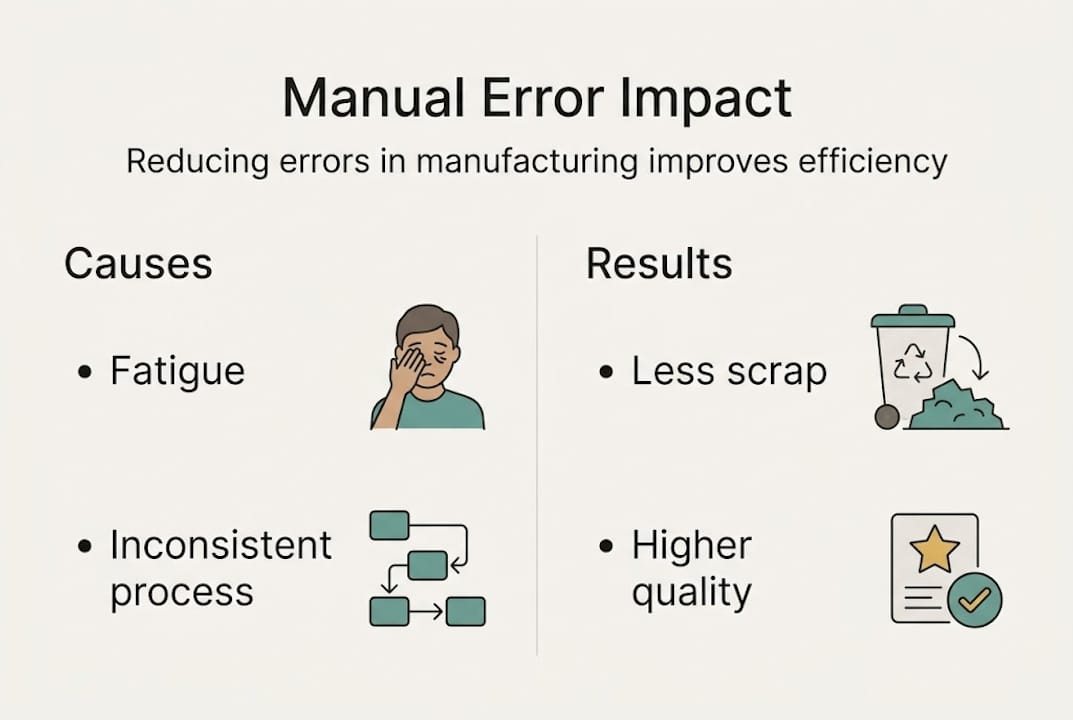
Inertia is a real force. Legacy processes feel safe because they are familiar, even when the data tells a different story. Change fatigue is real too, particularly in operations that have been through multiple failed improvement initiatives. But the manufacturers who break through this inertia, track error costs systematically, empower operators to flag inefficiencies, and genuinely celebrate error reduction as a business achievement, are the ones building durable operational advantage.
Exploring cost-saving manufacturing tips is a practical first step toward making that shift.
The strategies in this article are proven. The results are real. The next step is finding the right tools to put them into practice consistently across your facility.
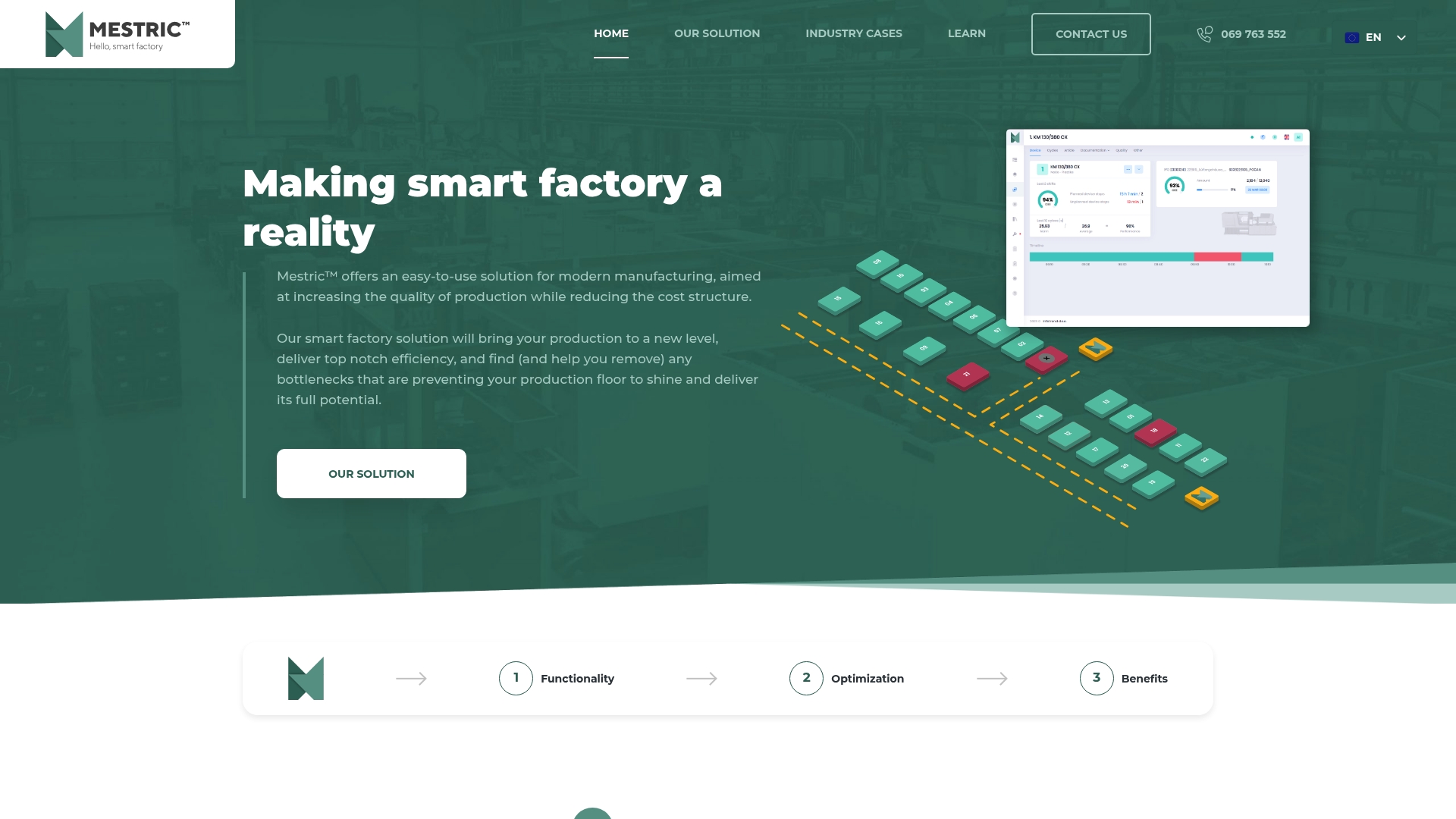
Mestric™ gives manufacturing leaders the real-time visibility, quality monitoring, and performance analytics needed to identify and eliminate error-prone processes at their source. From understanding the differences between MES and traditional manufacturing to streamlining your production operations with connected data, Mestric™ makes digital transformation achievable. You can also explore the full range of manufacturing software types to understand which solutions best fit your current challenges and growth targets.
The primary causes are inconsistent processes, inadequate training, operator fatigue, and reliance on paper-based recording or inspection methods. Manual errors drive 20-30% of unplanned production downtime, making them one of the highest-priority areas for operational improvement.
Significantly. Smart factory automation can cut unplanned downtime by up to 50%, reduce defect rates by 30-50%, and improve throughput by 10-30%, depending on the processes targeted and the maturity of implementation.
Zero errors is an unrealistic target, but near-elimination is achievable. Bosch’s machine vision deployment raised error catch rates to 99-100%, demonstrating that the right combination of automation and human oversight can reduce errors to the lowest achievable levels.
Assembly, quality control, and data recording deliver the largest gains, as errors in these areas most directly cause costly scrap, rework, and non-compliance issues that affect both output and customer satisfaction.


 069 763 552