

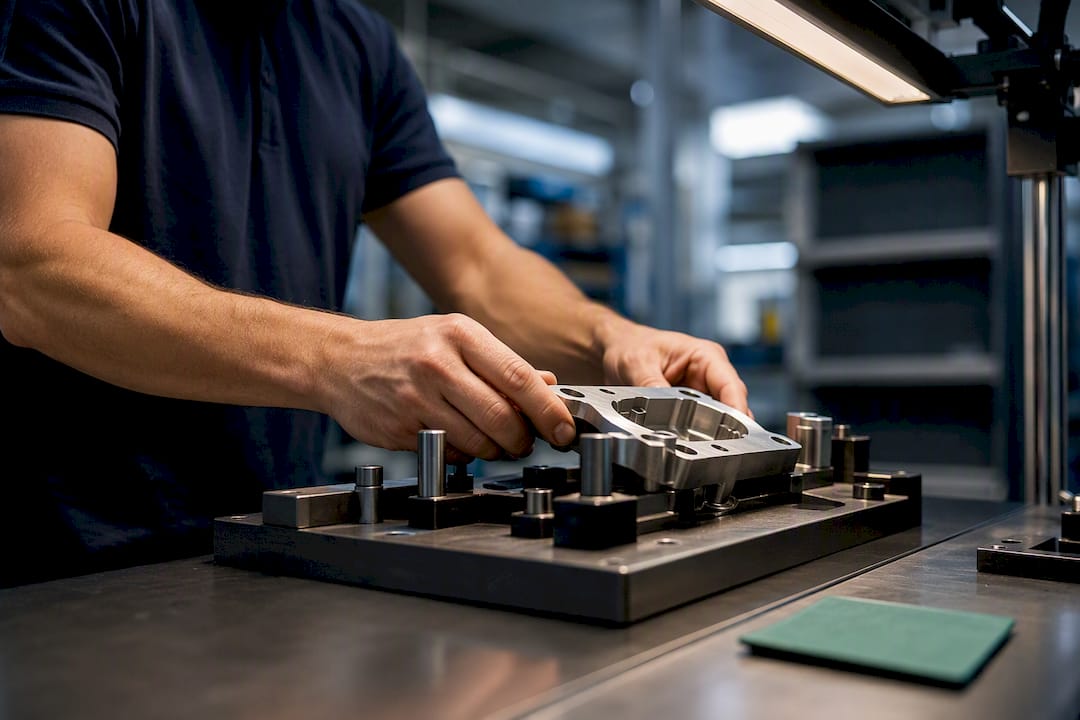
Poka-yoke is a set of simple design techniques that prevent or immediately detect human errors at the source, cutting defects and rework. Rather than inspecting problems out after the fact, you design the process or the fixture so the mistake either cannot happen or gets caught the instant it occurs. It works best on manual assembly and high-volume repetitive tasks, where the same small slip repeats hundreds of times a shift, and it pays off through fewer defects, less rework, and a higher first-pass yield.
TL;DR:
- Most small manufacturers can start with inexpensive mechanical or visual poka-yoke solutions like connector keying and color coding, which rarely fail and cost little to implement.
- Properly prioritizing failure modes using Pareto analysis and FMEA ensures efforts target the most costly or frequent errors, maximizing return on investment.
- A successful poka-yoke rollout depends on thorough observation, pilot testing, clear escalation rules, and operator training to prevent shortcuts or bypasses.
- Integrating poka-yoke with 5S, FMEA, SPC, and digital systems like MES enhances defect detection, sustainability, and enables real-time KPI tracking.
- Mechanical and visual fixes work well initially, but scaling effectiveness across shifts and variants benefits significantly from digital enforcement and measurement tools.
Poka-yoke was developed by Shigeo Shingo as part of the Toyota Production System, where it worked alongside jidoka, the practice of stopping a line the moment something goes wrong rather than letting a defect travel downstream. The Japanese term translates loosely as “mistake proofing,” and the idea is deliberately unglamorous: instead of training people to be more careful, you change the task so carelessness has nowhere to hide.
Two design principles sit underneath every poka-yoke device you’ll encounter:
Shingo’s own framing treated poka-yoke less as a single gadget and more as a philosophy that only works when paired with a broader lean mindset. That distinction matters for how you plan your rollout. A prevention device removes the failure mode entirely; a detection device still relies on someone or something responding correctly within seconds. Both belong in your toolkit, but they solve different problems, and conflating them is one of the more common planning mistakes production teams make early on.
Academic reviews of poka-yoke group implementations into a small number of recurring categories: physical or shape-control devices, sequence and flow controls, warning or detection systems, and informational aids that guide the operator without physically blocking anything. Each category trades off differently against cost, maintenance burden, and how much operator discipline it still relies on.
Here are six examples worth knowing, roughly ordered from lowest to highest effort:
Pro Tip: Start any new line with connector keying and fixture design before you touch anything electronic. A mechanical fix that physically cannot fail beats a sensor-based fix that occasionally does.
A poka-yoke rollout succeeds or fails on sequencing. Skipping the observation or pilot stage often leads to ineffective fixes that operators may bypass.
Set escalation rules before you go live, not after. Decide in advance who gets notified when a detection-type poka-yoke stops the line, how long a shift supervisor can leave it stopped before escalating further, and who has authority to override it in a genuine emergency. Without that clarity, operators either ignore the stop or escalate everything, and both outcomes defeat the purpose of the device.
Poka-yoke rarely works in isolation. It sits inside a wider quality system, and treating it as a standalone project is one of the more common ways implementations underdeliver.
Lean programmes that treat poka-yoke as one tool among several, rather than a standalone initiative, tend to hold their gains longer because the surrounding discipline keeps reinforcing the fix.
Most failures trace back to three habits: over-engineering a fix when a simple one would do, skipping operator training so the device gets bypassed, and never reviewing feedback once the fixture is installed. A torque limiter operators find awkward will get defeated with a bit of tape within a month if nobody asks why.
Build in maintenance from day one. Gauges drift, sensors fail, and fixtures wear, so schedule recalibration and keep spare parts on hand rather than discovering a failed poka-yoke during a defect spike. Any change to the part or process needs a change-control step that reviews whether the existing poka-yoke still applies.
| Metric | What it tells you |
|---|---|
| Defect rate by failure mode | Whether the specific error targeted actually dropped |
| First-pass yield | Overall assembly quality without rework |
| Time to detect | How quickly a poka-yoke catches an error after it occurs |
| Cost of poor quality (COPQ) | Total financial impact of scrap, rework and warranty claims |
Pro Tip: Track defect rate by failure mode, not a blended quality score. A blended number can mask one fixture quietly failing while others compensate.
A manufacturing execution system extends what a physical poka-yoke device can do on its own. Where a fixture stops one operator from making one mistake, an MES enforces the sequence across the entire line and refuses to release the next step until the prior check registers as complete.
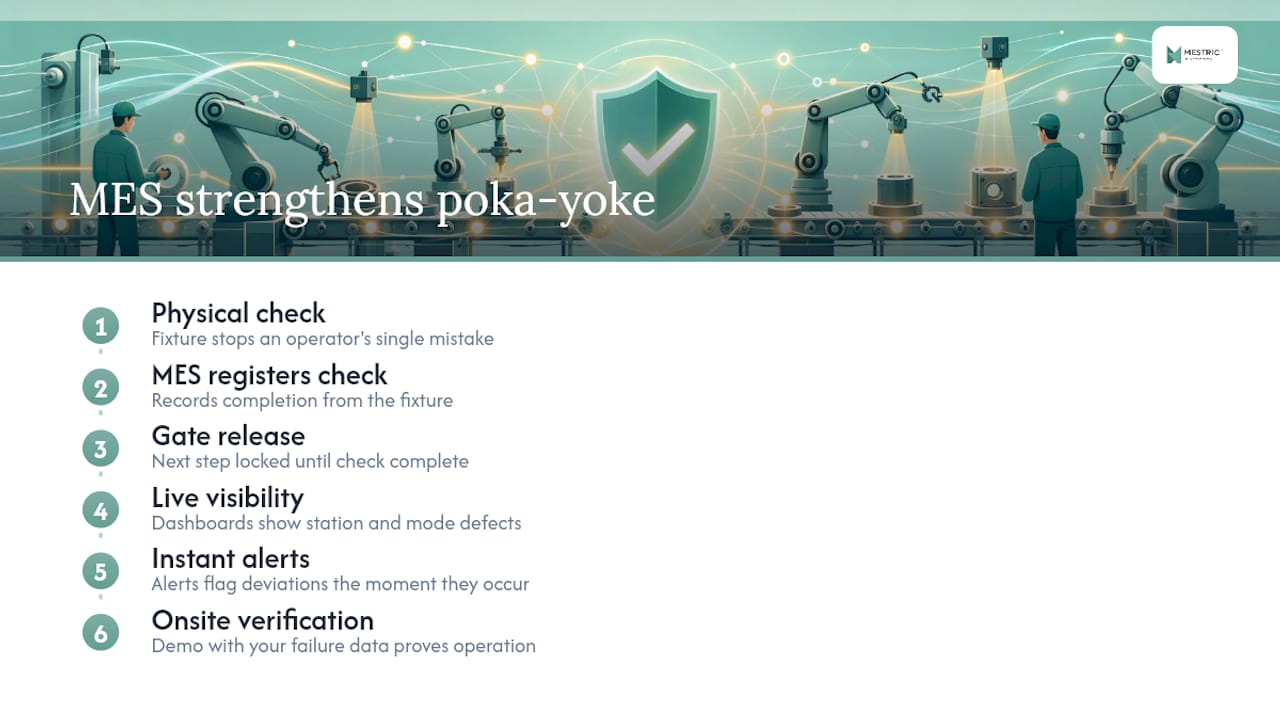
You also get the measurement side for free. Real-time dashboards surface defect trends by station and by failure mode as they happen, rather than waiting for a weekly quality report, and instant alerts flag a deviation the moment it occurs rather than the moment someone notices it. That combination of enforcement and visibility is exactly what turns a handful of good poka-yoke devices into a system you can actually verify is working. An onsite demonstration on your own line, using your own failure data, tends to make the case faster than any spec sheet.

Most SME teams don’t have the budget for sensor-heavy fixes on day one, and that’s fine. Start with mechanical or visual poka-yoke: connector keying, fixture design, colour coding. These cost little and fail rarely.
Operator buy-in matters more than the device itself. A fixture that slows people down gets defeated quietly, so ask for feedback before you finalise the design, not after. Measure the first fix properly, show the defect rate drop to the floor, then use that win to justify the next one. Scaling from proven results beats scaling from ambition.
— Andraž
Mechanical and visual poka-yoke fixes solve the failure modes you can catch by watching the line. Scaling them across multiple shifts, stations, and product variants is a different problem, and it’s where a digital layer earns its place. A manufacturing execution system enforces the sequence controls your poka-yoke design depends on and captures the KPI data (defect rate by failure mode, first-pass yield, time to detect) automatically, rather than relying on someone filling in a paper log at the end of a shift.
If you’re weighing up whether a manufacturing execution system makes sense for your line, Mestric offers onsite demonstrations that show real-time dashboards and alerts running against your own equipment, not a sample data set. Request a demo to see how your current poka-yoke fixes could translate into tracked, verifiable KPIs.
Poka-yoke is a design technique that prevents a human error from happening or catches it immediately after it occurs, before a defective part moves to the next step.
No. Poka-yoke is a preventive quality assurance approach built into the process design, while quality control is inspection after the fact; the two work together but solve different problems.
Prevention devices make the error physically impossible, such as a keyed connector, while detection devices let the error occur but flag or stop it immediately, such as a sensor triggering an alert.
Use Pareto analysis to find the most frequent failure modes, then score them with FMEA for severity and detectability to identify the highest-value fix.
Yes. Most effective poka-yoke fixes, such as fixture design or colour coding, are mechanical or visual and require minimal investment, which is why smaller producers frequently start there before adding digital tools like an MES.


 069 763 552