

Manufacturing executives face mounting pressure to optimise production efficiency whilst maintaining quality standards in increasingly competitive markets. Many organisations continue relying on traditional manufacturing methods, assuming incremental improvements suffice. However, manufacturing execution systems fundamentally transform how production operates, offering real-time visibility and control that manual processes cannot match. This guide examines the critical differences between MES and traditional manufacturing approaches, clarifying how digital transformation impacts efficiency, quality control, and operational decision-making. Understanding these distinctions enables informed choices about modernising production environments to meet 2026’s demanding manufacturing landscape.
| Point | Details |
|---|---|
| Real-time monitoring advantage | MES provides continuous production visibility enabling immediate response to quality issues and bottlenecks |
| Automation versus manual tracking | Traditional methods rely on periodic manual data collection whilst MES automates information capture throughout production cycles |
| Integrated quality control | MES embeds quality monitoring within production workflows rather than relying on separate periodic inspections |
| Dynamic scheduling capability | MES adjusts production schedules proactively based on real-time conditions unlike rigid traditional planning |
| Scalability challenges | Traditional manufacturing struggles with consistency and efficiency as production volumes increase |
Manufacturing execution systems represent sophisticated digital platforms that bridge enterprise planning and shop floor operations, creating seamless information flow throughout production environments. These systems connect directly with manufacturing equipment, capturing data at every production stage from raw material receipt through final product shipment. MES platforms transform how organisations manage work orders, monitor quality parameters, track resource utilisation, and optimise scheduling decisions.
The core functions of MES extend far beyond simple data collection. These systems actively manage production workflows, automatically routing work orders based on equipment availability, operator skills, and material readiness. Real-time monitoring capabilities enable immediate visibility into performance metrics, allowing production managers to identify bottlenecks before they cascade into significant delays. Quality control becomes embedded within the production process itself, with automated checks occurring at critical stages rather than relying solely on end-of-line inspection.
MES platforms excel at reducing manual errors through automation and standardisation. When operators receive digital work instructions directly at their workstations, the likelihood of miscommunication or outdated procedures diminishes dramatically. The system tracks every action, creating comprehensive audit trails that support regulatory compliance and continuous improvement initiatives. This level of documentation proves invaluable when investigating quality issues or optimising process parameters.
Resource allocation becomes significantly more efficient with MES implementation. The system analyses current production status, equipment capabilities, and pending orders to recommend optimal scheduling decisions. This dynamic approach contrasts sharply with static planning methods, enabling manufacturers to respond quickly to changing priorities or unexpected disruptions. Production managers gain the ability to simulate different scenarios, evaluating potential impacts before committing to schedule changes.
Core MES capabilities include:
Pro Tip: When evaluating manufacturing execution system efficiency, focus on systems offering equipment connectivity rather than manual data entry, as this dramatically improves data accuracy and timeliness.
“MES bridges the gap between enterprise planning and shop floor operations, enabling manufacturers to translate strategic objectives into tactical production decisions with unprecedented precision.”
Traditional manufacturing approaches typically rely on manual processes lacking real-time data for critical decision-making, creating inherent inefficiencies that compound as production complexity increases. Paper-based travellers, spreadsheet tracking, and periodic manual data collection characterise these conventional systems. Whilst familiar and seemingly straightforward, these methods introduce significant delays between when events occur on the shop floor and when decision-makers receive actionable information.

The absence of integrated real-time monitoring severely limits responsiveness in traditional manufacturing environments. Production managers often learn about quality issues, equipment failures, or material shortages hours after they occur, by which point considerable waste may have accumulated. This reactive posture contrasts unfavourably with the proactive approach enabled by digital systems. The role of data in manufacturing efficiency becomes increasingly critical as market pressures demand faster response times and tighter quality tolerances.
Scheduling flexibility represents another significant challenge for traditional manufacturing operations. Static production schedules developed days or weeks in advance struggle to accommodate the inevitable disruptions that characterise real manufacturing environments. Equipment breakdowns, material delays, quality holds, and priority changes all require schedule adjustments, yet traditional systems lack the visibility and analytical tools to optimise these changes quickly. The result often involves suboptimal decisions made under time pressure with incomplete information.
Quality control in traditional manufacturing typically relies on periodic sampling and end-of-line inspection rather than continuous monitoring throughout production. This approach creates several problems. Defects may propagate through multiple production stages before detection, increasing scrap costs and rework requirements. Root cause analysis becomes more difficult when significant time has elapsed between defect creation and discovery. The lack of real-time quality data prevents operators from making immediate process adjustments that could prevent defects from occurring.
Traditional manufacturing challenges include:
Pro Tip: Organisations maintaining traditional methods should audit how long information takes to flow from the shop floor to decision-makers, as this lag time directly impacts waste and efficiency losses.
Scalability presents perhaps the most significant limitation of traditional manufacturing approaches. Methods that function adequately at lower production volumes often break down as complexity increases. Manual tracking becomes overwhelming, communication gaps widen, and the likelihood of errors multiplies. Maintaining consistency across shifts, operators, and production runs proves increasingly difficult without standardised digital systems enforcing best practices.
The efficiency gap between MES and traditional manufacturing becomes strikingly apparent when examining specific production metrics and operational capabilities. Real-time data represents the fundamental differentiator, enabling MES platforms to support proactive decision-making whilst traditional methods remain largely reactive. This distinction cascades through every aspect of manufacturing operations, from how quickly organisations respond to quality issues to how effectively they utilise expensive equipment and skilled labour.
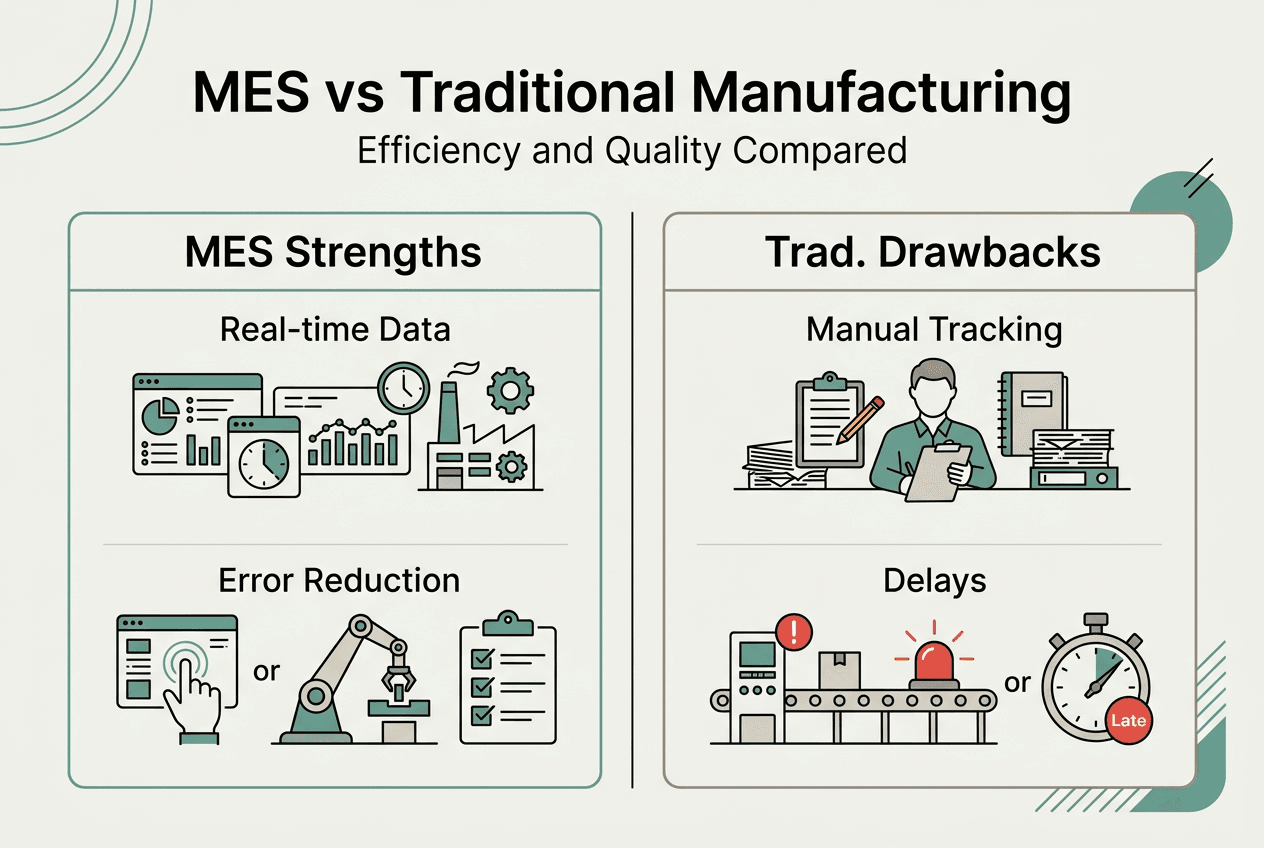
MES platforms automate production scheduling based on current conditions rather than static plans developed days earlier. When equipment unexpectedly goes offline, the system immediately recalculates optimal work order routing, minimising downtime impact across the entire production environment. Traditional manufacturing requires manual intervention for such adjustments, introducing delays and increasing the likelihood of suboptimal decisions. The cumulative effect of these differences translates directly into measurable efficiency improvements, with MES implementations typically increasing equipment utilisation by 15 to 25 percent.
Quality control approaches differ fundamentally between the two methodologies. MES embeds quality monitoring within production workflows, capturing measurements and inspection results automatically at each critical stage. Operators receive immediate feedback when parameters drift outside acceptable ranges, enabling real-time corrections before defects propagate through subsequent operations. Traditional manufacturing’s periodic inspection approach means defects often travel through multiple production stages before detection, multiplying scrap costs and complicating root cause analysis.
| Aspect | MES approach | Traditional manufacturing |
|---|---|---|
| Data collection | Automated real-time capture from equipment and operators | Manual periodic recording prone to delays and errors |
| Quality monitoring | Continuous tracking with immediate alerts for out-of-spec conditions | Periodic sampling and end-of-line inspection |
| Schedule optimisation | Dynamic adjustment based on current production status | Static plans requiring manual revision |
| Traceability | Complete digital records linking materials, processes, and products | Paper-based systems with potential gaps |
| Decision support | Real-time analytics and predictive insights | Historical reports with significant lag time |
How MES enhances efficiency from order to shipment:
The efficiency advantages extend beyond direct production activities into supporting functions. Inventory accuracy improves dramatically when MES automatically tracks material consumption rather than relying on periodic physical counts. Maintenance becomes predictive rather than reactive, as equipment monitoring identifies developing issues before failures occur. Customer service benefits from real-time order status visibility, enabling accurate delivery commitments and proactive communication about potential delays.
“Manufacturing execution systems transform production environments by providing the real-time visibility and control necessary to compete effectively in markets demanding both efficiency and quality excellence.”
Traditional manufacturing’s manual tracking creates inherent inefficiencies that compound as production complexity increases. The time required to collect, consolidate, and analyse production data means decision-makers work with information that may be hours or days old. In fast-paced manufacturing environments, this lag time translates directly into missed opportunities for optimisation and increased waste from delayed problem detection. The contrast with MES’s instantaneous data availability highlights why improving manufacturing efficiency with MES has become a strategic priority for competitive manufacturers.
Quality assurance with MES delivers measurable defect reduction through continuous monitoring and immediate feedback loops. Operators no longer wait for quality reports to discover process drift; the system alerts them instantly when measurements approach specification limits. This proactive approach prevents defects rather than simply detecting them after production, fundamentally changing the economics of quality management.
Successful MES implementation requires systematic planning and execution, beginning with comprehensive assessment of current operations and clear definition of improvement objectives. Organisations must evaluate existing systems, identify integration requirements, and establish measurable targets for efficiency gains and quality improvements. This foundational work ensures the implementation addresses actual business needs rather than simply deploying technology for its own sake.
Key implementation stages for MES deployment:
Stakeholder involvement proves critical throughout implementation. Production operators provide invaluable insights into workflow practicalities and potential adoption challenges. Maintenance teams contribute equipment connectivity expertise. Quality personnel help define inspection points and acceptance criteria. IT staff ensure proper integration with enterprise systems. Engaging these groups early builds buy-in and surfaces potential issues before they derail implementation progress.
Integration with existing enterprise resource planning (ERP) systems and shop floor equipment represents a technical challenge requiring careful planning. MES helps maintain efficient production flow by analysing current operations and adjusting schedules based on real-time conditions, but this capability depends on reliable data exchange with both planning systems and production equipment. Organisations should prioritise equipment connectivity over manual data entry, as automated data collection dramatically improves accuracy whilst reducing operator burden.
Pro Tip: Start MES implementation in a high-value production area experiencing clear pain points rather than attempting enterprise-wide deployment immediately, as early wins build momentum and provide learning opportunities before broader rollout.
Common implementation pitfalls include underestimating training requirements, attempting overly ambitious initial scope, and failing to establish clear success metrics. MES represents a significant workflow change for production personnel accustomed to traditional methods. Adequate training time and ongoing support prove essential for successful adoption. Similarly, trying to implement every MES capability simultaneously often overwhelms organisations. A phased approach focusing on highest-priority capabilities delivers faster value whilst building competence for subsequent phases.
Continuous monitoring and adaptation ensure MES delivers sustained value beyond initial implementation. The system generates extensive analytics highlighting improvement opportunities that may not have been apparent during initial deployment. Organisations should establish regular review processes examining key performance indicators, identifying optimisation targets, and adjusting system configuration as production requirements evolve. This iterative approach transforms MES from a static system into a dynamic platform supporting ongoing operational excellence.
The production optimisation guide provides detailed frameworks for leveraging MES capabilities to achieve measurable efficiency gains. Streamlining production operations requires both appropriate technology and disciplined improvement processes, with MES serving as the enabling platform for data-driven decision-making.
Manufacturing executives seeking to transform production efficiency and quality through digital solutions will find valuable resources and proven strategies at Mestric. The platform offers comprehensive guidance on implementing MES effectively, from initial assessment through full deployment and optimisation. Mestric’s expertise helps organisations navigate the complexities of manufacturing digitalisation, avoiding common pitfalls whilst accelerating time to value.
Discover how leading manufacturers leverage MES to achieve measurable improvements in efficiency, quality, and cost performance. The manufacturing software types guide clarifies how different systems complement each other within integrated production environments. Explore practical approaches for MES tools for efficiency that deliver rapid return on investment. Learn proven methods for streamlining production operations through intelligent automation and real-time visibility. Mestric provides the insights and solutions manufacturing leaders need to compete successfully in 2026’s demanding production landscape.
MES delivers efficiency improvements through real-time visibility enabling proactive decision-making, automated data collection eliminating manual tracking delays, and dynamic scheduling that optimises resource utilisation based on current conditions. Traditional methods lack these capabilities, resulting in reactive management and suboptimal resource allocation.
Real-time quality data enables immediate corrective actions when process parameters drift outside specifications, preventing defects rather than simply detecting them after production. This proactive approach reduces scrap costs, minimises rework requirements, and improves overall product consistency compared to periodic inspection methods.
Organisations often implement MES in phases, maintaining traditional methods in some areas whilst digitising others. This hybrid approach allows gradual transition, building competence and demonstrating value before full deployment. However, maximum efficiency gains require comprehensive MES adoption across interconnected production processes.
Common challenges include underestimating training requirements for personnel accustomed to traditional workflows, technical complexity of integrating MES with existing systems, and resistance to change from operators comfortable with established methods. Successful implementations address these through comprehensive training, phased deployment, and clear communication of benefits.
Most organisations observe measurable improvements within three to six months of MES deployment, with full return on investment typically occurring within 12 to 24 months. The timeline depends on implementation scope, production complexity, and how effectively the organisation leverages MES impact on production processes for continuous improvement initiatives.
MES platforms typically connect with existing production equipment through various interfaces and protocols, eliminating the need for wholesale equipment replacement. Older equipment lacking digital connectivity may require retrofit sensors or manual data entry points, but the majority of modern manufacturing equipment supports MES integration without replacement.


 069 763 552