


TL;DR:
- Effective process improvement involves a structured cycle of mapping, analyzing, redesigning, piloting, and monitoring manufacturing workflows. Prioritizing projects using impact versus effort assessments and choosing appropriate methodologies, such as Kaizen or Six Sigma, ensures sustainable gains. Pilot studies and disciplined sequences prevent common pitfalls and enable lasting enhancements in manufacturing efficiency.
Step by step process improvement is a structured method for enhancing manufacturing workflows by identifying bottlenecks, eliminating waste, and refining operations through repeatable cycles. In manufacturing, this approach is known formally as Business Process Improvement (BPI) or, at greater rigour, as Lean Six Sigma. Both terms describe the same core discipline: applying a defined sequence of steps to close the gap between current performance and target performance. Tools like Lucidchart and Miro support process mapping in manufacturing, while Six Sigma metrics and prioritisation matrices give your analysis the precision it needs to produce measurable results.
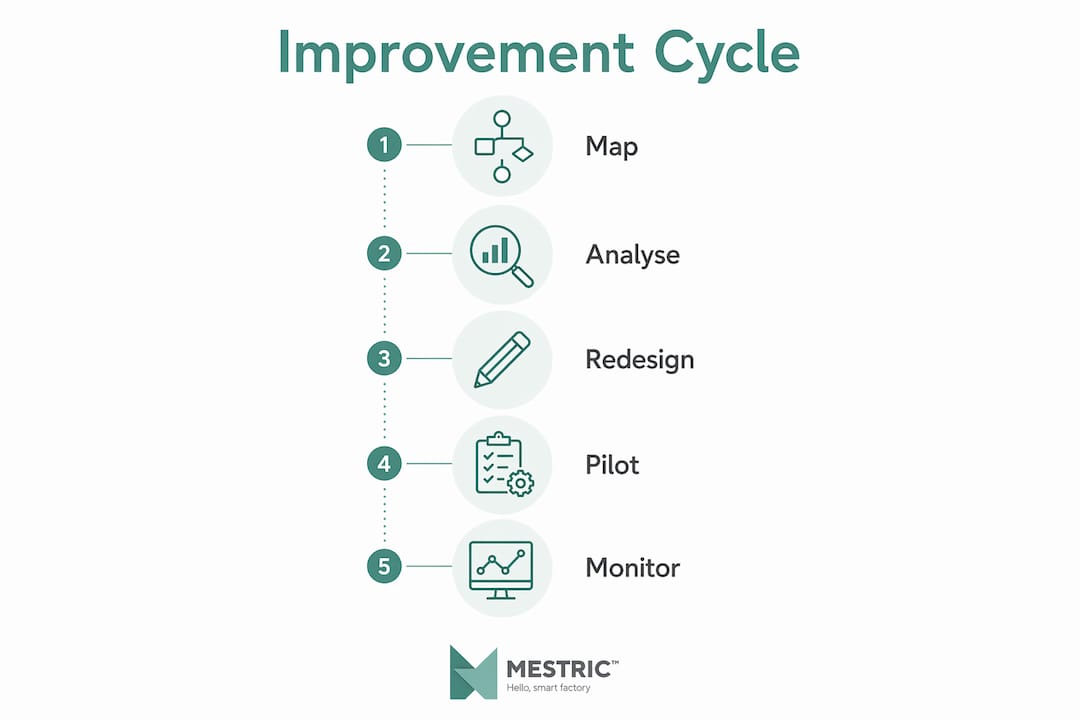
The core 5-step cycle accepted across manufacturing is: map the current state, analyse for bottlenecks and waste, redesign the process, implement a pilot, and monitor KPIs before iterating. Each step builds on the previous one. Skipping any stage undermines the whole effort.
Here is how each step works in practice:
Map the current state. Shadow operators on the shop floor and document every handoff, decision point, and delay. Use tools like Lucidchart or Miro to create a visual process map. You cannot improve what you have not accurately described.
Analyse for bottlenecks and waste. Look for rework loops, waiting times, and manual data entry that adds no value. The Process Cycle Efficiency (PCE) metric is a reliable diagnostic here. If your team spends 16 active hours out of a 40-hour cycle, your PCE is 40%, meaning 60% of cycle time is pure waste.
Redesign the process. Remove the waste identified in step two. Redesign handoffs to reduce waiting, eliminate redundant approvals, and consolidate manual steps where possible. Involve the operators who run the process daily. Their input prevents redesigns that look good on paper but fail on the floor.
Implement a pilot. Never roll out changes across the entire facility at once. Run a 30–60 day pilot with one line or one shift. This approach reveals operational issues early and at low cost, before a full rollout amplifies the problem.
Monitor KPIs and iterate. Track the agreed metrics weekly during the pilot and monthly thereafter. Successful projects revisit processes quarterly for the first year. Iteration is not a sign of failure. It is the mechanism by which gains compound over time.
Profi tipp: When mapping the current state, record the process as it actually runs, not as the procedure manual says it should run. The gap between the two is often where the most significant waste hides.
| Step | Primary action | Key output |
|---|---|---|
| Map current state | Shadow operators, document handoffs | Accurate process map |
| Analyse waste | Calculate PCE, identify rework loops | Waste register |
| Redesign | Eliminate non-value-added steps | Revised process design |
| Pilot | Run on one line for 30–60 days | Validated change data |
| Monitor and iterate | Track KPIs, review quarterly | Sustained performance gains |

The Impact vs Effort matrix is the most reliable tool for selecting which processes to tackle first. It measures impact in annual pounds saved or revenue protected, and effort in person-weeks. This prevents the common mistake of reacting to whoever complains loudest rather than to where the data points.
Mid-market manufacturing teams typically fix 2 out of 20 identified broken processes per quarter. That constraint is real. Spreading effort across ten projects simultaneously produces shallow results across all of them. Fixing two processes thoroughly produces lasting gains and builds the team’s confidence and capability.
Use these criteria when scoring projects for the matrix:
The projects that score high on impact and low on effort are your immediate priorities. Projects that score high on both impact and effort belong in your quarterly planning cycle, not your sprint backlog.
Profi tipp: Balance quick wins with at least one larger strategic project per quarter. Quick wins build momentum and stakeholder confidence. Strategic projects deliver the step-changes in efficiency that quick wins alone cannot achieve.
The right methodology is the one your team can sustain and that matches the nature of the problem, the richness of your data, and your organisation’s cultural readiness for change. There is no universal answer, but there are clear patterns.
The four methodologies most relevant to manufacturing are:
A common mistake is reaching for Six Sigma or a full Business Process Management (BPM) framework before the team has the data maturity or cultural readiness to support it. The administrative overhead of formal frameworks can overwhelm a team that has never run a structured improvement cycle. Start with Kaizen or PDCA, build the muscle, then graduate to more demanding methodologies as your capability grows.
Profi tipp: Check your quality monitoring data before selecting a methodology. If you lack reliable baseline data, start with measurement before you start with improvement.
Pilot studies are the single most effective risk-reduction tool in process improvement. A 30–60 day pilot with defined baselines catches hidden friction cheaply, before a full-scale rollout turns a small problem into a facility-wide disruption.
Follow these steps to design and run a pilot that produces reliable results:
Define the scope. Select one production line, one shift, or one product family. Narrow scope produces cleaner data and easier root-cause analysis if something goes wrong.
Establish measurable baselines. Record current cycle time, defect rate, downtime, and throughput before the pilot begins. Measurement must precede action. Teams that skip this step often find their baseline data is unusable or that performance was worse than assumed.
Run the pilot for 30–60 days. This duration is long enough to capture shift variation, weekly demand cycles, and operator learning curves, but short enough to maintain focus and momentum.
Use control charts to track performance. Plot your KPIs weekly. Control charts show whether variation is random or caused by a specific change in the process. This distinction determines your next action.
Document standard work and hand over formally. When the pilot confirms the improvement, write up the new standard operating procedure, train all relevant operators, and assign a named process owner. Without this step, gains erode within months as old habits return.
Profi tipp: Involve the operators who will run the new process in writing the standard work documentation. They catch practical gaps that engineers miss, and their ownership of the document increases the likelihood they will follow it.
The most damaging mistake in systematic process enhancement is automating a broken process. Automation applied to a wasteful process accelerates the waste rather than eliminating it. Manual lean mapping must come before any automation investment. Fix the process first, then automate the fixed version.
Other frequent pitfalls include:
A structured improvement framework prevents initiative drift. Without a clear sequence and defined ownership, improvement projects lose momentum and support within weeks of launch.
Addressing these pitfalls requires deliberate communication at every stage. Brief your team on the purpose of each step, share the data openly, and celebrate incremental wins. Improvement culture is built through repeated small successes, not through a single large project.
Structured, stepwise improvement cycles outperform ad-hoc fixes because they produce repeatable, measurable gains that compound over time.
| Pont | Részletek |
|---|---|
| Follow the 5-step cycle | Map, analyse, redesign, pilot, and monitor before scaling any change. |
| Prioritise with data | Use an Impact vs Effort matrix to select projects by financial value, not by complaint volume. |
| Match methodology to maturity | Start with Kaizen or PDCA; graduate to Six Sigma when data and capability support it. |
| Pilot before full rollout | A 30–60 day pilot with baseline KPIs prevents costly facility-wide disruptions. |
| Measure before you act | Baseline data is non-negotiable; without it, you cannot validate any improvement. |
I have seen manufacturing teams invest months in improvement projects that produced nothing lasting. The pattern is almost always the same: a problem gets attention, a solution gets implemented quickly, and within a quarter the process has drifted back to its old behaviour. The fix felt like progress. It was not.
What separates teams that sustain gains from those that do not is not intelligence or resources. It is the discipline to follow a sequence. Mapping before analysing. Piloting before scaling. Documenting before handing over. Each step exists because skipping it creates a specific, predictable failure mode.
I am also sceptical of teams that reach for Six Sigma before they have run a single PDCA cycle. Formal frameworks carry real overhead. They require trained practitioners, data infrastructure, and management commitment. Kaizen, by contrast, asks only that people pay attention to their own work and make small improvements daily. That is a much lower bar, and it builds the habits that make formal frameworks work later.
The other thing I would emphasise is the value of production bottleneck identification as a starting point. Most facilities have one or two constraints that limit the output of the entire system. Fixing those first produces disproportionate results and builds the credibility needed to sustain a broader improvement programme.
Start simple. Measure everything. Pilot before you scale. The teams that follow this sequence consistently outperform those that do not.
— Andraž
Real-time data is the foundation of any credible improvement cycle. Without it, your baseline measurements are estimates, your KPI tracking is delayed, and your pilots produce ambiguous results.
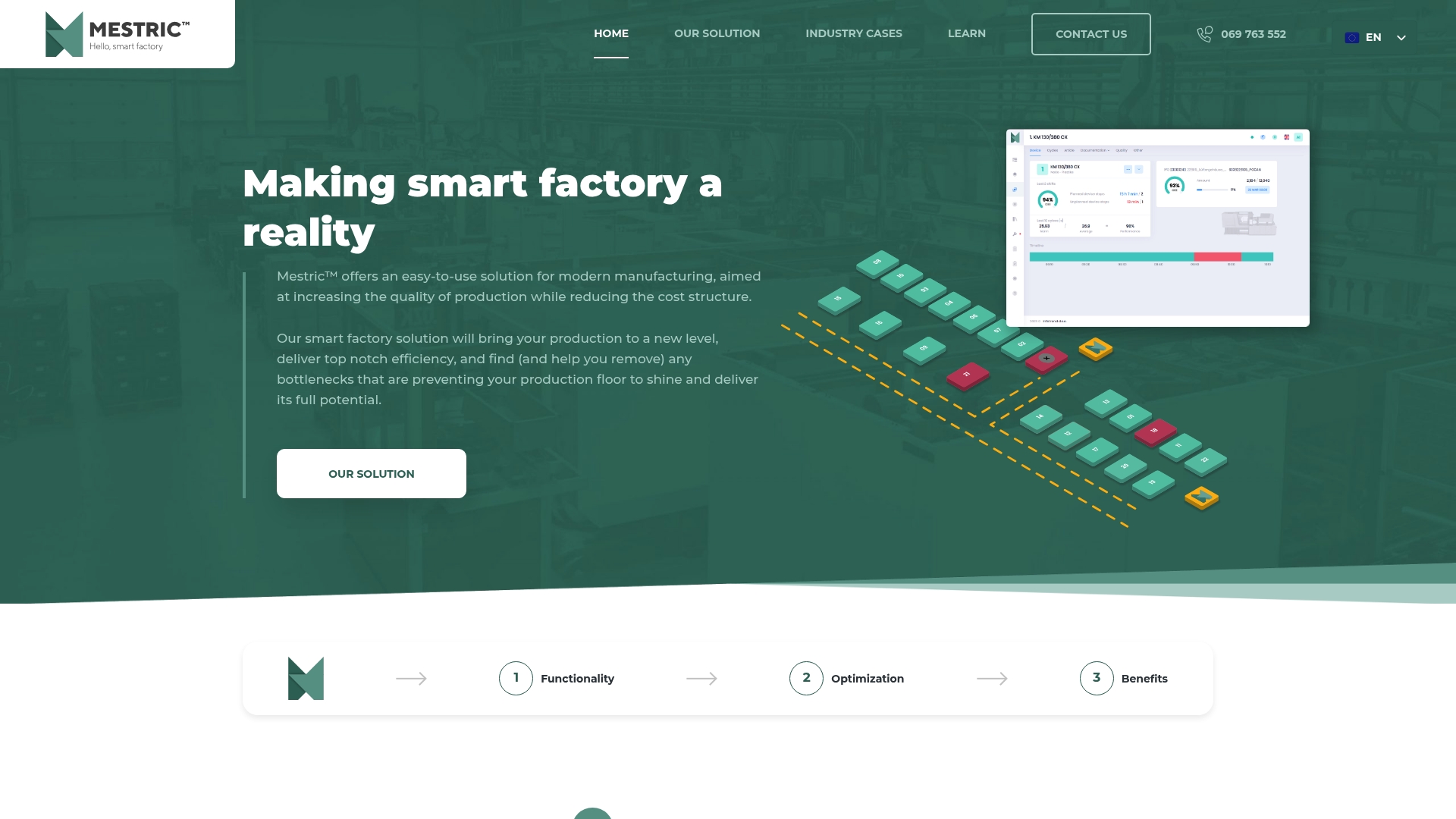
Mestric connects directly with your production equipment to deliver live performance metrics, downtime data, quality parameters, and cost analysis in a single dashboard. This means your improvement team spends less time collecting data manually and more time acting on it. When you run a pilot, Mestric captures the before-and-after KPIs automatically, giving you the evidence you need to justify a full rollout. For manufacturers ready to move from spreadsheets to a structured, data-driven improvement programme, explore how Mestric accelerates process improvement with real-time MES capabilities. You can also see how modern systems compare in this guide to MES vs traditional manufacturing.
The first step is mapping the current process accurately, including every handoff, decision point, and delay. You cannot identify waste or redesign effectively without a precise picture of how the process actually runs today.
A pilot should run for 30–60 days. This duration captures shift variation and operator learning curves while remaining short enough to maintain focus and produce actionable data.
Process Cycle Efficiency (PCE) measures active work time as a proportion of total cycle time. A PCE of 40% means 60% of your cycle time adds no value, which makes it a direct indicator of where improvement effort should focus.
Use Kaizen when your team lacks an established improvement culture or reliable baseline data. Use Six Sigma when variation is the core problem and you have the data infrastructure and trained practitioners to support statistical analysis.
The most common causes are skipping baseline measurement, automating broken processes before fixing them, and running too many projects simultaneously. Each failure mode is preventable with a structured improvement cycle and disciplined prioritisation.


 069 763 552