


TL;DR:
- A continuous improvement workflow is a repetitive cycle applying PDCA to enhance manufacturing efficiency, quality, and performance. It relies on standardised work, effective governance, and traceable documentation to sustain gains and prevent recurring problems. Leadership discipline in executing all four phases consistently, supported by real-time data tools, is essential for lasting success.
A continuous improvement workflow is a structured, iterative process that enables manufacturing operations to achieve ongoing gains in efficiency, quality, and performance by systematically planning, testing, measuring, and standardising improvements. The foundational method is the PDCA cycle (Plan-Do-Check-Act), a closed loop that compounds gains through repeated cycles rather than one-off projects. Supplementary frameworks such as DMAIC (Define, Measure, Analyse, Improve, Control) and Lean management practices extend this capability for more complex problems. Quality management standards like ISO 9001:2015 formalise these cycles into auditable systems, giving manufacturing leaders both a methodology and a compliance framework to work within.
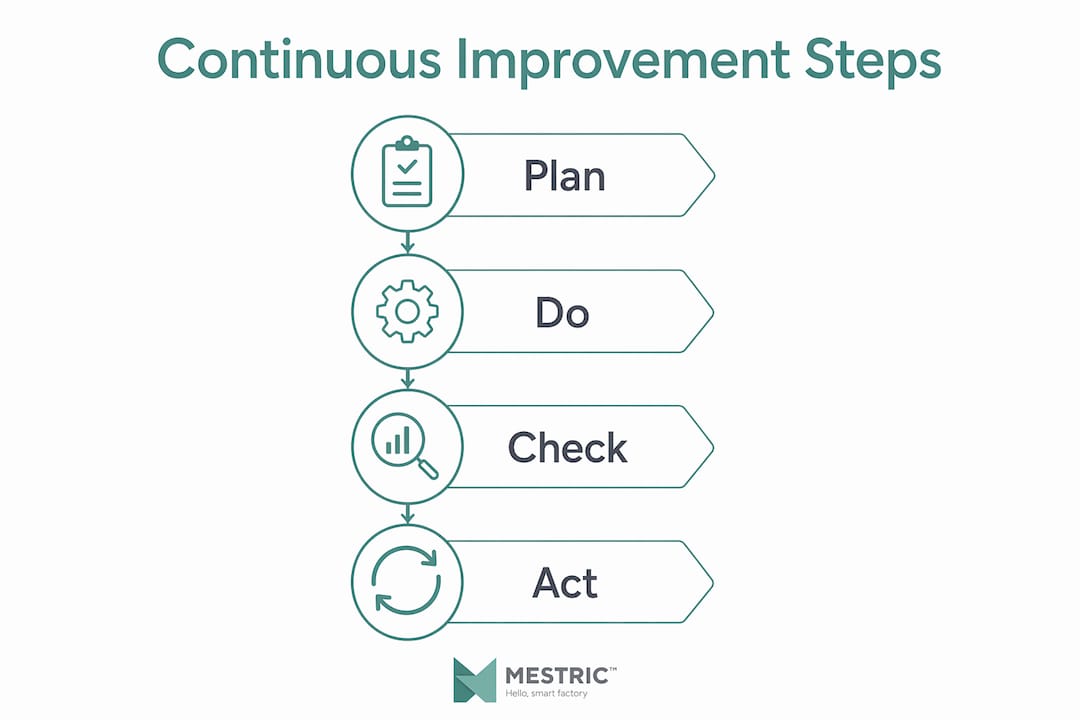
A well-designed continuous improvement workflow follows four distinct phases, each with a specific function in the improvement cycle.
Plan. Define the problem, identify root causes, and set a measurable objective. In a manufacturing context, this might mean analysing defect rates on a specific assembly line and setting a target reduction of 15% over six weeks. The Plan phase requires data, not assumptions.
Do. Run a small-scale test of your proposed solution. The PDCA small-scale test approach reduces risk before wider rollout. Testing on one shift or one production cell before deploying across the facility is standard practice.
Check. Measure the results of your test against the objective. Effective organisations treat this phase as rigorous evidence collection, not a brief team meeting. You compare actual KPI movement against the baseline you established in the Plan phase.
Act. If the test succeeded, standardise the change and update work instructions. If it did not, return to Plan with new information. The Act phase must update standards and controls for lasting gains, otherwise the improvement dissolves within weeks.
Repeating all four stages is what creates compounding improvement. Stopping after a single cycle is one of the most common mistakes manufacturing teams make.

DMAIC is suited for complex problems requiring deep statistical analysis, longer timeframes, and cross-functional teams. PDCA handles routine incremental improvements more efficiently. Use DMAIC when the root cause is unclear, the problem spans multiple processes, or the financial impact justifies a Six Sigma project. Use PDCA for daily and weekly improvement cycles at the cell or line level.
| Criteria | PDCA | DMAIC |
|---|---|---|
| Problem complexity | Alacsony vagy közepes | High |
| Timeframe | Days to weeks | Weeks to months |
| Data requirements | Basic KPIs | Statistical analysis |
| Team size | Small, local | Cross-functional |
| Best use case | Routine incremental gains | High-impact systemic issues |
Profi tipp: If your team cannot define the problem in one sentence with a measurable target, you are not ready to start the Do phase. Spend more time in Plan.
Lean management practices, particularly those derived from the Toyota Production System, provide the governance structure that makes continuous improvement sustainable rather than sporadic. The central concept is Standardised Work: a documented description of the current best method for completing a task. Without it, you have no reliable baseline from which to measure improvement.
The Toyota Production System requires standardised work as a prerequisite for kaizen. Without a stable process baseline, you cannot detect abnormalities, and without detecting abnormalities, you cannot know whether a change represents genuine improvement or simply new variability. This is why many organisations misunderstand kaizen as isolated improvements rather than parts of a governed system requiring abnormality detection and containment before any improvement activity begins.
Daily Management Systems reinforce this governance through structured feedback loops:
Daily management with gemba walks transforms continuous improvement from a quarterly event into a daily operating mechanism. This is the difference between a manufacturing operation that sustains gains and one that repeatedly solves the same problems.
“Standardised work is not the enemy of improvement. It is the foundation that makes improvement meaningful.” This principle from Lean TPS governance explains why stabilising the process baseline before attempting improvement is non-negotiable in high-performing manufacturing operations.
Profi tipp: Before launching any improvement project, document the current method in a Standardised Work Chart. If operators are doing the task differently, standardise first. Then improve.
Effective workflow enhancement strategies depend on the right combination of KPIs, documentation, and digital tools. Without measurement, you are managing by opinion rather than data.
The core KPIs for a manufacturing continuous improvement workflow include:
ISO 9001:2015 operationalises improvement through PDCA-aligned documentation requirements. Auditors trace objectives, risk planning, implementation records, KPI results, and corrective actions across all four phases to validate that improvement is systematic rather than accidental. This means your documentation must connect Plan-phase objectives to Act-phase outcomes in a traceable chain.
Corrective and Preventive Action (CAPA) processes sit within the Act phase of PDCA. A CAPA record documents the non-conformance, root cause analysis, corrective action taken, verification of effectiveness, and any updates to standards or controls. For ISO 9001 compliance, these records are not optional. They are the evidence that your quality improvement strategies are working.
Digital QMS platforms automate PDCA workflows, provide real-time KPI dashboards, and reduce manual reporting burden. Automation improves evidence collection and supports CAPA within the Act phase, which is particularly valuable when managing multiple concurrent improvement projects across a facility.
Profi tipp: Set a review cadence for each active improvement project: daily for Do-phase tests, weekly for Check-phase analysis, and monthly for Act-phase standardisation reviews. Without a calendar, the Check and Act phases get skipped under production pressure.
A common failure mode is underinvestment in the Check and Act stages. Manufacturing teams favour Plan and Do because they feel productive. Skipping rigorous Check and Act phases leads to recurring problems and lost improvements. This is the single most predictable reason continuous improvement programmes stall after early wins.
Launching an effective continuous improvement workflow requires a structured start, not a broad initiative. Follow these steps to build momentum without overwhelming your team.
Define a problem that matters to operators. Operator-driven PDCA cycles focused on real pain points promote engagement and sustain improvement culture more effectively than management-driven priorities alone. Start with a problem your frontline team raises repeatedly.
Set a specific, measurable objective. “Reduce rework on Line 3 from 4.2% to 2.5% within eight weeks” is a valid objective. “Improve quality” is not. The objective defines what success looks like in the Check phase.
Document the current standard. Before you change anything, record how the process currently works. This is your baseline. Without it, you cannot measure whether your improvement worked.
Run a small-scale test. Apply the proposed change to one shift, one cell, or one operator. Collect data for a defined period before drawing conclusions.
Analyse results and decide. Compare Check-phase data against your baseline. If the improvement holds, standardise it. If not, revise your hypothesis and run another cycle.
Extend and repeat. Once standardised on one line, extend the improvement to adjacent processes. Then identify the next problem and begin again.
Common pitfalls to avoid when building your workflow:
Building a daily management cadence with Leader Standard Work is what separates manufacturing operations that sustain continuous improvement from those that run improvement projects and then revert. Leadership discipline in maintaining the cadence is not optional. It is the mechanism. Mestric’s production supervisor checklist offers a practical framework for embedding this cadence into daily operations.
A continuous improvement workflow delivers sustained manufacturing gains only when all four PDCA phases are executed with equal rigour, supported by standardised work, daily management systems, and traceable documentation.
| Pont | Részletek |
|---|---|
| PDCA is the core structure | Execute all four phases consistently; skipping Check or Act destroys long-term gains. |
| Standardised work comes first | Stabilise the process baseline before attempting any improvement activity. |
| Governance sustains momentum | Daily management systems and gemba walks embed improvement into daily operations. |
| Documentation enables compliance | ISO 9001 requires traceable PDCA records linking objectives to outcomes across all phases. |
| Start with operator pain points | Frontline-driven improvement cycles build ownership and sustain continuous improvement culture. |
From my experience working with manufacturing operations across different sectors, the most common reason continuous improvement programmes fail is not a lack of tools or methodology. It is a lack of leadership cadence. Teams understand PDCA. They can draw the cycle on a whiteboard. What they struggle with is maintaining the discipline to execute Check and Act phases under production pressure, week after week, when output targets are competing for attention.
The organisations that get this right treat continuous improvement as a daily operating rhythm, not a separate workstream. Their supervisors have standard work that includes reviewing improvement metrics. Their managers conduct gemba walks on a fixed schedule. Their KPI boards are updated in real time, not at the end of the week. This is not complexity. It is discipline.
Technology is accelerating what is possible here. When a Manufacturing Execution System connects directly to equipment and surfaces deviations in real time, the Check phase becomes faster and more accurate. Leaders spend less time collecting data and more time acting on it. The governance structure remains the same. The speed and reliability of the feedback loop improves significantly.
My honest view is that manufacturing leaders who invest in the governance layer first, standardised work, daily management, and visual controls, and then layer in digital tools, achieve far better results than those who buy software hoping it will create the culture. The culture has to come first. The technology amplifies it.
— Andraž
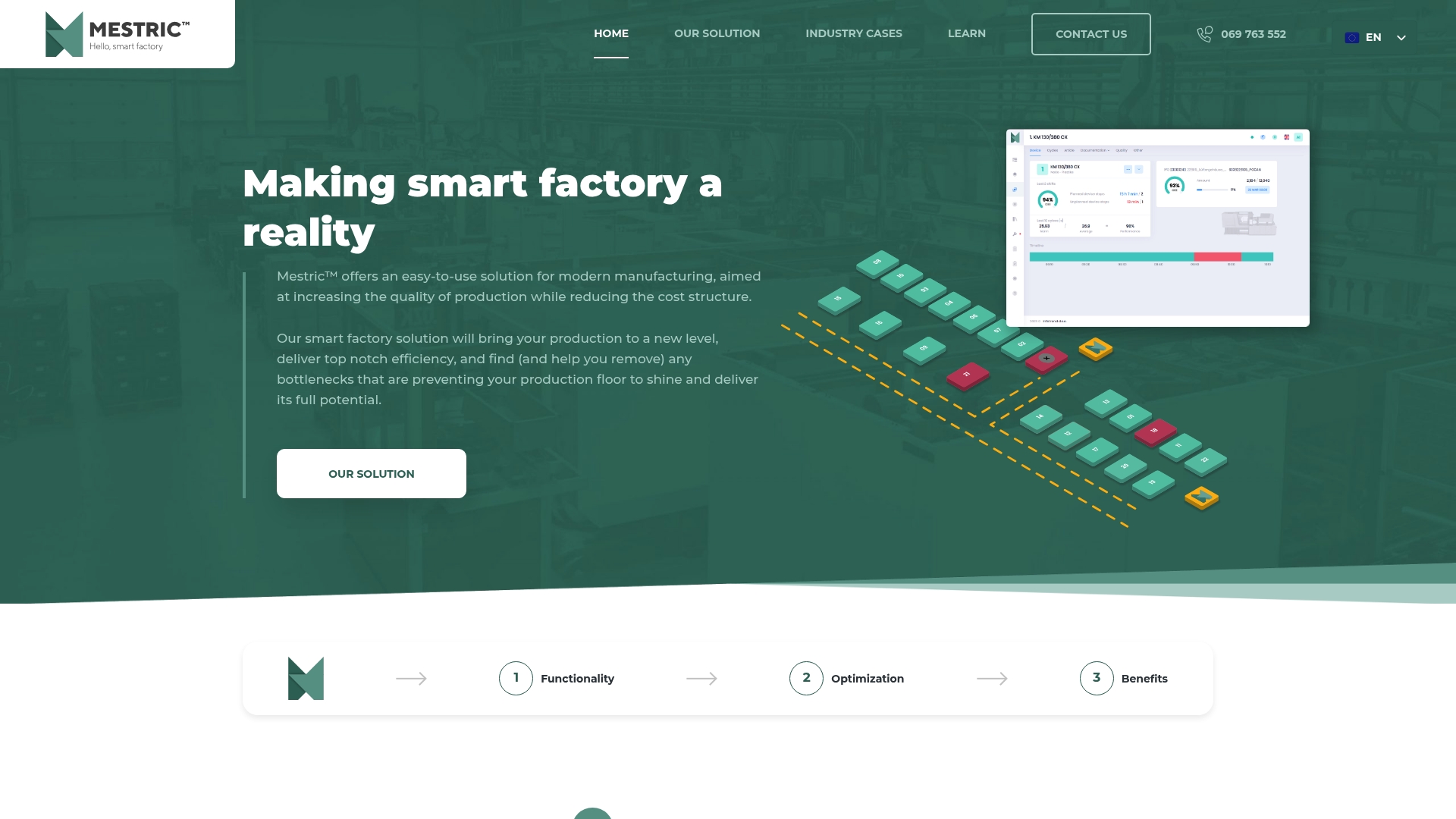
Mestric connects directly to your manufacturing equipment to deliver the real-time KPI data your continuous improvement workflow depends on. Defect rates, cycle times, OEE, and downtime are visible on a single dashboard, giving your team the Check-phase evidence they need without manual data collection. Mestric’s CAPA tracking and audit-ready documentation support ISO 9001 compliance and keep your Act-phase records complete and traceable.
If you are comparing your current approach against what a modern MES can deliver, the MES kontra hagyományos gyártás comparison is a practical starting point. You can also explore how Mestric supports manufacturing process optimisation with step-by-step guidance tailored to operational leaders.
A continuous improvement workflow is a structured, repeating cycle of planning, testing, measuring, and standardising improvements to manufacturing processes. The most widely used framework is PDCA (Plan-Do-Check-Act), which compounds gains through iterative cycles rather than one-off projects.
Use DMAIC when the problem is complex, the root cause is unclear, or the financial impact justifies a full Six Sigma project with statistical analysis. Use PDCA for routine, incremental improvements at the cell or line level where faster cycles are more practical.
The most common cause is underinvestment in the Check and Act phases. Teams favour Plan and Do because they feel productive, but skipping rigorous measurement and standardisation means improvements are not locked in and problems recur.
Standardised work defines the current best method for a task and provides the stable baseline needed to detect abnormalities and measure whether a change represents genuine improvement. Without it, improvement results are unreliable.
ISO 9001:2015 requires PDCA-aligned documentation that traces objectives, implementation records, KPI results, and corrective actions across all four phases. This makes continuous improvement auditable and ensures it is systematic rather than incidental.


 069 763 552