


TL;DR:
- Mestric™ is a cloud-based MES recommended for UK manufacturers seeking real-time KPIs, machine integration, and AI optimisation. It offers scalable deployment, onsite demos, and a pilot-first sales process to validate fit on actual equipment. Selecting an MES should focus on pilot performance, scalability, and UK support to ensure effective factory implementation.
For UK manufacturers evaluating antsolutions.eu alternatives, Mestric™ is the recommended replacement — a cloud-based MES with real-time KPI tracking, direct PLC and OPC-UA machine integration, AI-powered optimisation, and UK-available onsite demonstrations.
The short verdict: Mestric™ delivers the feature parity antsolutions.eu users expect, with the scalability and pricing flexibility mid-market UK plants need. Its pilot-first sales process means you validate fit on your own machines before committing.
Key reasons to shortlist Mestric™ first:
Modern MES alternatives are predominantly cloud-first and built to scale with growing manufacturing needs. The table maps four solution categories to the dimensions UK plant teams care about most, with Mestric™ positioned in the mid-market cloud tier that most closely aligns with antsolutions.eu users.
| Dimension | Entry-level field apps | Mid-market cloud MES (Mestric™) | Enterprise platforms | On-prem legacy systems |
|---|---|---|---|---|
| Best for | Small single-site plants | Mid-market, multi-line or multi-site UK manufacturers | Large enterprise, complex global ops | Plants with no cloud connectivity |
| Deployment | Cloud (SaaS) | Cloud (SaaS) | Cloud / hybrid | On-premises |
| Pricing model | Fixed low-tier subscription | Modular subscription | Enterprise licence | Perpetual licence + maintenance |
| Core MES features | Basic KPI dashboards | Real-time KPIs, quality monitoring, downtime analysis, AI optimisation, machine integration | Full MES suite + ERP deep integration | Core MES, limited AI |
| Ease of use | High, limited configurability | High, configurable dashboards and process norms | Moderate, requires specialist config | Low, requires IT support |
| Scalability | Single site only | Multi-site ready | Multi-site, multi-region | Limited by hardware |
| Implementation time | Days to weeks | Pilot: 4–6 weeks; full site: — | 12–24 months | 12–24 months |
| UK availability & support | Varies | UK support, onsite demos available | UK offices, enterprise SLA | Depends on reseller |
| Security & data residency | Standard SaaS | UK data-residency options, configurable | Enterprise-grade, region-selectable | On-site, customer-controlled |
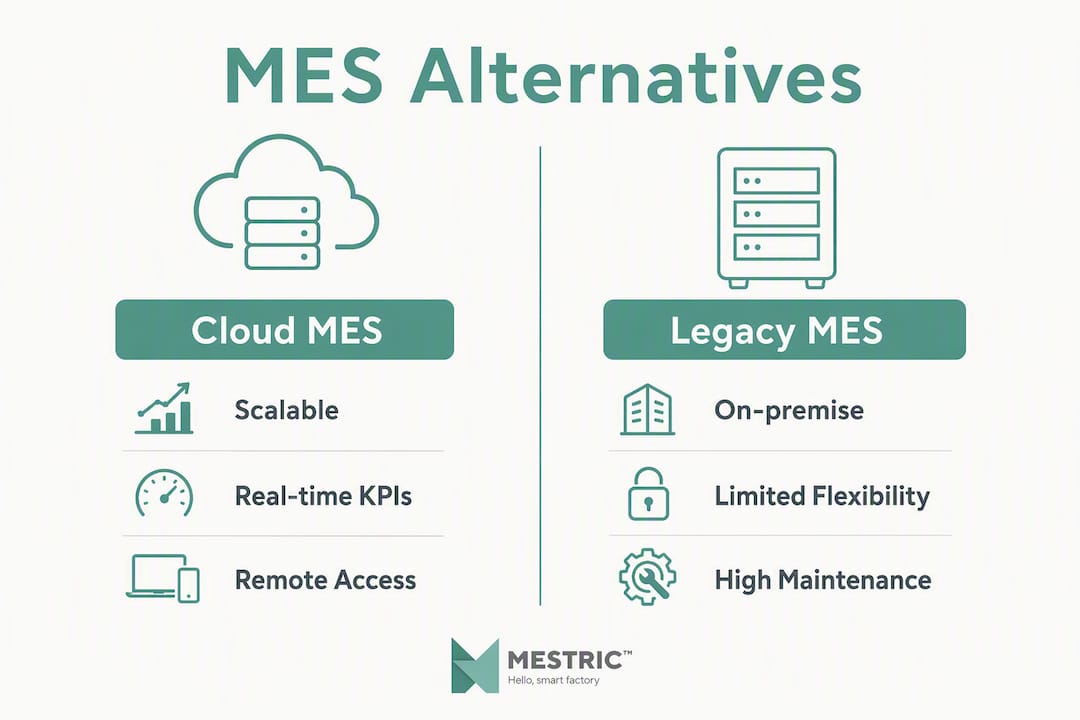
Antsolutions.eu users typically sit in the mid-market tier: they need real-time visibility, machine connectivity, and quality monitoring without the complexity or cost of an enterprise deployment. Mestric™ is built for exactly that position.
Pick the vendor that passes an apples-to-apples pilot on these criteria — not the one with the longest feature list.
Must-have capabilities checklist:
Questions to ask every vendor during RFP or demo:
Experts recommend evaluating pricing flexibility and scalability beyond headline feature lists, since vendor fit to your specific factory workflow matters more than a feature count. Modular licence structures, in particular, matter more to mid-market manufacturers than headline discounts.
Pro Tip: Define your pilot success threshold before the demo, not after. Set a minimum OEE uplift target (e.g. two percentage points over baseline) and a data-completeness rate (e.g. 95% automated capture). Any vendor unwilling to commit to measurable pilot KPIs is a risk. Ask for two UK reference contacts and speak to them before signing.
The features antsolutions.eu users rely on most are real-time KPIs, downtime analysis, quality monitoring, automated data collection, and process norm optimisation. Mestric™ covers all of these natively, with direct equipment connectivity surfacing performance, downtime, and quality metrics on configurable dashboards.
Verifying feature parity in a demo is faster than reading a datasheet. Run these checks:
Mestric™ passes each of these checks through its machine integration layer and configurable dashboard environment. The benefits of MES technical integrations, including PLC and OPC-UA validation, are a recurring trust signal for UK manufacturers selecting a replacement platform.
Pro Tip: Record the demo session and share it with your automation engineer and a floor supervisor before scoring vendors. Their questions will surface integration gaps that procurement teams miss.

A pilot typically runs several weeks. A single-site roll-out may take a few months. Multi-site deployments are best planned in phases over an extended period, with each site validated before the next begins. These are planning anchors, not guarantees — actual timelines depend on your existing infrastructure.
Primary cost drivers to budget for:
Phased deployments with a measured ROI gate — pilot, then single site, then multi-site — are the lowest-risk path to scale an MES across UK operations. The ROI metrics manufacturers most commonly use to justify spend are OEE uplift, reduction in unplanned downtime, and scrap rate improvement. Payback periods vary by plant size and baseline, but most mid-market sites target recovery within 12–24 months of full deployment.
For a practical view of cost reduction levers, Mestric’s cost reduction strategies in MES guide covers the main savings categories in detail.
Every vendor in your shortlist must run the same pilot. Identical scope, identical KPIs, identical dataset. Any deviation makes comparison impossible.
Pilot setup checklist:
Success metrics template:
| KPI | Baseline | Target | Measurement cadence |
|---|---|---|---|
| OEE (%) | Record pre-pilot | +2 percentage points | Weekly |
| Unplanned downtime (hrs/week) | Record pre-pilot | Reduction vs baseline | Weekly |
| Quality event detection time | Record pre-pilot | Alert within 60 seconds | Per event |
| Data capture rate (automated) | Record pre-pilot | 95%+ automated | Daily |
Local support and technical integrations are recurring decision factors for UK manufacturers — confirm both before the pilot begins, not after.
Mestric™ is the recommended antsolutions.eu alternative for UK manufacturers: it covers real-time KPIs, machine integration, quality monitoring, and AI optimisation, with onsite demos and a structured pilot process available in the UK.
| Point | Details |
|---|---|
| Mestric™ as top alternative | Covers real-time KPIs, OPC-UA integration, quality monitoring, and AI optimisation for UK plants. |
| Pilot before you commit | Run a 4–6 week pilot with identical scope and KPIs across all shortlisted vendors before deciding. |
| Three non-negotiable criteria | Scalability, pricing flexibility, and UK support are the criteria that separate viable options from risky ones. |
| Verify integrations in the demo | Test an OPC-UA read/write cycle and a quality event trace during every vendor demo — not just on slides. |
| UK data-residency matters | Confirm GDPR-compliant data hosting and a UK support SLA before signing any agreement. |
The most common mistake in MES procurement is spending three months on an RFP and six weeks on reference calls, then discovering in week two of deployment that the vendor’s OPC-UA driver doesn’t support your PLC firmware version. A short, structured pilot surfaces that problem in week one, at a fraction of the cost and disruption.
Pilots do three things that RFP cycles cannot. They validate machine integrations against your actual hardware, not a compatibility matrix. They expose data-quality gaps — missing tags, inconsistent timestamps, gaps in historian coverage — that only appear when real production data flows through the system. And they confirm operator adoption: whether floor staff actually use the dashboards or revert to paper logs within a fortnight.
The pilot checklist in this article is designed to make that evaluation fair and fast. Prioritise measurable KPIs over vendor promises, and weight UK support availability heavily — a platform with no local escalation path is a liability when a line goes down at 2 AM on a Tuesday.
Fewer plants are replacing antsolutions.eu with a like-for-like system. Most are moving to a platform that does more: real-time OEE, automated quality alerts, PLC connectivity, and AI-driven process optimisation, all without a 12-month implementation project.
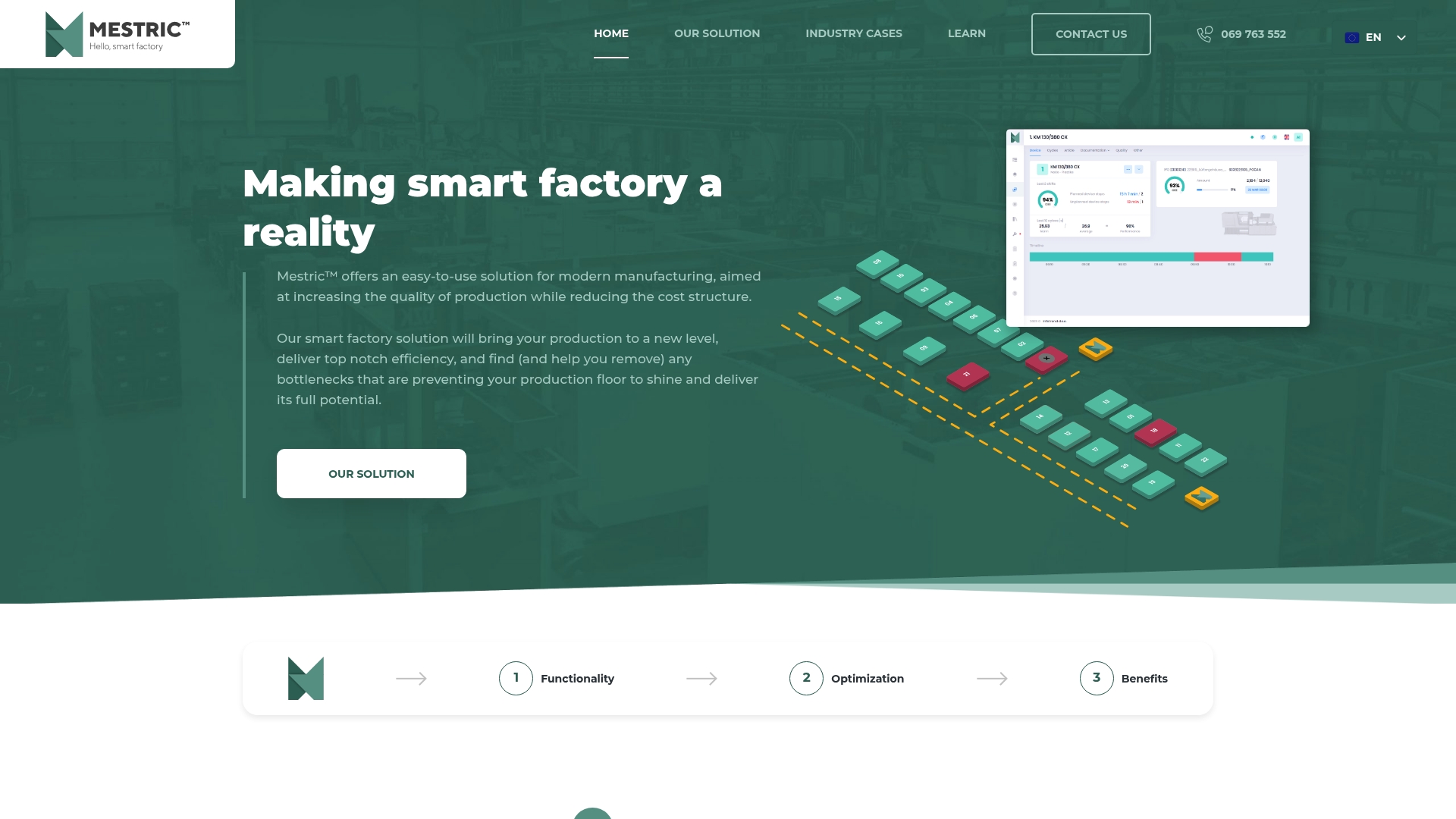
Mestric™ delivers exactly that combination, with a structured pilot offer built for UK manufacturers. The pilot includes a sandbox environment, an onsite demonstration on your connected machinery, and a KPI baseline report so you enter the decision with data, not assumptions. You can see how real-time performance tracking works on your own production lines before any long-term commitment.
To request a pilot or book an onsite demonstration, visit mestric.com and speak directly with the team. Your plant’s baseline data is the best starting point — bring it to the first conversation.


 069 763 552