

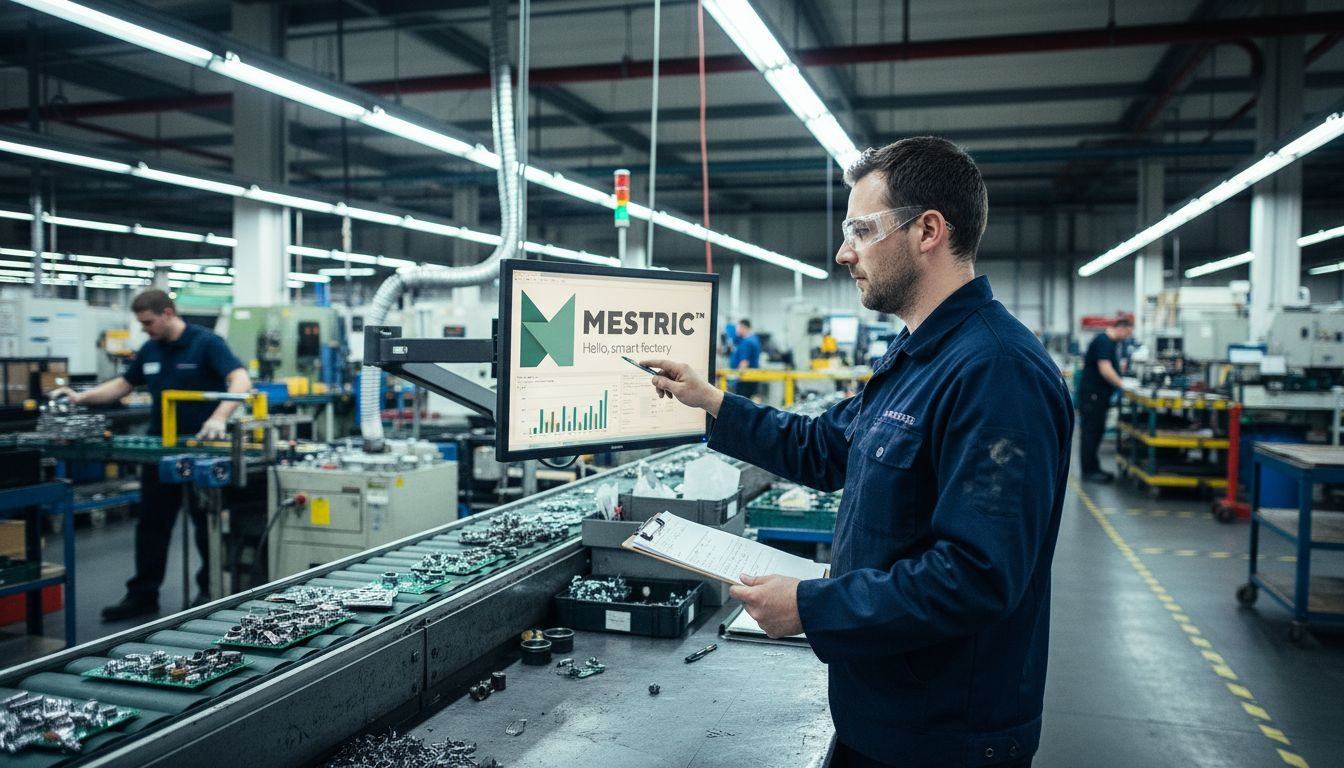
Equipment breakdowns and unexpected bottlenecks can derail even the most efficient production schedule, leaving plant managers searching for smart solutions. Across factories in the United Kingdom, United States, and beyond, AI-driven manufacturing execution systems (MES) are reshaping how global teams optimise production, anticipate problems, and boost quality. This overview guides you through the foundational concepts of AI in manufacturing, showing how these intelligent technologies turn complex data into practical, real-time decisions that keep your lines moving.
| Point | Details |
|---|---|
| AI Enhances Operational Performance | Integrating AI into manufacturing transforms raw data into actionable insights, enabling proactive problem resolution and improved efficiency. |
| Core AI Technologies | Key technologies such as Machine Learning, Digital Twins, and Predictive Maintenance significantly optimise production processes and reduce downtime. |
| Real-Time Data Utilisation | Combining AI with Manufacturing Execution Systems (MES) provides real-time insights and automates decision-making, enhancing overall production visibility. |
| Strategic Implementation is Crucial | Successful AI integration requires a clear strategy, addressing potential challenges such as data quality and workforce adaptation before full deployment. |
Artificial intelligence in manufacturing refers to machine learning systems and algorithms that analyse production data, recognise patterns, and make decisions with minimal human intervention. Unlike traditional automation that follows pre-programmed rules, AI systems learn from experience and adapt to changing conditions on your factory floor.
Your manufacturing environment generates enormous volumes of data every second. AI transforms this raw data into actionable insights that directly improve your operational performance. The technology enables your plant to detect problems before they become expensive downtime events.
Three Core AI Technologies You’ll Encounter
Your manufacturing operations typically employ several AI approaches:
These systems work together to create what manufacturing experts call intelligent production environments. Your equipment becomes self-aware—monitoring its own health, reporting degradation, and recommending interventions before failures occur.
AI doesn’t replace your decision-making; it accelerates it by presenting evidence-based recommendations backed by data analysis across thousands of production cycles.
When integrated with your manufacturing execution system, AI provides real-time visibility into production quality, equipment performance, and resource utilisation. Your plant managers access dashboards showing what’s happening now and what will likely happen next.
The fundamental shift is this: traditional systems react to problems after they happen. AI-powered manufacturing anticipates problems before they materialise. This difference translates directly into lower costs, improved quality, and better resource planning.
Why This Matters for Your Operation
Consider what happens when your line experiences an unexpected equipment failure. Without AI, you discover the problem when production stops. With AI, the system alerts your maintenance team days earlier, allowing planned intervention during scheduled downtime rather than emergency repair during production hours.
The same logic applies to quality control. AI analyses thousands of product images and sensor readings per hour, catching defects that might escape human inspection. Your reject rates decrease whilst your inspection efficiency increases simultaneously.
Pro tip: Start by identifying your most problematic production bottleneck—the single constraint costing you the most downtime or scrap—and focus your initial AI implementation there rather than attempting a factory-wide rollout.
Your factory floor is already generating data from hundreds of sensors, machines, and systems every single second. The question is whether you’re capturing and analysing it effectively. Modern AI technologies turn this data deluge into competitive advantage by automating decision-making across your entire operation.
The most impactful AI systems in manufacturing share a common trait: they learn continuously from production data and improve their predictions over time. Unlike traditional software that requires manual updates, AI adapts autonomously to your changing production environment.
Machine learning forms the foundation of most manufacturing AI applications. Your systems train on historical production data to recognise patterns that indicate equipment degradation, quality issues, or process inefficiencies. When your machines exhibit similar patterns in real-time, the system alerts operators before problems escalate.
Digital twins create virtual replicas of your physical production lines. These simulations run countless “what-if” scenarios simultaneously, testing process changes before implementing them on actual equipment. Your plant avoids costly trial-and-error by validating optimisations virtually first.
Predictive maintenance systems monitor equipment condition continuously and forecast failures weeks in advance. Rather than replacing parts on fixed schedules or after breakdowns, you intervene precisely when needed—extending equipment life whilst preventing unexpected downtime.
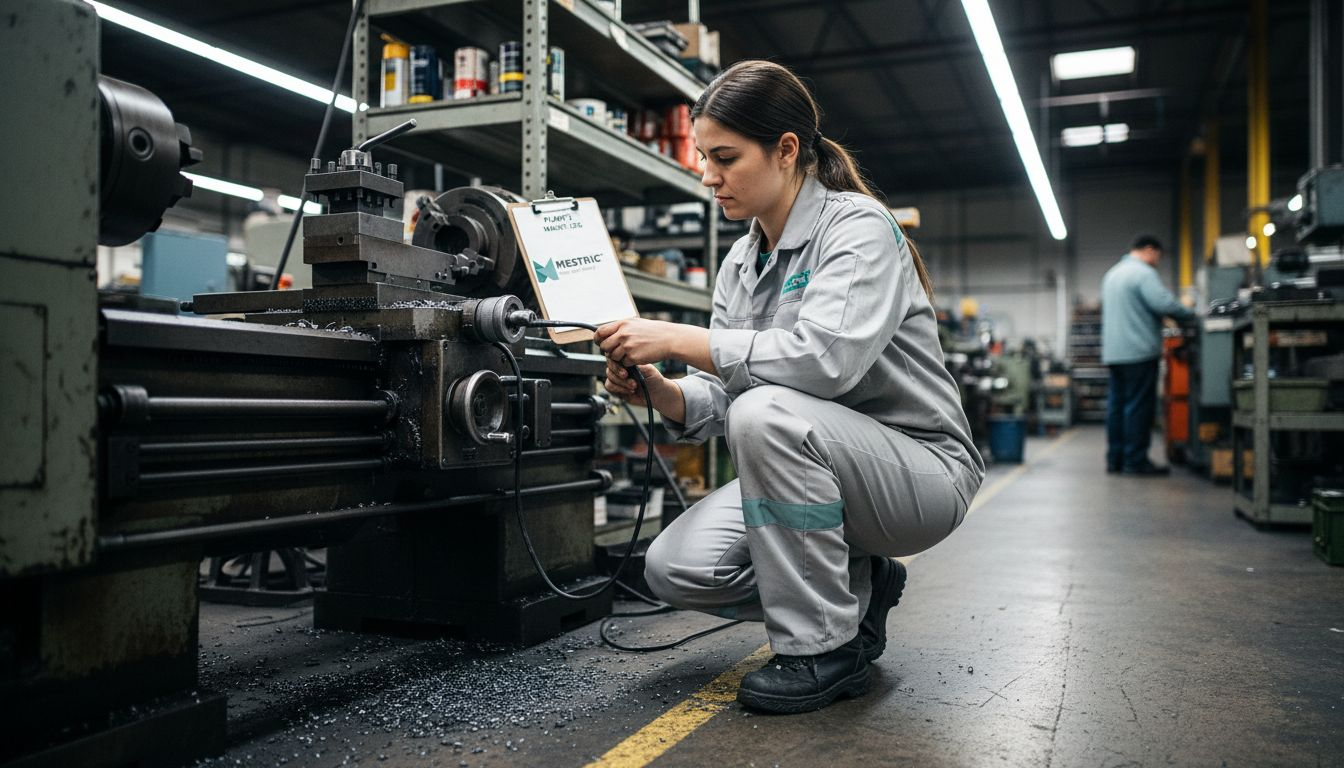
These technologies work together seamlessly. AI-driven quality monitoring analyses product images and sensor data in real-time, catching defects your human inspectors might miss across thousands of units daily.
To help you quickly review the major AI technologies shaping manufacturing, see the summary below:
| Technology | Main Function | Typical Business Benefit |
|---|---|---|
| Machine learning | Pattern detection and prediction | Prevents failures, improves quality |
| Digital twins | Simulate real production lines | Safer & faster process optimisation |
| Predictive maintenance | Monitors equipment health | Reduces downtime, extends asset life |
| AI-driven quality monitoring | Automated defect detection | Raises inspection efficiency, lowers rejects |
Your competitive advantage lies not in having AI, but in deploying it faster and more effectively than your competitors across your highest-impact production constraints.
Key capabilities your AI system delivers:
When integrated with smart manufacturing platforms, these technologies create a closed-loop system where your factory continuously monitors itself, learns from experience, and improves autonomously.
The real power emerges when AI handles routine optimisation, freeing your engineering team to focus on innovation and strategic improvements. Your plant becomes faster, smarter, and more responsive to market demands.
Pro tip: Begin by mapping your three biggest pain points—whether downtime, scrap, or throughput—then implement AI targeting the single highest-impact problem first, which typically delivers ROI within 6–12 months.
Your manufacturing execution system collects production data constantly, but traditional MES platforms process this information passively. Adding AI transforms your MES from a data recorder into an active decision-maker that optimises your operations autonomously in real-time.
When AI and MES work together, your plant achieves something previously impossible: simultaneous visibility into what’s happening now and what will happen next. This combination eliminates the lag between problem detection and intervention.
Real-time process optimisation happens automatically when AI analyses incoming sensor data against thousands of historical production cycles. Your system identifies optimal parameter settings for current conditions and adjusts equipment settings instantly, without waiting for operator input.
Predictive quality assurance uses AI-driven machine learning models to catch defects before they reach downstream processes. Rather than inspecting finished products, your system predicts quality issues from process parameters and alerts operators to intervene early.
Dynamic resource allocation becomes possible when AI forecasts demand patterns and material requirements simultaneously. Your MES directs labour, equipment, and materials precisely where they’re needed next, eliminating bottlenecks before they materialise.
Traditional MES systems show you production metrics after events occur. AI-enhanced MES systems predict events before they happen and recommend interventions automatically.
The difference between reactive MES and AI-powered MES is the difference between looking in the rear-view mirror and seeing the road ahead clearly.
What your integrated system delivers:
When your MES connects directly with manufacturing equipment through IoT sensors, AI analyses vast data volumes to enable supervisory control and continuous optimisation. Your plant becomes self-regulating within predefined boundaries.
The practical result: your production runs faster, with fewer interruptions, generating higher-quality output. Your operators shift from reactive troubleshooting to strategic oversight.
Pro tip: Start your AI-MES integration by connecting your three highest-frequency machines first, allowing your system to learn their unique behaviours before scaling across your entire production floor.
AI implementation in manufacturing delivers measurable results, but success requires acknowledging both the opportunities and obstacles you’ll encounter. Your plant won’t experience benefits automatically—they emerge only when you align technology, people, and processes strategically.
Operational efficiency gains appear first. Your production lines run faster with fewer unplanned interruptions because AI predicts equipment degradation weeks in advance. Maintenance happens during scheduled windows rather than emergency repairs during production hours, protecting your output targets.
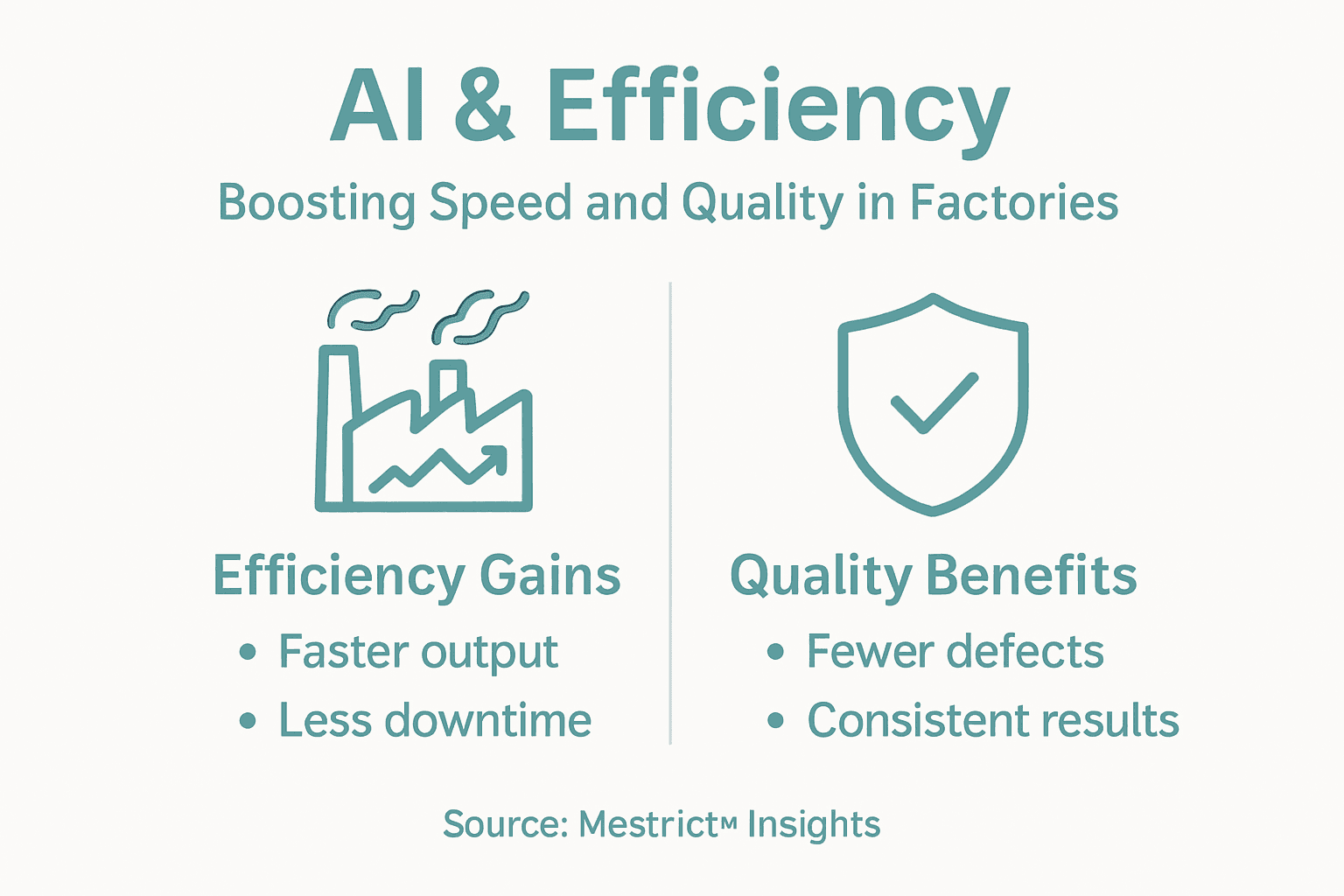
Quality improvements follow quickly. AI catches defects your human inspectors would miss across thousands of units daily. Reject rates drop whilst first-pass yield increases, directly improving your margin per unit produced.
Reduced maintenance costs emerge as you shift from fixed-schedule replacements to condition-based intervention. Equipment lasts longer because you address problems when early warning signs appear, not after catastrophic failure.
AI-driven predictive maintenance also improves supply chain resilience by forecasting material needs weeks ahead, preventing production halts caused by shortage surprises.
The plants capturing the biggest benefits treat AI as a strategic investment requiring organisational change, not merely a software purchase.
Data quality issues slow early implementations. Your historical production data contains gaps, inconsistencies, and measurement errors. AI systems require clean, consistent data—garbage input produces garbage output regardless of algorithm sophistication.
Legacy equipment integration proves harder than expected. Older machines lack sensors or use proprietary communication protocols incompatible with modern AI platforms. Retrofitting sensors costs money upfront but unlocks the data AI needs to optimise effectively.
Workforce adaptation represents your biggest human challenge. Operators accustomed to manual control must trust autonomous system recommendations. Manufacturing workers need upskilling to understand AI outputs and intervene when recommendations seem incorrect.
Implementation timelines extend longer than anticipated. Most plants underestimate the months required for staff training, system customisation, and gradual rollout across production lines. Quick fixes typically fail; planned, methodical implementation succeeds.
Key obstacles to prepare for:
Successful plants acknowledge these challenges openly and build implementation timelines accounting for them. They invest in operator training before system launch, not after. They clean and standardise data before expecting AI to generate reliable predictions.
Pro tip: Assign a dedicated project manager to oversee your AI implementation and establish clear success metrics before installation begins—measurement discipline separates successful deployments from expensive failures.
AI-driven solutions dominate current manufacturing discussions, yet other proven approaches deliver efficiency gains without machine learning complexity. Your plant may benefit more from traditional optimisation methods, depending on your current capabilities and constraints.
The choice isn’t binary. Many successful plants combine AI with non-AI strategies to create comprehensive improvement programmes that address multiple bottlenecks simultaneously.
Here’s a concise comparison of AI-driven manufacturing versus traditional optimisation methods:
| Approach | Data Requirement | Flexibility | Potential ROI Timeline |
|---|---|---|---|
| AI-driven | Extensive historical data | Adapts to changing conditions | 6–18 months, often longer |
| Lean/Six Sigma | Minimal data needed | Relies on human discipline | Often immediate to 6 months |
| Robotics/Automation | Moderate sensor data | Requires manual oversight | 6–12 months, varies |
| Preventive maintenance | Basic equipment records | Fixed intervals only | Immediate, but less cost-efficient |
Lean manufacturing methodology eliminates waste through systematic process analysis and continuous improvement. Your team identifies non-value-adding steps, streamlines workflows, and reduces inventory holding costs. Unlike AI, Lean requires no historical data or sophisticated algorithms—just disciplined observation and operator engagement.
Six Sigma methodology uses statistical analysis to reduce process variation and defect rates. Your quality teams measure performance, identify root causes of variation, and implement targeted controls. This approach works particularly well when your problems stem from process inconsistency rather than equipment degradation.
Advanced robotics and automation improve throughput without machine learning. Collaborative robots work alongside operators, handling repetitive or dangerous tasks whilst humans manage decision-making. Human-centric manufacturing collaboration combines human judgment with robotic precision, creating flexible production without requiring AI systems.
Preventive maintenance scheduling uses fixed intervals and equipment age rather than predictive models. Your maintenance team follows standardised replacement schedules, preventing catastrophic failures through planned intervention. This approach costs more upfront but requires no data infrastructure investment.
Non-AI approaches require discipline and engagement from your team but offer transparency that builds operator confidence and understanding.
When alternatives make sense:
Many plants discover that systematic production optimisation using traditional methods actually solves their most costly problems before AI becomes cost-effective.
Your plant doesn’t choose between AI and alternatives—you combine them strategically. Use Lean to eliminate waste, deploy Six Sigma to reduce variation, implement collaborative robots for dangerous tasks, and add AI only where historical data justifies the investment.
This sequenced approach builds capability whilst managing risk. You gain quick wins from traditional methods, establish data-gathering foundations, then introduce AI targeting your highest-impact remaining problems.
Pro tip: Before investing in AI systems, map your top three efficiency problems and honestly assess whether Lean, Six Sigma, or process redesign could solve them faster and cheaper.
The article highlights the ever-present challenge of unplanned downtime, quality defects, and inefficient resource utilisation that manufacturing companies face. It explains how AI technologies like machine learning and predictive maintenance transform operations by detecting problems before they occur and optimising processes in real time. If you want to overcome these bottlenecks and accelerate your digital transformation journey, understanding the impact of AI in manufacturing is only the first step.
At Mestric™, we offer a user-friendly Manufacturing Execution System that integrates AI-powered optimisation tools with live production data. Our system provides clear insights into performance metrics, downtime causes, and quality parameters, empowering production managers to make faster, smarter decisions that reduce costs and boost output. Backed by extensive resources in our Learn - Mestric section, you can explore how AI enhances your MES capabilities and streamlines complex production workflows.
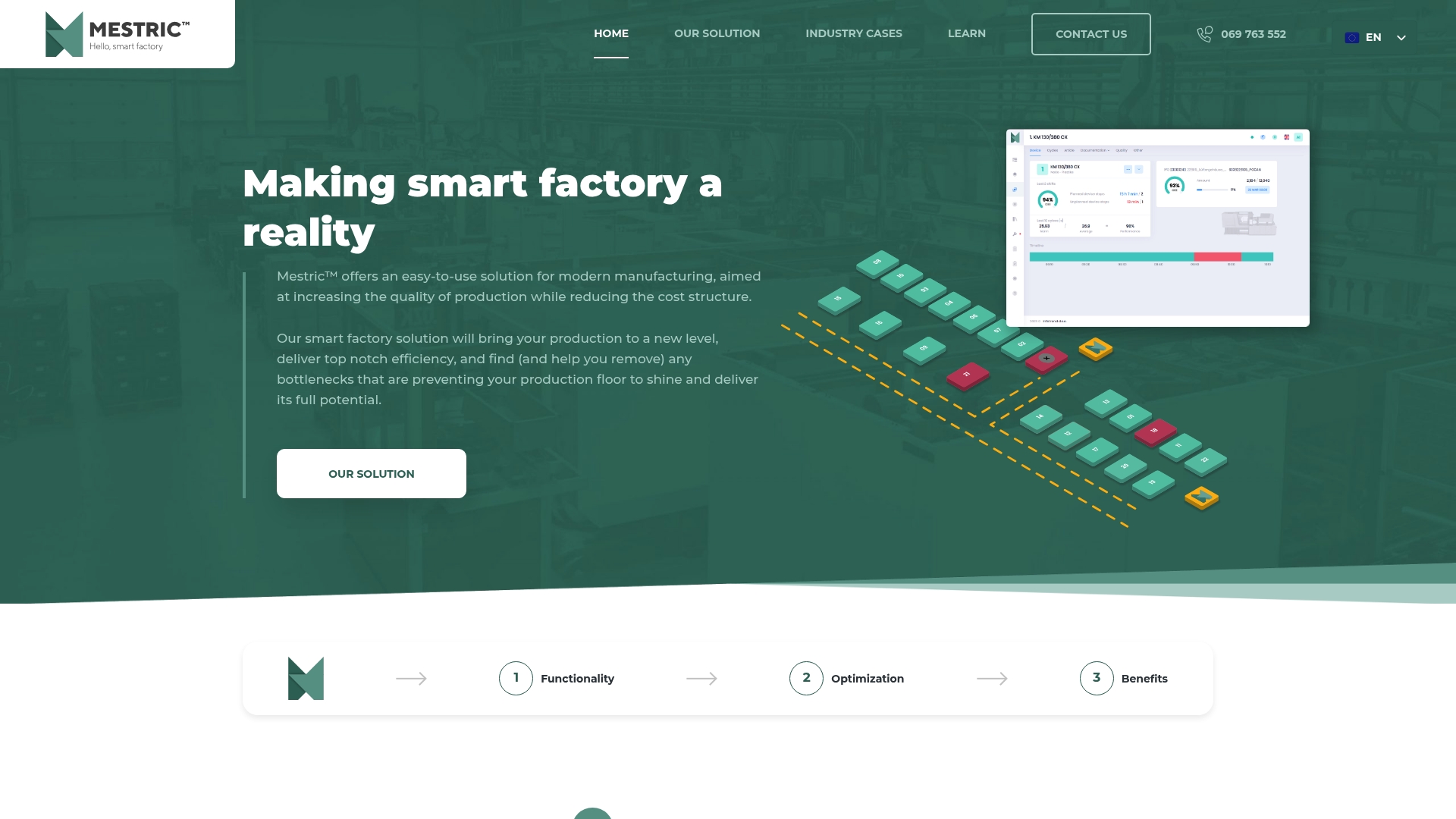
Experience the difference yourself—discover how Mestric™ turns your manufacturing data into actionable insights and real-time process improvements. Visit Mestric™ now to schedule a personalised demonstration and take the first step towards a more efficient, responsive factory floor.
AI in manufacturing refers to machine learning systems and algorithms that analyse production data, recognise patterns, and make decisions with minimal human intervention, improving operational performance.
AI improves efficiency by predicting equipment failures, enhancing quality control, and providing real-time insights. It helps reduce downtime and optimises resource allocation, leading to faster production processes.
The main technologies include machine learning for pattern detection, digital twins for simulating production scenarios, and predictive maintenance for monitoring equipment health to prevent failures and reduce downtime.
Manufacturers can integrate AI with their manufacturing execution systems (MES) to enhance real-time optimisation, enabling automatic adjustments to equipment settings and proactive quality assurance based on predictive analytics.


 069 763 552