


TL;DR:
- Factory data standardisation converts machine outputs and process records into consistent formats across plants. It improves decision-making, reduces costs, and enhances AI effectiveness by providing reliable, comparable data. Most manufacturers fail to implement it fully, but prioritizing high-impact workflows and establishing governance drives successful standardisation.
Data standardisation in manufacturing is defined as the process of converting disparate machine outputs, sensor readings, and process records into consistent formats, shared definitions, and common units across every system in your plant. Without it, your analytics are unreliable, your AI projects fail before they start, and your teams spend more time reconciling numbers than acting on them. Understanding why standardize factory data matters is not an IT question. It is a production question, a quality question, and a competitive question. Only 15% of manufacturers who have a data management strategy fully implement it, even as data volumes are set to triple by 2030. That gap is where operational advantage is won or lost.
Standardised factory data directly improves the quality of every decision your production managers make. When machines across a plant report temperature, cycle time, and reject counts in the same format and unit, your team can compare lines, shifts, and sites without manual translation. That comparison is the foundation of data-driven manufacturing.

Poor data quality costs organisations an average of £12.9 million annually. That figure reflects the cumulative drag of manual corrections, duplicated records, and decisions made on wrong numbers. Standardisation removes the root cause rather than treating the symptom.
The operational benefits are concrete:
One manufacturer implementing real-time anomaly detection on standardised equipment data prevented losses of £2.5 million annually. The technology was not novel. The standardised data underneath it was the deciding factor.
Pro Tip: Start by standardising the data feeding your highest-cost process first. A single bottleneck line with clean, consistent data will deliver faster ROI than a plant-wide rollout with inconsistent inputs.
Most manufacturers are not data-poor. They are, as one industry analysis puts it, data-illiterate. The problem is incompatible systems with no shared reference point, not a shortage of readings. A CNC machine, a SCADA system, and an ERP platform can all record the same production event in three different formats, with three different timestamps, and three different unit conventions.
The most common pitfalls follow a predictable pattern:
Standardisation requires balancing enough structure to enable interoperability without creating excessive bureaucratic overhead. Too rigid, and teams route around the standard. Too flexible, and the standard means nothing.
The governance failure is often more damaging than the technical failure. When no single owner is accountable for the standard, it drifts. New machines get connected with new naming conventions. Legacy systems never get updated. Within two years, the “standardised” environment is as fragmented as the one it replaced.
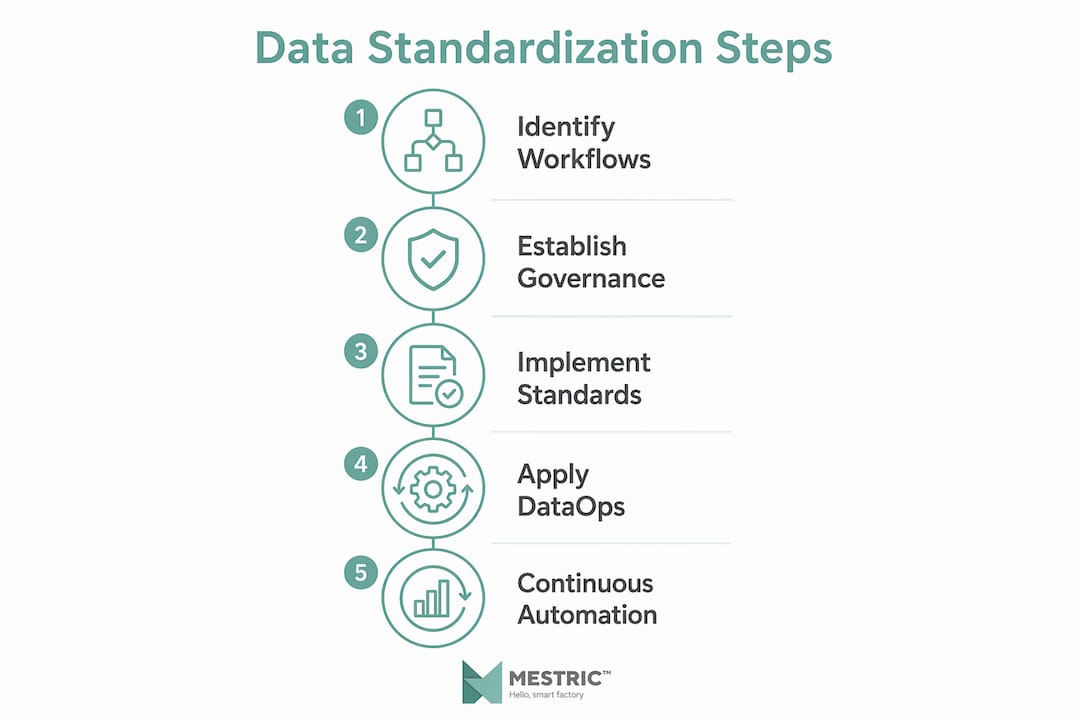
Effective factory data management starts with a value-driven scope, not a comprehensive one. Identify the two or three workflows where data inconsistency causes the most measurable pain, and standardise those first. Prove the return, then expand.
Governance means documented standards, named owners, and a change control process. A master data model with versioning aligns multiple plants and applications to shared definitions. Without versioning, a change to one field breaks downstream reports without warning. Assign a data steward in Operations, not just in IT, for each critical data domain.
OPC UA Companion Specifications and CESMII profiles give you a proven vocabulary for machine data. Rather than inventing your own naming conventions, map your existing data to these frameworks. This approach also future-proofs integration with new equipment, because vendors increasingly support OPC UA natively.
An Industrial DataOps layer between your operational technology and your IT systems harmonises and validates data near the source. This reduces costly rework further up the analytics chain and enforces security and governance at the point of collection. It also bridges the OT and IT gap without requiring a full system replacement.
Linking a raw sensor reading to its asset, process state, and timestamp is called semantic contextualisation. Without this context, automated analytics and AI produce fragile, unreliable outputs. With it, your models know not just what the reading was, but what it meant at that moment in that process.
Pro Tip: Automate validation rules at the point of ingestion. A data pipeline that rejects out-of-range or misformatted values immediately is far cheaper than one that passes bad data into your analytics layer and lets analysts find the errors weeks later.
Standardisation is not a project with an end date. New machines, new products, and new suppliers introduce new data formats constantly. Build automated validation and continuous monitoring into your data pipeline from day one. Treat a data quality alert the same way you treat a machine fault: investigate it, fix the root cause, and document the resolution.
AI and machine learning models require high-quality, consistent, and contextual data to produce accurate outputs. Building data lakes without a clear plan for how data will be used leads to failed AI projects and wasted investment. The model is only as good as the data it trains on. Inconsistent units, missing timestamps, and ambiguous labels produce models that perform well in testing and fail on the shop floor.
Regulatory pressure adds a second dimension. Traceability requirements under frameworks such as ISO 9001 and sector-specific standards demand that you can reconstruct the exact conditions under which any product was made. Standardised, auditable data makes that reconstruction straightforward. Non-standardised data makes it a manual forensic exercise, which is expensive and error-prone.
The benefits of consistent data for compliance and digital transformation include:
Only 1 in 4 manufacturers are confident they collect the right data, and 86% agree that effective data use is essential for success. That gap between belief and confidence is precisely where standardisation closes the distance. You can read more about integrating manufacturing data to understand how these principles apply across connected plant environments.
Standardising factory data is the single most effective step manufacturers can take to make analytics reliable, AI viable, and compliance manageable at scale.
| Point | Details |
|---|---|
| Start with high-value workflows | Standardise the data feeding your costliest bottleneck first to prove ROI before expanding. |
| Governance precedes technology | Assign named data stewards in Operations and document standards with version control before building pipelines. |
| Use open standards | OPC UA and CESMII profiles provide a proven vocabulary that reduces custom integration work. |
| Add semantic context at source | Link every reading to its asset, process state, and timestamp to make AI and analytics outputs reliable. |
| Treat it as a continuous capability | Automate validation and monitor data quality continuously rather than running a one-off standardisation project. |
Manufacturing leaders tend to frame data standardisation as infrastructure. They fund it like infrastructure, too: a capital project with a defined scope, a go-live date, and a handover to IT. That framing is why so many standardisation efforts stall or regress within 18 months.
The manufacturers I have seen succeed treat standardisation as a business capability, the same way they treat quality management or production scheduling. It has owners, it has metrics, and it gets reviewed in operational meetings, not just IT steering committees. The cultural shift is harder than the technical one, and it takes longer. But it is the only version that sticks.
The other mistake I see repeatedly is chasing completeness. Teams spend months mapping every data point across every system before standardising anything. By the time the map is finished, the business has moved on, new machines have been installed, and the map is already out of date. Start with the data that drives your most expensive decisions. Get that right. Then expand.
Standardised data is not the destination. It is the foundation that makes every other investment in analytics, AI, and production quality monitoring worth making. Factories that build this foundation now will integrate new technology faster and at lower cost than those that do not. That is a compounding advantage, and it starts with a decision to treat data quality as an operational responsibility, not an IT one.
— Andraž
Mestric connects directly with your manufacturing equipment to collect, structure, and present production data in a consistent format your team can act on immediately.
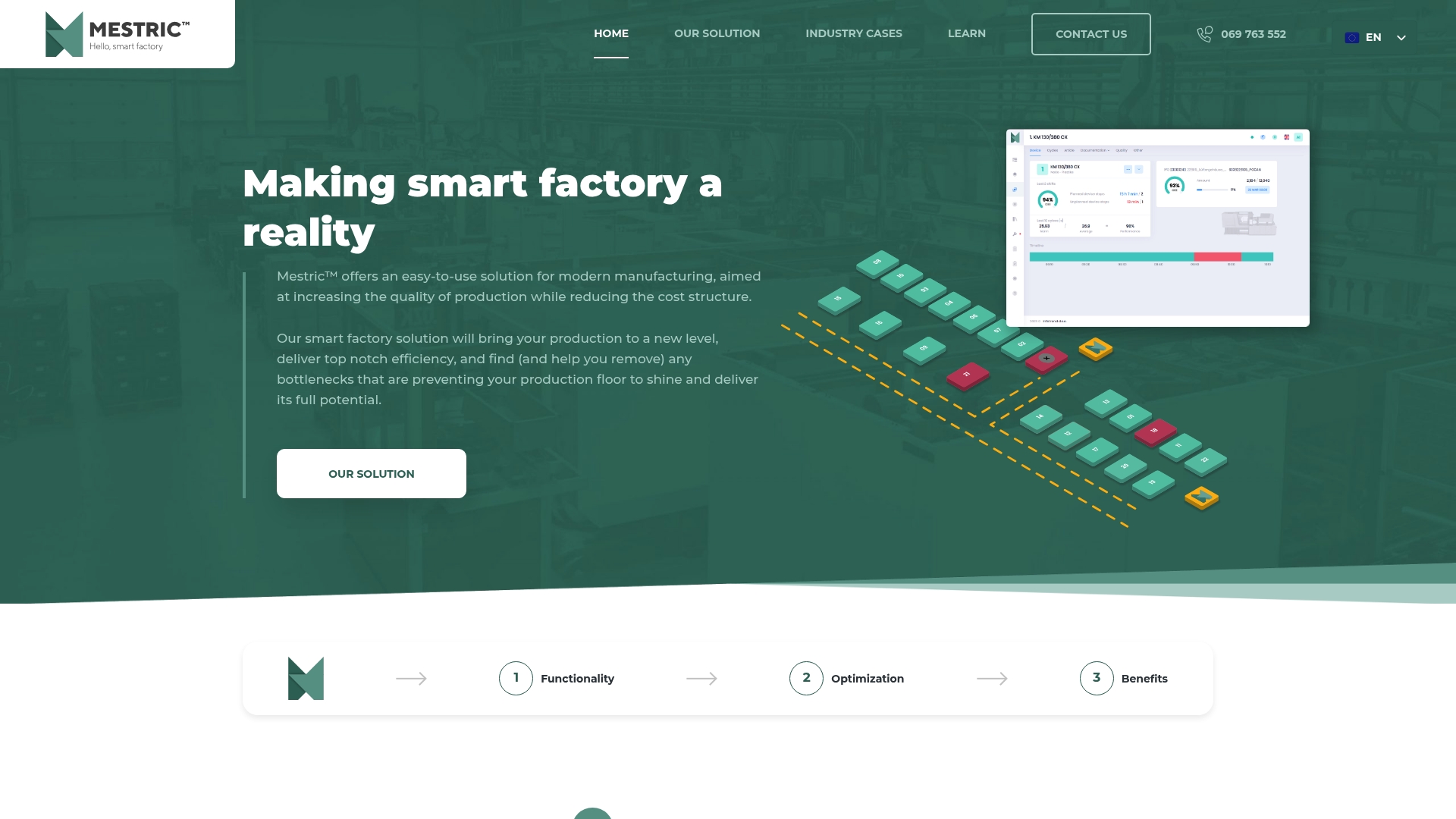
The Mestric Manufacturing Execution System captures real-time KPIs including performance metrics, downtime, quality parameters, and cost analysis across connected lines. All data is presented through a single interface, removing the reconciliation work that consumes analyst time in fragmented environments. If you are evaluating how a modern MES compares to traditional manufacturing approaches, Mestric’s platform demonstrates the practical difference that structured, real-time data makes to daily production decisions. You can also explore how Mestric supports real-time production monitoring to see how standardised data feeds directly into operational visibility.
Standardising factory data means converting machine outputs, sensor readings, and process records into consistent formats, shared units, and common definitions across all systems. This makes data comparable, reliable, and usable for analytics and reporting.
AI models require consistent, contextual, and complete data to produce accurate outputs. Without standardisation, models trained on inconsistent factory data perform poorly in real production conditions and deliver unreliable recommendations.
Begin with the two or three workflows where data inconsistency causes the most measurable operational cost. Establish governance with named owners and documented standards, then use open frameworks such as OPC UA to structure your data model before expanding to other areas.
Poor data quality costs organisations an average of £12.9 million annually through errors, manual corrections, and decisions made on inaccurate information. Standardisation reduces manual data cleaning by 40–60% through automation.
Standardised data with consistent timestamps, asset links, and process context makes traceability straightforward. This satisfies audit requirements under frameworks such as ISO 9001 and meets supplier data requirements in sectors including automotive, aerospace, and pharmaceuticals.


 069 763 552