


TL;DR:
- Incremental, KPI-driven improvements are more effective than broad digitalization programs.
- Mapping processes and involving operators help target real inefficiencies for measurable gains.
- Simple visibility tools and operator ownership foster sustainable, long-term shop floor efficiency.
Many plant managers approach efficiency improvement by launching broad digitalisation programmes, only to find teams overwhelmed and results hard to measure. The smarter path is incremental, KPI-driven improvement that targets specific pain points before expanding. This article walks you through a structured, practical approach: from defining the right metrics, to mapping workflows, to deploying a Manufacturing Execution System (MES) that connects real data to real decisions. Each step builds on the last, giving your team confidence and measurable wins at every stage.
| Point | Details |
|---|---|
| Start with KPIs | Focusing on a small set of measurable KPIs ensures targeted and incremental shop floor improvements. |
| Map and digitise workflows | Process mapping and MES implementation align digital data collection with real shop floor realities for actionable insights. |
| Solve recurring problems | Continuous improvement tools guided by MES data help achieve substantial efficiency gains on persistent issues like changeovers. |
| Integrate for impact | Linking MES with your ERP creates seamless data flows that support enterprise-wide visibility and long-term gains. |
Once you’ve identified the need for improvement, the most important thing you can do is resist the urge to fix everything at once. Shop floor process improvement works best when you begin with a small number of meaningful targets, gather reliable baseline data, and move forward from there.
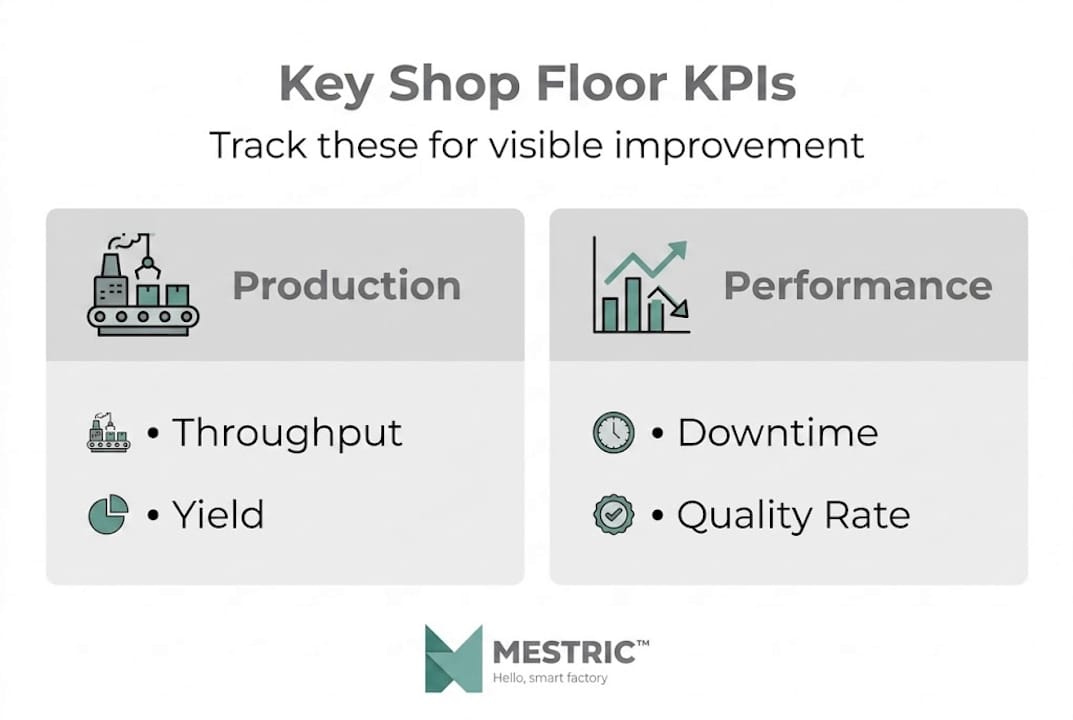
Start by selecting four to six core operational indicators that directly reflect your production health. According to best practice, you should begin with a limited set of operational indicators and use disciplined, incremental progress aligned to defined objectives. Spreading attention across twenty metrics at once almost always dilutes focus and slows progress. Concentrate on the indicators that matter most to your specific operation.
The table below shows five essential KPIs and what each one reveals about your operation:
| KPI | What it measures | Why it matters |
|---|---|---|
| Throughput | Units produced per shift or hour | Reveals actual production capacity vs. planned |
| Yield | Good units as a percentage of total output | Flags rework, scrap, and material waste |
| Quality rate | First-pass quality percentage | Identifies process consistency issues |
| Downtime | Unplanned machine or line stoppages | Highlights equipment reliability problems |
| Cost per unit | Total production cost divided by output | Connects efficiency to financial performance |
Tracking the right KPIs from the start gives your team a shared language and makes progress visible to everyone on the floor, not just senior management.
Before you finalise your KPI list, walk the floor with your supervisors and frontline operators. They know where the real friction is. A maintenance technician can tell you which machines stop most often. A line operator can describe which steps cause the most rework. This ground-level input is invaluable and prevents you from measuring things that look important on paper but miss the actual source of lost efficiency.
Once you have your KPIs, document current performance honestly. Use whatever data you have, whether from paper records, basic software, or operator logs. This baseline is your reference point. Without it, you cannot demonstrate improvement to stakeholders or know whether a change is actually working.
Key actions for your KPI assessment phase:
For practical guidance on selecting the right targets, smart KPI examples offer a useful starting point for manufacturing environments of all sizes.
Pro Tip: Introduce KPI tracking to operators gradually. Start by displaying one or two metrics on a visible screen near the line. Once the team is comfortable with those, add more. Rushing the rollout creates confusion and resistance, which undermines the whole effort from the start.
With KPIs defined, it is crucial to map your processes and align digital solutions directly with shop floor routines. Process mapping sounds straightforward, but it is where most efficiency programmes either gain real momentum or quietly stall.
Begin by documenting each step in your production workflow, from raw material arrival to finished goods despatch. Use a simple flowchart format that your team can review and contribute to. The goal is to identify where delays occur, where decisions are made manually without data, and where quality issues tend to originate. Bottlenecks become visible when you map processes honestly, and priorities become clear.
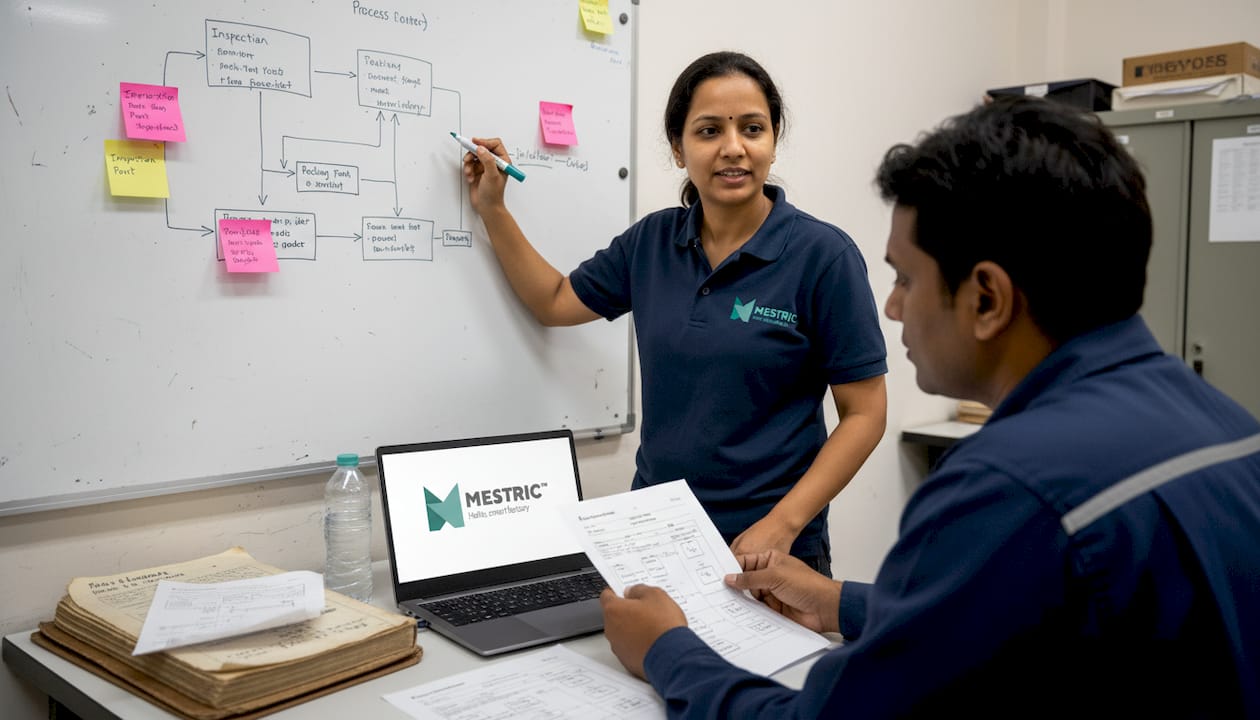
Once your map is complete, you are ready to introduce an MES. The value of MES for shop floor efficiency comes directly from aligning the digital workflow to actual shop floor workflows, including process mapping, KPI definition, real-time data collection, work orders, quality control, maintenance tracking, and operator adoption. An MES that does not reflect how your floor actually operates will be ignored within weeks.
Comparing your current approach to an MES-tracked workflow makes the productivity gap obvious:
| Area | Paper-based workflow | MES-tracked workflow |
|---|---|---|
| Data capture | Manual, end-of-shift entry | Real-time, automated from machines |
| Work orders | Printed sheets, prone to loss | Digital, accessible on any terminal |
| Quality checks | Paper forms, batch review | Inline prompts, instant alerts |
| Downtime recording | Operator memory or logs | Automatic detection, timestamped |
| Reporting | Hours to compile | Available instantly, always current |
For a fuller picture of how MES vs traditional approaches compare in real operations, the difference in response time and data accuracy alone often justifies the transition.
A practical MES rollout follows these steps:
Supporting streamlining manufacturing processes with an MES only works when the system reflects genuine shop floor conditions. Generic configurations rarely stick.
Pro Tip: Involve your maintenance team and line operators before go-live, not after. Ask them to review the downtime reason codes and work order formats before the system launches. Their early input prevents the most common adoption problems and creates a sense of shared ownership over the new tools.
Once live, your MES becomes the single source of truth for production data. Supervisors can see what is happening now, not what happened yesterday. That shift in visibility changes how problems are identified and responded to across every shift.
Once you have real-time data and clear workflows, you can identify and attack persistent inefficiencies with much greater precision. MES data reveals patterns that manual observation simply cannot. You start to see which machines stop most often, which shifts produce the most scrap, and which changeovers consistently run long.
Setup time and changeovers are among the most common sources of lost capacity in discrete manufacturing. These are the minutes or hours between the last good part of one production run and the first good part of the next. Across a week or a month, lost changeover time adds up to significant lost output.
Data-driven shop floor improvements make it possible to quantify this loss and target it precisely. Research from an industrial study on setup time shows that structured root-cause analysis and PDCA discipline delivered meaningful results without additional capital investment.
“Average individual setup time was reduced by 23.3% over five months, with process variation cut by nearly two-thirds, using quality tools and the PDCA cycle alone.”
Those are not theoretical figures. They came from applying a structured method to a real production environment, with no new equipment purchased. The only investment was disciplined problem-solving using existing data.
The PDCA cycle, which stands for Plan, Do, Check, Act, gives your team a repeatable framework for fixing recurring problems:
Quick wins from this process are important beyond the efficiency gain itself. When operators and supervisors see a specific problem get measurably smaller because of structured action, confidence in the whole programme increases. Teams become more willing to raise problems early, because they see that problems actually get resolved. That cultural shift is often more valuable than the initial efficiency gain.
Address recurring stoppages the same way. Use your MES downtime data to identify the top three causes of unplanned stops over the past month. For each one, run a brief root-cause session with the relevant operators and maintenance staff. Document the finding and apply the fix. Then track it.
Addressing inefficiencies creates a solid base, but lasting results depend on acting on the data and linking it with your wider business systems. Collecting data is not the goal. Using it to make faster, better decisions is.
MES analytics give you the ability to move from reactive problem-solving to proactive management. Instead of investigating why last week’s yield dropped, you can see yield declining in real time and intervene before the shift ends. That difference in response time prevents defects from accumulating and keeps production on target.
Integrating your MES with your ERP (Enterprise Resource Planning) system removes one of the most persistent sources of error in manufacturing operations: manual data re-entry. When production data flows automatically from the shop floor to the business system, inventory records stay accurate, material consumption updates in real time, and traceability becomes straightforward rather than a retrospective exercise. Qatar Steel’s implementation of Proficy Smart Factory MES demonstrates how closing this loop between production and enterprise systems eliminates manual re-entry and delivers real-time inventory and traceability visibility.
Research in data-oriented shopfloor management confirms that the greatest gains come not from data collection alone, but from the systems and disciplines that turn data into operational decisions.
The benefits of enterprise-wide data transparency are significant:
To streamline production operations sustainably, your MES should connect to scheduling, quality management, and financial reporting, creating a complete picture from machine to management.
Pro Tip: Do not try to integrate everything at once. Start with one ERP module, such as inventory or work orders, and validate the data flow before expanding. Iterative integration planning reduces risk and gives your IT and operations teams time to build confidence in the new data pipeline.
The long-term value of this closed-loop approach is that improvement becomes self-sustaining. Every production run generates data. That data surfaces problems. Structured analysis addresses those problems. Updated processes feed back into the MES. And the cycle continues, delivering incremental gains with each iteration.
There is a common assumption in manufacturing improvement circles that more technology automatically means better results. After working closely with plant managers across a range of production environments, we have observed the opposite is often true.
The most durable efficiency gains tend to come from the simplest, most visible changes. A well-placed KPI screen on the production floor, visible to every operator, often drives more behavioural change than an elaborate dashboard accessible only to management. When people can see their own performance in real time, they respond to it.
Efficiency programmes fail most often not because the technology is wrong, but because operators do not feel ownership of the tools or the targets. When KPIs are set by management and imposed on the floor without consultation, compliance is surface-level. When the floor team helps define what good looks like, the results are entirely different.
Using KPIs for focus rather than as a reporting exercise is the distinction that separates programmes that last from those that fade after three months. MES works best as a daily tool for fixing real problems, not as a system for generating compliance reports that nobody reads.
Simplicity, visibility, and operator ownership are the foundations of sustainable shop floor improvement. Technology supports those foundations. It does not replace them.
If you are ready to move from efficiency planning into practical action, Mestric™ gives you the tools to make it happen without the complexity of a traditional enterprise rollout.
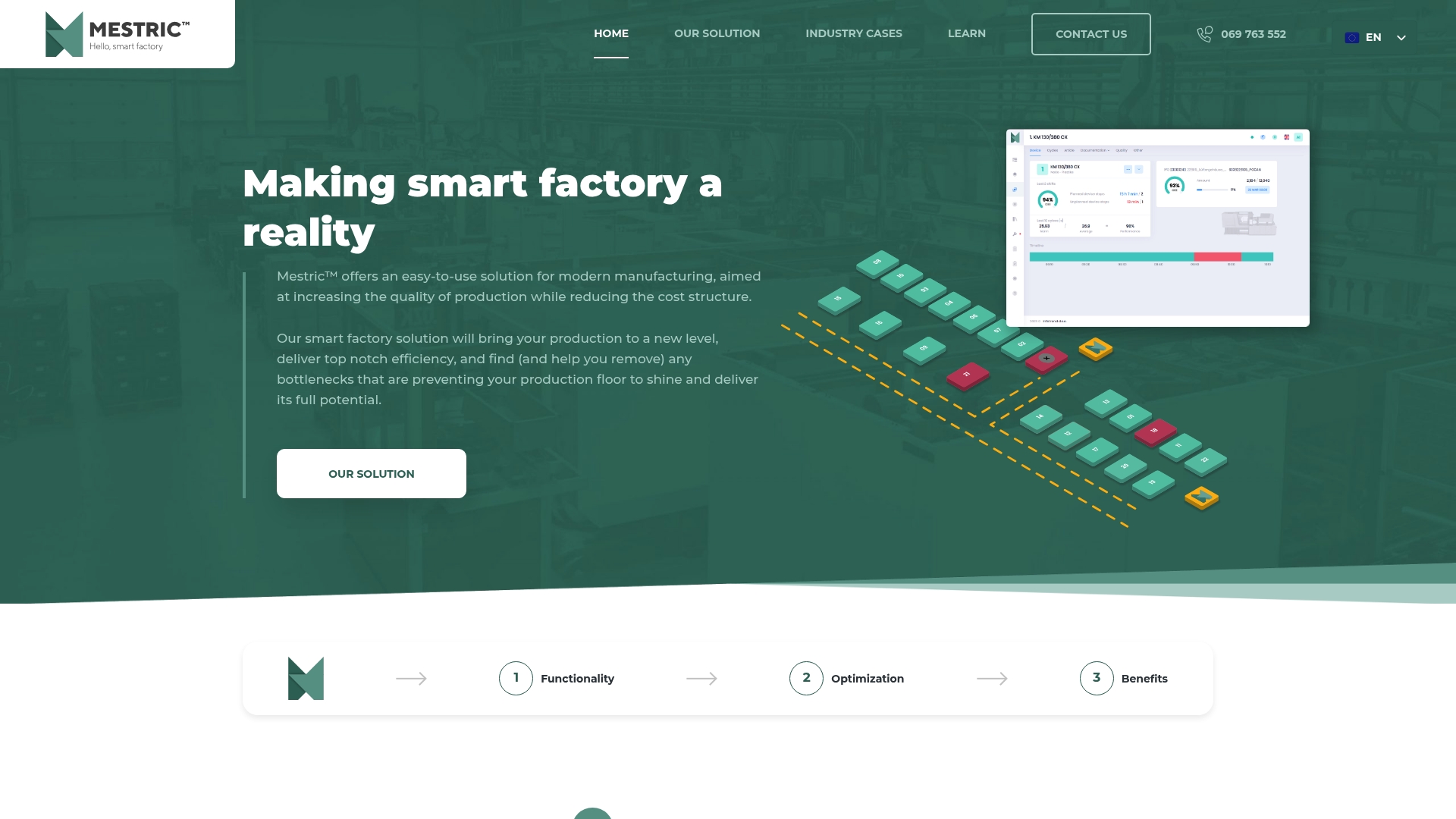
Mestric™ connects directly with your equipment, captures real-time production data, and surfaces the KPIs that matter to your operation every shift. Whether you are starting with a single line or scaling across a full facility, the platform supports modern MES approaches that fit how your floor actually works. From automated downtime tracking to quality monitoring and ERP integration, Mestric™ is built to support streamlined production operations at every stage of your improvement journey. Explore MES tools for efficiency and find out how other manufacturers are turning data into measurable gains.
Throughput, yield, quality rate, downtime, and cost per unit are the primary KPIs for measuring shop floor efficiency. Focusing on a limited set of KPIs ensures your team can act on the data rather than be overwhelmed by it.
Some operations see meaningful improvement within a few months, particularly when targeting setup times with structured root-cause analysis. One industrial study showed a 23.3% reduction in average setup time within five months using quality tools and PDCA.
Integrating MES with ERP removes the need for manual data re-entry and keeps production and business records accurate in real time. Qatar Steel’s MES deployment illustrates how this closes the loop between shop floor activity and enterprise-level visibility.
Early involvement and practical, role-specific training help operators understand the benefits and reduce resistance to new systems. Operator adoption is recognised as one of the most critical steps in any shop-floor-focused MES implementation.


 069 763 552