

Struggling with unpredictable downtime or inconsistent product quality is all too familiar for modern manufacturing leaders. The pressure to deliver results while keeping costs in check grows with every shift. Embracing digital transformation and real-time analytics offers a practical path to tackle these daily challenges. This guide breaks down step-by-step strategies for assessing and improving plant performance, blending real-time visibility with proven digital tools to help drive lasting productivity gains.
| Key Point | Explanation |
| 1. Evaluate operational performance | Assess current manufacturing metrics to establish baseline capabilities and identify areas for improvement. |
| 2. Implement real-time monitoring systems | Use Manufacturing Execution Systems to gain insights into operational dynamics and enhance data-driven decision-making. |
| 3. Leverage data analytics for optimisation | Utilise data-driven techniques to identify inefficiencies and develop targeted strategies for operational improvement. |
| 4. Enhance quality control with digital tools | Integrate real-time monitoring and automation to proactively manage product quality and reduce defects. |
| 5. Validate improvements through data analysis | Systematically analyse data to verify improvements in performance, ensuring informed decisions based on statistical evidence. |
Your first critical task in improving manufacturing efficiency involves a comprehensive evaluation of your current operational landscape. By systematically tracking manufacturing performance indicators, you’ll establish a baseline understanding of your production capabilities and potential improvement areas.
To effectively assess your operational performance, focus on these key dimensions:
Production Volume: Track total units manufactured per shift
Cycle Times: Measure time required for completing each production process
Equipment Downtime: Calculate total hours machinery remains non-operational
Quality Metrics: Evaluate defect rates and product consistency
Resource Utilisation: Analyse raw material consumption and workforce productivity
Understanding your current performance is the foundational step towards meaningful manufacturing transformation.
Employing a Manufacturing Execution System (MES) can significantly streamline this assessment process. Real-time production monitoring systems provide instantaneous insights into operational dynamics, enabling precise performance tracking across multiple parameters. These systems bridge shop-floor operations with strategic decision-making, transforming raw data into actionable intelligence.
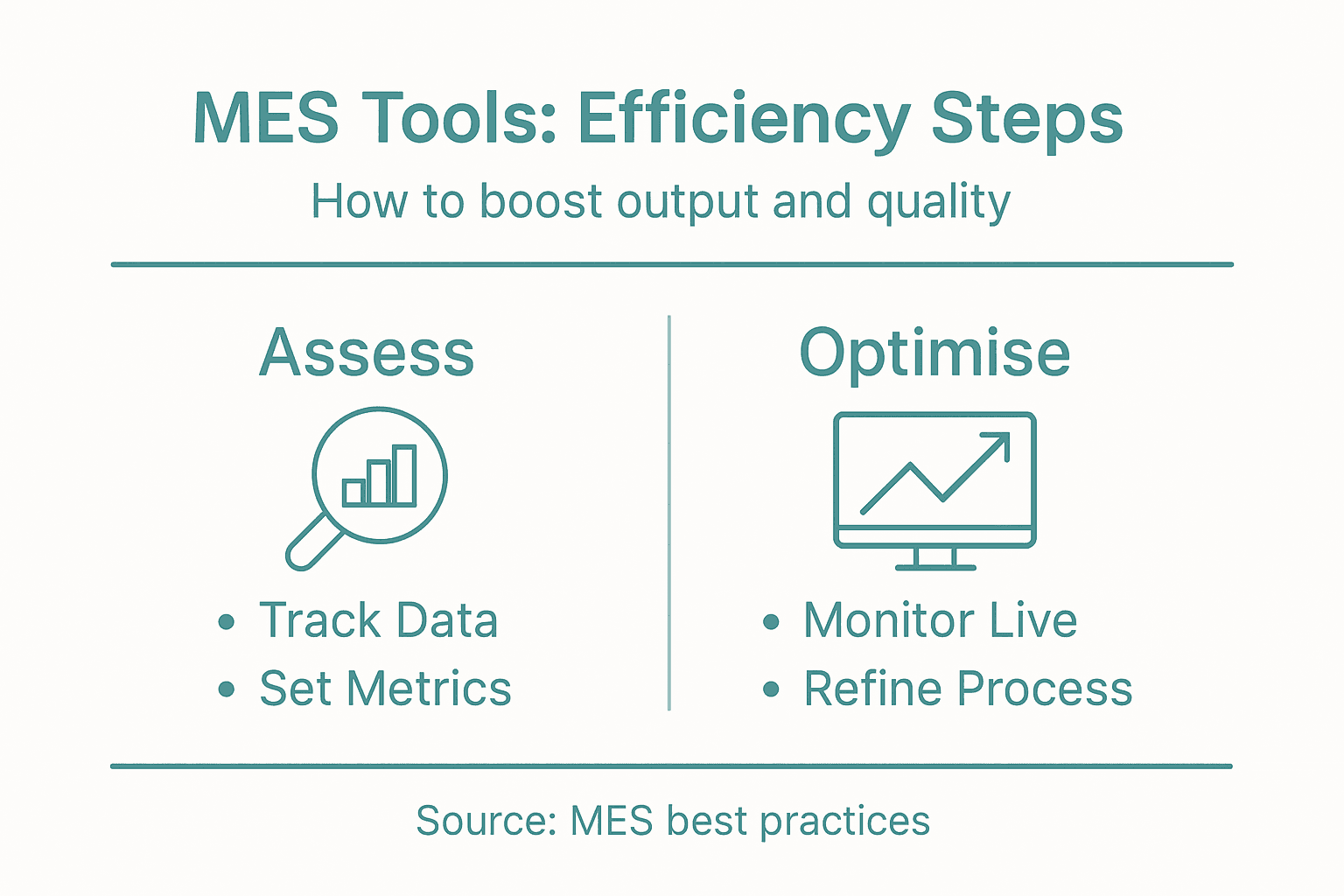
Pro tip: Establish consistent measurement intervals and standardise data collection methods to ensure accurate and comparable performance assessments.
Improving manufacturing efficiency requires implementing robust real-time performance monitoring systems that transform raw operational data into actionable insights. Leveraging machine performance transparency will enable your organisation to make data-driven decisions and optimise production processes.
To successfully implement real-time performance monitoring, follow these strategic steps:
Select an appropriate Manufacturing Execution System (MES)
Configure data collection endpoints across production equipment
Establish key performance indicators (KPIs)
Design intuitive data visualisation dashboards
Train operational staff on system usage
Real-time monitoring transforms data into your competitive advantage.
Your monitoring system should capture critical metrics such as:
Production Speed: Actual versus planned output rates
Equipment Efficiency: Overall machine performance and utilisation
Quality Metrics: Defect rates and production consistency
Energy Consumption: Power usage across manufacturing processes
Workforce Productivity: Individual and team performance indicators
Effective implementation requires understanding that real-time monitoring is more than technology deployment. It represents a cultural shift towards data-driven decision making, where transparency and continuous improvement become organisational priorities.

Pro tip: Begin with a pilot programme in one production line to validate system effectiveness and refine monitoring strategies before full-scale implementation.
Transforming manufacturing performance requires a strategic approach to leveraging advanced data-driven analytical techniques. Manufacturing process analytics enable organisations to uncover hidden inefficiencies and create targeted improvement strategies that directly impact operational excellence.
To effectively optimise production processes using analytics, implement these critical steps:
Integrate comprehensive data collection systems
Develop meaningful performance metrics
Establish baseline performance benchmarks
Create predictive analytical models
Implement continuous improvement protocols
Analytics transform raw data into strategic manufacturing intelligence.
Your analytical approach should focus on several key dimensions:
Operational Efficiency: Identifying bottlenecks and workflow interruptions
Resource Allocation: Optimising equipment and workforce deployment
Predictive Maintenance: Forecasting potential equipment failures
Quality Control: Tracking and reducing manufacturing defects
Cost Management: Understanding granular expense drivers
Advanced manufacturing analytics represent more than technological implementation. They signify a fundamental shift towards data-informed decision making, where continuous improvement becomes an organisational culture rather than a periodic exercise.
Pro tip: Select analytics tools that offer intuitive visualisation and can integrate seamlessly with your existing manufacturing execution systems to ensure rapid adoption and minimal disruption.
Digital technologies are revolutionising manufacturing quality management by providing unprecedented visibility and precision. Comprehensive quality monitoring systems enable manufacturers to detect and address potential defects before they impact production efficiency.
To effectively enhance your quality control processes, implement these strategic digital approaches:
Integrate real-time monitoring technologies
Establish automated inspection protocols
Develop comprehensive digital traceability systems
Create standardised quality benchmarks
Implement predictive quality analytics
Digital quality control transforms variability into consistency.
Your digital quality control strategy should encompass multiple critical dimensions:
Automated Inspection: Utilising machine vision and AI-powered detection
Process Standardisation: Ensuring consistent manufacturing protocols
Defect Prediction: Identifying potential quality issues before production
Comprehensive Traceability: Tracking product quality across entire manufacturing lifecycle
Continuous Improvement: Using data-driven insights to refine processes
Advanced digital quality management represents more than technological implementation. It signifies a fundamental transformation in how manufacturers approach quality, shifting from reactive problem-solving to proactive quality assurance.
Here’s a summary of how advanced digital tools impact quality control in manufacturing:
| Digital Tool | Function | Business Impact |
| Machine vision systems | Automated real-time visual inspections | Reduced manual errors and quicker defect detection |
| Predictive analytics | Forecasts quality issues before they arise | Minimises downtime and defect-related losses |
| Traceability software | Tracks products across all manufacturing stages | Enables root cause analysis and rapid recall |
| Digital dashboards | Presents quality metrics and alerts visually | Enables immediate corrective action and monitoring |
Pro tip: Prioritise digital tools that offer seamless integration with existing manufacturing systems and provide intuitive, actionable insights for your quality control teams.
Validating manufacturing performance improvements requires a systematic approach to data interpretation and comparative analysis. Key performance indicator (KPI) monitoring provides manufacturers with robust methodologies for measuring operational transformation.
To effectively verify your manufacturing improvements, implement these strategic data analysis techniques:
Establish baseline performance metrics
Define comparative measurement periods
Conduct detailed statistical analysis
Create visual performance dashboards
Validate statistical significance of changes
Data-driven insights transform assumptions into actionable knowledge.
Your data verification strategy should concentrate on these critical analytical dimensions:
Performance Comparison: Tracking quantitative improvements
Trend Analysis: Identifying consistent operational patterns
Statistical Significance: Determining genuine performance shifts
Continuous Benchmarking: Maintaining ongoing performance evaluation
Predictive Modelling: Forecasting future operational potential
Manufacturing data analytics represents more than numerical evaluation. It signifies a fundamental approach to understanding organisational performance, transforming raw information into strategic operational intelligence.
The following table compares traditional versus data-driven approaches for verifying manufacturing improvements:
| Approach | Data Collection | Performance Assessment | Decision-Making Basis |
| Traditional | Manual logs, periodic sampling | Subjective or delayed | Intuition/experience |
| Data-driven | Automated, continuous monitoring | Real-time, quantitative | Evidence-based, statistical |
Pro tip: Prioritise reproducible analytical methods and maintain consistent data collection protocols to ensure meaningful performance comparisons.
Improving manufacturing efficiency requires precise real-time performance monitoring, data-driven process optimisation, and advanced quality control as highlighted in the article. Manufacturers often struggle with invisible bottlenecks, inconsistent quality metrics and delayed decision-making, which hinder operational excellence. Mestric™ addresses these challenges by offering an easy-to-use Manufacturing Execution System that connects directly with equipment to deliver continuous KPI tracking, predictive analytics and AI-powered optimisation.
Experience how seamless integration of digital tools can transform production lines by reducing downtime, eliminating manual errors and driving cost savings. With Mestric™, production managers gain instant visibility into performance metrics, quality parameters and resource utilisation enabling proactive management that accelerates improvement cycles and delivers measurable business impact.
Elevate your manufacturing processes today.
Discover how Mestric™ can modernise your operations
Take the next step towards operational excellence. Visit Mestric™ now to request a demonstration and see how real-time data can empower your team to make informed decisions and sustain continuous improvement.
To assess current operational performance, start by systematically tracking key manufacturing performance indicators, such as production volume, cycle times, and equipment downtime. Establish a baseline understanding of your production capabilities and identify areas for improvement by collecting data consistently over a defined period.
Begin implementing real-time performance monitoring by selecting an appropriate Manufacturing Execution System (MES) and configuring data collection points across your equipment. Establish key performance indicators (KPIs) and design user-friendly visualisation dashboards to help staff effectively monitor performance metrics.
To optimise production processes using analytics, integrate comprehensive data collection systems that capture critical metrics, develop performance benchmarks, and create predictive analytical models. This approach will help you uncover inefficiencies and streamline operations within a few weeks.
Digital tools such as machine vision systems and predictive analytics can significantly enhance quality control by providing automated inspections and forecasting potential defects. Implement these technologies to automate your quality assurance processes and improve product consistency over time.
To verify improvements in manufacturing efficiency, establish baseline performance metrics and conduct detailed statistical analysis of data collected post-implementation. Create visual dashboards to compare results over defined periods and validate significant changes to ensure your enhancements are impactful.


 069 763 552