

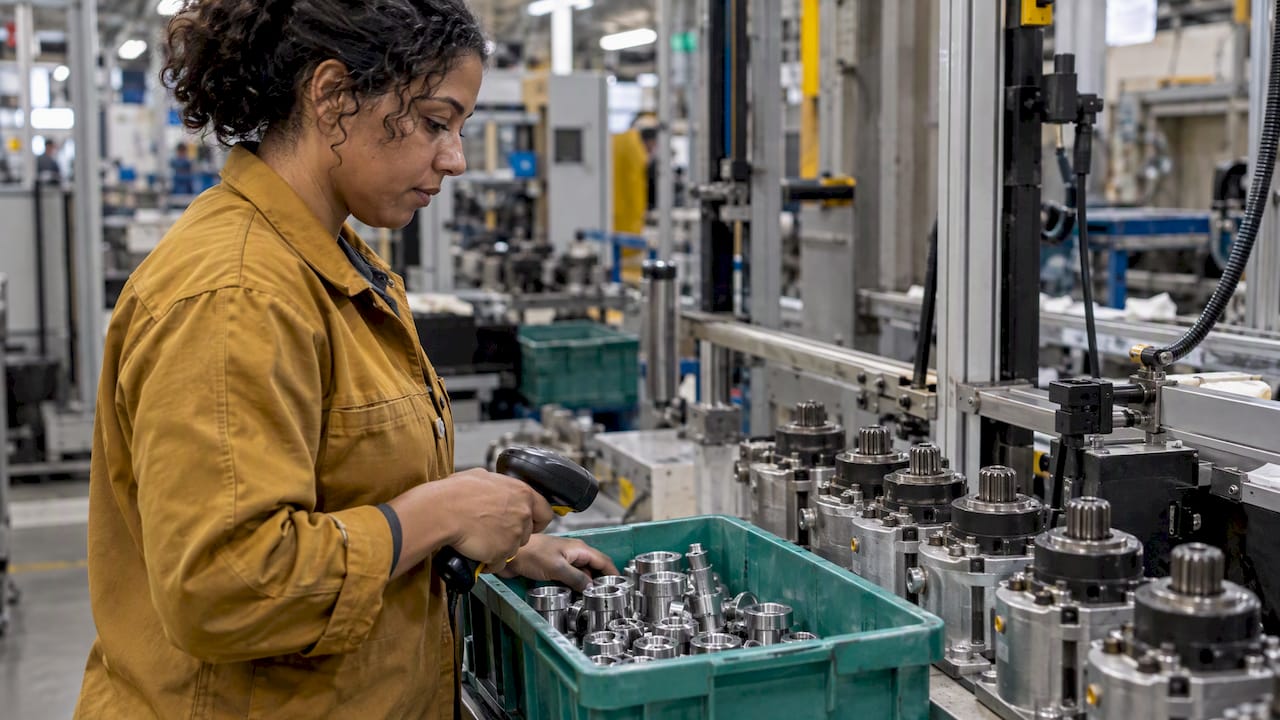
Product genealogy (in Slovenian, genealogija izdelkov) is the complete record of what went into a product and what happened to it on the way. It links each finished unit or lot to its raw material lots, components, machines, operators, process parameters and quality checks. If you can open one serial number and see all of that in minutes, you have genealogy. If you need to dig through paper travellers and spreadsheets, you have lot numbers.
This guide is for plant managers, quality leads and automation engineers. It explains what a genealogy record contains, what the EU rules expect, how to capture the data without manual entry and how to test that it works.
The word “genealogija” in Slovenian most often brings up family trees and the work of rodoslovci. In a factory the idea is the same, applied to products: where does this item come from, and what is it related to?
A genealogy record answers two questions:
It is often used as a synonym for traceability, but it is more specific. Traceability can stop at “supplier lot X was delivered on this date”. Genealogy follows the lot through every transformation: the batch of resin split across three moulding machines, the coil cut into 40 blanks, the two mixer batches blended into one filling run.
| Term | Question it answers | Typical record |
|---|---|---|
| Tracking | Where is it now? | Location, status, work order |
| Tracing | Where has it been? | Route, timestamps, stations |
| Genealogy | What is it made of and how was it made? | Input lots, machine parameters, test results, links between parent and child lots |
Tracking and tracing are parts of the picture. Genealogy is the structure that joins them to materials and process conditions.
EU traceability rests on the principle of documenting your immediate supplier and your immediate customer. The Slovenian government’s page on feed traceability explains that the purpose is to carry out targeted, precise withdrawals and recalls that protect public health and limit damage and market disruption. That page concerns feed, and food and feed rules are the clearest statement of the principle. Other sectors have their own regulations, so check which apply to your product.
For non-food consumer products, the General Product Safety Regulation (EU) 2023/988 started to apply on 13 December 2024 and sets obligations for businesses that place products on the EU market. Slovenia has a national law implementing it, the ZIUSVP. If you ever need to recall, the speed and precision of your genealogy decide how many units you pull back, and from whom.
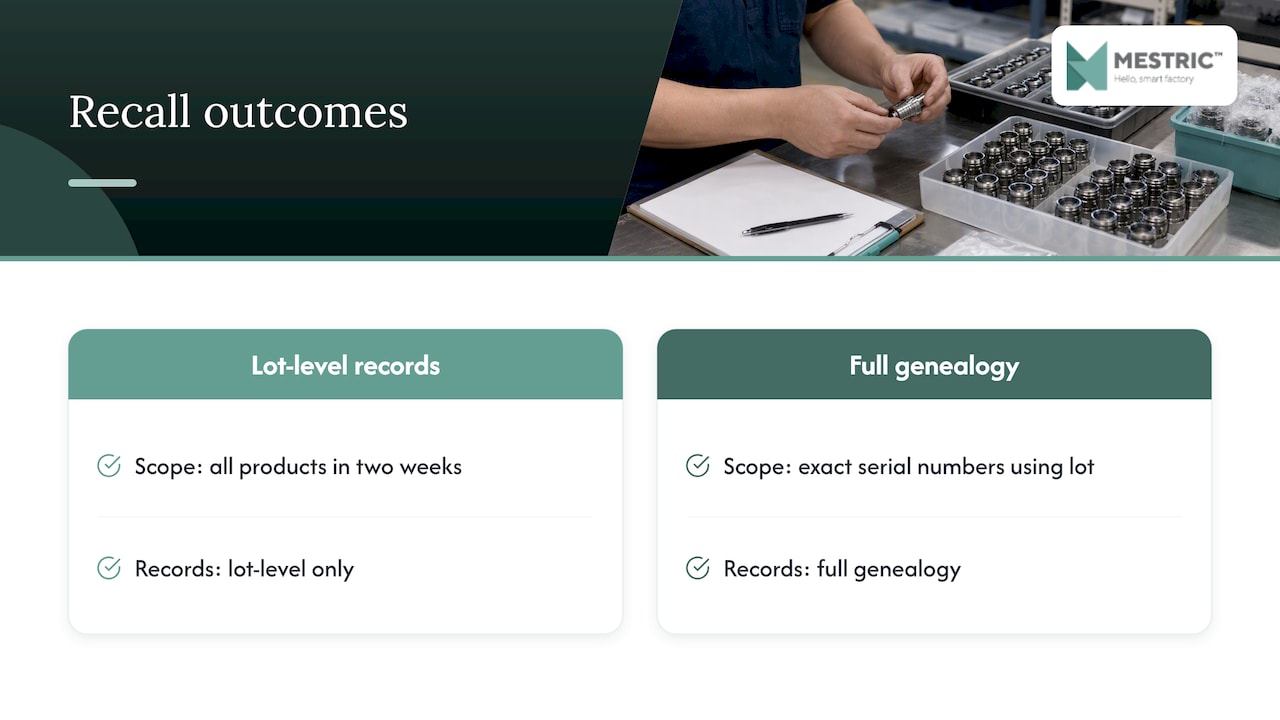
The difference is easy to put in numbers of your own. Suppose a supplier reports a defective lot of a component. With lot-level records only, you may have to quarantine every product built in a two-week window. With full genealogy, you list the exact serial numbers that used that lot.
Automotive, medical, electronics and food customers increasingly ask for proof, not promises. A supplier audit often starts with a request such as: show me everything about this serial number. Our own article on automating production tracking in automotive plants covers why that sector pushes hardest.
Genealogy is not only for crises. When scrap rises on one line, you can compare the genealogy of good and bad units: same material lot? Same tool? Same oven temperature profile? A record that includes process conditions turns a week of guessing into an afternoon of filtering.
Start from the question you must answer, not from the data you can collect. ISO 22005, the traceability standard for the feed and food chain, makes this point well: a traceability system should be designed around objectives such as meeting regulation, managing recalls or improving process yield. Collecting irrelevant data adds cost without making recalls more precise. The standard is written for food and feed, but the design logic carries over to other industries.
A practical record has five layers.
The ISO 22005 background notes that many factories assume recording lot numbers is enough. Audit-ready genealogy has to document the linkage between inputs and outputs where materials are mixed, split or transformed, and that linkage should be verifiable through regular mock recalls.
The most common reason digital genealogy projects fail is retrospective data entry. If an operator logs material usage at the end of the shift, the record reflects what they remember or assume. Automation specialists, including one MES-focused manufacturer’s explanation of smart factory data, make the same point: capture information when the work happens, from PLCs, sensors and scanners, so the genealogy shows actual process conditions rather than estimates.
In practice this means:
Our guide to the types of manufacturing data and collection methods goes through the options in more detail.
The ISA-95 model describes how information is shared between business and plant levels, including material information. A useful rule of thumb: the ERP knows what you planned to make and buy, the MES knows what actually happened on the floor. Genealogy lives where the work happens, which is the MES layer, and is then shared upwards. For a comparison of the software types, see 7 types of manufacturing software every plant manager should know.
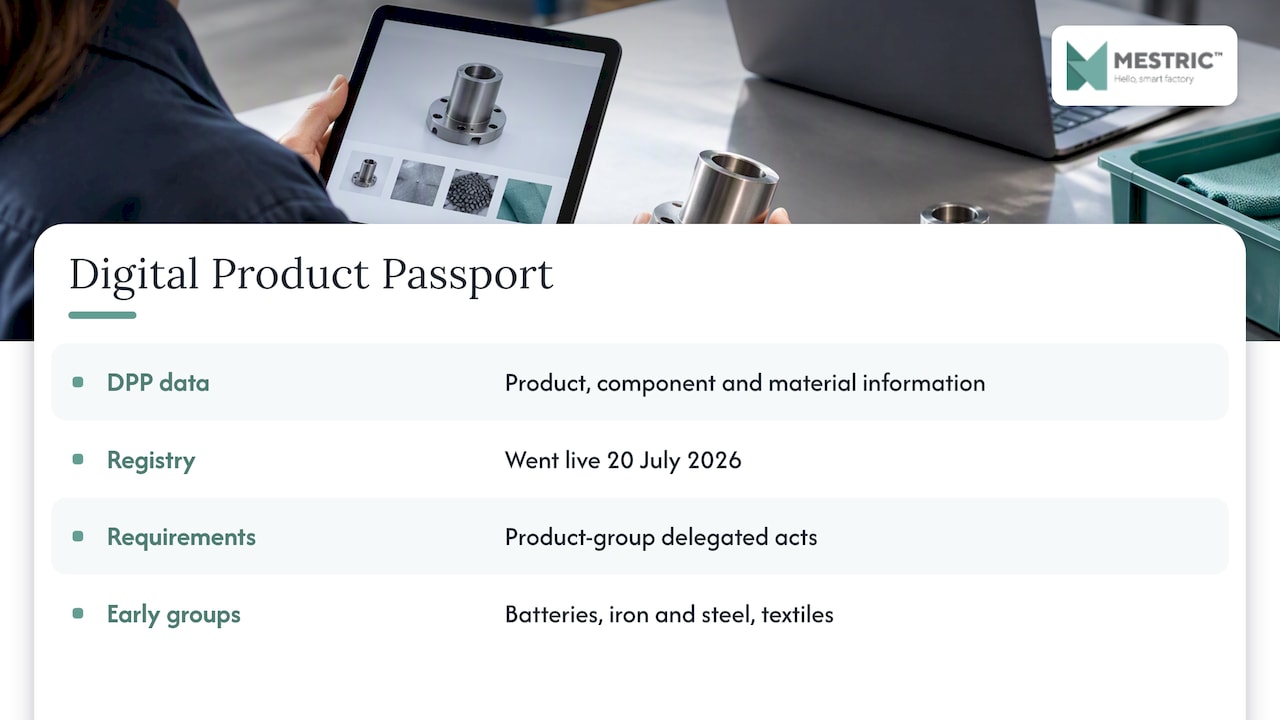
The EU Ecodesign for Sustainable Products Regulation (EU) 2024/1781 introduces the Digital Product Passport (DPP), a digital container for information about products, components and materials. The European Commission announced that the DPP Registry went live on 20 July 2026, together with a testing environment. Mandatory requirements will be introduced product group by product group through delegated acts, with categories such as batteries, iron and steel and textiles named as early candidates. The Commission’s DPP overview explains the concept and its sustainability and circularity aims.
If you make products in one of these groups, or supply components to someone who does, your customers will ask for structured, machine-readable data about materials and origin. Manufacturers who already hold clean genealogy data will find that far easier than those who rebuild it from paper. Suppliers of electronic assemblies and panels are already writing about substance rules in the same context, for example on REACH compliance for panel manufacturers.
A DPP is not the same thing as genealogy, and a genealogy system does not make you compliant on its own. It does give you the underlying facts, captured reliably, from which required data can be drawn once the rules for your product group are final.
We built Mestric around one belief: the data a factory trusts is the data nobody had to retype. Genealogy projects tend to start with a list of fields. We suggest starting with a single question: if a customer called tomorrow about one serial number, what would you need to answer in ten minutes?
Then work backwards. Which machines hold that data already? Which steps still rely on a clipboard? In many plants the answer is a handful of stations, such as material loading, mixing and final test, where a scanner or a machine connection closes most of the gap. Fixing those first gives you a working genealogy for one line rather than a perfect design for the whole plant that never goes live.
We also encourage teams not to treat genealogy as a compliance-only cost. The same records that satisfy an auditor show you which material lot, tool or setting is behind scrap and stoppages. That is why we connect genealogy to live KPIs, downtime and quality monitoring in one system, rather than keeping it as a separate archive.
— Andraž
| Measure | What to track |
|---|---|
| Time to trace | Minutes from request to a complete list of affected units |
| Precision | Units quarantined versus units truly affected |
| Completeness | Share of units with a full input and process record |
| Manual entries | Fields still typed by hand per shift |
The first two are the ones auditors and customers feel. The last two tell you where to improve.
Mestric™ MES connects directly to production equipment, collects data automatically and shows KPIs such as performance, downtime, quality parameters and costs on the shop floor and in the office. That gives you the foundation for genealogy: records created by the process itself, tied to the product being made. You can see it working with connected machinery at an onsite presentation. Read more about Mestric MES, or start with our pages on production traceability and production quality monitoring to see how they relate to your own lines.
Traceability is the general ability to follow a product through the supply chain. Genealogy is the detailed structure behind it: which input lots, machines, parameters and tests relate to each finished unit, including parent-child links when materials are mixed or split. Many manufacturers use the two words interchangeably, but genealogy is the deeper record.
There is no single genealogy rule for all products. EU law requires businesses to be able to identify suppliers and customers, and sector rules for food, feed, medical devices and consumer products add their own duties, including recall obligations. Check the regulations for your product category, and ask your quality or legal adviser what your customers’ contracts require on top.
Not always on day one, but paper records break down quickly as variants, suppliers and customers grow. A pilot on one line, with scanning at the critical stations, is a realistic start. It lets you prove value before extending it.
Run a mock recall. Choose a supplier lot or a production date, then time how long it takes to list every affected unit and where it was shipped. Compare the result with physical stock and shipments. Any gap shows exactly which step needs automatic capture.


 069 763 552