


Dynamic production replanning automatically updates the shop-floor schedule in real time, using live data on machine status, materials, and order priority to keep delivery dates reliable. The main gain is fewer urgent, last-minute replans and steadier on-time delivery. Enablers include APS software, digital twins, and connected MES platforms, which feed the real-world data these systems need to work.
TL;DR:
- Dynamic replanning reduces the need for last-minute schedule adjustments by continuously updating the shop floor plan based on live data and real constraints.
- Successful implementation requires high-quality data, clear policies, and gradual scaling with pilot projects focusing on critical bottlenecks.
- Key KPIs for measuring success include on-time delivery, schedule stability, and the number of manual override interventions.
- MES platforms that provide real-time machine data, downtime causes, and optimization suggestions are essential for effective shop-floor decision-making.
- Future advancements involve machine learning for predictive failure detection and tighter integration with supply chain systems to enable proactive planning.
A static schedule assumes nothing changes: no breakdowns, no late deliveries, no rush orders. Real factories rarely cooperate. Dynamic production replanning is the practice of adjusting the production schedule continuously, or near-continuously, as new constraints appear on the shop floor. It replaces the old habit of building a plan once a week and firefighting the gaps in between.
Static ERP scheduling tends to fail for a simple reason: ERP systems store transactional data well but rarely model real machine capacity, sequencing rules, or changeover times in enough detail to produce a feasible plan. A planner using ERP alone often has to manually rework the schedule every time something shifts, which is slow and error-prone. Dynamic production planning fixes that gap by treating the schedule as a living object rather than a fixed document.
Typical triggers for replanning include:
Manufacturers who adopt this approach typically report improved on-time delivery, fewer urgent order escalations, and better use of available machine capacity, because the plan reflects what the floor can actually do, not what the ERP calendar assumes it can do, as discussed in The Australian manufacturing + engineering.
Advanced Planning and Scheduling (APS) software sits above ERP and adds what ERP lacks: an optimisation engine that understands constraints such as sequencing rules, tooling changeovers, and finite machine capacity. Where ERP tells you what needs to be made and by when, APS works out how to sequence that work given real bottlenecks.
A digital twin takes this further by modelling the whole production system virtually, so planners can test “what if” scenarios before committing to a change. One documented digital twin implementation can compute a full year’s production plan in under 20 seconds, turning planning from a periodic, painstaking exercise into something closer to a continuous decision process. That same approach converts raw ERP data into an operable planning model that accounts for real constraints, not theoretical capacity.
None of this works without accurate shop-floor data. MES/ERP integration matters because:
Mestric’s real-time production monitoring capability is a practical example of the kind of data layer this planning approach depends on.
Rolling this out well means resisting the urge to automate everything on day one. A staged approach protects delivery performance while you build confidence in the new process.
Pro Tip: Pick your pilot bottleneck deliberately. A constrained work centre or a product family with high order variability will show measurable improvement fast, which makes the case for wider rollout far easier than a quiet, low-variability line ever will.
Three metrics matter more than the rest. On-time delivery (OTD) tells you whether the plan is translating into reliable dates for customers. Plan stability, measured as the number of schedule changes per day, tells you whether replanning is calming the shop floor or adding noise to it. Manual interventions, the number of times a planner has to override the system, tells you how much trust the plan has actually earned.
Secondary metrics worth tracking:
Statistic to watch: production planning built on a reliable digital twin layer, backed by accurate ERP and MES data, is associated with fewer urgent replans and steadier delivery reliability, because the plan reflects real constraints rather than a wish list. Track these KPIs monthly and use the trend, not a single snapshot, to decide whether your prioritisation rules need adjusting.
Most rollouts stumble on the same three problems.
Pro Tip: Give planners a small early win they can point to, one order type where lead time variance visibly drops, and adoption resistance tends to fall away on its own.
An MES earns its place in a dynamic replanning setup if it can connect directly to machines and surface the data planners actually need in the moment. Some platforms connect to shop-floor equipment and turn raw machine signals into the KPIs that a replanning decision depends on: current performance, downtime causes, and quality parameters, all in one view.
Features that matter here include real-time performance tracking across connected machines, downtime logging that flags the cause, not just the duration, optimisation hooks that highlight where a schedule change would help most, and cost and productivity analytics tied to the same live data feed.
When a planner can see exactly which machine is behind, why, and how that ripples through today’s schedule, replanning stops being guesswork and starts being a decision made on current facts rather than yesterday’s report.
Readers wanting a broader primer on how MES fits into scheduling can start with Mestric’s guide to production scheduling, which covers the fundamentals this article builds on.
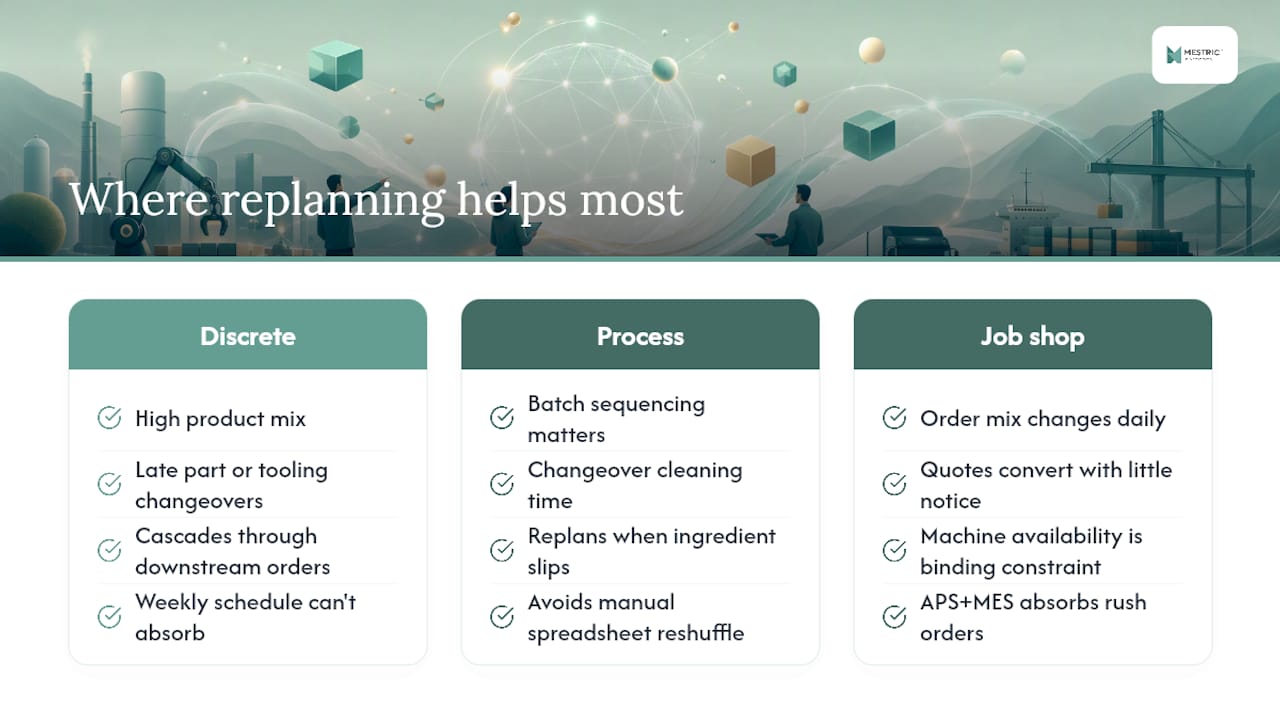
Discrete manufacturers with high product mix, think automotive component suppliers or electronics assembly, feel the benefit of dynamic replanning fastest, because a single late part or tooling changeover can cascade through dozens of downstream orders. A fixed weekly schedule simply cannot absorb that kind of disruption without manual firefighting.
Process manufacturers, such as food and beverage or chemicals, face a different challenge: batch sequencing and changeover cleaning time. Here, dynamic replanning helps by recalculating the optimal batch order whenever an ingredient delivery slips or a line needs unplanned cleaning, rather than forcing planners to manually reshuffle a spreadsheet.
Job shops and make-to-order fabricators, common across metalworking and precision engineering, arguably benefit most of all. Order mix changes daily, quotes convert to firm orders with little notice, and machine availability is the binding constraint almost every day. A shop running APS logic against live MES data can absorb a rush order without derailing everything already queued, because the system recalculates feasible sequencing rather than asking a planner to guess.
What ties these cases together is not the industry, but the presence of variability that a static schedule cannot model. Furniture manufacturers dealing with custom orders, pharmaceutical packagers managing changeover-heavy lines, and industrial equipment builders juggling long-lead components all share the same underlying problem: too many moving constraints for a weekly plan to hold. The CADCAM Group’s analysis of dynamic production planning points to the same conclusion across sectors, that the technology matters less than the discipline of matching the planning tool to where variability actually bites.
A schedule that changes in real time has to talk to procurement and inventory just as fast, or it creates new problems while solving old ones. If production replans around a late material delivery but purchasing does not see the updated priority, the same shortage repeats on the next cycle.
The tighter the feedback loop between the planning layer and inventory data, the more dynamic replanning helps rather than hinders supply chain coordination. Three effects are worth planning for specifically:
None of this happens automatically. It requires inventory and purchasing systems to receive the same real-time signals that trigger a replan on the shop floor, not a batch update overnight. Manufacturers who treat replanning as a shop-floor-only initiative, disconnected from procurement, tend to see the benefit cap out quickly: the schedule gets smarter, but the supply chain feeding it stays exactly as slow as before.
Scale is where many dynamic replanning projects quietly stall. A system that recalculates a feasible schedule for one product line in seconds can behave very differently once it is asked to do the same across twenty lines, three plants, and thousands of open orders simultaneously.
Three factors decide whether performance holds up as the scope grows.
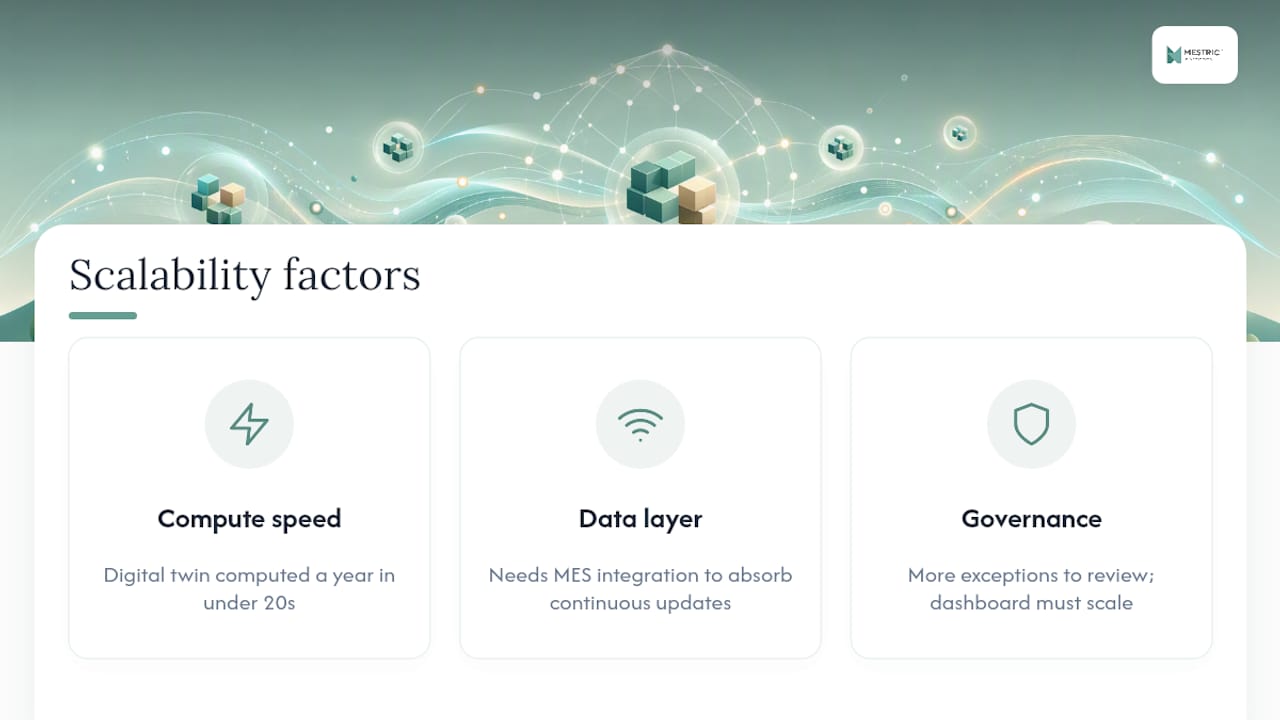
Computation speed under load. The digital twin approach documented in one implementation computed a full year of planning in under 20 seconds, but that kind of speed depends on how the underlying model handles complexity. As constraint counts grow, the optimisation engine needs to stay fast enough that planners can still test several what-if scenarios in a working session, not wait overnight for results.
Data architecture. Real-time replanning at scale needs a data layer that can absorb continuous updates from multiple machines, cells, or plants without lag. This is precisely where MES integration earns its keep. A platform that already aggregates machine data reliably at one site tends to extend more cleanly to additional lines than one bolted together from disconnected spreadsheets and manual reports.
Governance load. More scope means more exceptions to review. Scaling a pilot from one product family to an entire plant multiplies the number of edge cases a planner has to judge, so the exceptions dashboard and review-gate structure built during the pilot phase needs to scale with it, not get quietly dropped as volume increases.
The practical takeaway: test scalability deliberately during the pilot, not after full rollout. Push the pilot with a deliberately messy dataset, more orders than usual, a few conflicting priorities, before assuming the same rules will hold at ten times the volume.
Machine learning is starting to move beyond scenario calculation into prediction: forecasting which machines are likely to fail before they do, based on patterns in performance data, so replanning can happen ahead of a breakdown rather than in reaction to one. This shifts dynamic replanning from reactive to genuinely anticipatory.
Constraint programming and heuristic optimisation methods, long used in APS engines, are increasingly being combined with machine learning models that improve their own rule-weighting over time based on which past replans actually held up in practice. The result is a system that gets better at judging trade-offs, not just faster at calculating them.
Expect deeper integration between planning layers and supply chain visibility tools too, so that a replan triggered by a late shipment updates purchasing priorities automatically rather than as a separate manual step. The direction of travel across production optimisation practice is consistently towards tighter data loops rather than smarter algorithms in isolation. The algorithm matters less than whether it is fed accurate, current data.
Cloud-based digital twins, cheaper compute, and wider MES adoption among mid-sized manufacturers all point the same way: dynamic replanning stops being an enterprise-only capability and becomes accessible to smaller plants that previously relied on manual scheduling and instinct.
The planner’s role is changing from schedule builder to scenario judge. That shift matters more than any specific software choice. Start with one bottleneck, not the whole plant. Set a 90-day target you can measure, and treat the first small win as proof, not a footnote.
— Andraž
Some MES platforms bring together real-time machine connection, live KPI tracking, downtime logging, and optimisation tools into one platform rather than a patchwork of spreadsheets and disconnected reports. For a planner trying to move from static ERP schedules to something that actually reflects the shop floor, that means less manual data-chasing and more time spent judging trade-offs, which is where the role is heading anyway.
If you are weighing up MES against a traditional scheduling approach, the practical next step is to see it against your own data rather than a demo dataset. Request an onsite demonstration, pick one bottleneck or product family as a trial scope, and use the pilot structure covered earlier in this article to judge results within your first 90 days.


 069 763 552