

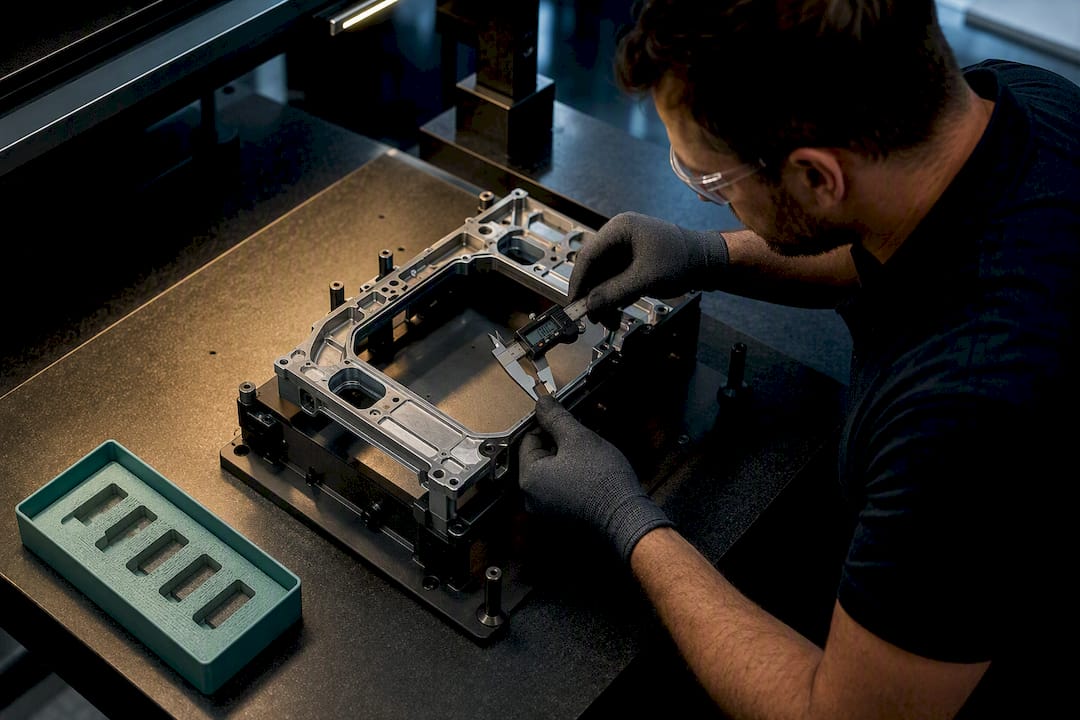
A quality control checkpoint is a defined hold point in a process where a named operator or QC role measures a product or parameter against a documented pass/fail limit, drawn from methods such as HACCP or FMEA, before work is allowed to continue. It only works when the criteria are measurable and the checkpoint can genuinely stop the line, not just record a note for later.
Kurzfassung:
- Only high-severity, low-detectability process points should be designated as checkpoints to ensure resource focus on the most critical risks.
- Checkpoints require precise documentation of methods, tools, sample sizes, roles, and escalation procedures to prevent drift and misinterpretation.
- Enforcing checkpoints effectively depends on automation like interlocks, real-time data transfer, and automatic line holds rather than relying solely on operator discipline.
- Automated systems can capture and analyze checkpoint data continuously, providing immediate visibility for swift corrective actions and reducing reliance on paper records.
- Implementing MES-connected checkpoints with automatic data capture and alerts improves audit readiness and minimizes the risk of process drift during production.
A checkpoint is a gate, not a suggestion. It sits at a fixed point in the process where a specific measurement, visual check, or test happens against a written pass/fail limit. Nothing moves forward until that check has been recorded, one way or the other.
That distinction separates quality control (QC) from quality assurance (QA). QA is the whole system: procedures, training, supplier qualification, document control. QC is the sharp end of that system. It’s reactive inspection at fixed points rather than the process design itself, which is why checkpoints sit inside a wider QA framework instead of replacing it.
Done properly, checkpoints deliver three concrete benefits:
For Slovenian manufacturers working under HACCP or ISO 9001, that audit trail is often the difference between a routine review and a lengthy corrective-action cycle.
Not every process step deserves a checkpoint. Overload the line with low-value checks and operators start treating all of them as noise, including the ones that matter. The fix is to use structured risk methods rather than gut feel.
Any point that scores high on severity and low on detectability without a check is a candidate for a formal checkpoint. Everything else can often be handled through periodic sampling instead.
A checkpoint is only as strong as its written criteria. “Inspect for defects” is not a checkpoint. It’s a suggestion an operator will interpret five different ways across five shifts.
Every checkpoint needs, written directly into the work instruction:
This level of detail matters because a checkpoint without explicit pass/fail wording and escalation instructions tends to drift into whatever the operator on shift decides is acceptable that day.
Pro-Tipp: Write the acceptance criterion as a single line inside the work instruction, not as a reference to a separate quality manual. Operators check the step in front of them far more consistently than a document three clicks away. Tips like this sit well alongside broader manufacturing quality control guidance for teams building out their SOPs.
Written criteria only work if bypassing them is difficult. Relying purely on operator discipline is the weakest form of enforcement, and it’s where most checkpoint programmes quietly fail.
This is where Echtzeit-Produktionsüberwachung earns its keep: checkpoints stop being a paper exercise and start actively gating production the moment a reading falls outside tolerance.
Every checkpoint reading needs a minimum record set, or the audit trail is worthless the moment someone asks a follow-up question.
Verification then checks whether the checkpoint is doing its job: audit frequency, sampling plans, and control charts all confirm the checkpoint still catches what it was designed to catch. When it fails, CAPA takes over: contain the affected material, run a root cause analysis, apply a corrective action, and verify that action actually worked before closing the record.
Two short examples show how the same logic applies to completely different industries.
Both examples generate pass/fail data that belongs in a weekly review, not just a filing cabinet. Plotting failures on a Pareto chart by machine, shift, or material lot usually surfaces the same two or three root causes behind most of your rejects, which is exactly where Beispiele für Qualitätsüberwachung can sharpen a team’s improvement meetings.
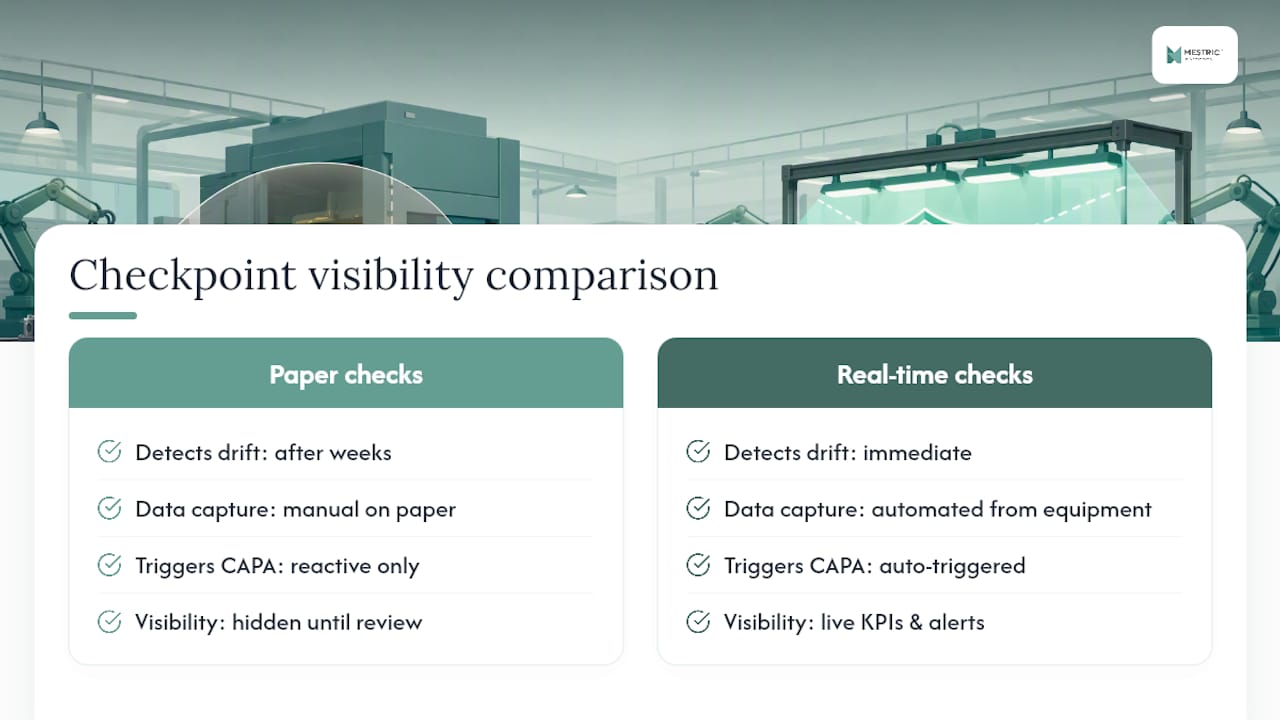
Paper checklists fail quietly. An operator signs off, the sheet gets filed, and nobody notices a pattern until a customer complaint forces a review weeks later. Automated holds and real-time KPIs close that gap by catching drift the moment it happens, not after the batch has shipped.
Certain modern MES platforms are built to address that gap by connecting directly to equipment, capturing checkpoint data automatically, and feeding CAPA workflows without manual data re-entry.
— Andraž
A written checkpoint is only as strong as its enforcement, and that’s precisely where Mestric™ MES earns its place on the shop floor. Rather than relying on operators to remember every tolerance and escalation path, Mestric™ MES connects directly to your equipment, captures checkpoint readings automatically, and can hold a line the moment a result falls outside tolerance.
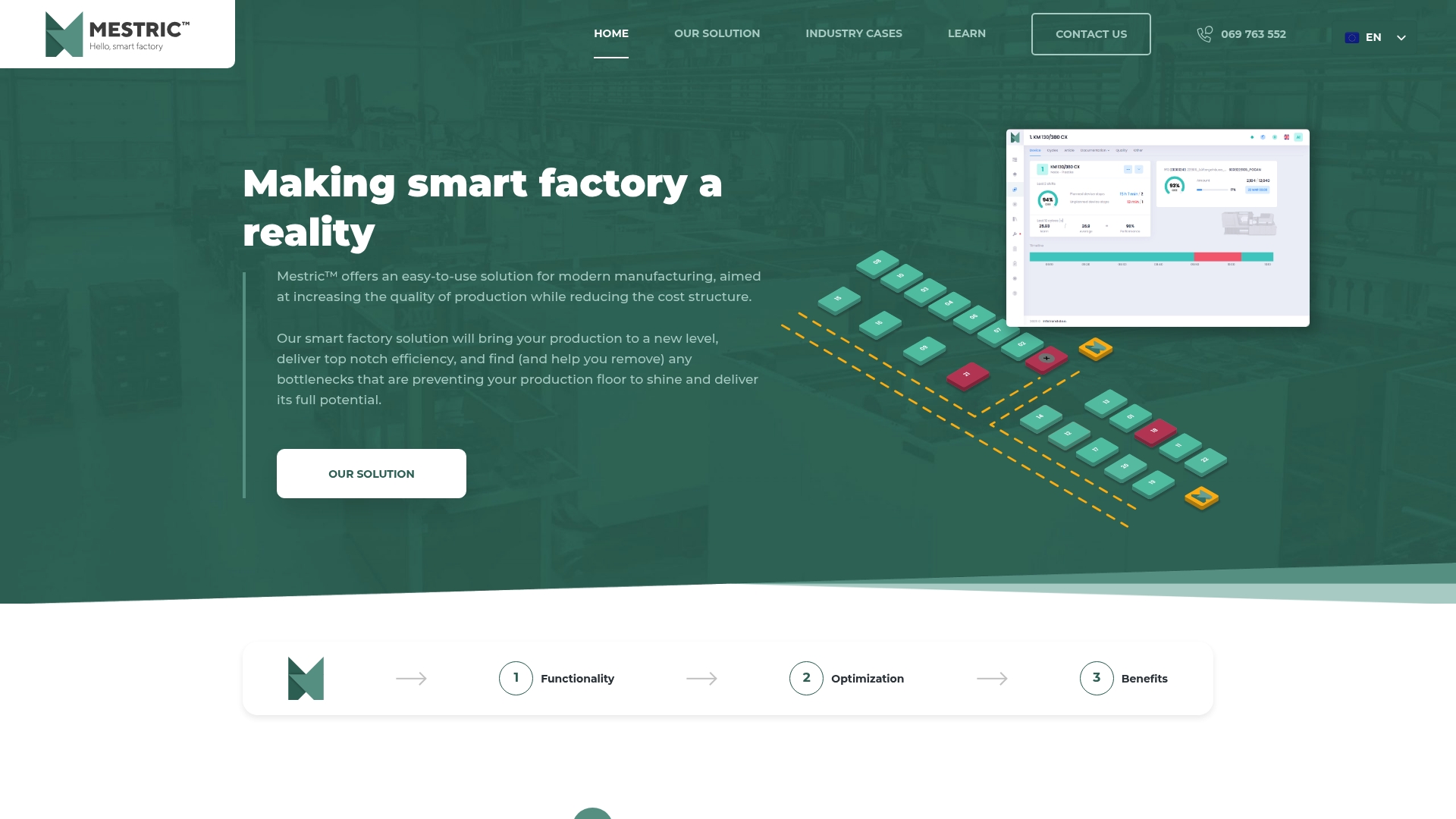
That matters most for manufacturers running HACCP-style critical limits or PCBA inspection gates, where a missed reading isn’t a paperwork issue, it’s a safety or scrap problem. Live KPI dashboards can turn checkpoint data into trend visibility allowing quality teams to act promptly during shifts rather than waiting for monthly reports. If your current setup depends on paper sign-offs or disconnected spreadsheets, it’s worth seeing how MES compares to traditional manufacturing methods before your next audit cycle. Request a demonstration and see how automated checkpoint holds work against your own production data.
For deeper technical grounding, consult ICH Q9’s risk management guideline for FMEA and HACCP methodology, and this in-process checkpoint checklist for regulated-industry documentation expectations.
It has an explicit pass/fail criterion, a named tool and method, and a defined owner, distinguishing it from a general inspection or a quality assurance procedure. Without those elements, it’s a guideline, not a checkpoint.
There’s no fixed number. It depends on scoring each process step for severity, likelihood, and detectability, a method drawn from ICH Q9’s risk framework, and placing checkpoints only where the risk actually justifies the effort.
IQC checks materials on arrival, IPQC monitors critical parameters during production, and FQC confirms the finished product works before shipment. This three-stage structure is a common way to organise checkpoints across a full production line.
Automated enforcement, through MES holds, PLC interlocks, or SPI/AOI signals, is more reliable than relying on operator discipline alone. A genuine hard stop prevents bypass far more consistently than a signature on a form.
Pricing for Mestric™ MES is available on request, tailored to your production setup and equipment integration needs. Contact Mestric directly to discuss a demonstration for your line.


 069 763 552