

An electronic batch record (EBR) is the digital version of the paper document that proves how a batch was made: which materials went in, which equipment ran, which parameters were recorded and who signed each step. In an EBR system the record is built while production happens, with data taken from machines and operators, instead of being written up afterwards. For a plant manager, the practical question is not only what an EBR is, but what it must contain, which rules it must meet and how it connects to the systems already on your shop floor. This guide answers those questions.
The content of an EBR follows the content of a good paper batch record. A GMP batch record guide lists the typical elements. We use it here as a practical checklist, and your quality unit decides the exact scope for your product and your master batch record (MBR).
| Record section | Typical content |
|---|---|
| Batch identity | Product name, strength, dosage form, unique batch number, planned batch size, MBR version, start and end dates |
| Materials | Raw materials, excipients and primary packaging with name, quality, supplier, lot number, quantity per recipe, quantity actually used, QC release date |
| Process steps | Step-by-step description, equipment asset numbers, required parameters with acceptance limits, actual recorded values |
| In-process controls | Checks such as pH, density, appearance, uniformity, moisture or particle size, with specification, result, date and operator |
| Signatures | Initials or signatures from two persons on each critical step (the four-eyes principle) |
| Deviations | A unique deviation number and a reference to the deviation file |
On paper, each line is a handwritten entry that someone must read later. In an EBR, each line becomes a field with rules: a value outside its limit is flagged immediately, a step cannot be skipped, and a signature is tied to a unique user.
An academic review of EBR implementation in the Macedonian Pharmaceutical Bulletin describes three integrated layers. They are a useful way to see where your own systems fit.
An EBR is not a PDF of a form. It only works when execution guidance, equipment and material integration, electronic approval and quality review run as one controlled workflow. That is why an ISPE case study on moving from paper to an MES with EBR describes controls such as automated recipe distribution, enforced task sequencing, automatic timestamps, online production data, electronic approvals and review by exception.
The same case study integrated the ERP system, the laboratory information system (LIMS) and weighing scales into the MES. In other words, the batch record is only as good as the connections behind it. If you want a closer look at how an MES differs from a paper-led way of working, read our comparison of MES and traditional manufacturing.
A Slovenian example of the same direction exists in academic work. A University of Ljubljana master’s thesis on the introduction of electronic batch records at Lek d.d. notes that pharmaceutical companies pursue paperless production by upgrading existing MES systems with electronic document management. The advantages it names include role-based access, version control so that only the latest valid document is used, faster creation and approval, and better traceability of who reviewed, approved and archived each document.
The academic review above links paper batch records with transcription errors, missing data, delayed batch review and limited traceability. These raise compliance risk and the chance of deviations. An EBR addresses them through automated documentation, process control and real-time verification.
In day-to-day terms, you can expect to work on these areas:
If your plant is not pharmaceutical, the same logic applies to food, chemicals, cosmetics and electronics. Customers and auditors in those sectors also ask who made what, on which line, with which material lots. Our guide on batch traceability with GS1 and ISA-95 goes deeper on that side.
Slovenia has no separate national EBR law that we can point to. Pharmaceutical manufacturers supplying EU markets fall under the common EU GMP supervision system. PDA explains that EU authorities issue GMP certificates or non-compliance reports and record them in the EudraGMDP database. In Slovenia the competent authority is JAZMP, which, for example, is named in an EMA presentation on a GMP facility in Ljubljana that is GMP-compliant to make active substances and investigational medicinal products.
For an EBR, two EU GMP texts matter most.
The European Commission’s Annex 11 on computerised systems sets the expectations for any computerised system used in GMP activities. From the revised text, these points affect your EBR directly:
EU GMP Chapter 4 describes the ALCOA expectations. Records should be attributable, legible, contemporaneous, original and accurate. Electronic records must also be complete, consistent, enduring, available and traceable. It also says that dynamic electronic data should stay available in a form that keeps the ability to search, query and trend, where that ability is part of the record’s meaning.
Das WHO guidance on data integrity adds a practical point: original electronic data and metadata, including audit trails, are subject to inspection and must be readily retrievable by system administrators. Plan audit-trail review and retrieval from day one, because an inspector may ask for the original data and not only a summary.
Your quality unit and your qualified person remain responsible for interpreting these texts for your products. Take them into your project plan before configuration begins.
We see the same pattern in many plants. The paper record is not the real problem. The real problem is the gap between what happens on the machine and what is written down later.
That is why we think of the electronic batch record as an output of good production data, not as a separate project. When machines are connected, when data is collected automatically and when operators follow a guided workflow, the record builds itself. Our Mestric™ MES is designed around exactly these foundations: direct equipment connection, automated data capture, live KPI dashboards and AI-powered recommendations for quality and process.
We also believe that a plant should see this working before it decides. That is why we show connected machinery in a real production environment at our demo centre, and why we talk through your workflows with you first.
Andraž
A sensible rollout follows the order below. It combines the validation expectations in Annex 11 with the steps that consultants and plants use in practice.
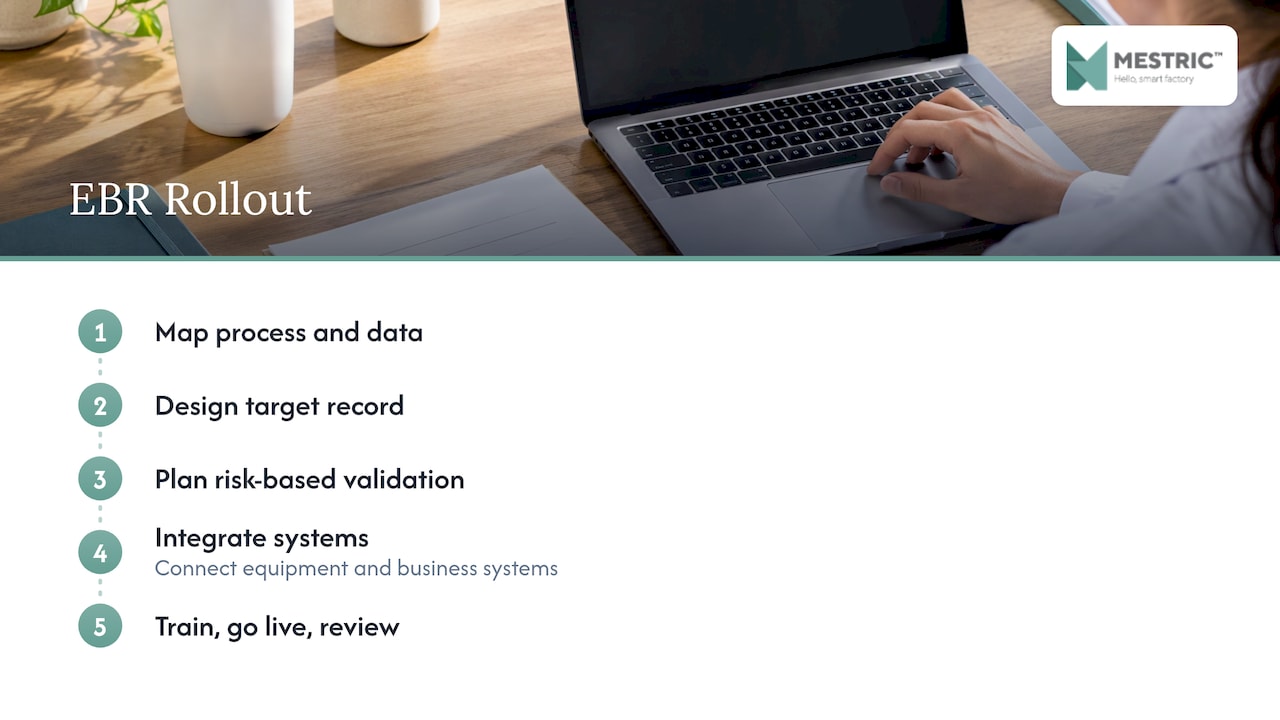
Write down how a batch really moves through the plant, including the workarounds. Then decide which data is critical to quality and which is only nice to have. Streamlining the paper record before digitising it keeps you from copying old problems into the new system. A guide to streamlining paper batch records covers process mapping, data criticality analysis and functional architecture for this stage. Our own pages on assessing current workflows and data and on improving efficiency with process mapping help with the practical work.
Define the electronic MBR: steps, parameters and limits, in-process controls, approvals and the exceptions that need a deviation. Ask production, quality and engineering to review it together. A record that operators find easy to use will have fewer entry errors.
Annex 11 asks you to scale validation to risk and intended use. A practical MES validation file usually includes a validation plan, user requirements, functional and design specifications, configuration and interface specifications, a risk assessment, a traceability matrix, IQ/OQ/PQ protocols, test scripts, a validation summary, change control and periodic review, as listed in a practical MES validation guide. For the wider lifecycle and performance review thinking behind GMP computerised systems, this overview of validation duties is a helpful companion.
Connect the equipment first, then ERP, LIMS and scales where they apply. The ISPE case study followed GAMP 5, lifecycle development and a risk assessment focused on data integrity, product quality and patient health. See how we approach integrating an MES with equipment.
Train operators on the exact workflow they will use, and train reviewers on review by exception. After go-live, hold periodic reviews of the system and its indicators, as Annex 11 expects. Document every change through change control.
A dashboard should help the person on shift decide what to do next. The ISPE case study supports online production data, exception and deviation visibility, disposition support and analysis as reporting goals. It also describes review by exception, in which the reviewer sees critical exceptions and deviations and not the normal events that support none of them.
A useful starting set looks like this:
| Metrik | What it tells you |
|---|---|
| Open deviations per batch and per line | Where quality risk is building up |
| Out-of-limit parameter alerts | Which steps drift from the recipe |
| First-pass yield | How many units are right the first time |
| Fehlerrate | Quality trend by station, line or shift |
| Cpk on critical parameters | Whether a process is capable and stable |
| Batch record review status | How long records wait before release |
| Right-first-time records | How often records need correction |
An example of a production line quality dashboard uses station, line, shift and plant views with defect rate, Cpk, active alerts and first-pass yield. Choose metrics that match your product risk, then review them regularly, as Annex 11 expects for the system and its process. Our pages on production KPI selection, quality KPIs und production exception alerts go through the options in more detail.
If you are planning to replace paper records, the first thing you need is reliable data from your machines. Mestric™ MES connects directly to manufacturing equipment, collects data automatically and shows performance, downtime, quality parameters and cost analysis on live KPI dashboards. You can see it working in a real production setting at our demo centre. Read about the Mestric™ MES solution and talk to us about your plant.
The subscription price is not published. We discuss it with you after the demonstration, once we understand your lines and your workflows.
An EBR is the record of how a batch was made. An MES is the system that runs and monitors production, and it usually supplies the execution control and the data the record needs. In regulated plants the EBR is commonly implemented as a function of the MES.
Not by name in the sources we reviewed. What EU GMP requires is that records, paper or electronic, are controlled, accurate and traceable. If you use a computerised system for GMP activities, Annex 11 applies. Your quality unit should confirm the specifics for your products.
It is a set of data-integrity attributes: attributable, legible, contemporaneous, original, accurate, complete, consistent, enduring and available. An EBR supports them through unique user logins, automatic timestamps, audit trails and automated data capture in place of manual transcription.
Yes. The same structure of materials, equipment, parameters, checks and sign-offs fits food, chemicals and other batch-based production. The regulatory frame differs by sector, so check which standards your customers and auditors apply.
Start with a map of your current process and a list of the data that is critical to quality. Then check how much of that data your machines can already supply automatically. That tells you how big the integration work will be.


 069 763 552