


Kurzfassung:
- Operational excellence relies on knowing which data drives meaningful outcomes and acting on it quickly.
- Common hurdles include data overload, poor infrastructure, and lack of cross-functional leadership.
- Combining automation with human oversight and continuous review enables sustainable, data-driven improvements.
Manufacturing generates more data than ever before. Yet volume alone does not deliver results. Executives who invest in data collection without a clear strategy for its use often find themselves with dashboards full of numbers and no meaningful change on the shop floor. The real competitive advantage comes from knowing which data matters, how to analyse it effectively, and how to translate those insights into precise operational decisions. This article lays out the practical path from raw data to genuine operational excellence, covering the tools, strategies, and mindset shifts that make the difference.
| Punkt | Details |
|---|---|
| Strategic data use | Operational excellence is driven by purposeful, focused data analytics rather than simply collecting more data. |
| Balance automation and oversight | Effective data strategies blend automation with necessary human expertise to ensure safe, contextual decisions. |
| Continuous improvement | Adopt adaptable practices and scalable partnerships to meet both today’s and tomorrow’s manufacturing challenges. |
| Optimisation across lifecycle | Data analytics improves efficiency, quality, and sustainability at every stage of the production process. |
| Address scaling risks | Mitigate operational and security challenges by maintaining high data quality and robust infrastructure. |
Operational excellence in manufacturing today means consistently delivering high-quality products at the lowest viable cost, with the shortest possible lead times, while maintaining workforce safety and environmental responsibility. It is not a destination. It is an ongoing discipline sustained by well-structured processes and sound decision-making, and analytics in manufacturing has become its primary enabler.
Data analytics enables predictive maintenance, process optimisation, quality control, and inventory management across manufacturing operations. These four pillars are where data creates the most measurable impact:
Das real-time operational impact of each pillar compounds when they work together. A reduction in unplanned downtime directly improves throughput. Better quality control reduces the volume of rework, which in turn lowers material consumption. Tighter inventory alignment reduces storage costs.
“The manufacturers pulling ahead are not those with the most data. They are those with the clearest sense of which data drives outcomes and the infrastructure to act on it quickly.”
This distinction is what separates manufacturers who are digitally active from those who are genuinely data-driven.
After grounding operational excellence, it is important to zoom into the realities of turning raw data into meaningful, actionable guidance. The gap between data collection and strategic insight is where most digital transformation efforts stall.
The 46% COO challenge is telling: nearly half of chief operating officers cite data quality and infrastructure limitations as the primary barrier to scaling data-driven decision-making. That figure puts the problem in sharp focus.
“Nearly half of COOs report that poor data quality and weak infrastructure are the single biggest obstacle to realising value from their data investments.”
The most common hurdles manufacturers face include:
Practical strategies for working through these hurdles include:
Following a structured production optimisation guide can help you sequence these steps in a logical order and avoid the common mistake of building analytics layers on top of unstable data foundations.
Pro Tip: Automation should accelerate human decision-making, not replace it entirely. Pair every automated alert or recommendation with a defined human review step, particularly for safety-critical processes. The most reliable systems are those where experienced operators remain in the loop.
With hurdles addressed, the focus shifts to how manufacturing leaders convert data into measurable impact throughout operations, from planning right through to final delivery.
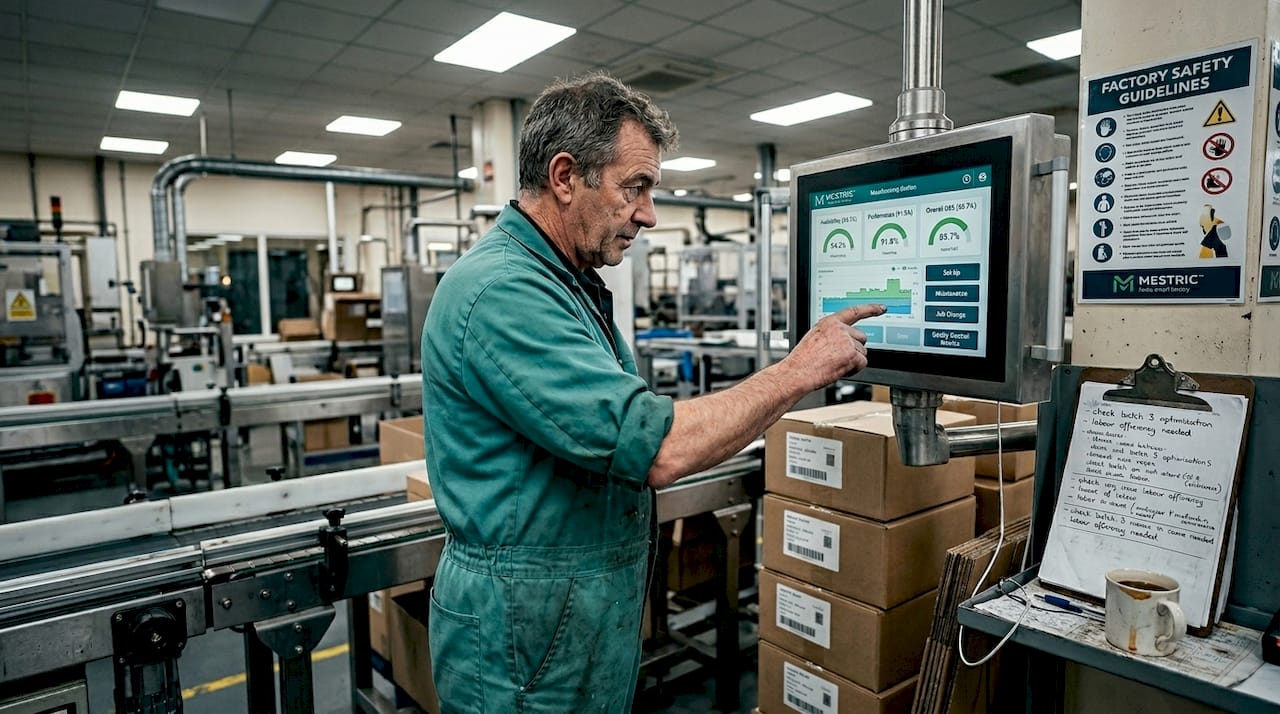
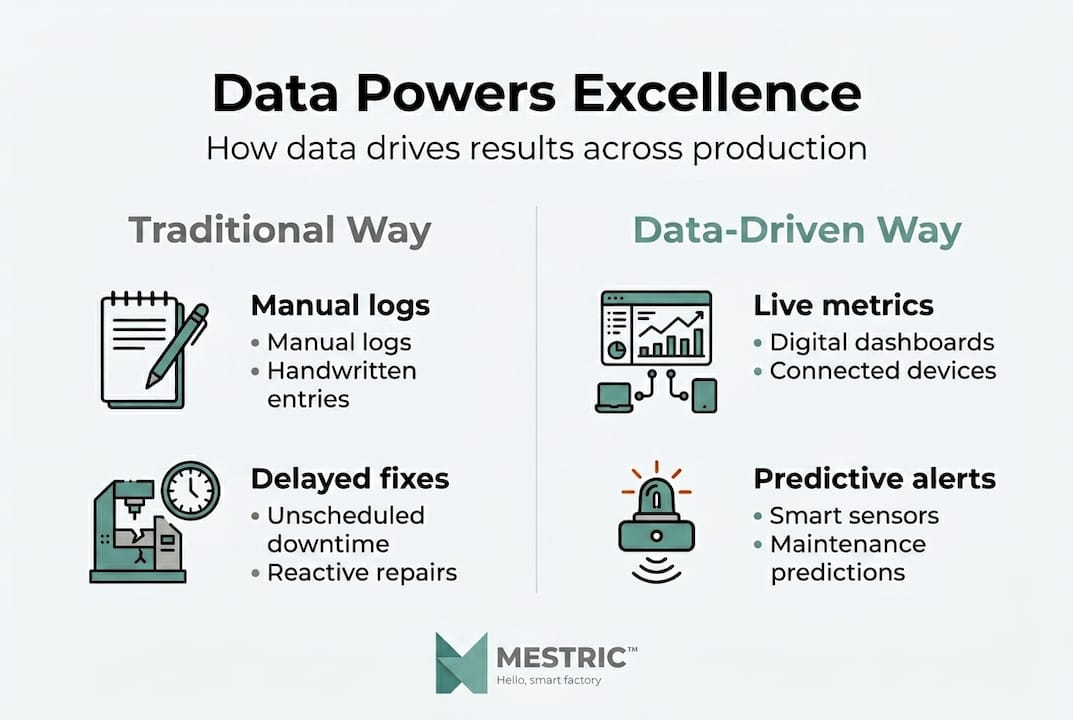
A useful way to see this clearly is to compare data-driven and traditional approaches at each lifecycle stage:
| Production stage | Traditional approach | Data-driven approach |
|---|---|---|
| Planning | Historical averages, manual forecasting | Real-time demand signals, predictive modelling |
| Scheduling | Fixed production runs, manual adjustment | Dynamic scheduling based on live capacity data |
| Execution | Operator observation, periodic checks | Continuous sensor monitoring, automated alerts |
| Quality assurance | End-of-line sampling | Inline quality monitoring with immediate feedback |
| Maintenance | Scheduled or reactive servicing | Predictive maintenance based on equipment health data |
| Inventar | Fixed reorder points | Demand-driven, real-time stock alignment |
Das efficiency workflow with MES ties these stages together by providing a single connected view of production performance. When each stage feeds data into the next, the entire production system becomes self-correcting.
One of the most significant areas of measurable improvement is OEE (Overall Equipment Effectiveness), which combines availability, performance, and quality into a single metric. Make-to-order complexity reduces OEE by 4 to 12 percentage points compared to standard manufacturing environments. Understanding this difference allows executives to set realistic improvement targets and prioritise the right interventions for their specific production model.
To close feedback loops effectively and translate data into continuous gains, follow these four steps:
This cyclical approach, supported by predictive analytics in manufacturing, moves organisations away from reactive problem-solving and towards genuine continuous improvement. Downtime reduces. Inventory aligns more closely with actual production needs. Quality defects are caught earlier and at lower cost.
With the direct value of data explored, it is worth looking at expert-level guidance for achieving the next tier of gains. Specifically, how you balance efficiency and sustainability as both priorities grow in importance.
Many executives treat these as competing objectives. The evidence suggests otherwise. Multi-objective optimisation, a data strategy that simultaneously pursues multiple performance targets, offers a practical way to advance both at the same time. A published study in tube manufacturing demonstrated a 5.1% efficiency gain alongside a 12.4% reduction in CO2 emissions using this approach. These results came from analysing production variables holistically rather than optimising for one dimension at a time.
The comparison below illustrates the difference this makes in practice:
| Outcome area | Without advanced data strategy | With advanced data strategy |
|---|---|---|
| Energy consumption | Managed reactively, high variance | Optimised continuously, lower variance |
| Equipment utilisation | Based on fixed schedules | Adjusted dynamically to demand |
| Emissions | Tracked periodically | Monitored in real time, linked to process changes |
| Production efficiency | Improved incrementally | Improved systematically through multi-variable analysis |
| Reporting burden | Manual, time-intensive | Automated, near real-time |
The lesson from driving efficiency and quality simultaneously is that the underlying data infrastructure must be capable of handling multi-objective analysis. This requires intentional investment in reusable AI capabilities and ecosystem partnerships rather than point solutions that solve one problem in isolation.
Pro Tip: When evaluating AI tools for your production environment, prioritise those built on modular, reusable architectures. A tool that solves one specific problem in one specific context will not scale. Invest in platforms that can be reconfigured across different processes and that integrate cleanly with your existing systems and partner ecosystems.
Scaling data strategies enterprise-wide also requires cross-site data standardisation. When every plant uses consistent data definitions, KPI frameworks, and reporting structures, insights from one facility can be applied to others with confidence. Without this, scaling produces noise rather than knowledge.
Conclude the journey by arming executives with practical, forward-looking steps to drive lasting operational excellence in a manufacturing landscape that continues to shift.
The following five practices represent the most critical foundations for data-driven excellence right now:
Continuous improvement philosophies such as Kaizen and Six Sigma provide the cultural scaffolding for these practices. They establish the expectation that the current state is always improvable and that data is the primary evidence base for deciding what to change. AI-powered quality control tools, when embedded within this culture, accelerate the rate of improvement without replacing the disciplined thinking behind it.
Here is the uncomfortable truth that most digital transformation programmes avoid: the bottleneck in most manufacturing organisations is not a lack of data. It is a lack of the culture, leadership, and cross-functional alignment needed to act on it.
We see this pattern repeatedly. An organisation invests in sensors, a new analytics platform, and a team of data specialists. Within 12 months, the dashboards are rich with information. Yet production metrics have barely moved. The investment is technically sound. The outputs are accurate. But nothing changes because there is no agreed-upon process for translating an insight into an operational decision.
The organisations that achieve lasting process optimisation leadership share one common trait. Their senior leaders do not treat data as an IT project. They treat it as a strategic language that every function, from operations and quality to procurement and finance, must learn to speak. Cross-functional buy-in is not a soft requirement. It is the mechanism through which data becomes action.
“Purposeful data use, with clear ownership, defined processes, and leadership commitment, consistently outperforms organisations drowning in data but lacking the structure to use it.”
There is also a risk in chasing the newest analytics technology before stabilising the fundamentals. Many manufacturers invest in AI and machine learning before their underlying data quality is sufficient to support it. The result is sophisticated models generating unreliable outputs, which erodes trust in the entire analytics programme. Getting the basics right, accurate data, consistent definitions, and clear ownership, is not a preliminary step. It is the work.
Leadership’s role is to make it easier for teams to act on data than to ignore it. That means building data literacy at every level, removing structural barriers to cross-functional information sharing, and being willing to make decisions based on evidence even when it challenges established assumptions.
The insights in this article point to one clear conclusion: the gap between manufacturers who are merely data-rich and those who are genuinely data-driven is a choice, not a technical limitation.
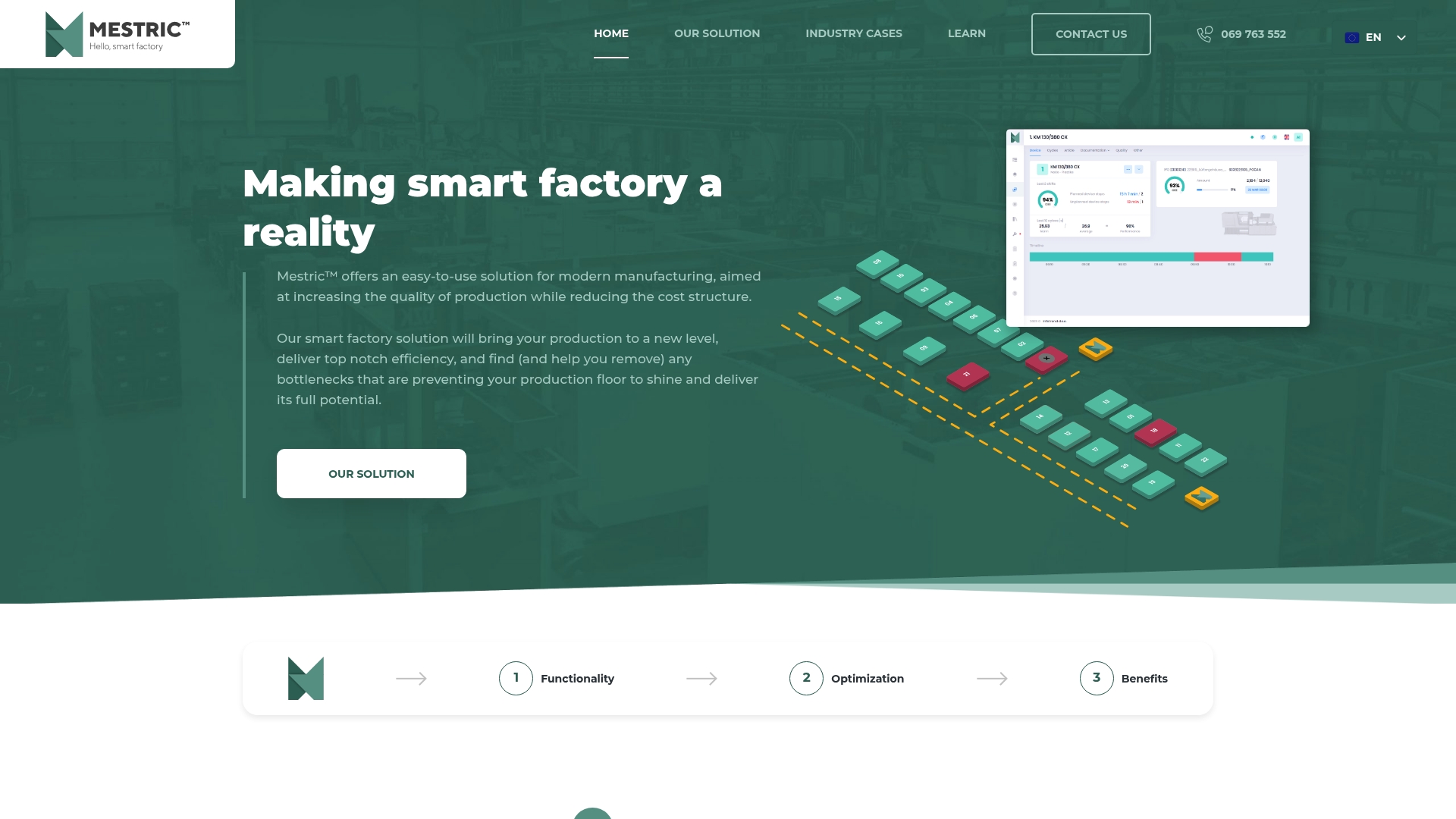
Mestric™ is built specifically to help you close that gap. From real-time KPI tracking and AI-powered production alerts to integrated quality monitoring and cost analysis, the platform connects directly to your equipment and gives your team the visibility to act with confidence. Whether you are comparing manufacturing efficiency with MES against your current setup or exploring the full range of essential manufacturing software options for your plant, Mestric™ provides the tools and the expert guidance to move from insight to measurable improvement. Book an onsite demonstration and see what connected manufacturing looks like in practice.
Process performance, equipment health, quality outputs, and inventory levels are the primary types of data driving measurable operational improvements. These four areas collectively cover predictive maintenance, process optimisation, quality control, and inventory management.
Focus on clear business objectives first, then automate data quality checks and implement governance policies to ensure only useful, actionable information reaches decision-makers. The 46% COO challenge underscores that infrastructure and quality decisions must come before scale.
While benefits are widespread, complex make-to-order environments may see smaller OEE gains compared to standard manufacturing processes. Make-to-order complexity reduces OEE by 4 to 12 percentage points versus standard operations, so target-setting must reflect this reality.
Over-reliance on analytics can weaken the human oversight that catches edge cases and contextual errors. Without human review built into automated processes, even accurate data can lead to costly misinterpretations on the shop floor.
Multi-objective optimisation using data analytics can drive simultaneous gains in both areas. A tube manufacturing study demonstrated a 5.1% efficiency gain and a 12.4% CO2 reduction when both targets were pursued together through advanced data strategies.


 069 763 552